

A few days ago, I offered to read and review a new book being produced by Fast Track Impact – I can’t think of a better way of ensuring I’m thinking along the right lines with regard to this crucial aspect of a research project! I can’t wait to read it.
Meanwhile, we’ve been planning for the first steering group meeting for the network, and I’m looking forward to see the project being fleshed out as we pool ideas and discuss the various activities and actions that I’ve either embarked upon or promised to do as part of the network!
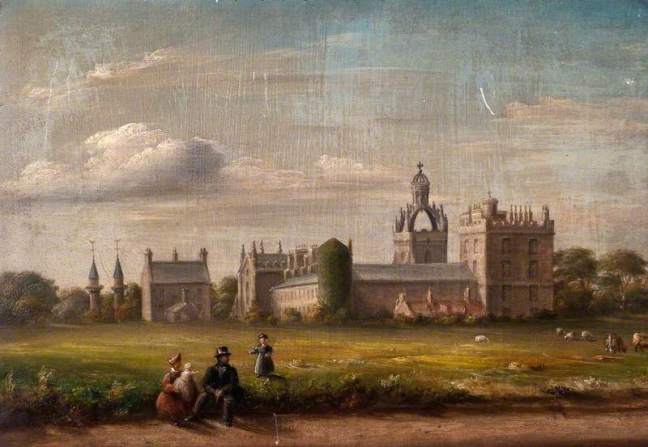
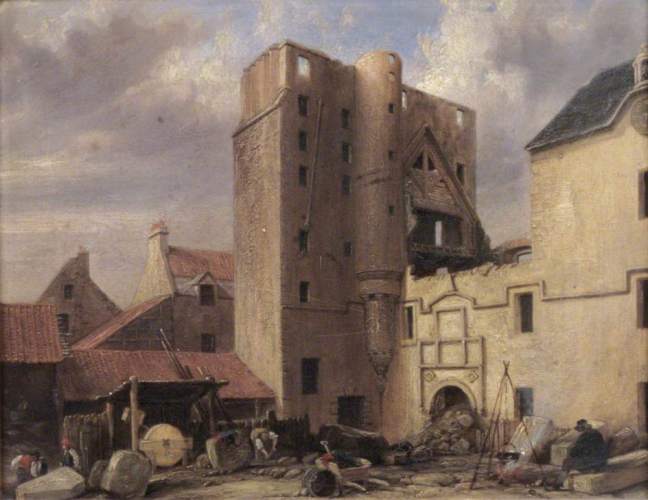
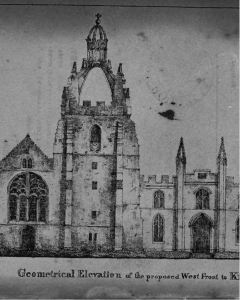
I’ve also recently been in touch with two scholars who between them have years of experience and knowledge about the early legal deposit collections at the University of Aberdeen. Reading about King’s College and Marischal College’s library provision led me to investigate reports and evidence provided by various libraries firstly in response to a Parliamentary Select Committee on legal deposit in 1817-18, and secondly to a Royal Commission on Scottish universities and their management, in the late 1820s.
As far as legal deposit was concerned, it’s fair to say that music was the Cinderella category, along with juvenile literature and ephemera. Sometimes music was singled out; maybe we can use this to read between the lines in other responses to the official questions?
- 1817 – Trinity College Dublin tells their London agent “to claim neither music, novels nor school books”
- 1818 – St Andrews fills in a return to the Select Committee, alluding to “works of little utility“, saying they’ve recently been receiving only “those of the most trifling and useless description”. Scholar Elizabeth Ann Frame observed from their records that,”A small proportion of the contents of every parcel, chiefly of children’s books and books of mere amusement, is laid aside in a separate bale accompanied with an exact list, besides being referred to in the Register. All these bales are arranged in regular order, in a room adjoining to the Library”. But was music “mere amusement?” It’s hard to say. Most of it would not have been in “books”, for a start. Also, there’s plenty of evidence of the music being used – a lot!
- 1826 – Aberdeen informs the Royal Commission that, “trifling or pernicious works are sent in great abundance.”
- 1826 – Dr McGill, Glasgow professor of Divinity, advises that “The Stationers’ Hall privilege is not at all effective: we get very few valuable books comparatively, we get a great many idle books” (whatever he may have included under this term) “and it is very expensive to bind them.” Further to this, the author of a book about Glasgow University Library (Dickson, The Glasgow University Library, 1888 p.16), concluded that, “The working of the privilege was in reality far from satisfactory. The library freely obtained its share of the works of fiction, juvenile literature, fugitive poetry, and music that were issued yearly from the press; but the books were procured with ease in the inverse ratio of their value, and continuations, periodicals, and works with expensive plates, especially if issued in parts, were either not procured at all, or supplied imperfectly.”
- In a report published in 1837, King’s College Aberdeen alluded to what Barrington Partridge (The History of the Legal Deposit of Books p.128) called “shoals of useless publications … including children’s primers, and labels for blacking.” (Barrington Partridge cites Parliamentary Papers (1837), xxxviii, p.64. He similarly cites an 1826 Edinburgh allusion to “a great deal of trash“, although it would be imprudent to assume that this embraces music. However, we do know that the University of Edinburgh sold at least some of its legal deposit music, as it would appear did King’s College Aberdeen, judging by evidence that I blogged about last week and the week before.
 your music. What do you do? Well, if you have a publisher, they might submit it to Stationers’ Hall, where it would be registered. They might not, though. (Some publishers thought they’d have the best of both worlds – they’d print a copyright statement to the effect that it had been entered at Stationers’ Hall, but they wouldn’t actually bother doing so.) In any event, it’s a bit hit or miss.
 So what did I do yesterday? I networked! Potential networkers can be found in a wide variety of places – not just academic departments or university libraries. We need people with technical skills every bit as much as we do researchers and librarians.
 had my ‘librarian hat’ on, primarily, but even that hat has a musicological lining, so I couldn’t help thinking research-minded thoughts from time to time. In particular, one train of thought was provoked by the discovery of a pile of early 20th century popular songs with eye-catching cover art, betraying cultural trends and prevailing preoccupations such as patriotism around war-time; nostalgia; family ties; romantic relationships; or the portrayal of children. Not ‘serious music’, this, but the pictures and the content, not to mention musical styles such as ragtime, all tell us about
 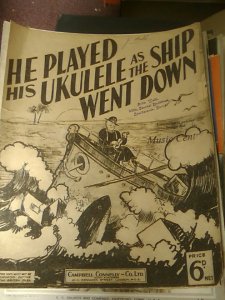 Is it worth keeping, then? It might be. Not for the classical musicians to attempt to analyse as they would a Haydn string quartet, but to inform us about cultural history. So, if early twentieth century popular music can inform us in this way, then it follows that the Georgian and early Victorian songs and other material appearing in legal deposit music collections will have their own stories to tell … and any statistics about library usage tells us just which volumes were popular with the borrowers. I’ve made a start on this with the St Andrews historical copyright music collection, having collated the music borrowing records from 1801-1849 and started gathering statistics.

