Torn between Copyright Music and the East India Company!

I’m back from vacation with a vengeance, here.  I’ve thought of not one, but two future projects worth pursuing, so I am getting in touch with people whom I think might be interested.  One project is closely linked to the Claimed From Stationers’ Hall network, whilst the other idea could be said to tie together several strands from all the research I’ve done in the past decade or so.  Obviously, grant-writing time is approaching again!  Watch this space.

An interesting news snippet is my recent discovery that a librarianship student from Robert Gordon’s University has been doing a placement at the University of Aberdeen’s Library Special Collections – and looking at their Copyright Music collection!  This really is very exciting – I love to hear of people getting engaged with these materials, and I’m really happy to think that Aberdeen’s collection is attracting attention.  Retired music librarian and rare books cataloguer Richard Turbet did much work on it a few years ago, but it’s definitely time to be woken from its slumbers with some more close study!

So much for copyright music.  I still have more writing to do for a substantial journal article about the UK’s repertoire, amongst other things.  And we have the Brio journal issue to work towards, later this year, too. All this will be done!

Perso-Indica workshop on “John MacGregor Murray (1745-1822): Persianate and Indic Cultures in British South Asia” – Paris, May 28th 2019.

However, right now, I’m focusing on writing a paper for a seminar at the Sorbonne, which takes place at the end of May.  Sir John Macgregor Murray took an almost obsessive interest in Scottish and clan culture, but it appears he was as interested in Indian culture, commissioning translations and texts in Persian, on matters relating to Indian religion, festivals and agriculture.  His career was spent in the private army of the East India Company, so maybe we shouldn’t be too surprised that he took an interest in the customs of the land that was his home for more than two decades.  He did have a base in Scotland too, having bought Lanrick Castle in his mid-twenties, though I haven’t investigated how often he came home, or whether his wife and son ever stayed there without him.  (Much as I’d like to know, I have to remind myself that I’m interested in his cultural activities, not his entire biography!)

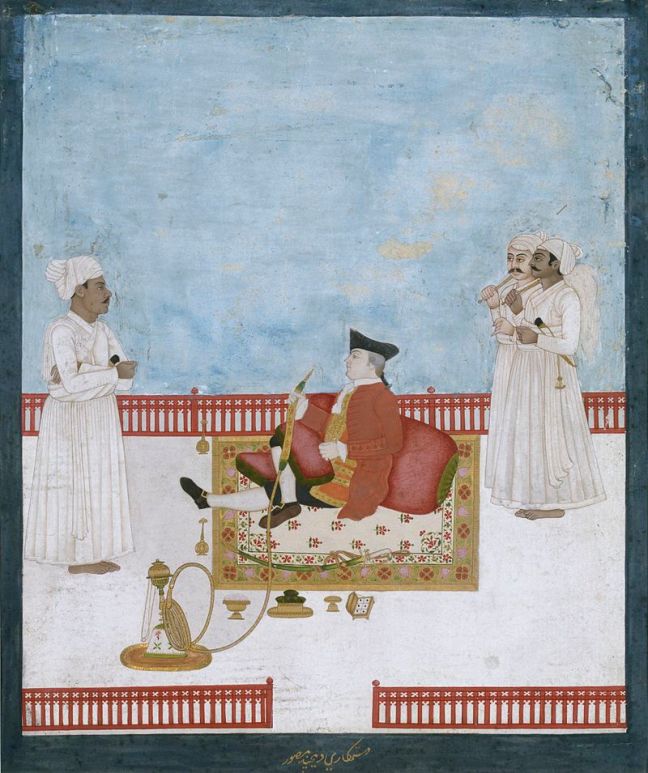
800px-Portrait_of_East_India_Company_official from VAM.ac.uk via wikipedia
By Dip Chand (artist) – https://collections.vam.ac.uk/item/O16731/painting-portrait-of-east-india-company/, Public Domain, https://commons.wikimedia.org/w/index.php?curid=18728491 from Wikipedia

(The above image is dated 1760, a bit before Sir John joined the East India Company, but it was so lovely, I just had to include it!)


Curation and Documentation

In our research into the legal deposit music collected in British libraries during the Georgian era, a key thread is obviously the histories of individual collections between then, and now.  Two hundred years is a long time, so contemporary evidence is significant.

For example, in 1826, the pseudonymous Caleb Concord wrote in the (short-lived) Aberdeen Censor that the students at Aberdeen’s Marischal College should be more concerned about what had happened to the legal deposit music that had been claimed by Aberdeen’s other higher education institution, King’s College.  Corroborating this, Professor William Paul, who had once been librarian at King’s College, told an official commission in 1827, that he believed some of the music had been sold at some time before he went to the college, ie, before 1811.  (Commissioners for Visiting the Universities and Colleges of Scotland, Evidence, Oral and Documentary, Taken and Received by the Commissioners … for Visiting the Universities of Scotland.  Vol.4, Aberdeen (London: HMSO, 1837).  There is evidence for Stationers’ Hall music having been sold at Edinburgh University in the late eighteenth century, too.

In St Andrews, by contrast, there are not only archival records documenting senate decisions about the library, but also the borrowing records, which I’ve written and blogged about quite a bit over the past couple of years – not to mention the handwritten catalogue by a niece of a deceased professor of the University.  A payment was made to her in the 1820s, but the catalogue continued to be updated until legal deposits ceased to be claimed by the University in 1836, when the legislation changed. (Miss Lambert married and moved to London in 1832, so the later years were not completed by her.)

Bibliographic Control

In the middle few decades of the nineteenth century, some of the libraries began to attempt better control and documentation of their music.  However, I don’t propose to write about every legal deposit library in this posting, because my main reason in writing today is to share a small but interesting excerpt from William Chappell’s first book about English national songs.  Now, in my own doctoral thesis and subsequent book, I focused on Chappell’s later work, Popular Music of the Olden Time (1855-1859), and its later iteration, Old English Popular Music.  I mentioned that PMOT had grown out of his earlier Collection of National Airs (1838-1840), and I highlighted a few key features of that work.

A Rare Find
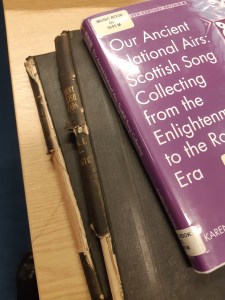
2018-08-17 11.12.52Today, sifting through a library donation of largely 20th century scores, I was astonished2018-08-17 11.15.05 to lift two obviously older volumes out of one of the boxes.  We’re now the proud owners of the third set of Collection of National Airs known to be held in Scotland.  Since I haven’t looked at this title for a decade or so, I leafed through both volumes briefly, to remind myself what they were like.  (The volumes had belonged to a Mrs Chambers, and either she or a young relative had practised their drawing skills on the flyleaves, but we’ll overlook those for now!)
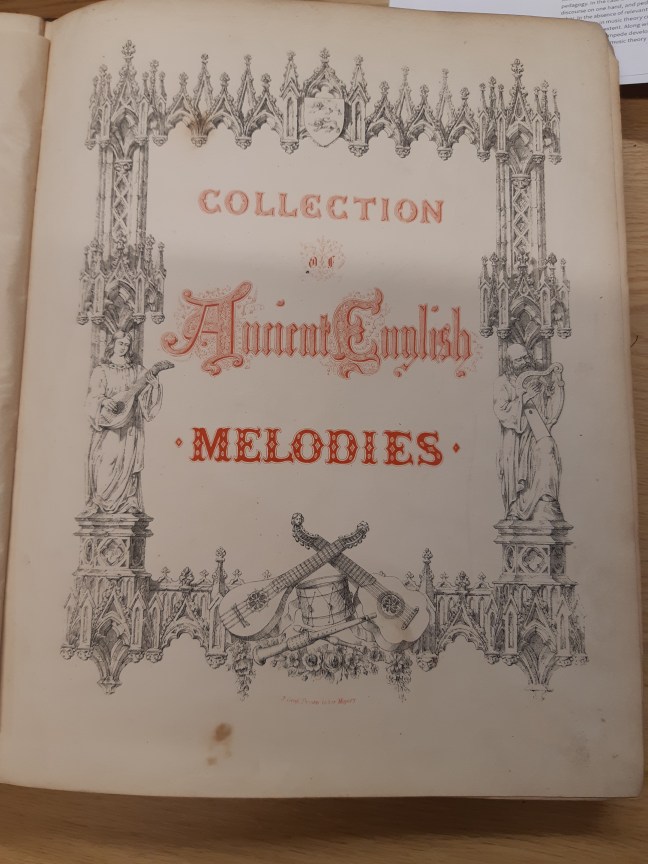
2018-08-17 11.13.56Chappell’s work is in two volumes: the first contains the subscriber’s list and a preface, with the rest of the volume devoted to the tunes themselves. The second volume contains commentary, winding up with a conclusion and then an appendix.

England has no National Music

The preface opens with the words which have echoed (metaphorically speaking) in my ears since I first read them:-

“The object of the present work is to give practical refutation to the popular fallacy that England has no National Music,- a fallacy arising solely from indolence in collecting; for we trust that the present work will show that there is no deficiency in material, whatever there may have been in the prospect of encouragement to such Collections.”

Of course, Chappell was preoccupied with national songs (“folk songs”) and ballads – as was I, at the time I first read it.  So I hadn’t paid attention to a footnote later in the Preface.  But, as I read on, there it was – William Chappell commenting on the legal deposit music in what is now the British Library!  It is clear that the music – in Chappell’s eyes, at any rate – was in need of organisation.  (We now know that  it was much the same in Oxford, Edinburgh or Edinburgh’s Advocates’ Library – the forerunner of the National Library of Scotland.)

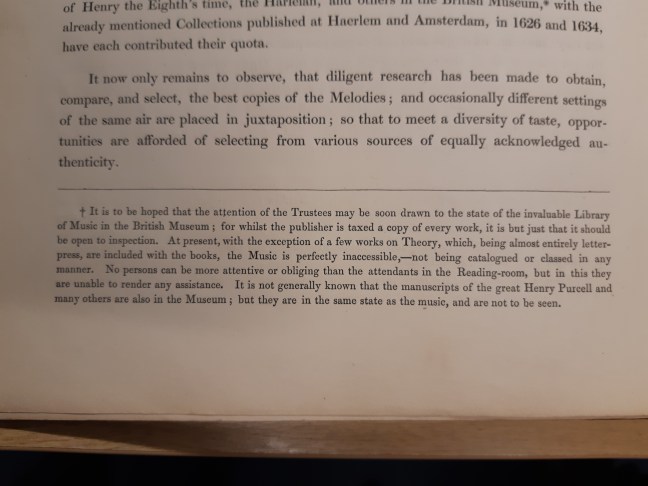
On page iv, Chappell named various key collections of British tunes, naming the British Museum (the forerunner of our British Library) as the repository for some of these collections.  A footnote afforded him the chance to make an aside about the contemporary custodial arrangements there.

Attentive, Obliging … Inaccessible, Not Catalogued

It is to be hoped that the attention of the Trustees may be soon drawn to the state of the invaluable Library of Music in the British Museum; for whilst the publisher is taxed a copy of every work, it is but just that it should be open to inspection.  At present, with the exception of a few works on Theory, which, being almost entirely letterpress, are included with the books, the Music is perfectly inaccessible, – not being catalogued or classed in any manner.  No persons can be more attentive or obliging than the attendants in the Reading-room, but in this they are unable to render any assistance.  It is not generally known that the manuscripts of the great Henry Purcell and many others are also in the Museum; but they are in the same state as the music, and are not to be seen.”
2018-08-17 11.09.45

Changing the subject, it’s interesting for us as modern readers to note that Chappell’s conclusion at the end of the second volume winds up with a sorrowful observation about the decline in musical education, since an unspecified time when music was a key part not only of a young gentleman’s education, but also of young children’s.

Merry England

“The Editor trusts, however, that he has already satisfactorily demonstrated the proposition which he at first stated, viz. that England has not only abundance of National Music, but that its antiquity is at least as well authenticated as that of any other nation.  England was formerly called “Merry England.”

Music taught in all public schools

“That was when every Gentleman could sing at sight;- when musical degrees were taken at the Universities, to add lustre to degrees in arts;- when College Fellowships were only given to those who could sing;- when Winchester boys were not suffered to evade the testator’s will, as they do now, but were obliged to learn to sing before they could enter the school;- when music was taught in all public schools, and thought as necessary a branch of the education of “small children” as reading or writing;- when barbers, cobblers and ploughmen, were proverbially musical;- and when “Smithfield with her ballads made all England roar.” Willingly would we exchange her present venerable title of “Old England,”, to find her “Merry England” once again.”

Chappell should read the commentary in today’s social media about the self-same topic!


We’re a research network! (And Scroll Down for the Pixis Variations Challenge!)

Pixis Hommage a Clementi TP
Title page of Hommage a Clementi, by Pixis. Image from copy in Glasgow University Library Collection, with thanks

It feels like time for a quick update, so I’ll spend the last few minutes of the working day doing just that.  Here’s a quick reminder of what the Claimed From Stationers’ Hall music research network is all about:-

The project is investigating the music deposited in the former British Copyright Libraries under the Queen Anne Copyright Act and subsequent legislation up to 1836, when most university libraries lost their legal deposit entitlement, receiving book grants instead. The repertoire largely dates from the late 1780s (when legal action clarified the entitlement of music to copyright protection) through to 1836.

The project aims to establish what exactly has survived; whether there are interesting survival patterns; and the histories of the music’s acquisition, curation and exploitation, not just in during that era, but also subsequently. It also aims to raise the profile of the material and to foster more engagement with it, both within and outwith academia; and the repertoire can be used to inform historical cultural perceptions which often became embedded into contemporary writings; for example, an idea very prevalent during the 19th century was that the English had no national music; and yet collections of national songs were very popular.  Thus, both the  fact that these books were popular, and our close reading of the paratext within individual volumes can be used to inform our modern-day understanding.  But a nation’s music is not just “national songs”, of course – it’s the whole repertoire of music published within that country.

To date, I’ve visited the University Libraries of St Andrews, Edinburgh and Glasgow.  I’ve been in touch with retired scholars from Aberdeen, and I’ve visited the National Library of Scotland.  Next, I need to spread my wings south of the border, and hopefully after a few more such meetings, we’ll have a clearer idea of what we’d like to talk about when we plan a study day to be held in Spring 2018.

The exciting, and yet tantalising part of all these visits is the realisation that there is a lot to explore, but not being able to stop and do all the research then and there!  For example, there are undoubtedly pieces of legal deposit music at the University of Edinburgh that aren’t labelled as such, but that appear in other copyright libraries and therefore probably arrived by the same means.  I so long to find them all, or to encourage other people to find them!  Similarly, the University of Glasgow has a very generous collection of copyright music – alluded to by the late 19th century author, W. P. Dickson amongst “works of fiction, juvenile literature, fugitive poetry, and music … issued yearly from the press” – but previously summarised by Divinity Professor Dr McGill in 1826 as “a great many idle books”.   (Dickson, The Glasgow University Library, 1888 p.16)  I’m eager to see if I can work out which volumes they might have been in before they were re-bound into their present volumes!  Meanwhile, the National Library of Scotland has an online catalogue, a card catalogue, but also “the Victorian catalogue”.  This I must see!

It is interesting to reflect that earlier musicologists have also had a hand in the arrangement and preservation of these materials.  Cedric Thorpe Davie in St Andrews disbound some volumes, and moved pieces to different places in the library.  Fourth Reid Professor Donaldson got involved with the Advocates’ collections in Edinburgh; Hans Gal had a go at listing some of the Edinburgh University Library Collections; and Henry Farmer spent some time in what for anyone else would have been retirement, as a music librarian at Glasgow University Library – one of the many careers in his portfolio! – and yes, he did some sorting out and rearranging, too.  Whilst we sigh over the thought of original sources being shuffled, we also owe these chaps a debt of gratitude for taking care of them and ensuring that they were preserved at all.

The Pixis Variations Challenge

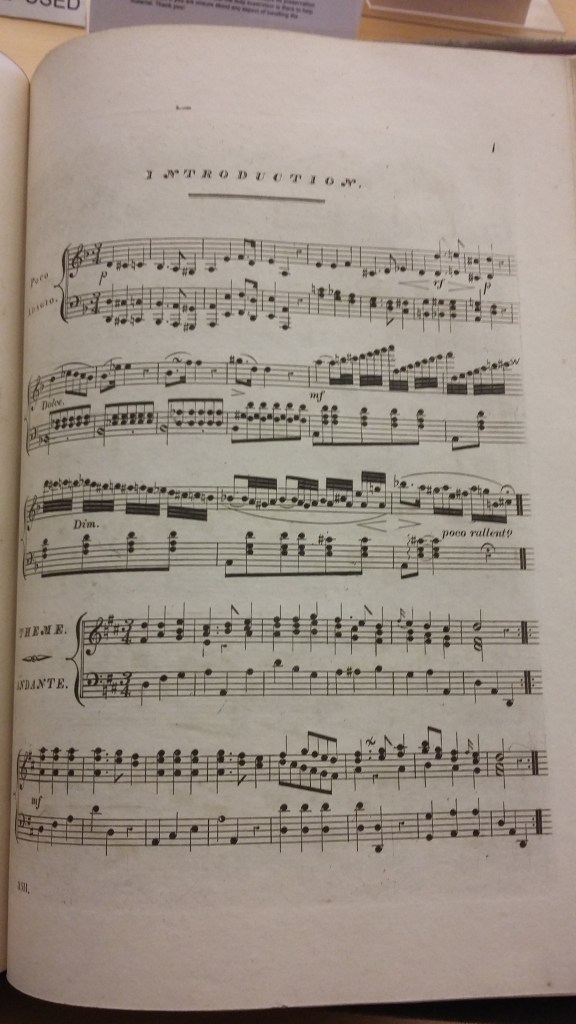
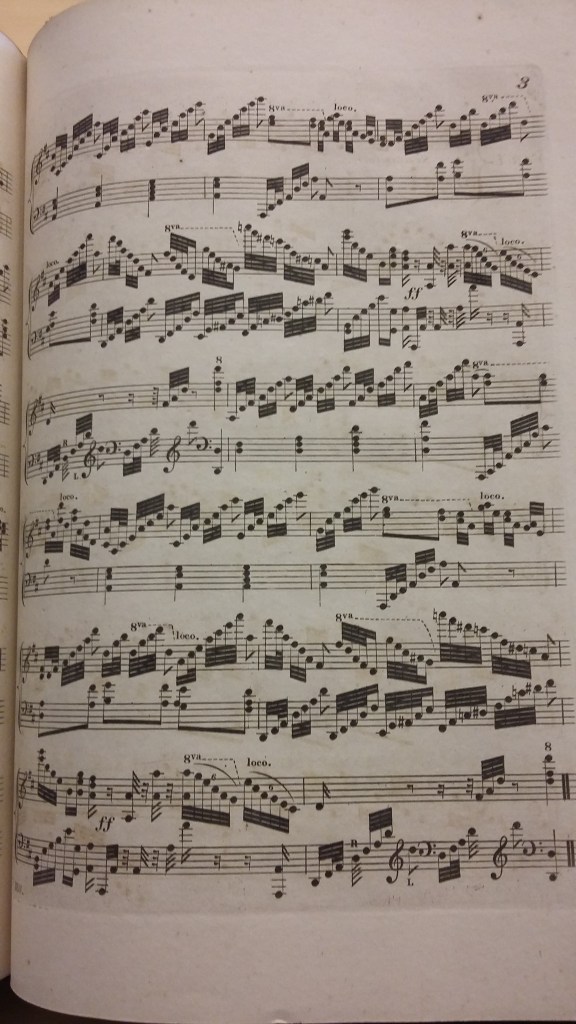
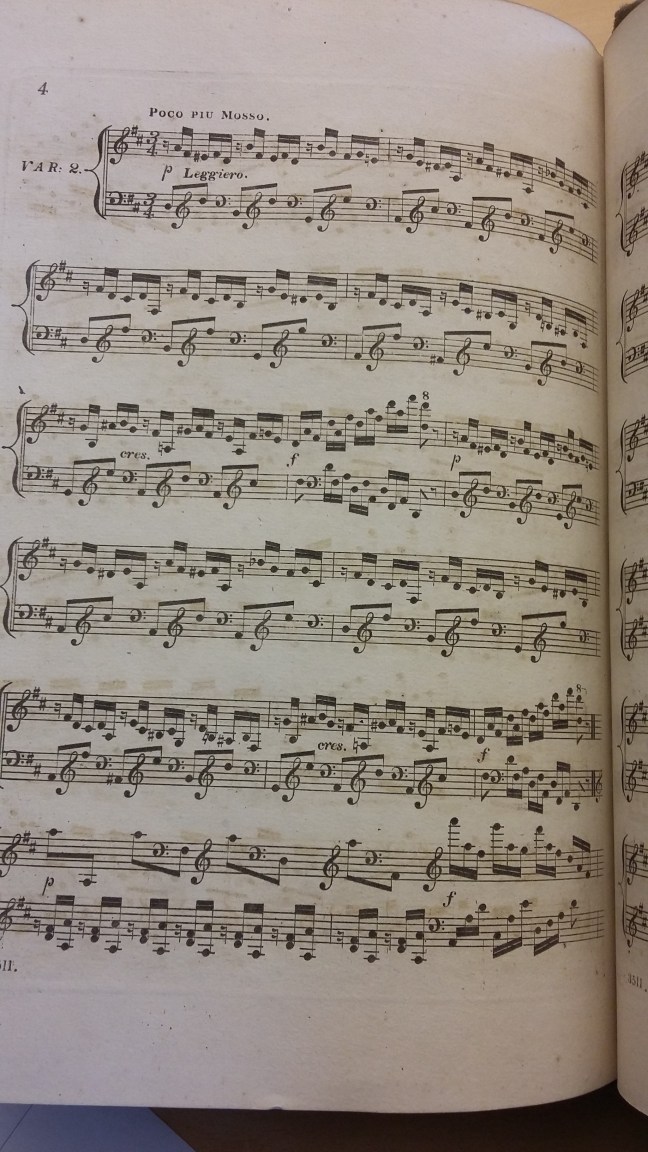
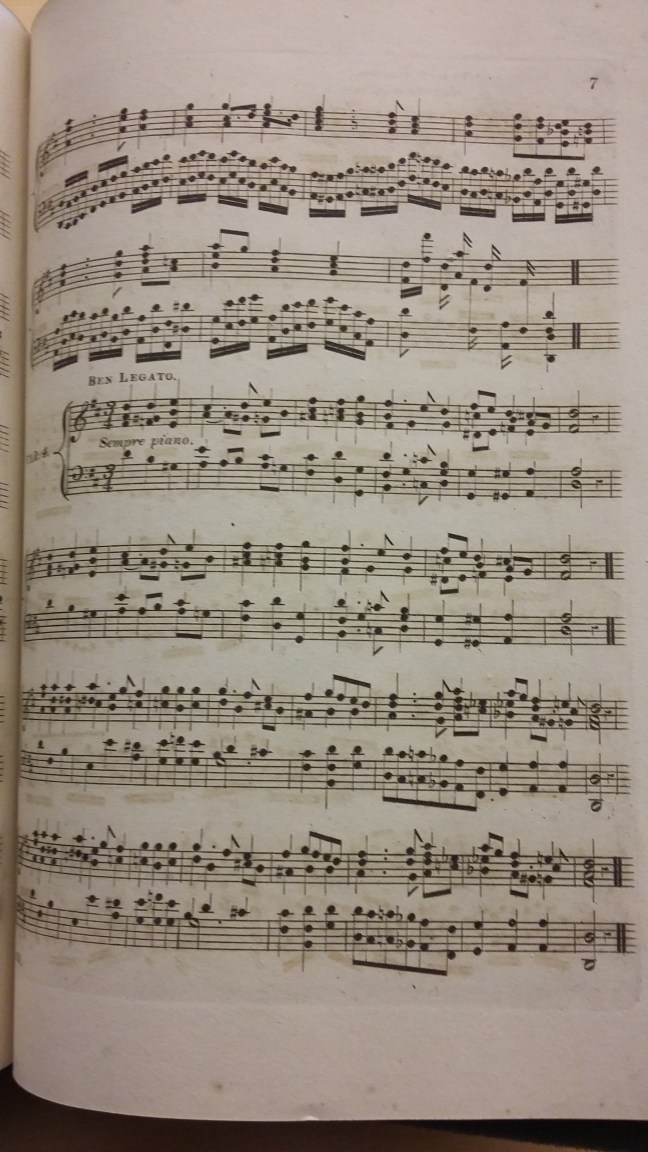
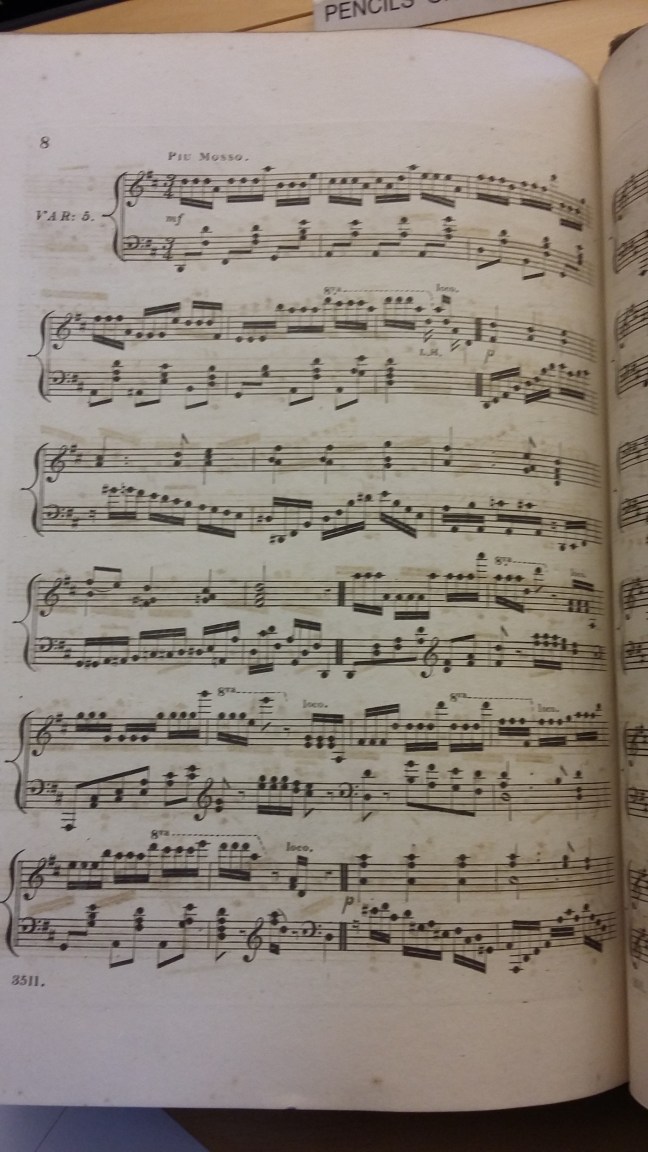
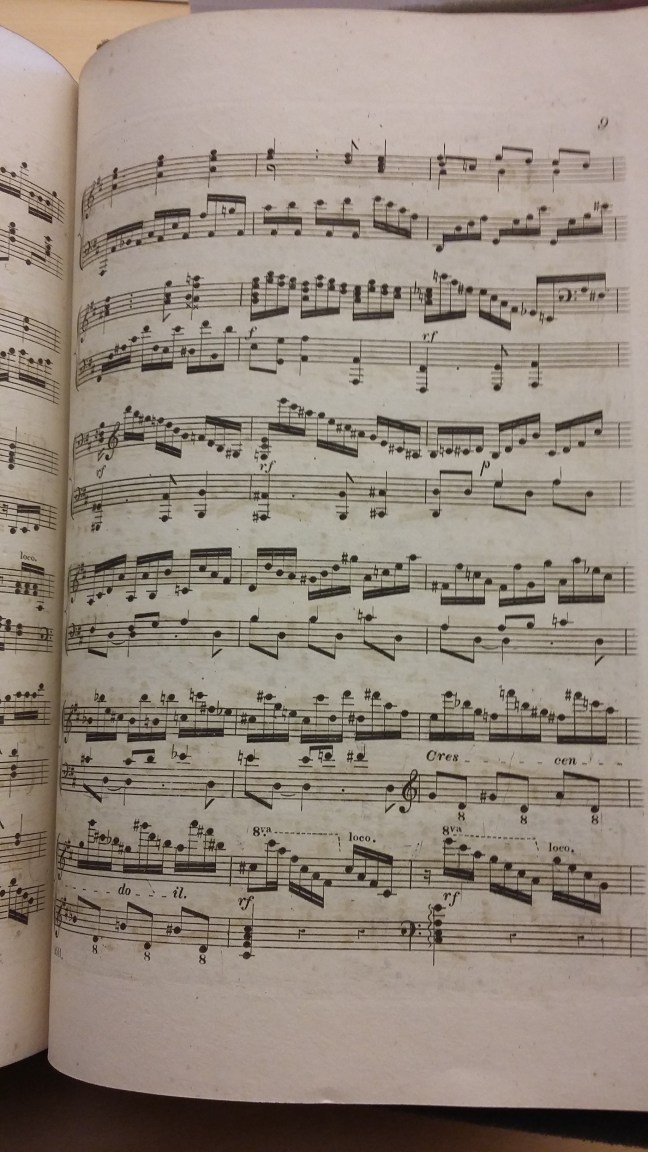
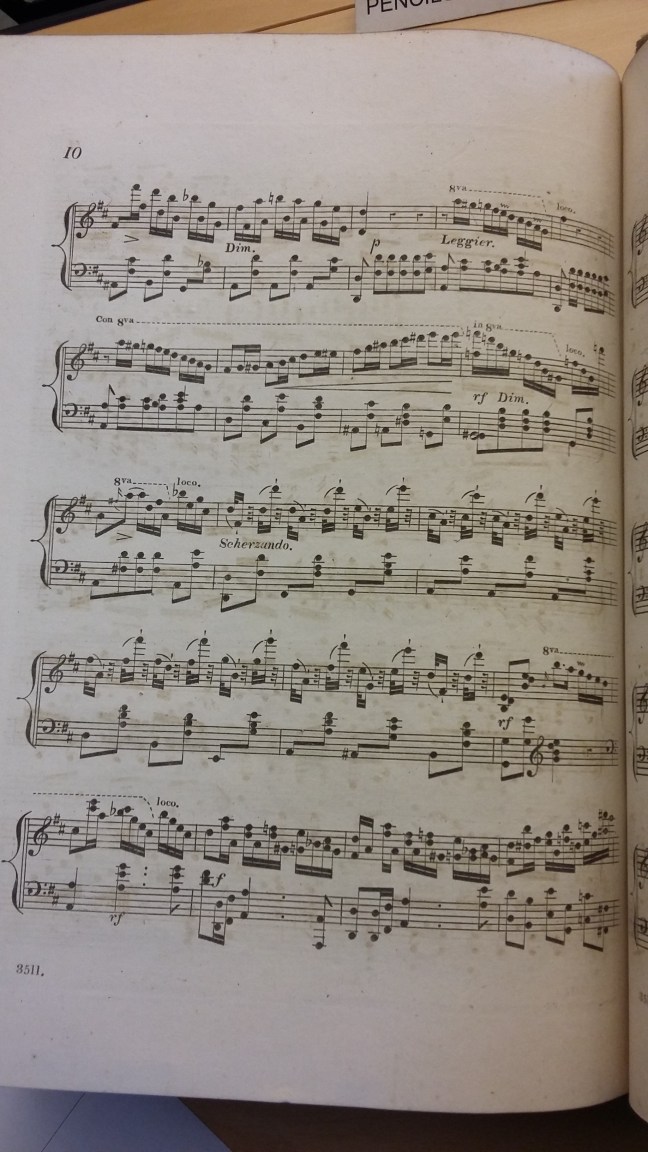
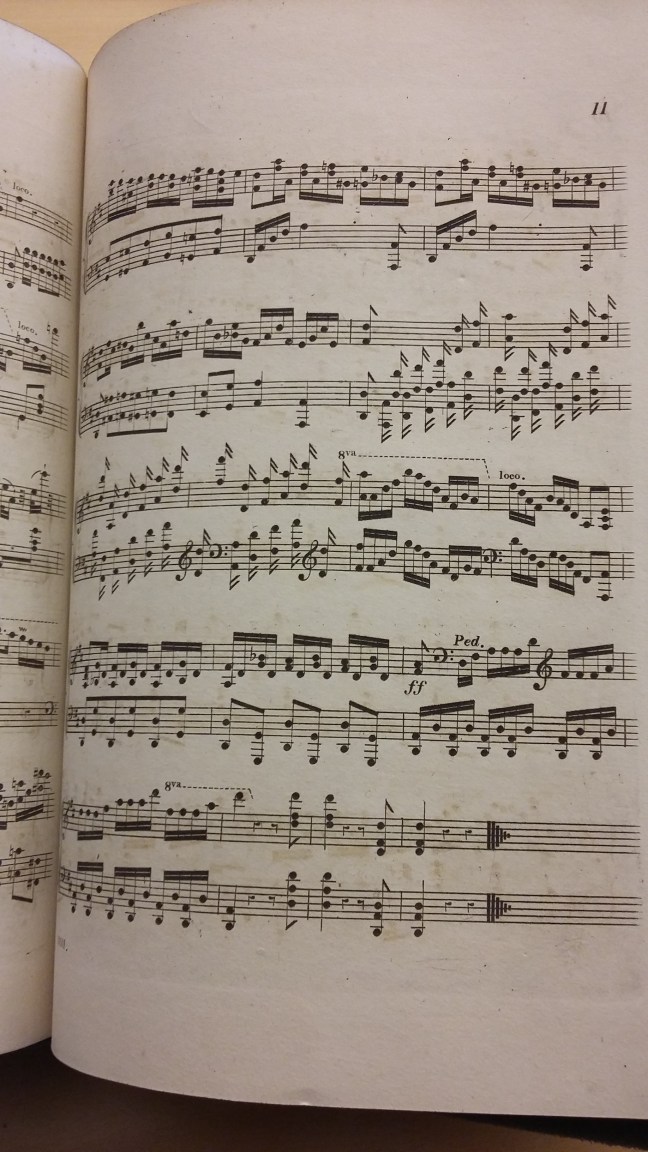
I long to play, or hear performed, some of these long-forgotten treasures.  I’ve been generously allowed by the Special Collections department of Glasgow University Library, to share a set of piano variations by the now forgotten German composer, Pixis:  Hommage a Clementi, which are actually based on the National Anthem, ‘God Save the King’.   I’m putting them on our Twitter feed and Facebook page, one page at a time.  At page 3, my pianistic skills are already being stretched beyond their comfort zone!  I wonder if anyone will get to the end …. ?  PLEASE let us know if you do!

Other pieces were undeniably less interesting.  I tweet “on this day” posts about some of the pieces that were registered, just to give a flavour of what was being published.  These references come with no value-judgements whatsoever!  Luckily for me, I don’t have instant access to all these pieces, so I would only go out of my way to hunt down something that looked particularly intriguing.

Here, for the record, is the start of Pixis’s variations – I’ll add the rest in due course.  Please do keep following the blog!  And I’m pleased to say that it’s not long before the first of our guest postings will appear – a welcome change of “voice” and a fresh insight into a different aspect of this fascinating topic.

Pixis Hommage a Clementi p1

Pixis Hommage a Clementi p2


Pixis Hommage a Clementi p3Pixis Hommage a Clementi p4Pixis Hommage a Clementi p5Pixis Hommage a Clementi p6Pixis Hommage a Clementi p7Pixis Hommage a Clementi p8Pixis Hommage a Clementi p9

Pixis Hommage a Clementi p10Pixis Hommage a Clementi p11


The Aberdeen-Norfolk Link

IMG_20170912_002006

To say that an expert on the Aberdeen copyright music collection lives less than fifteen miles away from my mother in Norfolk sounds too coincidental to be true. But retired special collections cataloguer Richard Turbet does indeed live in Holt, which is where we met this morning.  A small market town, buildings faced with traditional Norfolk flints, it wears its age well, many of the properties as old as the music we had met to talk about.

Richard was able to tell me the names of some people who had worked with him, or just after him, when he was occupied cataloguing the University of Aberdeen’s old legal deposit music online, in the days when original cataloguing was more usual, and dowloaded records were just becoming a possibility.  The names of cataloguers and university librarians now retired, served to remind me that the histories of collections have a lineage leading right up to the present day. Time didn’t just stand still after the tide of historical copyright music stopped flowing to the Scottish university libraries.

Richard also confirmed an interesting difference between the bound collections of music in Aberdeen and St Andrews. The latter were at least roughly categorized before binding. However, Aberdeen’s collections were apparently completely randomly bound.  We also know that, unlike the steady borrowing of music from St Andrews’ University Library, access to the library at King’s College was so severely restricted at that time, that any borrowing would have been limited, still less of the musical collection. (If there are loan records, I urgently need to find out about them and to seek them out!)

This was a thoroughly enjoyable, as well as an informative meeting. IMG_20170912_001955Driving back through heavy showers, I was largely oblivious to the weather. I had a pageful of notes to think about and follow up, and the possibility of further future contact. The Aberdeen-Norfolk connection is indeed a good thing, and I’m delighted to have made contact again after a gap of several years.
Might my next expedition be to Aberdeen???


Impact, Dissemination and Big Data

A few days ago, I offered to read and review a new book being produced by Fast Track Impact – I can’t think of a better way of ensuring I’m thinking along the right lines with regard to this crucial aspect of a research project!  I can’t wait to read it.

Meanwhile, we’ve been planning for the first steering group meeting for the network, and I’m looking forward to see the project being fleshed out as we pool ideas and discuss the various activities and actions that I’ve either embarked upon or promised to do as part of the network!

I’ve also recently been in touch with two scholars who between them have years of experience and knowledge about the early legal deposit collections at the University of Aberdeen.   Reading about King’s College and Marischal College’s library provision  led me to investigate reports and evidence provided by various libraries firstly in response to a Parliamentary Select Committee on legal deposit in 1817-18, and secondly to a Royal Commission on Scottish universities and their management, in the late 1820s.

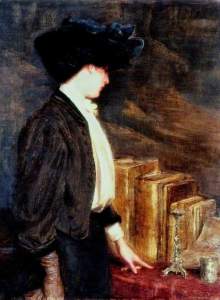
Straker, Henry, 1860-1943; Woman Looking at Books

As far as legal deposit was concerned, it’s fair to say that music was the Cinderella category, along with juvenile literature and ephemera.  Sometimes music was singled out; maybe we can use this to read between the lines in other responses to the official questions?

  • 1817 – Trinity College Dublin tells their London agent “to claim neither music, novels nor school books”
  • 1818 – St Andrews fills in a return to the Select Committee, alluding to “works of little utility“, saying they’ve recently been receiving only “those of the most trifling and useless description”.  Scholar Elizabeth Ann Frame observed from their records that,”A small proportion of the contents of every parcel, chiefly of children’s books and books of mere amusement, is laid aside in a separate bale accompanied with an exact list, besides being referred to in the Register.  All these bales are arranged in regular order, in a room adjoining to the Library”.  But was music “mere amusement?” It’s hard to say.  Most of it would not have been in “books”, for a start.  Also, there’s plenty of evidence of the music being used – a lot!
  • 1826 – Aberdeen informs the Royal Commission that, “trifling or pernicious works are sent in great abundance.”
  • 1826 – Dr McGill, Glasgow professor of Divinity, advises that “The Stationers’ Hall privilege is not at all effective: we get very few valuable books comparatively, we get a great many idle books” (whatever he may have included under this term) “and it is very expensive to bind them.”  Further to this, the author of a book about Glasgow University Library (Dickson, The Glasgow University Library, 1888 p.16), concluded that, “The working of the privilege was in reality far from satisfactory.  The library freely obtained its share of the works of fiction, juvenile literature, fugitive poetry, and music that were issued yearly from the press; but the books were procured with ease in the inverse ratio of their value, and continuations, periodicals, and works with expensive plates, especially if issued in parts, were either not procured at all, or supplied imperfectly.”
  • In a report published in 1837, King’s College Aberdeen alluded to what Barrington Partridge (The History of the Legal Deposit of Books p.128) called “shoals of useless publications … including children’s primers, and labels for blacking.”  (Barrington Partridge cites Parliamentary Papers (1837), xxxviii, p.64.  He similarly cites an 1826 Edinburgh allusion to “a great deal of trash“, although it would be imprudent to assume that this embraces music.  However, we do know that the University of Edinburgh sold at least some of its legal deposit music, as it would appear did King’s College Aberdeen, judging by evidence that I blogged about last week and the week before.


Commissions, Enquiries, Disputes

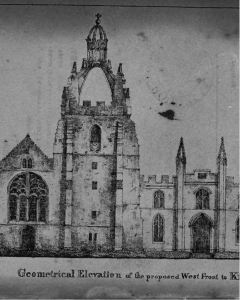
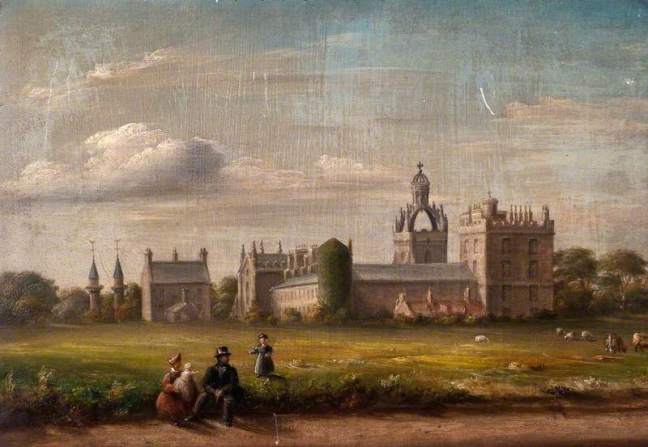
Unknown artist; King's College from the East
Unknown artist; King’s College from the East; Aberdeen Art Gallery & Museums; http://www.artuk.org/artworks/kings-college-from-the-east-108020

Looking into the history of the copyright music collection at the University of Aberdeen, there’s a wealth of information about the history of the two university colleges – King’s College and Marischal College – and their endless dispute about who should receive the legal deposit books from Stationers’ Hall.

  • Iain Beavan published a great article in Library and Information History in 2015: ‘Marischal College Library, Aberdeen, in the Nineteenth Century: an Overview’ (LIH 31:4, pp.258-279)
  • I have in front of me a magnificent tome published in 2011: The Library and Archive Collections of the University of Aberdeen: an Introduction and Description, edited by Iain Beavan, Peter Davidson and Jane Stevenson.
  • There’s also an article by Richard Turbet listing which music was received by King’s College prior to 1801 – not much of the repertoire survives now – ‘Music deposited by Stationers’ Hall at the Library of the University and King’s College of Aberdeen, 1753-96′, in the Royal Music Association Research Chronicle no.30 (1997) pp.139-162

As part of this project, I’ll be compiling a bibliography of literature and sources pertaining to the historical copyright music claimed from Stationers’ Hall – these are the kinds of materials that will be going into it!  The bibliography might appear in this  blog, or perhaps in our institutional repository.  Or I could try to publish it in a journal: what would you find most useful?

This week, I’ve been reminded that one can’t focus on the copyright music in Aberdeen without being aware of the animosity between King’s College, who received the copyright deposits – and Marischal College, which didn’t, but technically had access to them.  Access? That’s a moot point.  Access to the college libraries was exceptionally restricted!

So we find ourselves not only looking at listings of the kind of publications that this project concerns, but also at documented arguments between institutions, and public demands for more access to the materials paid for out of public moneys and by student fees.  It’s very easy to disappear down a rabbit warren of Royal Commission reports, appendices and memoranda, learning more and more about the seemingly endless circling that preceded the union of King’s and Marischal into the University of Aberdeen, and – of course – the library provision.  This is all fascinating stuff, but leads one away from the main project question: What happened to the copyright music?

Iain Beavan pointed me to the ‘Evidence’, from one of the professors interviewed by a Commission in 1827. Reverend Professor William Paul was librarian for a year at some earlier point. Asked if legal deposit books were sold, he was clear that they were not, but that some music had been sold in the past:-  “I believe a little time before I came into the College the music was sold.”  He actually came to the College in 1811, and the Copyright Act Revd Paul referred to elsewhere in his evidence was that of 1814.

The reference was fiendishly tricky to track down, but it can be found on Google books as well (of course) in a few libraries, on page 64:-

  • Commissioners for Visiting the Universities and Colleges of Scotland, Evidence, Oral and Documentary, Taken and Received by the Commissioners … for Visiting the Universities of Scotland.  Vol.4, Aberdeen (London: HMSO, 1837)

We might note that Revd Paul is alluding to a time prior to 1811, whilst ‘Caleb Concord’ (actually John Jaffray), whom I blogged about last week, raised the issue of what happened to the copyright music at King’s College, in the Aberdeen Censor in 1824.  However, the long-lived Jaffray’s much later obituary reveals that he went to Edinburgh in 1811 to work for the Church of Scotland’s Missionary schemes – not his first church appointment – suggesting that both Reverend gents were alluding to something that happened in the early years of the 19th century.

(I’ve just recorded a podcast about the Claimed From Stationers Hall music research project. You might care to listen to it here.)

Caleb Concord! What kind of Pseudonym is that?

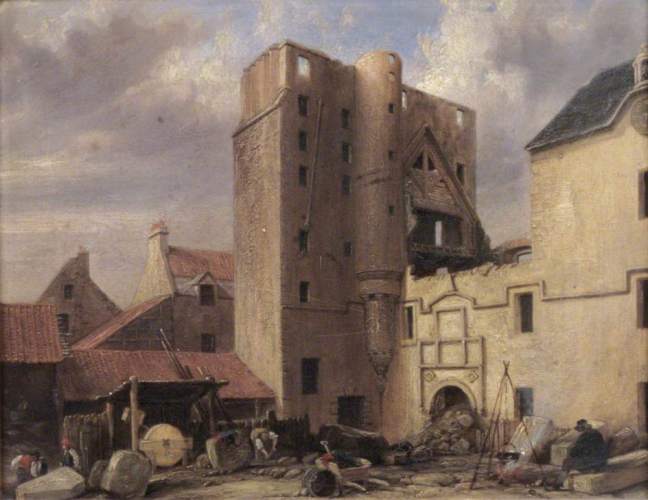
Auld, Patrick Campbell, 1813-1866; The Demolition of Marischal College
Demolition of Marischal, 1837 Painting by Patrick Campbell Auld, from Art.uk

In historical musicological research, sometimes apparently inconsequential names assume disproportionate importance. This was the fate of Caleb Concord this week.  Apparently a contributor to the Aberdeen Censor – a journal which only lasted 13 months from January 1824 to January 1825, Dominie (schoolmaster) Concord submitted his autobiography in four lengthy letters, and in one of them, he opined that the Marischal students should be more concerned about what had happened to the Stationers’ Hall music.

This raised more questions than answers.  I went to read the journal at the National Library of Scotland.  Concord appears several times in the journal, including a couple of letters to the editor, quite apart from his autobiographical contributions.  The pieces are very tongue in cheek (viz, his wives’ names, their characterisation – and a flattened cat!).  His name also appears in another contemporary Aberdonian book by someone else delighting in not one but two pseudonyms (a common enjoyment in the 1820s).  But you won’t find Concord in genealogical or newspaper sources online, and I’ve been fortunate to have made contact with perhaps the only person who could immediately provide an identification.  Behind the pseudonym lurked a very real person, but not the person I thought!

Concord claimed to be a good singer and piper, teacher not only in school but also of songs and psalmody on Thursday nights!, and a kirk session clerk.  Last week, I conjectured that he could have  been the schoolmaster of Footdee and session clerk of St Nicholas Parish, one William Smith, in the 1824 Aberdeen post office directory, maybe even a brother of the publisher, bookseller Lewis Smith.  I was completely wrong!  Iain Beavan has generously provided a positive identification, which we’ll divulge in due course.  Whether ‘Concord’ was musical remains to be seen!

Now, one might ask whether his identity actually matters one iota?!

Aberdeen Censor illustration rotated
Illustration at front of Aberdeen Censor

The most important thing about “Caleb Concord” is his observation about the Marischal  students, and it’s intriguing because at that time, the Marischal students had virtually no access either to their own college library or to the library of King’s College Aberdeen – and it was King’s College that received the Stationers’ Hall legal deposit materials.  Last year, Iain Beavan wrote a fascinating article, ‘Marischal College Library, Aberdeen, in the Nineteenth Century: an Overview’, in Library and Information History 31:4 (258-279).  It is clear that students in the early to mid 19th century had a very raw deal as far as libraries were concerned, and the animosity between the two colleges extended for many decades on account of King’s College’s determination to keep hold of the legal deposit books.

What we do know, from Barry Cooper and Richard Turbet’s bibliographical work on the Aberdeen early music holdings, is that not much survives from before 1801, and some 4000 items survive from after this.  Iain Beavan has found reference to the possibility that some of the Stationers’ Hall music might have been sold, and that’s a matter of some interest.  Certainly, the debate was raging about legal deposit holdings in Aberdeen, and it is not surprising that the public debate should be referred to in a local journal.