Dr Karen McAulay explores the history of Scottish music collecting, publishing and national identity from the 18th to 20th centuries. Research Fellow at Royal Conservatoire of Scotland, author of two Routledge monographs.
Right, my two proofs (an article and a contributed chapter), and the final version of another article, have all been returned to their editors. It has actually been quite interesting revisiting recent and not so recent research, after some time away from it. Such revisitations help consolidate things in one’s mind, and keep the topics alive and vivid.
The Big Idea
Tomorrow, by contrast, is a day for looking ahead: I need to start a book proposal and apply for some funding. Storm Amy will determine which desk, on which side of the country, I might be using. Waterproofs at the ready, but I don’t think I’ll take an umbrella! Scottish wind can invert the hardiest of specimens.
(Do I live in the 1950s these days?!) I’ve been tracing a woman who briefly worked for publisher Thomas Nelson in Edinburgh in the mid-1950s. Yesterday, I found a memo from her to one of the managing directors. Instructed to throw a book away if she couldn’t find a use for it, she promptly did find a use for it, giving it to the library of the Glasgow training college where she had previously worked.
I admired her honesty in telling him, because there was probably no need to report back on what happened to a book that was clearly regarded as inconsequential. It came from the Toronto branch of Nelson’s, and was about important Canadian educationalists; I can see why it might not have been much use in the Edinburgh office. (She had, in fact, travelled back from Montreal at the age of 16 – I have no idea how long she’d been there – so maybe he knew this, and thought she’d be interested in this combination of a country she’d visited, as well as a topic she knew well.)
Nonetheless, she did tell him, and reported that not only did the college librarian thank her, but her former boss at the college had commented that it was a title she’d actually been looking for. My interest was piqued, and I checked Jisc Library Hub Discover. Sure enough, the college has since been absorbed into a university, but the university library still has that book – the only copy in the UK. It has survived 72 years and at least one library relocation. I wondered if it had subsequently been borrowed by that senior training college lecturer – the one who had been looking for it?
Apparently not! The book has no trace of ever having been borrowed. Let’s hope she at least sat and read it in the library!
Today, after submitting an article to a journal, I suddenly realised that I hadn’t added to my ‘activity log’ for a while. It has been a sombre summer; I went down south twice; did nothing scholarly at all for some five weeks of the summer; and promptly went down with some virus or other when I got back to Glasgow for the second time – so it’s hardly surprising if I took my eye off the ball. Nonetheless, I decided there was no harm in looking out the activity log and updating it. I got quite a surprise. The two rejections earlier this year, coming close after one another, had hurt. I feel a bit sore about the piece I had genuinely thought was accepted one or two years ago, but more recently turned out to be very much not so; and even more sore about the piece that was requested and then kindly but firmly declined. I felt misunderstood!
But it appears that this scholarly year hasn’t been as bad as I thought, notwithstanding those two knocks. I’ve had an article published; and I’ve given a conference paper and two talks. To any ambitious American academic, this probably seems like pathetically small beer, but I’m a British musicologist, I’m 67, and I’m not trying to secure tenure in terms of a full-time academic contract, so it’s all okay. (I could get a dozen articles published in a year, and it would make no difference to my age or status.)
I have a book chapter and a couple more articles accepted and pending publication. Another article accepted subject to revisions, which I’ve submitted – fingers crossed this time! And today’s article just submitted. That doesn’t seem too bad to me. I now have a couple of half-promised articles which I really ought to get on with; another idea for a collaborative article; and the conundrum of a possible third book. (I’m nowhere near writing this illusive thing, but I do have angles to explore, before I can formulate a precise way forward.)
But what I do know, is that the more irons I have in the fire (yes, more cliches – sorry!), the less I mind about the rejections. Maybe I just directed them to a subject area more dissimilar to my own than I realised, so didn’t hit the targets that were expected? In any case, having other things submitted and under consideration at least offers the hope that next time I might be successful.
More irons in the fire …
I wonder what my activity log will look like by the end of the year?!
I wrote an article. Revised it. Revised the revisions. I have no problem with this – it’s all intended to make it a better article, and hopefully it is now better. However, I feel less positive about the mechanics of submitting it! You have to use a platform called Manuscript Central. Manuscript Central is a product of the ScholarOne platform. (It was owned by Thomson Reuters, then Clarivate and is now owned by Silverchair. Still with me?) I Googled it, and one journal publisher described it as user-friendly.
I’ve used it before. Indeed, I’ve uploaded revisions before. But today, I couldn’t work out how to do all my re-revisions within the platform. After much huffing and puffing, I did submit a manuscript. I’m less confident as to whether I submitted it correctly! And I dislike feeling thwarted by technology. It doesn’t encourage me!
Confused – but no hair was torn out!
On the positive side – I normally have the greatest difficulty stopping research activity when I stop being a part-time researcher for the day, but today I was more than happy to close the document. Gently, if metaphorically shutting the door behind me!
On Thursday, I’ll turn to the next article for submission. Hmm, which platform for this one …?
It’s a whole year since I retired from librarianship, and started my new contract as a part-time postdoctoral fellow at the Royal Conservatoire of Scotland. Do I miss librarianship? No, I’m afraid I don’t! And am I going to give a step-by-step account of my first year not being a librarian, able to focus entirely on research? No! (I’ve blogged so much about my research that you, dear reader, have already read countless highlights.)
Along with my research, I did a little maternity cover supervising some undergraduate dissertations – that was interesting and enjoyable, and I was proud to see ‘my’ students graduate this week. (Humour me – I’ve never been able to talk about ‘my’ students before, even if it was only for one module.)
And I took up my IASH Heritage postdoctoral fellowship at the University of Edinburgh in January. Originally planned to be for six months, it has been extended over the summer, so I’m certainly not done yet with Thomas Nelson’s educational music publishing activities.
Help me Determine my Prospective Audience?
Indeed, I’m contemplating what exactly I shall do with all the information I’ve gathered – do I write a scholarly article? Keep going and consider a book as research output? And for whom would it be written? Educational historians? Social historians? Musicologists? If you’re any of these categories – or indeed, some other category – say, a historian of publishing – it would be immensely helpful if you could respond via this blog and let me know in what way it would interest you. Any feedback will help me determine my prospective audience. I’d be really grateful.
I have two follow-on ideas which I am going to pursue this summer, along with some more archival research.
But first – I need a holiday!
I’ve saved up the bulk of my annual leave so that I could take the next four weeks off this July. Family concerns mean I’m not able to consider ‘a holiday’ abroad, or indeed staying away anywhere that involves significant outlay, just in case I had to come back hastily – but a break is called for. Last summer – partial retiree or not – I had a book to nurse through to completion, and the Christmas break was a disaster, with everyone around me succumbing to flu. (I didn’t. But I’m really no Florence Nightingale, so it was tough.) Yes, I definitely need a break.
Know When to Take a Break
I should put my research hat aside for the next four weeks. Apart from the ongoing concerns, my sleeping patterns are messed up with the early rising needed for my Edinburgh research days, and I am beset with insufficient sleep, broken nights and weird dreams.
Burning the Candle at both Ends?
When I finally wake in the morning and it’s time to get up, almost my first thought is consumed by whatever I’ve been thinking about the previous day.
But who WAS she?
So, this morning’s question was:- ‘But who WAS she?’ Some sneaky Googling turns into a lengthy trawl of deep and darkly forgotten corners of art and music history to track down the composer of some tunes for early years classes. Until it really is time to do something real (the family laundry). And as I get on with daily chores, the little voice says, ‘No, you know some people she was associated with. And that she was a composer. Isn’t that enough? It isn’t. How did Thomas Nelson the publishers know about her, for a start?’ She’s not a major player in my cast list, but I’m still curious about her. Am I capable of forgetting about her until August? I’m not sure that I am!
Meanwhile…
I need to spend some time researching fun things to do that aren’t research-based!
A few weeks ago, I led a community ‘Scottish song’ event. I found myself singing a solo – well, to say ‘found myself ‘ is inaccurate, because I HAD planned and rehearsed it with a pianist.
But it seemed to go down well enough, so, emboldened by this, I sang a couple of examples from Nelson’s Scots Song Book at my Work in Progress talk on Wednesday. This time, I prerecorded my accompaniment myself. (Three cheers for the decent mic I had purchased during lockdown!)
I reminded myself that my esteemed audience were a mixture of musicians and non-musicians, and I was there as a researcher rather than a star turn, so hopefully they’d listen kindly rather than critically!
And it was fine. I suppose the more often you do something, the easier it gets. I have played in public, conducted in public, and sung in a choir numerous times, but singing solo? That’s something new.
I have another talk coming up in a few weeks. Of the two songs I sang this week, I much preferred one to the other – the range was more comfortable. So I looked through NSSB4 again last night, and hit upon a favourite – ‘I’ll aye ca’ in by yon toun.’ I took it to the piano for a first play through. Yes, I like Easson’s setting. It’s reasonably modern, and playable.
At this point – just as I’d finished the chorus – I was obliged to stop.
‘But, I was …’
You’d be alarmed at how routine governs my activities. No point causing upset by continuing to play, so the song will wait for another time. Supper couldn’t wait!
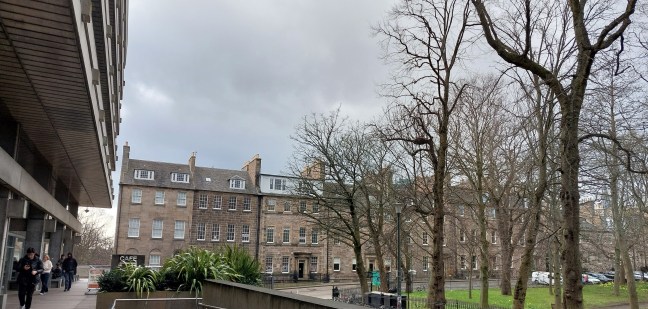
However, I thought I’d look for a YouTube rendition, to accompany my breakfast this morning, and what did I find, but a Topic recording of Jean Redpath performing it in the American Serge Hovey’s setting. I never heard Jean sing live, but she got an honorary DMus from the University of Glasgow (my Alma Mater), and her enthusiasm for Scottish song was influenced by her time at the University of Edinburgh – as I sit with a cuppa in the Library cafe, I’m literally looking out at the School of Scottish Studies building where she’d have talked with Hamish Henderson.
Having heard Redpath’s beautiful singing, I am less sure that my singing is a good idea, but there’s only one way I can share Easson’s setting, and that’s by playing it. Which, without a singer, wouldn’t work at all. I’d better get practising!
Dutifully, I booked a morning off because we were anticipating the advent of a roofer at home, and I didn’t want to be torn between roofing conversations and research work. The afternoon was my own, apart from a couple of rescheduled meetings at the end of the day. (There wouldn’t be anyone on the roof by then, surely.)
‘Anticipating’ was the word I just used, and it was just that. The storms a few weeks ago played havoc with more roofs than our own. Anyway, here I sat, two laptops in front of me, nothing happening on our roof, and Scholarly Satan started tugging at my conscience.
“You could sort out your timesheets, you know.”
“You can reschedule that tutorial. Do It Now.”
“You’ve got to update your CV, haven’t you? You LOVE formatting documents and getting the bullet-points and punctuation just right.”
“Oooh, look, you can action that email straight away – wouldn’t it feel good to be so on-the-ball?”
And then came his masterstroke.
“This is Scholarly Stuff, you know. There’s nothing sinful about Scholarly Stuff.” Which is true, of course, apart from the fact that I wasn’t meant to be working! Anyway, it’s now 4 pm, and I propose to walk away from the laptops for half an hour, until the last and only official duties of the day. I fear I’m too old to mend my ways now.
I read some advice the other day (you’ll have seen it often enough):-
If you aren’t happy where you are working, then leave.
There’s another adage, which is similar on the face of it, which goes like this:-
If you keep on doing what you’ve always done, you’ll get what you’ve always got.
I know there’s value in the first suggestion, but it isn’t always possible, is it? You may be well aware that you’ve probably been in the same job too long, but personal circumstances mean you simply can’t leave. Or your role is so specialised that you would have to relocate, which might not be an option.
This is why I prefer the second adage. Sometimes you have to take a long view, and your Plan B might involve changing direction whilst sitting tight. Get ready for a new role, adjust your mindset accordingly, but accept that it’ll be a while before you make the move.
Alt-Ac-tually
I feel for people at the start of an academic career, with the struggle to get one foot on the ladder. Do you actively want an Alt-Ac career, or do you feel you have no choice?
I wanted to be an academic music librarian. That became my career, but later I regretted not having finished my first PhD and given academia a fair shot.
My Plan B began with getting a PhD. Afterwards, I was very fortunate to get partial secondment as a researcher for more than a decade, whilst remaining in librarianship for the bulk of my week.
Adjust Mindset
It’s not just a question of having the right qualifications. You need to ensure that you believe in yourself as a scholar, and that others see you as a serious academic.
Write the articles;
Publish the book (if appropriate) or chapters,
Attend conferences (partial attendance isn’t ideal but it’s better than non-attendance, if cost or time are problematical);
Give talks, whether scholarly or as public engagement;
Seek opportunities for career development. (I did a part-time PGCert a couple of years after the part-time PhD).
DO NOT, repeat DO NOT, write yourself out of a career option because you believe yourself incapable of it. (Aged 21, I believed I would never be able to stand in front of a class of students. And on what did I base that assumption? I’d just taught English to assorted European students for about a month. I did it. I planned lessons, and stood there, and did it. So who said I couldn’t?! And it gets worse. There weren’t many women doing music PhDs when I was 21. Guys told me it was incredibly hard to break into academia – and I just took their word for it. How naive WAS I?!)
Look instead for opportunities to practise the areas you feel need improvement. You may need to think laterally. Music librarians seldom teach music history, but they do deliver research skills training. Lots of it.
Today
Fast-forward to now. I left Glasgow at 7 am today, in subzero temperatures. Edinburgh is bright, clear and breathtakingly … well, breathtakingly cold as well as beautiful! A freezing cold early start might not sound like a luxury to the average retired librarian. I’ve never wanted to be conventional, though.
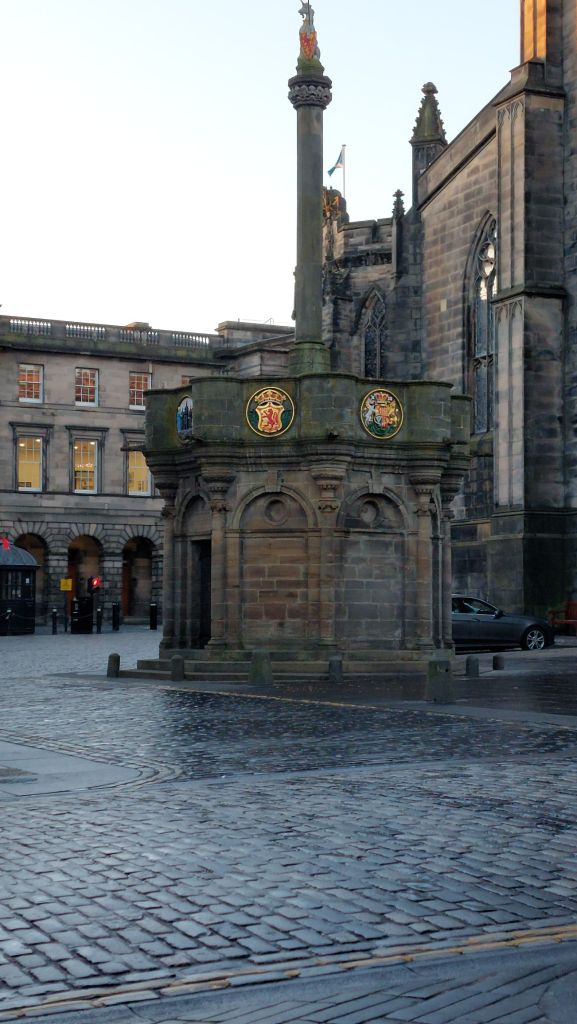
The Mercat Cross, Edinburgh
This is the first week in my IASH Heritage Collections fellowship. For the first time in my career, I’m NOT juggling librarianship and research. I’m part of a vibrant community of practice, and I have both the University Library and the National Library of Scotland just down the road. Thus, today, I saw a set of four Scottish song books that are remarkably hard to find as a set. (Three cheers for legal deposit!)
And last night, the year got off to an even better start, with an article being accepted. Just a few minor tweaks to do, which won’t be difficult.
It feels to me as though my long-term plan might be working out quite well!
Probably the most eventful year I’ve ever reported, 2024 saw plenty of action. However, I’d like to add a few words of explanation before I go any further. Firstly, everyone’s different and everyone’s circumstances are different. (You know the old saying about how you have to ‘walk a mile in someone’s shoes’ before you understand their experiences and challenges?) I’ve spent far too long on introspection, measuring myself unfavourably against high-achievers. It gets you nowhere, apart from feeling inadequate. You will know what is possible in your own situation; please don’t feel I’ve set myself up as an example. I’ve done it my way.
If you’re on the tenure track hamster wheel elsewhere in the world, you may read this and wonder at how little I’ve achieved. On the other hand, if you’re not employed as an academic, you might be surprised at how much. If you’re fully retired, you may think I’ve lost my marbles, but if you’re semi-retired, you might understand! Similarly, everyone’s personal circumstances at home are different too.
For full disclosure, my research career has been what you’d now call alt-ac (alternative academic); I have had 10½ paid hours a week on research for over a decade, but my main career has been in music librarianship. (I’ve never been a full-time academic, and my outputs were achieved in less than one third of my working week.) As you’ll see, I recently gave a keynote about being ‘alt-ac’, and I’d certainly be open to further bookings of this kind, if your institution or network was interested. (I’m in the UK.)
Highlights
I had successful eye surgery in February.
I retired from librarianship at the end of June.
I was promoted to part-time postdoctoral research fellow in July (10½ hours a week).
I’ve had the opportunity to do some teaching cover.
My second monograph was published. (It has a 2025 imprint, but actually came out in autumn 2024.)
I was elected a Fellow of IAML (UK & Ireland) in the spring, and of the Royal Conservatoire of Scotland in November.
I was keynote speaker for the ECRN Alt-Ac Showcase at the University of Birmingham.
I successfully applied for a research fellowship at IASH (the Institute for Advanced Study in the Humanities) at the University of Edinburgh, which I shall be taking up between January and June 2025.
I received the Mervyn Heard Award from the Magic Lantern Society in December, for research into Bayley and Ferguson’s service of song publications.
Four fellowships of various kinds is quite an impressive number, however you look at it, so I must remind myself of this before I start beating myself up about my relatively modest upward progress!
Publications
A Social History of Amateur Music-Making and Scottish National Identity: Scotland’s Printed Music, 1880-1951 (Routledge, 2025)
Book Review: Gun Sireadh, Gun Irraidh: The Tolmie Collection (Folk Music Journal Vol.12 no.5, pp.127-9; my review of a new edition of the Tolmie Collection, a significant Gaelic song anthology, here re-edited by Kenna Campbell and Ainsley Hamill)
[Article withdrawn due to pressures of time, but published on this blog: ‘The Exhilaration and Exasperation of Hybridity: Third-Space Professionalism in the Library’]
2 accepted chapters pending publication.
2 articles recently submitted, pending peer review. [February 2025 update: one got through peer review, has been revised, edited and I’ve approved the proofs. The other got through peer review and now awaits the revisions. Nonetheless, satisfactory progress!]
Speaker
Exchange Talk, Royal Conservatoire of Scotland, Jan 2024, ‘From Magic Lantern to Microphone: the Scottish Music Publishers & Pedagogues inspiring Hearts & Minds through Song’
NAG (National Acquisitions Group) Talk, April 2024, ‘Redressing the Balance: Getting Historically Under-Represented Composers and Contemporary Environmental Concerns into Library Stock’
Print Networks, conference held at University of Newcastle, July 2024, ‘‘Music for All’: the Rise and Fall of Scottish Music Publishing, 1880-1964’
Exchange Talk, Royal Conservatoire of Scotland, Nov 2024, ‘The Glory of Scotland’ (it’s the title of a Scottish song book published for the 1951 Festival of Britain)
Keynote for ECRN Alt-Ac Showcase at the University of Birmingham, Nov 2024, ‘My Alt-Ac Life’
Other Activities
BBC Scotland: ‘Good Morning Scotland’ interview
Book launch
Fellowships of IAML(UK) and RCS
Mervyn Peak Award, Magic Lantern Society
New job title: Post Doctoral Research Fellow
Peer reviews for AHRC and a scholarly journal
Providing teaching cover
Successful application: Heritage Collections Research Fellowship, IASH (Institute for Advanced Studies in the Humanities at the University of Edinburgh), for Jan-June 2025.
Edinburgh University Library from The Meadows (Wikipedia image)
Forward Planning
My IASH Fellowship will allow me the opportunity to explore the former Edinburgh publisher, Thomas Nelson’s archives, to find out more about their publishing in the music field. There wasn’t a great amount, but I aim to explore correspondence and find out how it fits into the wider range of their activities. I’ll be spending more of my time on research than I ever have since 1982!
Meanwhile, I’ve been working on an article for a history publication; I want to get that finished in the near future, so that I can turn my attention to another article on a different topic. What I do after that will probably depend on how the IASH Fellowship research goes, and what interesting possibilities reveal themselves to me. There’s bound to be enough for an article. But could I expand it to something book-length? I’ll have to wait and see!
I attended a meeting about grant applications, today. There was lots of good advice, including the development of a five-year career plan. A very sound suggestion. However, most early career researchers are really at the start of their research career, whilst I? I’ve done less research in my research career than a full-time researcher – obviously, as I got my PhD aged 51, and since then I’ve mostly been a 0.3 researcher – and my research development has thus been spread over a longer period. Similarly, I do have some teaching experience, but not an enormous amount. So …
In planning the next five years, young researchers have different parameters (making a good start, developing their strengths, possibly more able to relocate geographically, possibly without family responsibilities), whilst old ones are trusting they’ll still be fit and well in five years’ time; might not be able to relocate; and might well have family or caring responsibilities. (Should the plan also have the equivalent of a runaway truck ramp or escape lane, in case personal circumstances change unexpectedly?!)
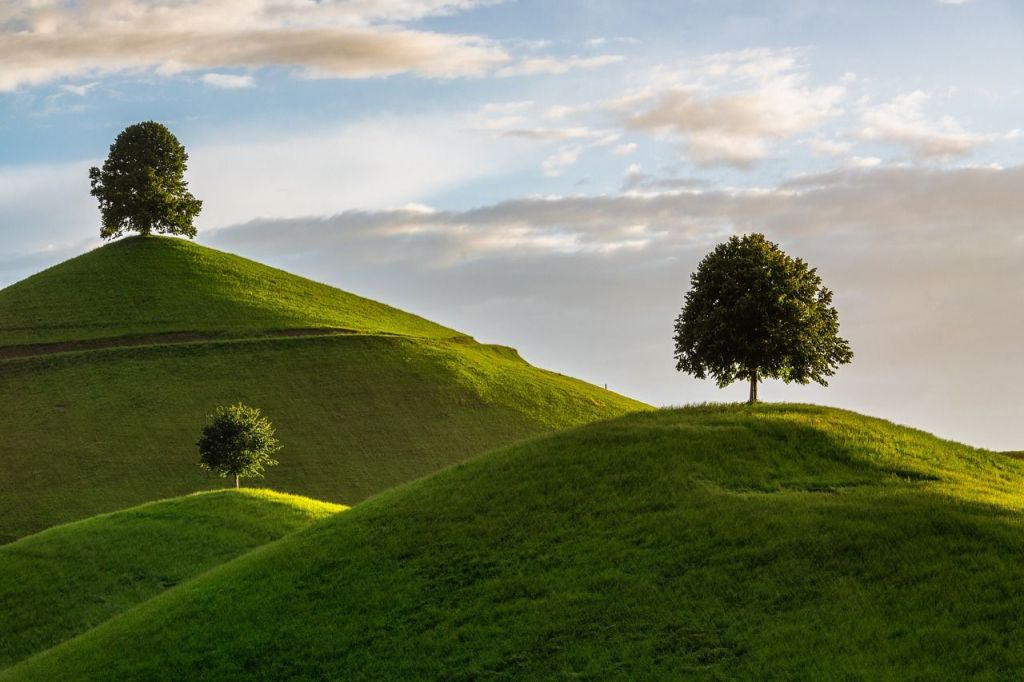
Over the Hill? Which Hill?!
Maybe over one hill, but there are other hills to climb!
Five years at the start of a working life are different from five years somewhere nearer the end. I want to go on forever! Realistically, that’s impossible. (I might live another three decades, but who can say if I’ll still be researching at 96?!)
However, I read a posting the other day about the use of metaphors in health care, and I can see a parallel for scholars here; they talk about a journey with an illness, whilst we use metaphor to talk about our research journey.
To continue with the journeying, travelling metaphor: I climbed the librarianship hill as far as I could get. I didn’t reach the top, but I made reasonable progress. Looking around, I saw other hills I’d like to climb. You could say I’ve used the state retirement age as an opportunity to come down from the library hill, so I can spend more time climbing elsewhere.
I’d like to write another book. But I’ve only just published my second; I need at least three or four more years to do enough research into a new topic to merit a book. And I haven’t decided what exactly it will be about yet, though this might well become apparent in the next year or so.
Despite all this, a five-year research plan does seem desirable. I must apply myself to devising it!












 Karen McAulay, Musicologist