Dr Karen McAulay explores the history of Scottish music collecting, publishing and national identity from the 18th to 20th centuries. Research Fellow at Royal Conservatoire of Scotland, author of two Routledge monographs.
I’m looking forward to giving a talk to students at the University of Edinburgh this week. The University Library was one of the recipients of legal deposit materials during the Georgian era, before the law changed in 1836. Amongst all the learned tomes and textbooks, they received sheet-music too. The interesting question, of course, is what they did with it!
Now, as you know, I’m a bit of an enthusiast when it comes to bibliographies, but this time I’ve prepared a very minimal bibliography in a novel format. Should you wish to share it, here’s an easy URL to the same animated bibliography:-
Our bibliography was only updated at the end of August, but a mere five weeks later, there were a number more useful publications waiting to be added, including some references gleaned from a couple of exciting articles by Nancy Mace. So, a new edition of the bibliography has been uploaded …
Notwithstanding this, please check what’s there already, and do let me know if you’ve written about any aspect of historical music copyright, music library history, or music publishing history that might be pertinent to our field of study! We’d really like to add details to our listing.
It’s some months now since we agreed at our workshop that it might be possible to make a comparison across libraries of a small sample of the legal deposit music acquired during the Georgian era. A spreadsheet was shared and duly returned, or completed by me to the best of my ability where available data was more sketchy, and this month I’ve been pondering which data “slices” might be most amenable to comparison.
Here are the facts: a couple of libraries have identifiable runs of legal deposit music from that era. Other libraries may have recognisable sequences, or scattered volumes containing legal deposit music, or volumes which were collated later along with other material NOT acquired by legal deposit. The bindings, too, may be done to a house style, or may be so different that it’s clear the volumes arrived via a different route.
And then there are the catalogues. Same problem. The Universities of St Andrews and Aberdeen have their sequences of volumes, so the shelf-marks should be easy to recognise in the catalogues, too. This may be the case in Glasgow and Oxford too, but it might not be as clear-cut as it is in St Andrews and Aberdeen. Interrogating the catalogues for music from particular years will yield items that were NOT acquired by legal deposit as well as items that were. And it’s even more complicated in some of the other libraries! The vaster the collections, the trickier it gets. There’s one more problem, too. It’s not all catalogued online. Where an online catalogue can be interrogated by date, a paper one cannot!
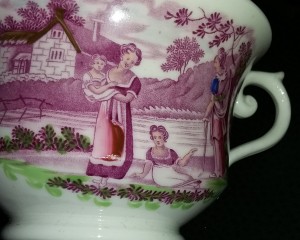
Batt-printed porcelain contemporary with the copyright music era
And then we have the problem that Kassler’s Music Entries at Stationers’ Hall 1710-1818 not only ends at 1818 – in other words, eighteen years before the Library Deposit Act in 1836 – but the last eighteen years of his index are listed as an appendix, and have a different history to the rest of the book: this appendix covers ‘Music entries from 1811 to 1818 in the William Hawes Manuscript’, which is an extract copied from the Stationers Hall registers. It doesn’t give as much detail (notably, no publisher, not as much title information – and no library locations are given) but it does at least mean that we have a list of some kind up to 1818.
After that? We’re on our own! Adam Matthew Digital has produced an online database providing digital images of the Stationers’ Hall registers, so it might be that we’d have to arrange for someone to transcribe the entries for the last eighteen years of the era that we’re interested in.
The first question is, do any of the Georgian legal deposit libraries subscribe to the Literary Print Culturedatabase?
And the next is, can we find grant funding to make transcription a real possibility?!
Anyway, I’m wondering about not one but two data-slices, firstly at the tail-end of Kassler’s index – which would still mean we lacked some of the Stationers’ Hall data, but would include the most library stock – and then, perhaps later on, to consider the five or six years prior to the Copyright Rescinding Act. This would allow us to make comparisons between what was published, by whom, and whether different kinds of material were by now being kept.
Before any kind of listing could be made, we have to decide what style of bibliography we’re aspiring to. Do we want it online? Do we want short-titles or full descriptive bibliography? What skills do we require in a research assistant for this kind of task? Certainly, we need an understanding of music AND of what cataloguing or bibliography-making entails.
We’ll all need to mull over these problems before we can make any positive plans of action!
Just thought I’d remind you that we have an extensive bibliography pertaining to the history of music legal deposit and copyright in the UK (and further afield, in a few instances). Do take a look – if you have written on the subject but I haven’t picked up the citation, please do forward it! Similarly, if you have colleagues whose work ought to be included in this listing, it would be great if you could let me know. I’d hate for anyone to be missed out! Very many thanks.
Colleague Dr Brianna Robertson-Kirkland, lecturer at the Royal Conservatoire of Scotland and researcher on various eighteenth and early nineteenth-century humanities projects, is also a member of the Claimed From Stationers’ Hall network. She has recently reviewed the Library of Congress digital music website, Early American Sheet Music, and you can read her review online in the Royal Musical Association research Chronicle (2018):-
Since Brianna offers insight into some very pertinent issues about digitised music collections, I’ve added the review to our CFSH Bibliography, which you’ll find here, and also via the index to this blog.
Looking at the historical copyright music collections, certain categories do leap out … theatrical music, single songs, instructional material, instrumental music, Napoleonic-era music … and music by women. Now, there are various websites detailing women composers, and it would be rash (indeed, unnecessary) to create another one, but for the purposes of the Claimed From Stationers’ Hall network, what we need is a list of the women composers represented in and around the Georgian era – say, from 1760-1840.
I found all the women’s names in the “Authors” index of Michael Kassler’s Music Entries at Stationers’ Hall, 1710-1818 (Routledge, 2004), and then added in some extra names that appeared in St Andrews’ University Library Copyright Music Collection – specifically, in the volumes that have been catalogued online, from Vol.130 to Vol.385. (Kassler also lists writers of lyrics, performers, and dedicatees, in separate indices – I have not included these.) The resultant list can be found here:- Women Composers of the Georgian Era. (List compiled by Karen E McAulay, Royal Conservatoire of Scotland, 07/2018).
A WORD OF CAUTION! Researchers should cross-refer between Kassler and Copac, to ensure that works post-1818 are also represented, and to eliminate any names which may have other than strictly authorial responsibility for the works cited.
Kassler’s book is one I consult almost daily. It’s available in a number of university libraries, both as hardback and e-book. Recommended!
I tweeted about this earlier today, and I’ll reiterate it here – please do share any links to useful lists of historical names! If your list has both “ancient and modern”, I’ll still be happy to include the link. However, to keep it relevant, let’s not add lists of women composers from the 20th century onwards. The Claimed from Stationers’ Hall network is about predominantly Georgian music, published in Britain and legally deposited in British libraries – that’s the network’s remit, and that’s what the research funding is enabling!
Hayes, Deborah – Classic Women[composers, musicians] NB Deborah has a separate page for seven women active in the late 1700s. Worth a look!
Hans Gal (1890-1987) catalogued Edinburgh University’s Reid Music Library during the summer and autumn of 1938, at the instigation of Sir Donald Tovey. The latter was keen to find work for the gifted composer and musicologist, who had emigrated from Vienna when Hitler annexed Austria. (Here’s a recording of his earlier Promenadenmusik for wind band, which he wrote in 1926. ) A grant from the Carnegie Trust enabled Gal’s catalogue to be published in 1941. When the Second World War ended, Gal joined the University music staff, and remained there beyond retirement age.
The reader is referred to the Hans Gal website for further biographical information (I am checking this weblink, which occasionally falters):- http://www.hansgal.org/
Gál, Hans, Catalogue of manuscripts, printed music and books on music up to 1850 : in the Library of the Music Department at the University of Edinburgh (Reid Library) (London, Edinburgh: Oliver and Boyd, 1941)
(Partially) catalogued by Gal
The catalogue is in three parts, listing manuscripts, printed music, and books on music. Gal did not list every individual piece of music in the library, but prioritised more serious classical music, whether vocal or instrumental. One might suggest that there were various reasons for Gal’s decision.
In his preface, he explains that, ‘for practical reasons I confined this catalogue to the old part of the library, namely the manuscripts, printed music and books on music up to 1850, which is the latest limit of issues that might be looked upon as of historical importance’. [Gal, vii]
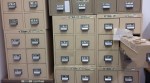
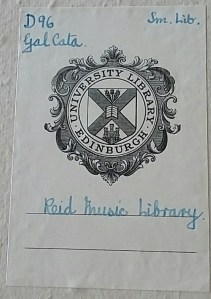
However, this was not the only limitation placed on the listing. Gal omitted many of the pieces of sheet music that must have arrived as legal deposit copies during the Georgian era, until copyright legislation changed in 1836. The Reid music cupboards contained a number of Sammelbänder, or ‘binder’s volumes’, ie, bound volumes of assorted pieces of music. Occasionally Gal made oblique reference to these, eg, to cover the 44 items in volume D 96:-
“Songs, Arias, etc., by various composers (Th. Smith, D. Corri, Bland, R. A. Smith, Rauzzini, Davy, Kelly, Urbani; partly anon.) Single Editions by Longman & Broderip, Urbani, Polyhymnian Comp., etc., London (ca. 1780-1790). Fol. D 96″ [Gal, 44]
Longman & Broderip were prolific music publishers, amongst the most assiduous of firms making trips to Stationers’ Hall to register new works. They published a lot of theatrical songs and arrangements, and much dance music, as well as the more serious, ‘classical’ music repertoire. The catalogue entry cited above details some more commonly known composers of decidedly middle-of-the road, if not downmarket material. One does not need to speculate as to whether Gal considered such material less respectable, for he made no secret of his disdain for much of the music published in this era! In the preface, he asserts that,
“The gradual declining from Thomas Arne to Samuel Arnold, Charles Dibdin, William Shield, John Davy, Michael Kelly, is unmistakeable, although there is still plenty of humour and tunefulness in musical comedies such as Dr Arnold’s “Gretna Green”, Dibdin’s “The Padlock”, Shield’s numerous comic operas and pasticcios.
“After 1800 the degeneration was definitive, in the sacred music as well as in songs and musical comedy. […] It is hardly disputable that the first third of the nineteenth century, the time of the Napoleonic Wars and after, was an age of the worst general taste in music ever recorded in history, in spite of the great geniuses with which we are accustomed to identify that period.” [Gal, x]
Faced with several hundred of such pieces in a number of bound volumes, and quite possibly a limited number of months in which to complete the initial cataloguing, it is hardly surprising if Gal was content to make a few generic entries hinting at this proliferation of ‘bad taste’. (One might add as an aside, that Gal’s wife at one point observed that Gal ‘hated swallowing the dust in archives’, in connection with an earlier extended project in the late 1920s – clearly, he was able to overcome his distaste when the need arose! (See http://www.hansgal.org/hansgal/42, citing private correspondence of 10.10.1989)
Interestingly, it is evident that Edinburgh, like several other of the legal deposit libraries, must have been selective in what was retained, but it’s significant that national song books were certainly considered worth keeping. Gal, in turn, included some of the prominent titles in his listing.
Thus, Gal’s catalogue is another reminder to us that the history of music claimed from Stationers’ Hall under legal deposit in the Georgian era, actually and actively continues beyond the Georgian era, for the material has already been curated by musicologists and bibliographers prior to our own generation. In St Andrews, Cedric Thorpe Davie took an active interest, whilst Henry George Farmer was involved in curating the University of Glasgow collection.
Meanwhile, in connection with the current Claimed From Stationers’ Hall network research, the priority is to establish which volumes – formerly in the Reid School of Music cupboards, but now in the University of Edinburgh’s Centre for Research Collections – were received under legal deposit. Two spread-sheet listings enable us to examine the contents of different volumes, by volume:-
Where publication dates are not given in the spread-sheet, they can be looked up in Copac, and even if there are no decisive dates, then their presence in other legal deposit collections will suggest that these copies arrived by the same route. If music predates 1818, then works can be looked up in Michael Kassler’s Music Entries at Stationers’ Hall, 1710-1818, from Lists prepared for William Hawes, D. W. Krummel and Alan Tyson. (Click here for Copac entry.)
Essentially, the first task is to ascertain which volumes contain legal deposit music, and then to look not only at what survives, but whether there are any patterns to be discerned. In terms of musicological, book, library or cultural history, the question today is not whether the music was ‘degenerate’ or in ‘bad taste’, but to ask ourselves what it tells us about music reception and curation in its own and subsequent eras.
Postscript: as an interesting twist in the world of library and book history, my own copy of Gal’s catalogue was purchased secondhand – a withdrawn copy from a university library where the music department closed a few years ago. What goes around, comes around, as they say!
Well, what else would you do if you were snowbound for a third day?! The bibliography has been updated considerably. This is not to say that I’ve read every single reference, which would be difficult in my part-time research existence, but hopefully there will be plenty of inspiration for anyone embarking on any aspect of the research network’s interests.
There’s a permanent tab on this blog for the bibliography, but you can go to it directly here.
NB. As well as posting this as a regular blogpost, it has also been replicated as a separate page, so that it’s easier to find later on using the tabs along the top of the blog.
This is a bibliography covering the various aspects of the Claimed From Stationers’ Hall music research project. It’s a work-in-progress, and suggestions for further additions are warmly welcomed. Click here to access the pdf.
It should be noted that blank headings have been left for any documentation about the institutions themselves, rather than just about their libraries. This is because so much information was accumulated about the University of St Andrews, and it was felt that similar material might later turn up in connection with the other legal deposit libraries.
Headings cover the following topics:-
Copyright and Legal Deposit, & Publishing History (General)
Copyright and Legal Deposit, & Publishing History (Music)
Whilst I was postdoctoral research assistant to the AHRC-funded Bass Culture project, I authored a blogpost about how/where to locate all the fiddle tune-books we were researching. I revisited that 2015 posting today, because the same resources are pertinent to the Claimed From Stationers’ Hall (CFSH) historical legal deposit music research network.
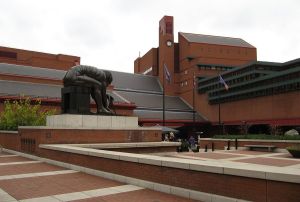
Bibliographic control of early printed and manuscript sources is key to historical research. In musicological discussions about British publications, it doesn’t take long before someone mentions Schnapper and BUCEM, although they’ve largely been superseded by RISM (the Répertoire Internationale des Sources Musicales). It was hardly surprising that RISM (UK) came up in conversation at the recent CFSH meeting that I attended at the British Library just before Christmas, because our whole network centres around firstly tracing eighteenth and early nineteenth century British legal deposit music in libraries, and secondly raising the profile of this corpus of material.
Let’s set this meeting in context by explaining who Edith Schnapper was; what she achieved with BUCEM; and how it fits in with RISM.
1957 – Schnapper
British Union-Catalogue of Early Music / Schnapper
Dr Edith Schnapper was a bibliographer who listed British published music prior to 1801, in a two-volume bibliography entitled British Union-Catalogue of Early Music printed before the year 1801: a record of the holdings of over one hundred libraries throughout the British Isles (London: Butterworth Scientific Publications, 1957). Behind this huge undertaking was the Council of the British Union-Catalogue of Music, chaired by C. B. Oldman, with representatives from the great and the good of music and music librarianship of the time – ASLIB, the Bibliographical Society, the Bodleian, Cambridge University Library, the British Council, the British Museum, the Royal Academy of Music and the Worshipful Company of Musicians, along with other private individuals. Editorship had commenced with O. E. Deutsch in 1946, succeeded by Schnapper in 1950.
1912, 1940 – Squire, Smith
Around 60% of the material listed in BUCEM came from the British Museum (now the British Library), and Schnapper was able to draw upon an earlier publication for this:- W. Barclay Squire’s, The Catalogue of Printed Music published between 1487 and 1800 and now in the British Museum (2 vols, 1912) and William C. Smith’s supplement of 1940. For the rest, Schnapper consulted over one hundred other libraries, in person and through correspondence. Although inclusivity was key, a significant category was not fully listed. Oldman, in the preface to BUCEM, noted that,
“The only substantial exception consists of sheet-songs of the 18th century, which were published in vast quantities, especially from 1730 onward. While a considerable proportion of them has been catalogued in their entirety, notably the important early songs in the Chetham Library at Manchester, there remain several extensive collections mostly of the later 18th century, which had to be left uncatalogued through lack of time.“
The collections alluded to were other legal deposit libraries (Oxford, Cambridge, and the National Libraries of Ireland and Scotland), and two significant public libraries (Glasgow’s Mitchell Library and Manchester’s Henry Watson Library). Even though the British Museum probably had the largest and most complete collection of music deposited under legal deposit, we have to face the fact that not all music was actually registered or deposited. The unregistered material is an unknown quantity, and copies could be scattered pretty much anywhere.
1952 onwards – RISM
RISM logo
Contemporaneously with BUCEM, and eventually supplanting it for early British printed music, emerged RISM, a huge international undertaking which began in print and more recently moved over to digital format. RISM has been produced in various series covering different categories of musical material, both published and manuscript, and including writings about music as well as the music itself. See the RISM website for full details (http://www.rism.info/ ). Under Publications, the website summarises,
“The RISM publications represent RISM’s activities that began in 1952 and continue to the present day. The online catalog is the focus of RISM’s current activities and is freely available online. Series A documents musical sources in two parts: printed music (A/I) and music manuscripts (A/II). Series B is designed to cover specific categories of repertory. Series A and B are supplemented by Series C, the Directory of Music Research Libraries. Special volumes have also been published on the Tenorlied and RISM library sigla (now available as an online database).”
Different countries have branches of RISM, and the UK branch is of course highly pertinent to our present research: http://rism.org.uk. Since 1984, this branch has been run by the RISM (UK) Trust. Again, the opening summary is helpful,
“This database holds details of pre-1850 music sources preserved in libraries and archives in the UK. It includes manuscripts from national, public and academic libraries, county and city record offices, cathedral and chapel libraries and some private collections. It also now includes more than 300 printed anthologies from the 16th century, with links to digitised copies of the music in the Early Music Online collection at Royal Holloway. We estimate that about two-thirds of surviving manuscript sources in the UK have now been documented. Work has recently begun to document music sources in Ireland. Some music collections in Dublin libraries, notably the Mercer’s Hospital Collection at Trinity College, Dublin, are included in the present database. A new database dedicated to sources across Ireland has recently been launched by the RISM Ireland working group.”
See also the UK RISM page, ‘About RISM’, published in 2011:-
“The UK’s contribution to RISM is overseen by the RISM (UK) Trust, which was also historically responsible for documenting music source material in Dublin. An Irish working group has been set up to oversee the collection of data in the Irish Republic and Northern Ireland, and a new list of repository sigla has been drawn up (please see RISM Ireland’s webpage at http://www.musicologyireland.com/rism/index.html).
“Between the 1950s and 1990s, cataloguers in the UK concentrated largely on documenting printed music, along with manuscripts dating from before 1600. The data was published in RISM Series A/I and B. Work is now ongoing on the cataloguing of music manuscripts from the period 1600 to 1850, a key period in music history and one for which much significant material is held in the UK. That data is being made available via this website, as Music Manuscripts after 1600 in British and Irish Libraries.”
RISM A/1 for the UK was based on BUCEM, as is clear from Hugh Cobbe, ‘RISM A/II: The United Kingdom Contribution’, Journal of the Royal Musical Association Vol. 113, No. 1 (1988), pp. 146-148) http://www.jstor.org/stable/pdf/766276.pdf :-
“In the United Kingdom the national contribution to A/I was swiftly completed, largely thanks to the earlier publication of the pioneering British Union Catalogue of Early Music (London, 1957); all that was required were addenda et corrigenda, and it proved possible for librarians to provide these in the normal course of their work.”
As a trust, RISM (UK) is dependent on external funding. Between 2001 and 2007, AHRC funding supported the cataloguing of UK music manuscripts; and in 2011, JISC’s Rapid Digitisation Programme supported the digitisation and documentation of over 300 early printed music anthologies at the British Library. However, with no current funding, the work of RISM (UK) is currently dormant.
2017 – Legal Deposit Music: Visits to the British Library and Lambeth Palace Library
Prior to organising a workshop for stakeholders (those who curate or work with the historical legal deposit music collections) and other interested librarians, musicologists and historians, I’ve been meeting with key individuals and groups to talk about the aims and projected outcomes of the network. My meetings at the British Library and Lambeth Palace Library a couple of weeks ago were part of this process. At both meetings, I explained that the network has a steering group, which hopes to run a workshop for key players and other interested parties in Spring 2018. I also outlined the outcomes that I had committed myself to in the AHRC funding application:-
Blog, newsletters, social media. Guest blogposts. These are all well up to speed.
Conference papers
Workshop leading to published papers of some kind.
Journal articles
Raising the profile of collections by social media and by public events
Performing the collections – small-scale local events? Local history groups? At a National Trust property or another stately home? Ideally, it would be good to have at least one public performance or other event, volunteered by a participant, participant’s library or other group.
Bibliography (currently being compiled)
Various threads emerged, different at each meeting. At the British Library, the potential of such a large corpus of music for big data analysis was a significant interest, but it led on to discussion of the whole issue of bibliographic control, and the fact that RISM (UK) currently has no funding to continue bibliographic documentation beyond the present cut-off circa 1800. However, the situation is more complicated than you might think.
For example – leaving RISM aside for a moment – the British Library and Glasgow University Library have all their legal deposit music catalogued. I have yet to explore the situation at the Bodleian and the University of Cambridge. The University of St Andrews availed itself of funding for retrospective cataloguing of post-1800 material at individual libraries at the beginning of the present century; this way, they were able to catalogue a large proportion of their post-1800 copyright music collection, but not the earlier copyright music. Some of the University of Aberdeen’s copyright music is catalogued online – this is a work in progress. The National Library of Scotland still depends on the paper slip Victorian music catalogue for much of its nineteenth century printed music. Meanwhile, the University of Edinburgh has been able to undertake basic-level cataloguing of rare music materials that were in the Reid Hall collection, using volunteer assistance – it can be found on a spreadsheet on the University’s Research Collections website. Some of this material may well have arrived via the legal deposit route, though we don’t yet know which. However, these examples in themselves highlight the fact that uncatalogued material, material still catalogued on paper, or indeed, just not accessible via union catalogues such as Copac or WorldCat, is now effectively invisible, in an age where so much is catalogued online, or even available digitally. So, there’s a big research question – what do we do with analogue materials? What approaches could be taken, to the cataloguing of, and digital access to, the Stationers’ Hall copyright collections or indeed on a wider basis? This could form the basis for a much larger funding application.
If RISM (UK) had further funding, then the copyright music repertoire could be considered as a starting point for reviving RISM (UK) documentation activity. As a potential launchpad for a much bigger enterprise, the CFSH network acquires much greater significance!
We also talked about the “gap” between RISM with its detailed documentation, and IMSLP, with less detailed metadata but invaluable digital repertoire. How could we bridge the gap? (Could the early legal deposit music be digitised? There is a vast amount of it!)
This was by no means all that we talked about – another interesting strand was our discussion of a mass of music imported to Australia from the likes of Manchester and Liverpool in the late nineteenth century, and more recently acquired and repatriated by the British Library. The story of this separate corpus of material sounds fascinating!
Meeting at Lambeth Palace Library
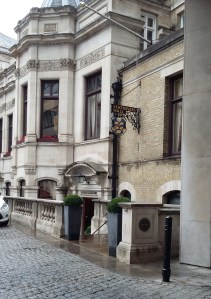
Mention of Lambeth Palace inevitably conjures up pictures of the Thames and views of the Houses of Parliament; of archbishops and Anglican clergy; not to mention walled gardens, and impressive interiors literally oozing history. But of most importance to the present project is the fact that in 1996, the Palace Library took over the custodianship of Sion College Library’s pre-1850 materials, including some music.
Sion College was one of the legal deposit libraries throughout the eighteenth century until 1836, having been founded in the early seventeenth century:
“The Reverend Thomas White (c.1550 – 1624), Vicar of St Dunstan-in-the-West, Fleet Street, left £3000 in his will “for the acquisition of a house for the making of a College of Ministers, Rectors (Readers) and Curates within the City of London and the suburbs of the same.”
The most historical and valuable material from Sion College (just a handful of music falls into this category) is kept as a separate special collection, but there could be further material as yet uncatalogued apart from this.
Before the acquisition of this material by Lambeth Palace Library, its retention was sometimes threatened by financial exigencies, because books were occasionally sold to raise funds for the college coffers! This means that not all of the legal deposit books and music Sion College might have had, was still in their possession at the time when the surviving stock was transferred to Lambeth Palace.
Rather to my surprise, I learned that Sion College Library had provided its clerical readers with wide-ranging reading matter, and was by no means confined to sermons, lectionaries and theological treatises. So … did they keep secular as well as sacred music, for the enjoyment of the clergy? The four surviving early music rarities indicate that they did!
I was able to inspect the Sion Benefactors’ Book – a very old volume indeed, commenced in 1633 and maintained through the centuries, itemising books gifted to the library. This does include Stationers’ Hall material, but in the 18th century, it basically lists gifts and copyright material up to circa 1789; after that, “See” lists provide references to later gifts documented elsewhere.
I also learned that Lambeth Palace Library occasionally holds concerts and visits for various groups – including current members of Sion College, which now functions mainly as a sociable society for the clergy. And of course, the Palace is a near neighbour of the modern-day Vauxhall Gardens project. (I walked past it, in pouring rain – it’s very difficult indeed to visualise the eighteenth century gardens vibrant with theatrical, musical and sociable activity, such David Coke and Alan Borg describe in Vauxhall Gardens: a History.) In other words, there could be distinct audiences out there, if sufficient music could be pulled together into a programme or illustrated talk.
The big question first, though, is what can be identified apart from the four ‘special’ music books that were stored with the most valuable materials. Even if Lambeth Palace turned out not to hold very much historical copyright music, the library is still a stakeholder, insofar as it holds the rare books that once belonged to one of the copyright libraries. And so, too, in an indirect sense, are the members of Sion College itself. Wouldn’t it be exciting if a live music event could be coordinated? We’ll have to wait and see!


 Dear friends and fellow network members,
 Colleague Dr Brianna Robertson-Kirkland, lecturer at the Royal Conservatoire of Scotland and researcher on various eighteenth and early nineteenth-century humanities projects, is also a member of the Claimed From Stationers’ Hall network. She has recently reviewed the Library of Congress digital music website, Early American Sheet Music, and you can read her review online in the Royal Musical Association research Chronicle (2018):-
 useful lists of historical names! If your list has both “ancient and modern”, I’ll still be happy to include the link. However, to keep it relevant, let’s not add lists of women composers from the 20th century onwards. The Claimed from Stationers’ Hall network is about predominantly Georgian music, published in Britain and legally deposited in British libraries – that’s the network’s remit, and that’s what the research funding is enabling!
 Well, what else would you do if you were snowbound for a third day?! The bibliography has been updated considerably. This is not to say that I’ve read every single reference, which would be difficult in my part-time research existence, but hopefully there will be plenty of inspiration for anyone embarking on any aspect of the research network’s interests.
 NB. As well as posting this as a regular blogpost, it has also been replicated as a separate page, so that it’s easier to find later on using the tabs along the top of the blog.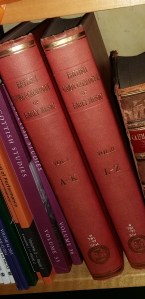
 Around 60% of the material listed in BUCEM came from the British Museum (now the British Library), and Schnapper was able to draw upon an earlier publication for this:- W. Barclay Squire’s, The Catalogue of Printed Music published between 1487 and 1800 and now in the British Museum (2 vols, 1912) and William C. Smith’s supplement of 1940. For the rest, Schnapper consulted over one hundred other libraries, in person and through correspondence. Although inclusivity was key, a significant category was not fully listed. Oldman, in the preface to BUCEM, noted that,
 and Lambeth Palace Library
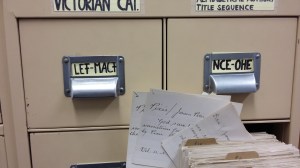 The National Library of Scotland still depends on the paper slip Victorian music catalogue for much of its nineteenth century printed music. Meanwhile, the University of Edinburgh has been able to undertake basic-level cataloguing of rare music materials that were in the Reid Hall collection, using volunteer assistance – it can be found on a spreadsheet on the University’s Research Collections website. Some of this material may well have arrived via the legal deposit route, though we don’t yet know which. However, these examples in themselves highlight the fact that uncatalogued material, material still catalogued on paper, or indeed, just not accessible via union catalogues such as Copac or WorldCat, is now effectively invisible, in an age where so much is catalogued online, or even available digitally. So, there’s a big research question – what do we do with analogue materials? What approaches could be taken, to the cataloguing of, and digital access to, the Stationers’ Hall copyright collections or indeed on a wider basis? This could form the basis for a much larger funding application.
 Mention of Lambeth Palace inevitably conjures up pictures of the Thames and views of the Houses of Parliament; of archbishops and Anglican clergy; not to mention walled gardens, and impressive interiors literally oozing history. But of most importance to the present project is the fact that in 1996, the Palace Library took over the custodianship of
  king of a College of Ministers, Rectors (Readers) and Curates within the City of London and the suburbs of the same.”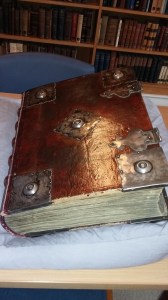
 Karen McAulay, Musicologist