Dr Karen McAulay explores the history of Scottish music collecting, publishing and national identity from the 18th to 20th centuries. Research Fellow at Royal Conservatoire of Scotland, author of two Routledge monographs.
I’m a Librarian and a Postdoctoral Researcher. (My secret skill is, basically, finding things!) I’ve just finished writing my second book – and I guess I’m lucky. I wasn’t dependent on the British Library. It’s too far away for me to visit more than infrequently.
I keep coming across social media comments that “the British Library is doing nothing.” That they’re not taking the situation seriously. That “nobody knows what’s happening.” I don’t work at the British Library, but I do feel heartily sorry for anyone working there. They’ve been victims of a serious cyber crime, for heaven’s sake, and I’m sure that they’ve been taking the best advice about cyber security in light of the attack. It’s the kind of thing where they won’t want to divulge too much of what has been done, for fear of copycat crimes, but at the same time, we the public (especially scholars and academics) all know the end result. We can’t use their catalogue or their e-resources. Visitors have to wait whilst librarians look things up in paper and card catalogues, and with the best will in the world, the service isn’t quite what we’re used to. It’s devastating.
It’s not that the British Library hasn’t tried to keep us up to date:-
Rachel Cooke’s letter to the Observer, link retweeted by the Guardian
Chief Executive Sir Roly Keating has since released an update (11 January 2024) on Restoring our Services
Additionally, a recent Computer Weekly feature provides some of the technical information that many people have been waiting for: British Library cyber attack explained: What you need to know (By Alex Scroxton, Computer Weekly Security Editor, 9 January 2024)
I think what worries me is that people may not know about other ways of finding information. Certainly, if the British Library is the only holder of a particular document, then you’re up the creek without access to that document. If the only way you can access a database, or a digitised copy of a rare document, is via the British Library, then similarly, you really are in a bind at the moment. I know. As a researcher myself, I know.
We’re Here to Help
But are researchers and students asking their own institutional librarians? And conversely, are library organisations saying, often enough (on social media and elsewhere), that librarians are happy to help wherever they can? OK, ‘often enough’ is as long as a piece of string, but say, several times a week? Are we the librarians telling our own patrons in our own libraries?
And if you’re stuck looking for information, are you aware where else you can look?
Options and Alternatives
If you’re at an academic institution in the UK, there is SCONUL Access. That gets you into other libraries as well as your own.
Anyone can look at Jisc Library Hub Discover to find out whether there are copies of books elsewhere in the country. You can find books in the British Library, sure, but also in dozens of other academic libraries, and other big libraries. Yes, databases and other online resources like journals etc, are generally restricted by licence to people AT a particular institution, but you can still sign up to SCONUL Access and go to look at books and other hard copy material in other universities etc.
Have you tried your big city public library?
Are you aware that inter-library loans can be obtained from nearly all libraries except the ones that have a legal deposit responsibility? They don’t just come from the British Library. Your university or college library can organise this. Public libraries do inter library loans too.
Have you looked on Internet Archive or Hathi Trust for digitised copies of older material? Even Google Books?
Ask a Librarian!
Have you consulted your own specialist librarian to see if they can think of other ways you can get to see that crucial book or article?
Have you looked at ResearchGate and reached out to scholars directly, if there’s a particular article that even your librarian hasn’t been able to source?
Now, I’m just one small academic librarian/postdoctoral researcher in one small academic institution. I can’t help everybody! But please, please, do reach out to your librarians. We can’t replace the invaluable, much-loved and extraordinarily well-resourced British Library, but we can certainly help you make sure that you haven’t left other stones unturned, that might be able to provide at least some of what you need?
It’s about a year since I visited Lambeth Palace and the British Library, making a minor detour via St Paul’s and Stationers’ Hall (virtually in the shadow of St Paul’s) on the off-chance of making an impromptu visit to the Hall. I wasn’t surprised to be disappointed on that occasion; I hadn’t expected to have time to drop by, which is why I hadn’t made an appointment.
Today, I had booked an appointment in advance, and had the pleasure of poring over one of Mr Greenhill’s registers – I’d chosen the one that began at the end of June 1817, and I just had time to look at the records for one year. For all the complaints about Mr Greenhill and his inefficiency or inability to collect all the legal deposit copies for the receiving libraries, I now have one thoroughly good thing to say about him: his handwriting is beautifully legible! Everything nicely spaced out, not sprawling or squidged into the end of a line or bottom of a page. Indeed, there were some days when he must have done little else than sit or stand and carefully inscribe book details into his ledgers – there were so many detailed entries, even two hundred years ago!
If you’ve used Kassler’s index of Stationers’ Hall music, you’ll know that the last few years are less detailed, because they came from a different source – William Hawes’ abbreviated copy from the registers for 1811-1818. This is why I wanted to see a register from this era, because I guessed there would be more to see. There was!
I was also curious to know how long it might take to transcribe the music entries from 1819-1836. I didn’t try timing myself, though, because I got interested in other aspects of the registration process. It’s lucky I had taken my own copy of Kassler with me – the pages for late June 1817-1818 are now carefully annotated in pencil, and I have work to do when I get back to Glasgow. I’ve had an idea! More of this very soon. I might have found the data-slice that the network has been looking for – it fits in rather nicely with some other threads I’ve been pursuing.
This afternoon, I also paid a visit to my opposite number in the British Library to mull over possible future directions for the Claimed From Stationers’ Hall research network. Whilst “Big Data” is appealing, there are also other ideas worth considering – which might indeed help acquire the big data that we need. We’ll see!
Tomorrow, I’m spending the day at the EFDSS (English Folk Dance and Song Society) conference, and giving a paper about national airs in Georgian British Libraries. It gives me a great deal of pleasure to have the opportunity to combine my doctoral interests in national song collecting, with my postdoctoral interest in repertoires and library collections on a national scale. Here’s my Powerpoint: National Airs in Georgian British Libraries. (You’ll also find it listed on the Calendar page of this website.)
No archival pictures today, I’m afraid. I was far too busy annotating my copy of Kassler’s Hawes appendix! But, since a posting is dull without a picture, I’ve shared a familiar outline – and the image from the conference website – with you …. !
This week I’ve been focusing on my paper for the EFDSS conference, Traditional Folk Song: Past, Present & Future, on Saturday 10 November, 9:30am – 5:00pm at Cecil Sharp House, London. I’ll be talking about ‘National Airs in Georgian British Libraries’, and particularly focusing on the collections in St Andrews and Edinburgh. I’ll also be alluding to that old nineteenth century irritation – the allegation that England had no national music!
As it happened, I needed to take a day’s annual leave for a non-work related reason yesterday, but I hoped that for most of the day I would be free to concentrate on my presentation. Well, it didn’t work out quite that way, but I did start writing in the evening. Today, I spent the first couple of hours teaching library research skills, then it was back to the laptop in the research room for the rest of the day.
By the end of the working day, I had written just over 4,000 words and felt I deserved a treat: I left my papers on the desk and came home to spend the evening sewing! (Better still, another little indulgence had arrived in the post for me: a silver sixpence dating from 1821, the year of George IV’s coronation, and with a hole pierced in it by a previous owner so that it could be worn on a ribbon. As of course I already am!)
The conference will actually be the culmination of a particularly busy week for me: I’ll be visiting the two Irish Georgian legal deposit libraries in Dublin earlier in the week, and Stationers’ Hall and the British Library on the day before the conference. One of my choir-members looked somewhat surprised when I remarked that I’d be fitting in choir practice between Dublin and the overnight sleeper between Glasgow and London!
I’m particularly looking forward to this conference because it will be a completely different audience to those at the conferences I’ve already been to this year. I’m intending to give a fairly wide-ranging paper. If I unearth any surprises in Dublin, then there will be last-minute tweaking to add them into the mix!
NB If you liked this, you might like a post I wrote on a related topic, earlier this year – essentially a continuation of the story after the period that I’ll be describing in my latest conference paper:- England has no National Music? Chappell Set Out to Refute This
In our research into the legal deposit music collected in British libraries during the Georgian era, a key thread is obviously the histories of individual collections between then, and now. Two hundred years is a long time, so contemporary evidence is significant.
For example, in 1826, the pseudonymous Caleb Concord wrote in the (short-lived) Aberdeen Censor that the students at Aberdeen’s Marischal College should be more concerned about what had happened to the legal deposit music that had been claimed by Aberdeen’s other higher education institution, King’s College. Corroborating this, Professor William Paul, who had once been librarian at King’s College, told an official commission in 1827, that he believed some of the music had been sold at some time before he went to the college, ie, before 1811. (Commissioners for Visiting the Universities and Colleges of Scotland, Evidence, Oral and Documentary, Taken and Received by the Commissioners … for Visiting the Universities of Scotland. Vol.4, Aberdeen (London: HMSO, 1837). There is evidence for Stationers’ Hall music having been sold at Edinburgh University in the late eighteenth century, too.
In St Andrews, by contrast, there are not only archival records documenting senate decisions about the library, but also the borrowing records, which I’ve written and blogged about quite a bit over the past couple of years – not to mention the handwritten catalogue by a niece of a deceased professor of the University. A payment was made to her in the 1820s, but the catalogue continued to be updated until legal deposits ceased to be claimed by the University in 1836, when the legislation changed. (Miss Lambert married and moved to London in 1832, so the later years were not completed by her.)
Bibliographic Control
In the middle few decades of the nineteenth century, some of the libraries began to attempt better control and documentation of their music. However, I don’t propose to write about every legal deposit library in this posting, because my main reason in writing today is to share a small but interesting excerpt from William Chappell’s first book about English national songs. Now, in my own doctoral thesis and subsequent book, I focused on Chappell’s later work, Popular Music of the Olden Time (1855-1859), and its later iteration, Old English Popular Music. I mentioned that PMOT had grown out of his earlier Collection of National Airs (1838-1840), and I highlighted a few key features of that work.
A Rare Find
Today, sifting through a library donation of largely 20th century scores, I was astonished to lift two obviously older volumes out of one of the boxes. We’re now the proud owners of the third set of Collection of National Airs known to be held in Scotland. Since I haven’t looked at this title for a decade or so, I leafed through both volumes briefly, to remind myself what they were like. (The volumes had belonged to a Mrs Chambers, and either she or a young relative had practised their drawing skills on the flyleaves, but we’ll overlook those for now!)
Chappell’s work is in two volumes: the first contains the subscriber’s list and a preface, with the rest of the volume devoted to the tunes themselves. The second volume contains commentary, winding up with a conclusion and then an appendix.
England has no National Music
The preface opens with the words which have echoed (metaphorically speaking) in my ears since I first read them:-
“The object of the present work is to give practical refutation to the popular fallacy that England has no National Music,- a fallacy arising solely from indolence in collecting; for we trust that the present work will show that there is no deficiency in material, whatever there may have been in the prospect of encouragement to such Collections.”
Of course, Chappell was preoccupied with national songs (“folk songs”) and ballads – as was I, at the time I first read it. So I hadn’t paid attention to a footnote later in the Preface. But, as I read on, there it was – William Chappell commenting on the legal deposit music in what is now the British Library! It is clear that the music – in Chappell’s eyes, at any rate – was in need of organisation. (We now know that it was much the same in Oxford, Edinburgh or Edinburgh’s Advocates’ Library – the forerunner of the National Library of Scotland.)
On page iv, Chappell named various key collections of British tunes, naming the British Museum (the forerunner of our British Library) as the repository for some of these collections. A footnote afforded him the chance to make an aside about the contemporary custodial arrangements there.
Attentive, Obliging … Inaccessible, Not Catalogued
“†It is to be hoped that the attention of the Trustees may be soon drawn to the state of the invaluable Library of Music in the British Museum; for whilst the publisher is taxed a copy of every work, it is but just that it should be open to inspection. At present, with the exception of a few works on Theory, which, being almost entirely letterpress, are included with the books, the Music is perfectly inaccessible, – not being catalogued or classed in any manner. No persons can be more attentive or obliging than the attendants in the Reading-room, but in this they are unable to render any assistance. It is not generally known that the manuscripts of the great Henry Purcell and many others are also in the Museum; but they are in the same state as the music, and are not to be seen.”
Changing the subject, it’s interesting for us as modern readers to note that Chappell’s conclusion at the end of the second volume winds up with a sorrowful observation about the decline in musical education, since an unspecified time when music was a key part not only of a young gentleman’s education, but also of young children’s.
Merry England
“The Editor trusts, however, that he has already satisfactorily demonstrated the proposition which he at first stated, viz. that England has not only abundance of National Music, but that its antiquity is at least as well authenticated as that of any other nation. England was formerly called “Merry England.”
Music taught in all public schools
“That was when every Gentleman could sing at sight;- when musical degrees were taken at the Universities, to add lustre to degrees in arts;- when College Fellowships were only given to those who could sing;- when Winchester boys were not suffered to evade the testator’s will, as they do now, but were obliged to learn to sing before they could enter the school;- when music was taught in all public schools, and thought as necessary a branch of the education of “small children” as reading or writing;- when barbers, cobblers and ploughmen, were proverbially musical;- and when “Smithfield with her ballads made all England roar.” Willingly would we exchange her present venerable title of “Old England,”, to find her “Merry England” once again.”
Chappell should read the commentary in today’s social media about the self-same topic!
Whilst I was postdoctoral research assistant to the AHRC-funded Bass Culture project, I authored a blogpost about how/where to locate all the fiddle tune-books we were researching. I revisited that 2015 posting today, because the same resources are pertinent to the Claimed From Stationers’ Hall (CFSH) historical legal deposit music research network.
Bibliographic control of early printed and manuscript sources is key to historical research. In musicological discussions about British publications, it doesn’t take long before someone mentions Schnapper and BUCEM, although they’ve largely been superseded by RISM (the Répertoire Internationale des Sources Musicales). It was hardly surprising that RISM (UK) came up in conversation at the recent CFSH meeting that I attended at the British Library just before Christmas, because our whole network centres around firstly tracing eighteenth and early nineteenth century British legal deposit music in libraries, and secondly raising the profile of this corpus of material.
Let’s set this meeting in context by explaining who Edith Schnapper was; what she achieved with BUCEM; and how it fits in with RISM.
1957 – Schnapper
British Union-Catalogue of Early Music / Schnapper
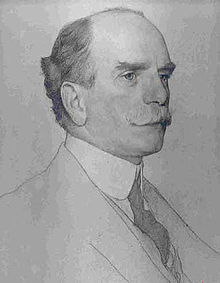
Dr Edith Schnapper was a bibliographer who listed British published music prior to 1801, in a two-volume bibliography entitled British Union-Catalogue of Early Music printed before the year 1801: a record of the holdings of over one hundred libraries throughout the British Isles (London: Butterworth Scientific Publications, 1957). Behind this huge undertaking was the Council of the British Union-Catalogue of Music, chaired by C. B. Oldman, with representatives from the great and the good of music and music librarianship of the time – ASLIB, the Bibliographical Society, the Bodleian, Cambridge University Library, the British Council, the British Museum, the Royal Academy of Music and the Worshipful Company of Musicians, along with other private individuals. Editorship had commenced with O. E. Deutsch in 1946, succeeded by Schnapper in 1950.
1912, 1940 – Squire, Smith
Around 60% of the material listed in BUCEM came from the British Museum (now the British Library), and Schnapper was able to draw upon an earlier publication for this:- W. Barclay Squire’s, The Catalogue of Printed Music published between 1487 and 1800 and now in the British Museum (2 vols, 1912) and William C. Smith’s supplement of 1940. For the rest, Schnapper consulted over one hundred other libraries, in person and through correspondence. Although inclusivity was key, a significant category was not fully listed. Oldman, in the preface to BUCEM, noted that,
“The only substantial exception consists of sheet-songs of the 18th century, which were published in vast quantities, especially from 1730 onward. While a considerable proportion of them has been catalogued in their entirety, notably the important early songs in the Chetham Library at Manchester, there remain several extensive collections mostly of the later 18th century, which had to be left uncatalogued through lack of time.“
The collections alluded to were other legal deposit libraries (Oxford, Cambridge, and the National Libraries of Ireland and Scotland), and two significant public libraries (Glasgow’s Mitchell Library and Manchester’s Henry Watson Library). Even though the British Museum probably had the largest and most complete collection of music deposited under legal deposit, we have to face the fact that not all music was actually registered or deposited. The unregistered material is an unknown quantity, and copies could be scattered pretty much anywhere.
1952 onwards – RISM
RISM logo
Contemporaneously with BUCEM, and eventually supplanting it for early British printed music, emerged RISM, a huge international undertaking which began in print and more recently moved over to digital format. RISM has been produced in various series covering different categories of musical material, both published and manuscript, and including writings about music as well as the music itself. See the RISM website for full details (http://www.rism.info/ ). Under Publications, the website summarises,
“The RISM publications represent RISM’s activities that began in 1952 and continue to the present day. The online catalog is the focus of RISM’s current activities and is freely available online. Series A documents musical sources in two parts: printed music (A/I) and music manuscripts (A/II). Series B is designed to cover specific categories of repertory. Series A and B are supplemented by Series C, the Directory of Music Research Libraries. Special volumes have also been published on the Tenorlied and RISM library sigla (now available as an online database).”
Different countries have branches of RISM, and the UK branch is of course highly pertinent to our present research: http://rism.org.uk. Since 1984, this branch has been run by the RISM (UK) Trust. Again, the opening summary is helpful,
“This database holds details of pre-1850 music sources preserved in libraries and archives in the UK. It includes manuscripts from national, public and academic libraries, county and city record offices, cathedral and chapel libraries and some private collections. It also now includes more than 300 printed anthologies from the 16th century, with links to digitised copies of the music in the Early Music Online collection at Royal Holloway. We estimate that about two-thirds of surviving manuscript sources in the UK have now been documented. Work has recently begun to document music sources in Ireland. Some music collections in Dublin libraries, notably the Mercer’s Hospital Collection at Trinity College, Dublin, are included in the present database. A new database dedicated to sources across Ireland has recently been launched by the RISM Ireland working group.”
See also the UK RISM page, ‘About RISM’, published in 2011:-
“The UK’s contribution to RISM is overseen by the RISM (UK) Trust, which was also historically responsible for documenting music source material in Dublin. An Irish working group has been set up to oversee the collection of data in the Irish Republic and Northern Ireland, and a new list of repository sigla has been drawn up (please see RISM Ireland’s webpage at http://www.musicologyireland.com/rism/index.html).
“Between the 1950s and 1990s, cataloguers in the UK concentrated largely on documenting printed music, along with manuscripts dating from before 1600. The data was published in RISM Series A/I and B. Work is now ongoing on the cataloguing of music manuscripts from the period 1600 to 1850, a key period in music history and one for which much significant material is held in the UK. That data is being made available via this website, as Music Manuscripts after 1600 in British and Irish Libraries.”
RISM A/1 for the UK was based on BUCEM, as is clear from Hugh Cobbe, ‘RISM A/II: The United Kingdom Contribution’, Journal of the Royal Musical Association Vol. 113, No. 1 (1988), pp. 146-148) http://www.jstor.org/stable/pdf/766276.pdf :-
“In the United Kingdom the national contribution to A/I was swiftly completed, largely thanks to the earlier publication of the pioneering British Union Catalogue of Early Music (London, 1957); all that was required were addenda et corrigenda, and it proved possible for librarians to provide these in the normal course of their work.”
As a trust, RISM (UK) is dependent on external funding. Between 2001 and 2007, AHRC funding supported the cataloguing of UK music manuscripts; and in 2011, JISC’s Rapid Digitisation Programme supported the digitisation and documentation of over 300 early printed music anthologies at the British Library. However, with no current funding, the work of RISM (UK) is currently dormant.
2017 – Legal Deposit Music: Visits to the British Library and Lambeth Palace Library
Prior to organising a workshop for stakeholders (those who curate or work with the historical legal deposit music collections) and other interested librarians, musicologists and historians, I’ve been meeting with key individuals and groups to talk about the aims and projected outcomes of the network. My meetings at the British Library and Lambeth Palace Library a couple of weeks ago were part of this process. At both meetings, I explained that the network has a steering group, which hopes to run a workshop for key players and other interested parties in Spring 2018. I also outlined the outcomes that I had committed myself to in the AHRC funding application:-
Blog, newsletters, social media. Guest blogposts. These are all well up to speed.
Conference papers
Workshop leading to published papers of some kind.
Journal articles
Raising the profile of collections by social media and by public events
Performing the collections – small-scale local events? Local history groups? At a National Trust property or another stately home? Ideally, it would be good to have at least one public performance or other event, volunteered by a participant, participant’s library or other group.
Bibliography (currently being compiled)
Various threads emerged, different at each meeting. At the British Library, the potential of such a large corpus of music for big data analysis was a significant interest, but it led on to discussion of the whole issue of bibliographic control, and the fact that RISM (UK) currently has no funding to continue bibliographic documentation beyond the present cut-off circa 1800. However, the situation is more complicated than you might think.
For example – leaving RISM aside for a moment – the British Library and Glasgow University Library have all their legal deposit music catalogued. I have yet to explore the situation at the Bodleian and the University of Cambridge. The University of St Andrews availed itself of funding for retrospective cataloguing of post-1800 material at individual libraries at the beginning of the present century; this way, they were able to catalogue a large proportion of their post-1800 copyright music collection, but not the earlier copyright music. Some of the University of Aberdeen’s copyright music is catalogued online – this is a work in progress. The National Library of Scotland still depends on the paper slip Victorian music catalogue for much of its nineteenth century printed music. Meanwhile, the University of Edinburgh has been able to undertake basic-level cataloguing of rare music materials that were in the Reid Hall collection, using volunteer assistance – it can be found on a spreadsheet on the University’s Research Collections website. Some of this material may well have arrived via the legal deposit route, though we don’t yet know which. However, these examples in themselves highlight the fact that uncatalogued material, material still catalogued on paper, or indeed, just not accessible via union catalogues such as Copac or WorldCat, is now effectively invisible, in an age where so much is catalogued online, or even available digitally. So, there’s a big research question – what do we do with analogue materials? What approaches could be taken, to the cataloguing of, and digital access to, the Stationers’ Hall copyright collections or indeed on a wider basis? This could form the basis for a much larger funding application.
If RISM (UK) had further funding, then the copyright music repertoire could be considered as a starting point for reviving RISM (UK) documentation activity. As a potential launchpad for a much bigger enterprise, the CFSH network acquires much greater significance!
We also talked about the “gap” between RISM with its detailed documentation, and IMSLP, with less detailed metadata but invaluable digital repertoire. How could we bridge the gap? (Could the early legal deposit music be digitised? There is a vast amount of it!)
This was by no means all that we talked about – another interesting strand was our discussion of a mass of music imported to Australia from the likes of Manchester and Liverpool in the late nineteenth century, and more recently acquired and repatriated by the British Library. The story of this separate corpus of material sounds fascinating!
Meeting at Lambeth Palace Library
Mention of Lambeth Palace inevitably conjures up pictures of the Thames and views of the Houses of Parliament; of archbishops and Anglican clergy; not to mention walled gardens, and impressive interiors literally oozing history. But of most importance to the present project is the fact that in 1996, the Palace Library took over the custodianship of Sion College Library’s pre-1850 materials, including some music.
Sion College was one of the legal deposit libraries throughout the eighteenth century until 1836, having been founded in the early seventeenth century:
“The Reverend Thomas White (c.1550 – 1624), Vicar of St Dunstan-in-the-West, Fleet Street, left £3000 in his will “for the acquisition of a house for the making of a College of Ministers, Rectors (Readers) and Curates within the City of London and the suburbs of the same.”
The most historical and valuable material from Sion College (just a handful of music falls into this category) is kept as a separate special collection, but there could be further material as yet uncatalogued apart from this.
Before the acquisition of this material by Lambeth Palace Library, its retention was sometimes threatened by financial exigencies, because books were occasionally sold to raise funds for the college coffers! This means that not all of the legal deposit books and music Sion College might have had, was still in their possession at the time when the surviving stock was transferred to Lambeth Palace.
Rather to my surprise, I learned that Sion College Library had provided its clerical readers with wide-ranging reading matter, and was by no means confined to sermons, lectionaries and theological treatises. So … did they keep secular as well as sacred music, for the enjoyment of the clergy? The four surviving early music rarities indicate that they did!
I was able to inspect the Sion Benefactors’ Book – a very old volume indeed, commenced in 1633 and maintained through the centuries, itemising books gifted to the library. This does include Stationers’ Hall material, but in the 18th century, it basically lists gifts and copyright material up to circa 1789; after that, “See” lists provide references to later gifts documented elsewhere.
I also learned that Lambeth Palace Library occasionally holds concerts and visits for various groups – including current members of Sion College, which now functions mainly as a sociable society for the clergy. And of course, the Palace is a near neighbour of the modern-day Vauxhall Gardens project. (I walked past it, in pouring rain – it’s very difficult indeed to visualise the eighteenth century gardens vibrant with theatrical, musical and sociable activity, such David Coke and Alan Borg describe in Vauxhall Gardens: a History.) In other words, there could be distinct audiences out there, if sufficient music could be pulled together into a programme or illustrated talk.
The big question first, though, is what can be identified apart from the four ‘special’ music books that were stored with the most valuable materials. Even if Lambeth Palace turned out not to hold very much historical copyright music, the library is still a stakeholder, insofar as it holds the rare books that once belonged to one of the copyright libraries. And so, too, in an indirect sense, are the members of Sion College itself. Wouldn’t it be exciting if a live music event could be coordinated? We’ll have to wait and see!
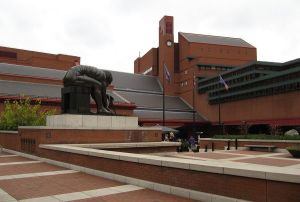
Last week, I attended two very fruitful meetings at the British Library and Lambeth Palace Library – the modern incarnations of two libraries receiving the old copyright music. The British Library was previously The British Museum Library, and Lambeth Palace Library inherited Sion College’s library. I’ve yet to finish writing up my notes from the second of these meetings, but there will eventually be a blogpost about what we discussed. Most crucially, we discussed possible dates for a workshop in Spring 2018, and I’ve since set the ball rolling back here in Glasgow, so watch this space!
Whilst in London, I made a quick pilgrimage to Stationers’ Hall, but since this was an unscheduled detour, I didn’t make myself known there. Definitely somewhere for my itinerary next time I’m down, because Stationers’ Hall recently brought their archives back in house. This is certainly something worth investigating!
I’ve experimented with different ways of interpreting research in an effort to reach out to different audiences. I’ve sewn an abstract and I’ve made podcasts and even a videocast. On the train home, I attempted a poem. (Well, an 8787 verse, at any rate!) If you’d like to see it, please visit our Facebook site, which seemed a more appropriate place for my amateur scribblings!




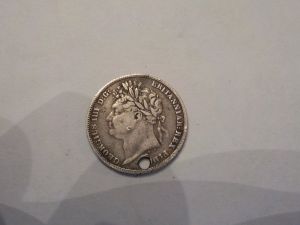 from 1821, the year of George IV’s coronation, and with a hole pierced in it by a previous owner so that it could be worn on a ribbon. As of course I already am!)
 Today, sifting through a library donation of largely 20th century scores, I was astonished
 to lift two obviously older volumes out of one of the boxes. We’re now the proud owners of the third set of Collection of National Airs known to be held in Scotland. Since I haven’t looked at this title for a decade or so, I leafed through both volumes briefly, to remind myself what they were like. (The volumes had belonged to a Mrs Chambers, and either she or a young relative had practised their drawing skills on the flyleaves, but we’ll overlook those for now!)
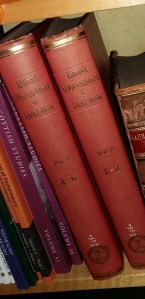
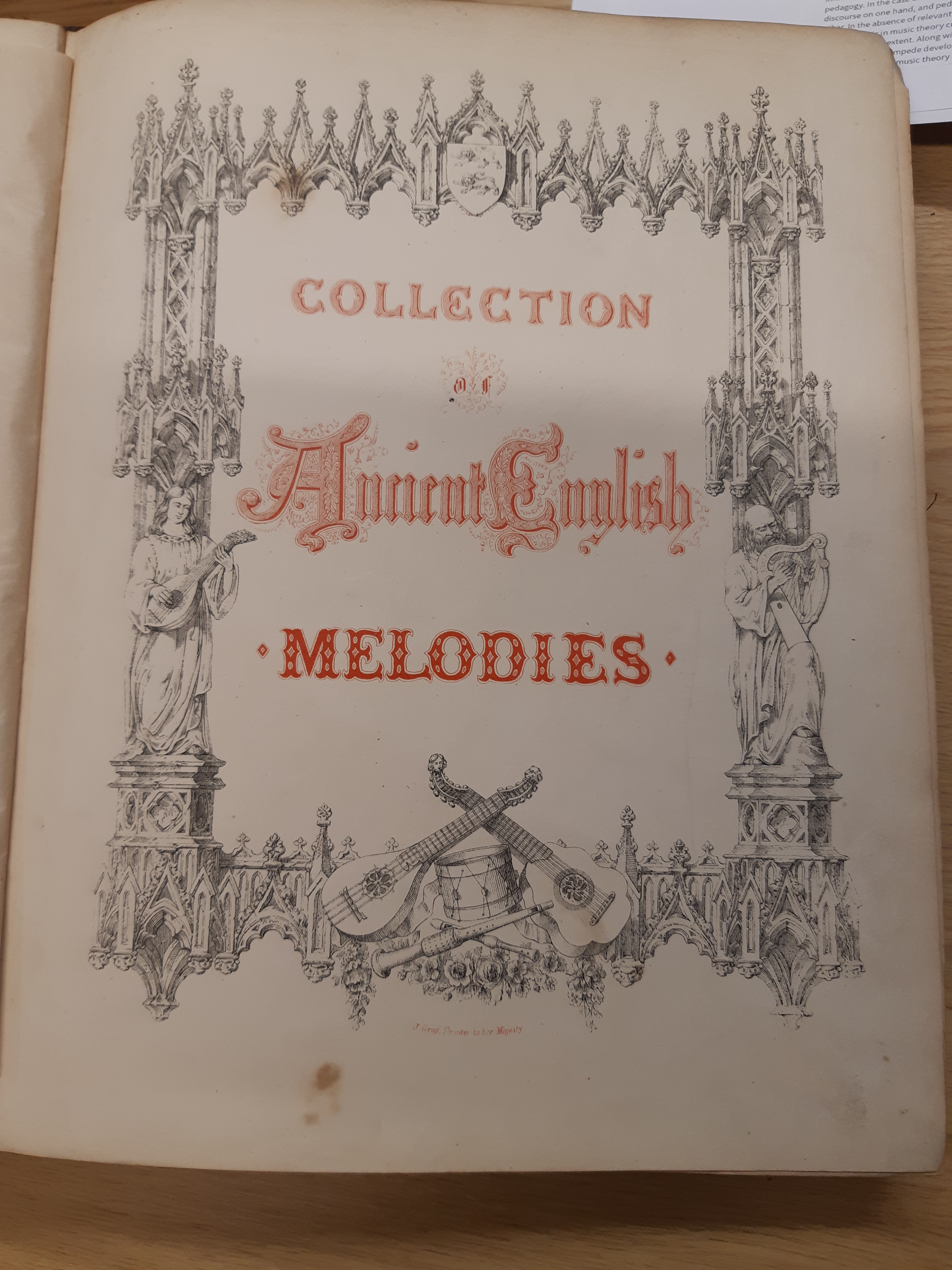 Chappell’s work is in two volumes: the first contains the subscriber’s list and a preface, with the rest of the volume devoted to the tunes themselves. The second volume contains commentary, winding up with a conclusion and then an appendix.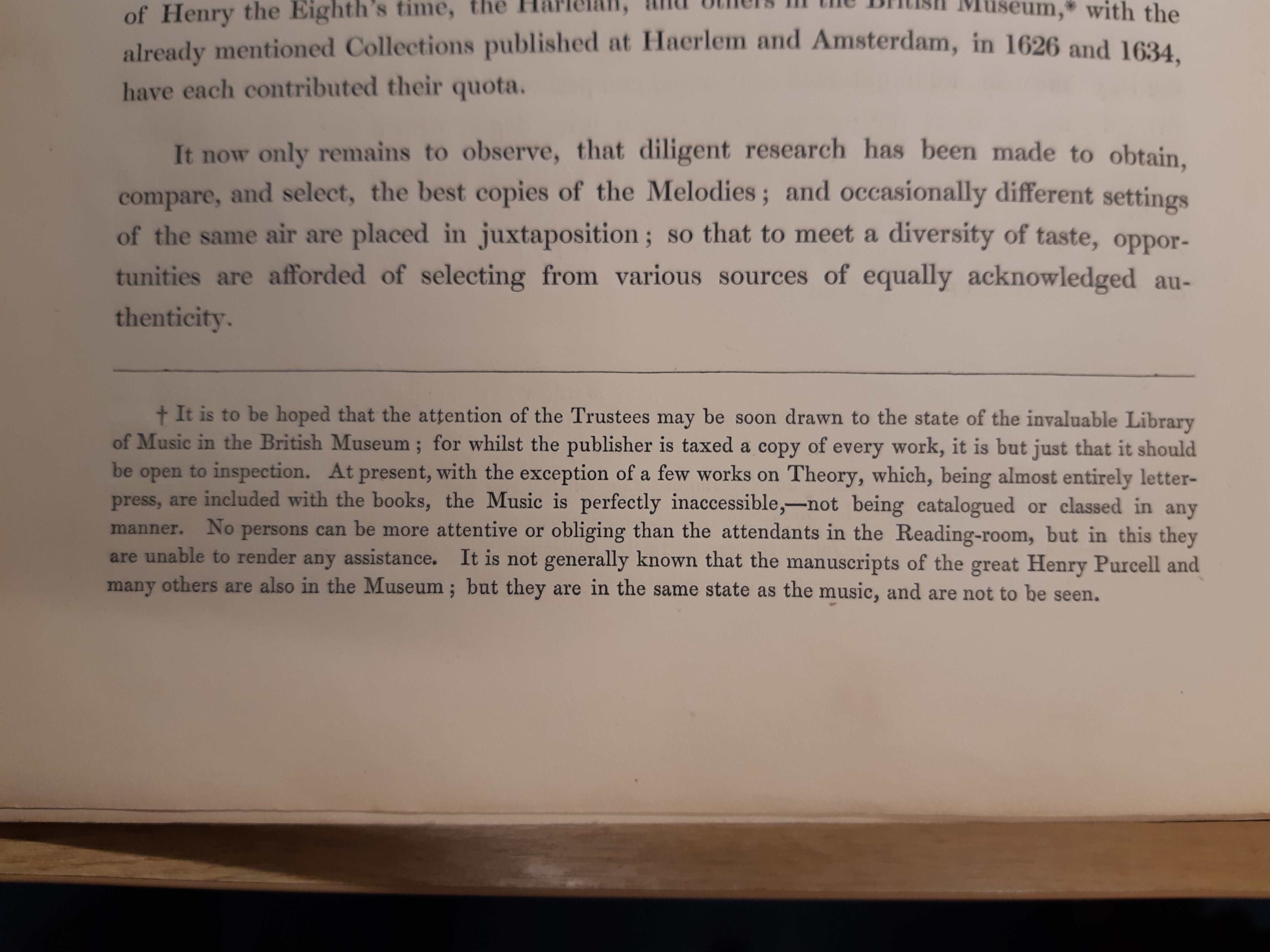
 Around 60% of the material listed in BUCEM came from the British Museum (now the British Library), and Schnapper was able to draw upon an earlier publication for this:- W. Barclay Squire’s, The Catalogue of Printed Music published between 1487 and 1800 and now in the British Museum (2 vols, 1912) and William C. Smith’s supplement of 1940. For the rest, Schnapper consulted over one hundred other libraries, in person and through correspondence. Although inclusivity was key, a significant category was not fully listed. Oldman, in the preface to BUCEM, noted that,
 and Lambeth Palace Library
 The National Library of Scotland still depends on the paper slip Victorian music catalogue for much of its nineteenth century printed music. Meanwhile, the University of Edinburgh has been able to undertake basic-level cataloguing of rare music materials that were in the Reid Hall collection, using volunteer assistance – it can be found on a spreadsheet on the University’s Research Collections website. Some of this material may well have arrived via the legal deposit route, though we don’t yet know which. However, these examples in themselves highlight the fact that uncatalogued material, material still catalogued on paper, or indeed, just not accessible via union catalogues such as Copac or WorldCat, is now effectively invisible, in an age where so much is catalogued online, or even available digitally. So, there’s a big research question – what do we do with analogue materials? What approaches could be taken, to the cataloguing of, and digital access to, the Stationers’ Hall copyright collections or indeed on a wider basis? This could form the basis for a much larger funding application.
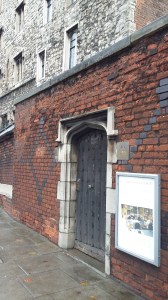 Mention of Lambeth Palace inevitably conjures up pictures of the Thames and views of the Houses of Parliament; of archbishops and Anglican clergy; not to mention walled gardens, and impressive interiors literally oozing history. But of most importance to the present project is the fact that in 1996, the Palace Library took over the custodianship of
  king of a College of Ministers, Rectors (Readers) and Curates within the City of London and the suburbs of the same.”
 Last week, I attended two very fruitful meetings at the British Library and Lambeth Palace Library – the modern incarnations of two libraries receiving the old copyright music. The British Library was previously The British Museum Library, and Lambeth Palace Library inherited Sion College’s library. I’ve yet to finish writing up my notes from the second of these meetings, but there will eventually be a blogpost about what we discussed. Most crucially, we discussed possible dates for a workshop in Spring 2018, and I’ve since set the ball rolling back here in Glasgow, so watch this space!
 Karen McAulay, Musicologist