Mind-Maps? Not This Time!

Thinking about the whole corpus of legal deposit music in the late 18th and early 19th centuries:-

  • Where it went
  • How it got there
  • What was retained
  • Who was involved in its immediate and subsequent curation
  • Whether it was used
  • What about the materials not retained?
  • The approach to this material in different institutions
  • Women composing music
  • Women performing music
  • Women teaching music
  • Music composed in response to war
  • Music in cultural history – what was popular, when, with whom?
  • Music for dance
  • Music pedagogy prior to the mid-19th century
  • Music for particular instruments (eg harp) or ensembles
  • Musical arrangements, music re-purposed in some way (and copyright issues)
  • National music – privileged in terms of retention?
  • Religious music – I haven’t separated out any strands here yet
  • Hymn books – published with and without music. Another strand I have yet to explore
  • Documentation, cataloguing
  • Big data (when more collections are catalogued online)
  • Comparison of retention patterns between different libraries
  • Digitisation
  • Performance possibilities
  • Finally, last and by no means least – The big picture. Even acknowledging the contribution of the European great masters to music of this era, have we underestimated the importance of contemporary British music? Some is good, admittedly some is bad, and some is indifferent – but much of it is significant in revealing cultural trends at the time. This, I believe, is the true importance of the Georgian legal deposit music corpus.

A Guest Blogpost on another Website

I authored the following piece for the UK Copyright Literacy website. New readers are warmly encouraged to explore our Claimed From Stationers’ Hall blog, and please do sign up to the Jisc mail list if you would like to join the conversation.

Legal Deposit (Copyright Behind the Scenes) – and Scores of Musical Scores

Some Interesting Work Out There!

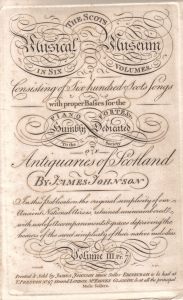
Figure 3, Johnson Scots Musical Museum, Frontispiece.

Whilst I’m writing up my notes after attending five meetings in three weeks, I shall share some more interesting links with you, to keep you supplied with reading matter until I’m in a position to post a longer piece! Do take a look at these:-

  • Copyright ABC’s – ‘The Scots Musical Museum’. A post on St Andrews’ Special collections blog, the acclaimed Echoes From the Vault.
  • A University of Auckland thesis about “New Zealand’s Published Music 1850-1913” by Libby [Elizabeth] Nichol includes a chapter about publishers’ relationship with the British Stationers’ Hall, as well as information about New Zealand legislation.
  • UK Copyright Literacy (‘Decoding Copyright and Bringing You Enlightenment’) is a group concerned with educating us about copyright, and they welcome guest blogposts. I was happy to oblige … my contribution will appear soon!

Recommended Reading

I’ve just been reading a great article by William Lockhart, ‘Trial by ear: legal attitudes to keyboard arrangement in nineteenth century Britain’, Music & Letters 93.2 (2012), 191-221. It’s on JSTOR:

http://www.jstor.org/stable/41684166

Now, it’s not about legal deposit per se, although it is mentioned. (If I were to make one minor point, it’s to clarify that when the author states that items were ‘physically deposited’ at Stationers’ Hall, this implies that the Hall was, itself, a legal deposit repository, but this was not so. Stationers’ Hall registered publications, then passed on the legal deposit copies to the libraries – if they weren’t directly sent from the publishers themselves.)

The article is, in fact, an excellent analysis of three British music copyright cases. Considering how prevalent musical arrangements were, it is no surprise that there was litigation concerning copyright from time to time. Legal arguments examined various factors. No-one disputed the importance of the melody, but as we all know, there is more to a composition than that, and as for a series of opera tunes rearranged into a different order for dancing to? Well, you’ll have to read it!

It was interesting to find names that I have often encountered in other capacities, and particularly fun to meet my friend the quadrille arranger, Philippe Musard, again. (I looked at some of his quadrilles while reconstructing the contents of the University of St Andrews’ most popular copyright music volume, vol.284, now missing.)

Even if I don’t rush off to follow up all Lockhart’s references, there are a dozen or so that I shall be adding to our bibliography. There’s a lot there, excellent for providing context to our own research:-

  • What music the Victorians enjoyed
  • The development of legal definitions around the process and art of musical arrangement
  • How musicians perceived arrangements
  • Evidence that the records of music registration were actually referred to in cases of litigation!

When I get the chance to open my laptop, I will get these references into Mendeley and then into the bibliography. For now, with a tablet on a crowded Virgin train, I have to concede temporary defeat!