Dr Karen McAulay explores the history of Scottish music collecting, publishing and national identity from the 18th to 20th centuries. Research Fellow at Royal Conservatoire of Scotland, author of two Routledge monographs.
I’m a bit of a juggler at the moment! The Claimed From Stationers’ Hall network has a dedicated Brio issue forthcoming in November, which I’ll be co-editing with Martin Holmes, the regular editor. Various articles have been promised, and I need to do some writing as well. Not to mention needing to do some book-reviews. I have several ideas there – I need to order some books that I’ve recently come across, to decide if they’d be usefully reviewed for our music librarian audience.
I also need to revise an article for another journal – I first wrote it a couple of years ago – to reflect the fact that the network came into being and more work has since been done.
But before that – next week I’m heading to the Sorbonne in Paris, as an invited speaker, to talk about Sir John Macgregor Murray’s involvement in Gaelic culture and song-collecting. The man who got a couple of passing mentions in my thesis and book, has been a major focus for historians interested in his involvement in commissioning and collecting Persian manuscripts on Indian customs and culture, whilst he was active in the East India Company’s private army. I’ll be the only musicologist there – I’ve polished my paper within an inch of its life, so hopefully it will be of interest to scholars from a different discipline and with a different focus. I made a page about Sir John, which you can visit if you’d like to know more about the man.
I’ve been awarded an Athenaeum Award by the Royal Conservatoire of Scotland, to enable me to attend the whole of the International Society of Eighteenth Century Studies conference in Edinburgh in July, where I’ll be joining a panel on paratext. I think paratext is probably one of my all-time favourite research topics, so this is very exciting.
But to clear the decks for some serious writing about paratext, I got my next speaking opportunity all written up and timed well ahead of schedule: I’m talking about copyright and John Cage in a Pecha Kucha presentation at the CILIP Icepops seminar on copyright literacy education towards the end of June. Writing to fit 20 slides each lasting for 20 seconds is a rather different challenge to writing a conference paper! Here’s a hint: if you Google it, you’ll find yourself recommended to write 60 words per slide. However, if you use a lot of long words, then this advice is not for you!! Take it from one who [now] knows!
I’m attending the Icepops conference in Edinburgh with my librarian hat on. In fact, I was at Edinburgh a couple of weeks ago for the National Bibliographic Knowledgebase roadshow – an interesting update – and a couple of days ago, I went to Dundee for a Rare Books Scotland meeting. Again, I wore my librarian hat, but had the opportunity to share an update on the Claimed From Stationers’ Hall network whilst I was at it.
And what else? As I mentioned, I have a glorious idea for a new grant application … but I’ll keep that under my hat until plans are a bit more advanced….
Back in January, I started thinking about the repurposing of tunes by Georgian composers – whether arrangements, piano variations or other interpretations. Rossini particularly came to mind, because his operatic airs were so very heavily used – but it wasn’t just Rossini’s rights that intrigued me – what about all the other instances of repurposed tunes? I blogged, and then I threw the question open to the Claimed From Stationers’ Hall network, and – as I’ve already posted – Paul Cooper of RegencyDances.org and German folklorist Jürgen Kloss enthusiastically joined in the discussion, sharing some useful links to articles and postings that I’ve since incorporated into the 5th edition of our bibliography.
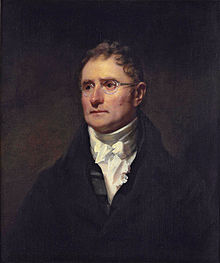
George Thomson, by Henry Raeburn
The conversation continued. Last week, Jürgen shared evidence that Scottish music publisher George Thomson became very concerned by the upstart Joseph Dale pirating piano music by Ignaz Pleyel that he, Thomson, had originally published. (I’ve used the Copac spelling of Pleyel’s forename here.)
German folklorist Jürgen’s thread was so intriguing that I offered to blog it in its entirety, and what follows is his input. I’d like to thank him for so graciously allowing me to reproduce his narrative on this blog.
Guest Blogpost by Jürgen Kloss
Morning Chronicle, 27.3.1794, BBCN
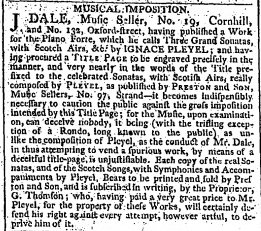
@juergenkloss (Jürgen Kloss) 12 Feb: Further to our early copyright discussions as to who “owns” the music?, I found this ad: “Musical Imposition”, in which George Thomson – editor and publisher of Scottish songs – warns against a “spurious” ed. of sonatas by Pleyel, publ. by J. Dale:-
OAPA, 12.3.1794
Indeed, Thomson regarded Dale’s ed. (ad in OAPA, 12.3.1794) as an attack on his own investment: “G. Thomson, who, having paid a very great price to Mr. Pleyel, for the property of these Works, will certainly defend his right against every attempt, however artful, to deprive him of it.”
Of course Mr. Dale kept on publishing these works: Twelve Grand Sonatas for the Piano Forte or Harpsichord […] In Which are Introduced a Variety of Scotch Airs, Book 2 (1798) (this copy in the University of Iowa Digital Library):- http://digital.lib.uiowa.edu/cdm/compoundobject/collection/pleyel/id/8775 … And he claimed to have the original editions:-
Pleyel – Twelve Grand Sonatas
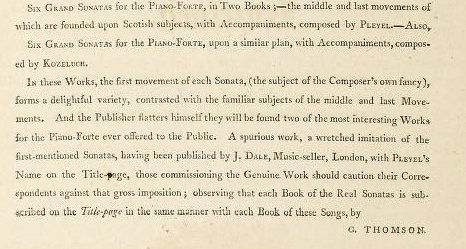
Even several years later, in some editions of his Select Collection, Mr. Thomson still warned against the “wretched imitation” published by Dale.
…and of course other publishers quickly offered their own editions. But Mr. Reeve sent letters to newspapers warning against “spurious” editions. This letter even appeared on the title-page of the sheet music, see below: https://archive.org/details/sheet-music-RobinAdair-Braham-London1812 …
Interestingly, composer J. Mazzinghi couldn’t resist publishing an answer to Mr. Reeve’s claims in his own edition of “Robin Adair”. He said it was a big success because of the tune and Braham’s performance (and Reeve had no rights to the song)! http://digitalcollections.baylor.edu/cdm/ref/collection/fa-spnc/id/8566 …
Of course: songs are money, especially popular hits like this one. Later it was claimed that “in one year, […] upwards of two hundred thousands copies” of the sheet music were sold. Therefore it is understandable that Reeve was a little bit nervous about competing editions:-
There is much fascinating detail to absorb in these stories that Jürgen has generously shared with us.
MAYBE YOU’D LIKE TO LEARN KNOW MORE?
Jürgen’s newspaper references are available via these electronic resources:-
Jürgen also traced a reference to a paper that Claire Nelson gave at the International Musicological Society’s 17th Congress in Leuven, in 2002. Here’s the abstract:-
The paper wasn’t published in its entirety that year – just the abstract, in the conference programme above – but the good news is that it became a chapter in Nelson’s doctoral thesis in 2003, when she completed her DMus at the Royal College of Music. The thesis can now be downloaded free of charge via the British Library’s EThOS service.
Nelson, Claire M., Creating a notion of ‘Britishness’ : the role of Scottish music in the negotiation of a common culture, with particular reference to the 18th century accompanied sonata (Royal College of Music, 2003, Access from EThOS:- https://ethos.bl.uk/OrderDetails.do?uin=uk.bl.ethos.489910
Go to page 240 of Nelson’s thesis to read more about George Thomson’s disgust at Joseph Dale’s shameful piracy. She quotes (and provides an English translation) from a letter that Thomson wrote to Pleyel in 1794:-
“Dale has done something most shameful and most offensive. He has published three sonatas with Scottish airs, exactly on the same plan as mine, and their title is engraved in the same way and almost in the same words, your name is given as the composer! His intention is evidently to deceive the public and without regard to my sonatas, pass a work supposedly of your composition, I have published an advert revealing the fraud, and hope that you have had no part in the work of Dale.”
Thesis footnote 102, translating the French original reproduced in Pincherle’s 1928 article, (Marc Pincherle, ‘L’Edition Musicale au dix-huitieme siecle: Une letter de Thomson a Ignace Pleyel’, Musique i (1928), pp.493-498), p.496.
Earlier Claimed From Stationers’ Hall Blogposts that you might enjoy:-
Copyright Contradictions (5 Feb 2019), referencing Paul Cooper’s postings about dance music publishers’ copyright skirmishes)
And of course there’s much more to be found in the network Bibliography!
Of particular interest in this context are the articles by William Lockhart ( ‘Trial by Ear: Legal Attitudes to Keyboard Arrangement in Nineteenth-Century Britain’, Music & Letters, 93.2 (May) (2011), 191–221 https://www.jstor.org/stable/41684166 [accessed 31 January 2018]) and Charles Michael Carroll (‘Musical Borrowing: Grand Larceny or Great Art?’, College Music Symposium, 18.1 (1978), 11–18 https://www.jstor.org/stable/40373912 [accessed 12 January 2019]) – but seriously, there is a lot more to read if you’re keen to find out more! And of course, don’t forget that Jürgen Kloss and Paul Cooper have both written extensively on the subject – their blogposts are also listed in the bibliography, naturally.
(I must confess that I’m eager to download Pleyel’s Twelve Grand Sonatas – whatever the edition! – to see what they’re like, too!)
Over the weekend, I put together a very tiny animation about a tune plagiarised from Moore’s Irish Melodies in 1815. Interesting Twitter conversation ensued with Paul Cooper (of RegencyDances.org) and folklorist Jurgen Kloss in Hennef, Germany. In brief, it does appear that folk tunes – and even country dances – were seen as fair game for repurposing and republication, although there are a number of legal disputes on record in contemporary newspapers. And I have some more great references for the bibliography, next time I’m updating it!
I unearthed an unexpected instance of musical plagiarism yesterday. And I wonder if Thomas Moore and James Power were even aware of it! I won’t divulge too many of the details, as I might be referring to it in a conference paper one day, but here’s the teaser, in the form of a brief Biteable animation! Please click the link below:-
Rossini, painting via ArtUK from Royal Society of Musicians of Great Britain
It is an inescapable fact that many a late Georgian or early Victorian music cabinet must have contained at least one set of piano variations on an operatic theme by Rossini. There are just so many of them! Since they proliferated in the 1820s (ie the last decade of Rossini’s operatic compositional phase, and the era when he also visited Britain), you won’t find them listed in Kassler’s Music Entries at Stationers’ Hall – his bibliography ends in December 1818. But you have only to search Copac or glance at St Andrews University Library’s listings, to see how many composers were inspired to write virtuosic variations on the great man’s tunes.
What did Rossini think of this, I wonder? I’ve only started to scratch the surface of this particular enquiry, but to date I’ve discovered only that copyright legislation was not as advanced in Italy as it is in the UK. What’s more, there may not be very many extant letters by the great man from the 1820s, and that the authoritative modern edition of his letters is in Italian. I do know Rossini would have been very conversant with legal documents, considering the number of contracts he signed for his many, many operas. None of this tells me (yet!) what Rossini thought of other composers making free use of his lovely melodies.
Rossini, painting via ArtUK from Royal College of Music
What I do have is William Lockhart’s article in Music and Letters (vol.93 no.2, 2012), ‘Trial by ear: legal attitudes to keyboard arrangement in nineteenth-century Britain’; Charles Michael Carroll’s ‘Musical Borrowing – Grand Larceny or Great Art?’ in College Music Symposium (vol.18 no.1, 1978); and Derek Miller’s Copyright and the Value of Performance, 1770-1911 (2018). I shall in due course have a couple more books on Rossini, so I haven’t yet given up on finding out how he felt about this evidence of his popularity. Maybe he just felt flattered – but I’d love to find his own words on the subject!
As for his published letters? Well, I may have to look for them. I know a little Italian, thankfully. But meanwhile, if you know anyone who has read the recent edition, please do let me now! I’d be deeply grateful!
We are delighted to announce that the Icepops 2019 call for contributions is now open. The conference is taking place on 26th June 2019 at the University of Edinburgh and you have from now until the 4th February to come up with an idea for your presentation.
We are looking for speakers on all aspects of copyright education from a variety of different perspectives. Last year we attracted expert speakers from educational & cultural institutions, publishing houses and government departments as well as an impressive number of international delegates. Our first keynote this year is composer, publisher and scholar Simon Anderson, who will be opening the conference with a musical theme. We particularly welcome sessions that might compliment this. However, we also retain the playful learning theme from last year and our afternoon keynote, the award-winning Charlie Farley from the University of Edinburgh will be leading an interactive workshop.
We would like to encourage presenters to address one of the themes of this year’s conference:
– Universal Copyright Literacy: bridging the gaps between lawyers, IP teachers, specialists and copyright muggles
– Engaging and creative approaches to copyright education including using games, music and performance
– Copyright education as part of digital and information literacy initiatives
– Copyright education in the cultural heritage sector
– Teaching copyright as part of scholarly and open practices
However, we wouldn’t want you to feel constrained if you have a great idea relating to copyright literacy that doesn’t fit 100% into any of the above. Please just let us know and we’ll see if it fits in the programme.
You probably didn’t expect to find a link to the latest edition of the Harvard Gazette on this website! Nonetheless, it contains an interview with Professor Derek Miller, author of a new book about copyright and performance rights from 1770-1911 – so there’s bound to be matter of interest to our networking project.
I haven’t yet got hold of the book itself, so I don’t know how much it focuses on European versus American copyright law, but I must confess I’m keen to find out. It’s fascinating to learn more about the philosophy and the reasoning that led to legislation developing the way it did.
Derek Miller, Copyright and the Value of Performance, 1770–1911 (Cambridge University Press, 2018) ISBN 9781108425889. Publisher’s link
And now I’ll add both to my Mendeley bibliography, pending the next time I update the network bibliography listing that appears as a separate page on this very blog.
Our bibliography was only updated at the end of August, but a mere five weeks later, there were a number more useful publications waiting to be added, including some references gleaned from a couple of exciting articles by Nancy Mace. So, a new edition of the bibliography has been uploaded …
Notwithstanding this, please check what’s there already, and do let me know if you’ve written about any aspect of historical music copyright, music library history, or music publishing history that might be pertinent to our field of study! We’d really like to add details to our listing.
Just thought I’d remind you that we have an extensive bibliography pertaining to the history of music legal deposit and copyright in the UK (and further afield, in a few instances). Do take a look – if you have written on the subject but I haven’t picked up the citation, please do forward it! Similarly, if you have colleagues whose work ought to be included in this listing, it would be great if you could let me know. I’d hate for anyone to be missed out! Very many thanks.





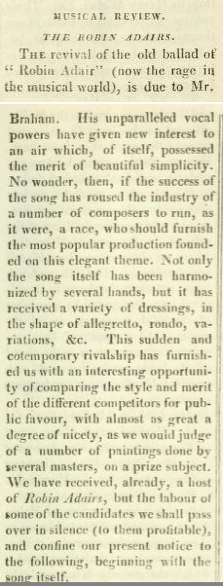 And here’s another disputed instance: that of “Robin Adair”. (See Jurgen’s blog of 2014, link below.) This old tune was revived in 1811. Composer William Reeve wrote a new arrangement and John Braham sang it with a new text. The new “Robin Adair” was a great hit…


 —————————————————————————–
 We are delighted to announce that the Icepops 2019
  You probably didn’t expect to find a link to the latest edition of the Harvard Gazette on this website! Nonetheless, it contains an interview with Professor Derek Miller, author of a new book about copyright and performance rights from 1770-1911 – so there’s bound to be matter of interest to our networking project.
 Dear friends and fellow network members,
