I researched flautist James Simpson, the father of Dundonian music publisher and seller Alexander Simpson, for some months before starting my PhD. In the mid-1800s, Alexander Simpson became a partner in Methven Simpson, which had stores in Dundee, St Andrews, Forfar and Edinburgh.
I was unaware of any links with musicsellers or publishers in Glasgow, but you can’t blame me for getting excited when I found out about Frank Simpson’s shop in Sauchiehall Street, a couple of years ago. Indeed, there was another Frank Simpson selling music elsewhere in Glasgow at the start of the twentieth century.
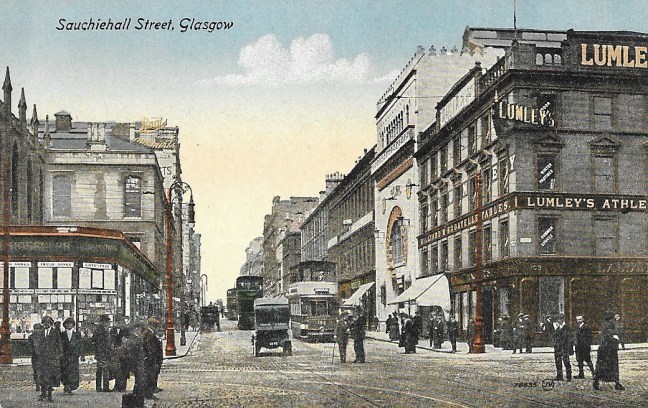
Let me save you a long story. The Sauchiehall Street Simpson established his shop in 1860 – not much later than Alexander Simpson’s early career in Dundee – and I wasn’t aware of Alexander having any brothers, or of the family having a Glasgow connection at all. The low premises on the left-hand side of the postcard foreground (above) are the shop the older Frank Simpson later settled in, with the shop remaining there for well over a half-century. Frank Simpson junior eventually joined him, importing banjos from S S Stewart in the USA, and teaching the instrument from the premises from the mid 1880s onwards. The other Simpson was a competitor, no connection with the Sauchiehall Simpsons (as their adverts make amply clear!), and it seems there was no connection with Methven Simpson.
However, this apparent dead end may not be a complete cul-de-sac, since the Sauchiehall Street shop was demolished to make way for British Home Stores circa 1964, and the owner by that time was a famous singer of Scottish repertoire. I believe the shop was subsequently combined with a couple of others, ultimately to form the Glasgow Music Centre, so … taking the links back in time again … it all forms part of my present research interest in late Victorian and Edwardian Glasgow music publishers. It just doesn’t connect with the Methven Simpson story. So many Simpsons!
During my perigrinations through the British Newspaper Archive (a present to myself, half-subsidised by Mum’s Christmas gift!), I caught Frank Simpson junior playing his banjo at a “minstrel concert” in Milton of Campsie, and twice at a Sabbath School Soiree in Kilbarchan.  I discovered that Frank Simpson also published cheap novels, and (from an advertisement whose provenance was uncited) -that the shop sold books, jokes and greasepaint as well as the thousands of pieces of sheet-music that Glasgow Herald adverts boasted of. Sadly, the British Library only seems to have five songs – but this material was not high art music, so there’s the possibility that it didn’t get logged in sufficient detail for me to be able to trace Frank Simpson’s imprint.
To date, the genealogical database Scotland’s People has not yielded the significant dates of Sauchiehall Street Frank Simpson senior – I could still look harder – but I do know that Simpson junior was born in Airdrie on 24th May 1866, and died in East Kilbride on 14 August 1936 at the age of 70. For now, I’m leaving them in limbo, since this is an intriguing but time-wasting detour away from the bigger questions about what the other, more active publishers were actually publishing!





 Karen McAulay, Musicologist