


This week’s news is cautiously optimistic. I have the opportunity to speak at a conference in New Zealand if I can secure the funding to get me there! I’ve applied for funding – so watch this spot.
What about the Colonies?
Meanwhile, however, it set me wondering about legal deposit in the colonies in the nineteenth century. This is not something that I’d thought about before. Obviously, early printed music in New Zealand or Australia would generally have come from Europe, whether as new imports, brought by emigrants or sent to them by their families. (See the excellent work being done by Sydney Living Museums in Australia, or – as an example of an early immigrant musician’s life – Michael Kassler’s fascinating paper, ‘The remarkable story of Maria Hinckesman‘, in Musicology Australia (2007). I really don’t know much about the nineteenth century music trade beyond Britain. I seized my copy of Partridge’s The History of the Legal Deposit of Books (1938) for a quick overview, where I learned that New Zealand’s own legal deposit legislation came much later. It would still be nice to know more about the publication of music actually composed there during the 19th century! Has anyone studied this?
You can’t beat a good bibliography
Over the past couple of years, I’ve compiled quite an extensive bibliography covering legal deposit (both at the general and music-specific level), and the nineteenth-century histories of the British legal deposit libraries. I’m sure I haven’t yet listed everything that’s out there, but progress is being made. I’m currently tidying up this listing, then I’ll post it online. What I need more of, are links to finding aids, published or online, outlining what archival information is available for the different libraries. Once I’ve got it into a shape fit for public consumption, I’d love to receive any further suggestions for suitable additions. A student at the University of Edinburgh made a great listing of catalogues, accounts, and borrower loan records (“receipt books” in eighteenth- and nineteenth-century terminology) this summer, and I’ve currently got a copy of it on my desk to peruse closely. Next week, I’m going to consult a couple of resources recommended to me by the National Library of Scotland’s Music Librarian – these will hopefully fill in my knowledge about what’s available there. In this age of the internet, it pays to remember that not everything is online, and it’s invaluable to know about the existence of earlier finding aids that remain in their original print format. I’m quite well clued-up about the resources in St Andrews, and I’ve got several useful links for Sion College’s holdings, now in Lambeth Palace Library. Any further suggestions about other libraries, anyone?!
Official Commissions
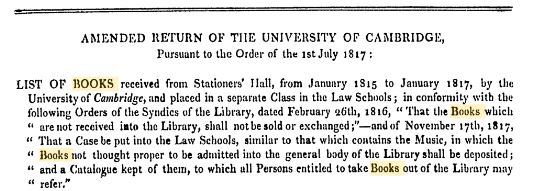
At various times, official commissions looked into the legal deposit libraries’ handling and curation of the legal deposit materials, and library provision for universities in general. I really do need to capture details of all surviving documentation. Partridge mentions that after the 1814 Copyright Act, returns were requested from the legal deposit libraries (1st July 1817), which resulted in the Return of the Libraries, ordered to be printed by the House of Commons on 6 March and 9 April, 1818 [BM.515 l 20] (Partridge ibid, p.73].* This contains a table of rejected items from Oxford or Cambridge – I have also found an amended return from Cambridge, which has of course been added to the bibliography!
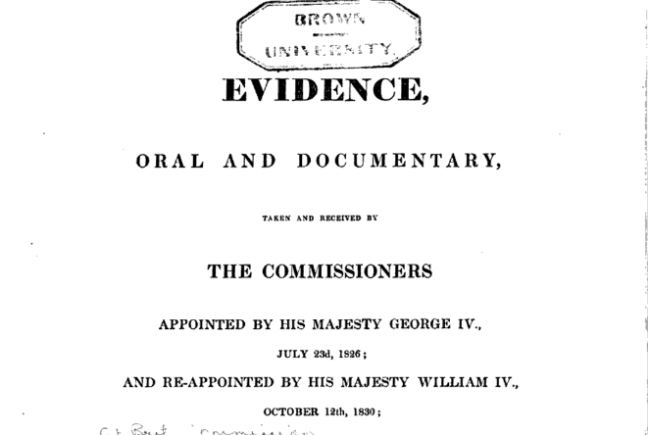
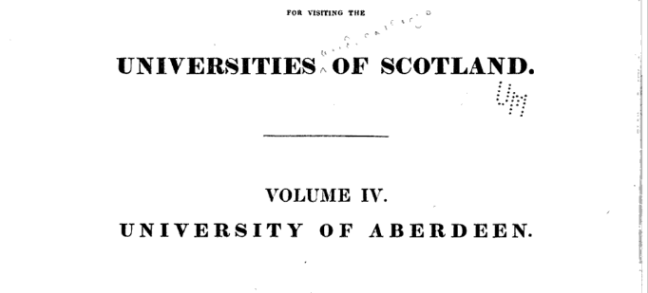
Similarly, from 1826 onwards, there was a Royal Commission investigating library provision to the University Libraries in Scotland. I’ve seen one of the huge tomes emanating from this exercise, regarding the Aberdeen responses, and transcribing interviews with individual professors. Revd. William Paul remembered the sale of some legal deposit music, a couple of decades earlier. Oh, really? This is interesting stuff!!
Great Britain. Commission for Visiting the Universities and Colleges of Scotland W. Clowes and Sons, 1837
It’s fair to say that bibliographic control of this material is sometimes slightly inconsistent, but it would appear desirable to track down each Scottish university’s response, and to look at the other responses from St Andrews, Edinburgh and Glasgow!

Guest Blogposts Ahead!
We now have five offers of guest blogposts for this blog, two of them scheduled for the beginning of December. Embracing technology, I’ve set up a Doodle poll for other interested guests. The link has been sent to everyone signed up to the Jisc Music from Stationers’ Hall mailing list. Completing a Doodle poll is simplicity itself, and I’ll get to see any responses to the poll. If you’re on the list, please check your email inbox! (If you’re not on the list, here’s how to sign up! Open Invitation to Join the Conversation)
And More Visits
When I only have one and a half days a week for research, even scheduling visits to all the former legal deposit libraries is just a touch more tricky, but I’m doing my best. Every week, I try to think ahead and start planning another trip, so we’ll see where I end up visiting next! Which reminds me … time to tie up some arrangements …
- House of Commons, Extracts of so Much of the Returns Made by the Universities of Oxford and Cambridge, (pursuant to the Orders of the 1st July 1817 and 20th February Last) as State, Whether Any of the Books Claimed under the Late Copyright Act Have Been Omitted to Be Placed in their Respective Libraries, and how otherwise disposed of. (1818) [Paper no.98. Available via database, UK Parliamentary Papers (ProQuest)]
 Normally, I’m busy being a librarian on a Tuesday, but since I have a day’s leave, I can look ahead to what’s in store tomorrow.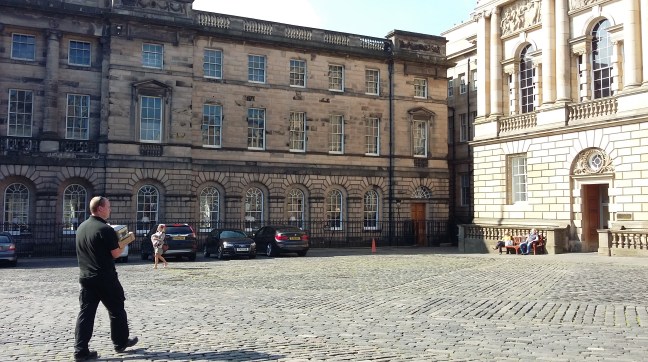
 Karen McAulay, Musicologist