Dr Karen McAulay explores the history of Scottish music collecting, publishing and national identity from the 18th to 20th centuries. Research Fellow at Royal Conservatoire of Scotland, author of two Routledge monographs.
Followers of this blog will know that you can look at historical piano teaching materials in the libraries that hold legal deposit collections. Nowadays, there are a handful of big national and university libraries in the UK that still receive one copy of everything published, under statutory legislation. But there are other libraries – especially in Scotland – that also received this material, until the beginning of Queen Victoria’s reign.
Theodore Latour was pianist to King George IV – Victoria’s uncle. He taught privately and at girls’ schools, played and composed, and also wrote some piano tutor books. As it happens, Emily Bronte had music by Latour in her collection, including one of his books of progressive exercises, although I haven’t examined that particular publication. (Robert K. Wallace mentions it, in his Emily Bronte and Beethoven: Romantic Equilibrium in Fiction and Music.)
It’s possible to find copies of some of Latour’s works online via Google Books, IMSLP or Archive.org, so if you’re interested, we could point you in the right direction.
I have been experimenting with other ways of talking/writing about the Stationers’ Hall Georgian legal deposit music corpus. Here are my Saturday afternoon efforts. Have you tried any such audiovisual presentations in your own research? Do you find them helpful?
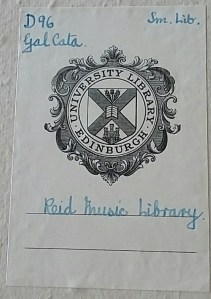
Hans Gal (1890-1987) catalogued Edinburgh University’s Reid Music Library during the summer and autumn of 1938, at the instigation of Sir Donald Tovey. The latter was keen to find work for the gifted composer and musicologist, who had emigrated from Vienna when Hitler annexed Austria. (Here’s a recording of his earlier Promenadenmusik for wind band, which he wrote in 1926. ) A grant from the Carnegie Trust enabled Gal’s catalogue to be published in 1941. When the Second World War ended, Gal joined the University music staff, and remained there beyond retirement age.
The reader is referred to the Hans Gal website for further biographical information (I am checking this weblink, which occasionally falters):- http://www.hansgal.org/
Gál, Hans, Catalogue of manuscripts, printed music and books on music up to 1850 : in the Library of the Music Department at the University of Edinburgh (Reid Library) (London, Edinburgh: Oliver and Boyd, 1941)
(Partially) catalogued by Gal
The catalogue is in three parts, listing manuscripts, printed music, and books on music. Gal did not list every individual piece of music in the library, but prioritised more serious classical music, whether vocal or instrumental. One might suggest that there were various reasons for Gal’s decision.
In his preface, he explains that, ‘for practical reasons I confined this catalogue to the old part of the library, namely the manuscripts, printed music and books on music up to 1850, which is the latest limit of issues that might be looked upon as of historical importance’. [Gal, vii]
However, this was not the only limitation placed on the listing. Gal omitted many of the pieces of sheet music that must have arrived as legal deposit copies during the Georgian era, until copyright legislation changed in 1836. The Reid music cupboards contained a number of Sammelbänder, or ‘binder’s volumes’, ie, bound volumes of assorted pieces of music. Occasionally Gal made oblique reference to these, eg, to cover the 44 items in volume D 96:-
“Songs, Arias, etc., by various composers (Th. Smith, D. Corri, Bland, R. A. Smith, Rauzzini, Davy, Kelly, Urbani; partly anon.) Single Editions by Longman & Broderip, Urbani, Polyhymnian Comp., etc., London (ca. 1780-1790). Fol. D 96″ [Gal, 44]
Longman & Broderip were prolific music publishers, amongst the most assiduous of firms making trips to Stationers’ Hall to register new works. They published a lot of theatrical songs and arrangements, and much dance music, as well as the more serious, ‘classical’ music repertoire. The catalogue entry cited above details some more commonly known composers of decidedly middle-of-the road, if not downmarket material. One does not need to speculate as to whether Gal considered such material less respectable, for he made no secret of his disdain for much of the music published in this era! In the preface, he asserts that,
“The gradual declining from Thomas Arne to Samuel Arnold, Charles Dibdin, William Shield, John Davy, Michael Kelly, is unmistakeable, although there is still plenty of humour and tunefulness in musical comedies such as Dr Arnold’s “Gretna Green”, Dibdin’s “The Padlock”, Shield’s numerous comic operas and pasticcios.
“After 1800 the degeneration was definitive, in the sacred music as well as in songs and musical comedy. […] It is hardly disputable that the first third of the nineteenth century, the time of the Napoleonic Wars and after, was an age of the worst general taste in music ever recorded in history, in spite of the great geniuses with which we are accustomed to identify that period.” [Gal, x]
Faced with several hundred of such pieces in a number of bound volumes, and quite possibly a limited number of months in which to complete the initial cataloguing, it is hardly surprising if Gal was content to make a few generic entries hinting at this proliferation of ‘bad taste’. (One might add as an aside, that Gal’s wife at one point observed that Gal ‘hated swallowing the dust in archives’, in connection with an earlier extended project in the late 1920s – clearly, he was able to overcome his distaste when the need arose! (See http://www.hansgal.org/hansgal/42, citing private correspondence of 10.10.1989)
Interestingly, it is evident that Edinburgh, like several other of the legal deposit libraries, must have been selective in what was retained, but it’s significant that national song books were certainly considered worth keeping. Gal, in turn, included some of the prominent titles in his listing.
Thus, Gal’s catalogue is another reminder to us that the history of music claimed from Stationers’ Hall under legal deposit in the Georgian era, actually and actively continues beyond the Georgian era, for the material has already been curated by musicologists and bibliographers prior to our own generation. In St Andrews, Cedric Thorpe Davie took an active interest, whilst Henry George Farmer was involved in curating the University of Glasgow collection.
Meanwhile, in connection with the current Claimed From Stationers’ Hall network research, the priority is to establish which volumes – formerly in the Reid School of Music cupboards, but now in the University of Edinburgh’s Centre for Research Collections – were received under legal deposit. Two spread-sheet listings enable us to examine the contents of different volumes, by volume:-
Where publication dates are not given in the spread-sheet, they can be looked up in Copac, and even if there are no decisive dates, then their presence in other legal deposit collections will suggest that these copies arrived by the same route. If music predates 1818, then works can be looked up in Michael Kassler’s Music Entries at Stationers’ Hall, 1710-1818, from Lists prepared for William Hawes, D. W. Krummel and Alan Tyson. (Click here for Copac entry.)
Essentially, the first task is to ascertain which volumes contain legal deposit music, and then to look not only at what survives, but whether there are any patterns to be discerned. In terms of musicological, book, library or cultural history, the question today is not whether the music was ‘degenerate’ or in ‘bad taste’, but to ask ourselves what it tells us about music reception and curation in its own and subsequent eras.
Postscript: as an interesting twist in the world of library and book history, my own copy of Gal’s catalogue was purchased secondhand – a withdrawn copy from a university library where the music department closed a few years ago. What goes around, comes around, as they say!
We’ve just had our attention drawn to a wonderful blogpost on Houghton Library Blog, uploaded on 24th June, 2016. The author, Andrea Cawelti, is a Rare Music Cataloguer at Harvard, and she had just attended Ian Gadd’s course on The Stationers’ Company to 1775, at Rare Book School – a summer school at the University of Virginia.Andrea spotted the registration of an additional verse to “God Save the King”, just three weeks after an assassination attempt. She mentions George Greenhill at Stationers’ Hall – the man who managed to get himself paid multiple times, but still struggled to keep on top of the job – and patriotic songs during the Napoleonic Wars. We know all about them too! Read on …
The last day in February, and Scotland grinds to a halt. I had places to go and people to see, not to mention a blissful research day ahead of me. Still, if we get Snowmageddon over and out of the way, then we can look joyously ahead to the Claimed From Stationers’ Hall research network’s impending workshop here in Glasgow on Monday 26th March.
Workshop Monday 26th March
We’ll be talking about the heritage collections of Georgian/Victorian legal deposit music up and down the UK, looking at ways to promote it, contemplating the many ways it sheds light on contemporary cultural and social history, pondering how we can improve access to it, whether by finding aids or digitisation, and considering how big data might be used to reveal stories hitherto untold. Representatives of almost all the old (and the current) legal deposit libraries will all be there. (This must be a first! Assuredly, there would not have been a nationwide meeting of university librarians in the late Georgian era. Nonetheless, the Scottish universities were certainly in touch with one another, if only to liaise about their London agents, working more or less effectively to secure the publications they were owed! Getting their fair share of sheet music was probably the lowest priority on the libraries’ agenda back then!)
We have a limited number of workshop places left, so if you’re working or researching in this field and can manage a day-trip to Glasgow, do get in touch to tell us about your interest and secure one of those places! Our recent February Newsletter tells more about it.
THE WHEEL COMES FULL CIRCLE
As you know, every week or so, I check Michael Kassler’s invaluable bibliography, Music Entries in Stationers’ Hall 1710-1818, and see if I can find a piece of music whose anniversary of copyright registration falls on that day. Sometimes the piece is good, sometimes deservedly forgotten, but all of them tell us something about musical tastes and trends at the time they were written.
Today, as I cool my heels (and my toes) at home on an enforced snow-day, I turned to 1798 to see whose anniversary it might be today. I found Stephen Storace’s ‘O Strike the Harp. For one, two or three voices, with an accompaniment for the harp or piano forte. The poetry from Ossian‘, which the publisher Joseph Dale registered on 28 February 220 years ago. As Kassler states, the song can be found in the British Library: GB Lbl G.352.(42.).
Could I find an image of this song, clearly inspired by the late 18th century trend for minstrelsy, and still drawing on Macpherson’s Ossian poetry, despite the fairly well-proven doubts about its authenticity?
The wheel certainly does come full circle: in earlier research, I spent considerable time thinking about minstrelsy as it appears in national song collections, and here’s a song that’s not a “national song”, but certainly has links with literary literacy. I was beginning to get interested in big data, which is why Sandra’s research attracted my attention. And big data is one of the themes at our forthcoming workshop, with two of her colleagues in attendance. Isn’t it satisfying when links join into a chain?
Postscript. Today, I discovered that the song has also been referenced in a new book, Figures of the Imagination: Fiction and Song in Britain, 1790–1850, by Roger Hansford. He comments that the song is about relationships, and that the lyrics might have been written from a minstrel’s standpoint. Another book to go on my “must read some day” reading list!
I authored the following piece for the UK Copyright Literacy website. New readers are warmly encouraged to explore our Claimed From Stationers’ Hall blog, and please do sign up to the Jisc mail list if you would like to join the conversation.
I’ve just been reading a great article by William Lockhart, ‘Trial by ear: legal attitudes to keyboard arrangement in nineteenth century Britain’, Music & Letters 93.2 (2012), 191-221. It’s on JSTOR:
Now, it’s not about legal deposit per se, although it is mentioned. (If I were to make one minor point, it’s to clarify that when the author states that items were ‘physically deposited’ at Stationers’ Hall, this implies that the Hall was, itself, a legal deposit repository, but this was not so. Stationers’ Hall registered publications, then passed on the legal deposit copies to the libraries – if they weren’t directly sent from the publishers themselves.)
The article is, in fact, an excellent analysis of three British music copyright cases. Considering how prevalent musical arrangements were, it is no surprise that there was litigation concerning copyright from time to time. Legal arguments examined various factors. No-one disputed the importance of the melody, but as we all know, there is more to a composition than that, and as for a series of opera tunes rearranged into a different order for dancing to? Well, you’ll have to read it!
It was interesting to find names that I have often encountered in other capacities, and particularly fun to meet my friend the quadrille arranger, Philippe Musard, again. (I looked at some of his quadrilles while reconstructing the contents of the University of St Andrews’ most popular copyright music volume, vol.284, now missing.)
Even if I don’t rush off to follow up all Lockhart’s references, there are a dozen or so that I shall be adding to our bibliography. There’s a lot there, excellent for providing context to our own research:-
What music the Victorians enjoyed
The development of legal definitions around the process and art of musical arrangement
How musicians perceived arrangements
Evidence that the records of music registration were actually referred to in cases of litigation!
When I get the chance to open my laptop, I will get these references into Mendeley and then into the bibliography. For now, with a tablet on a crowded Virgin train, I have to concede temporary defeat!
Posted on the very excellent Echoes from the Vaultblog by the capable and insightful Special Collections team at the University of St Andrews, another interesting article touching on the Copyright Collection there. (And it’s about one of the seminal books in Scottish music, as I discussed in my book, Our Ancient National Airs …)
The Lighting the Past team share their highlights from the ‘M’ section of the Copyright Deposit Collection. You can see the previous posts in the series here.
The title page of vol. 1 of the St Andrews copy of The Scots Musical Museum. s M1746.J8S3 Vol. 1
While cataloguing the ‘M’ classmark (music) of the Copyright Deposit Collection, Lighting the Past discovered 5 volumes from The Scots Musical Museum, a 1787-1803 Edinburgh publication attempting to capture all Scots folk music and verse, amounting to 6 volumes once complete.
Robert Burns took a keen interest in the planned compilation project whilst in Edinburgh in 1787, writing ‘An Engraver, James Johnson, in Edin[burgh] has, not from mercenary views but from an honest Scotch enthusiasm, set about collecting all our native Songs and setting them to music.’ With Burns as the principal editor of vols. 2-4 (he died prior to the publication…
We’re delighted to share our first guest blogpost, by Dr Brianna E Robertson-Kirkland. It’s fascinating to read about this Georgian musician’s passionate interest in copyright!
Figure 1: Portrait of Venanzio Rauzzini with his dog Turk. At the Herschel Museum of Astronomy. Wikimedia Commons.
As the reigning primo uomo at the King’s Theatre from 1774-1778 (and then briefly again in 1784), Venanzio Rauzzini enjoyed many privileges. A handsome salary, opportunities to compose his own arias and some pull when it came to casting; the castrato used all of his clout to demonstrate his versatility in the music industry. Prior to his London residency, he had shown an enthusiasm for composition as well as singing, having composed the opera Piramo e Tisbe, performed for the Bavarian court in 1769 and ‘two or three comic operas […] which has been very much approved’ (Rice, 2015: 6 & Burney, 1775, 1:128). His passion for composition did not diminish as he continued to write opera, songs and even instrumental music after his immigration to Britain. Composing opera in which he starred also gave Rauzzini the opportunity to showcase the talents of his young students. Vocal teaching was just another strand in his multidimensional musical career. One such student, Nancy Storace, debuted on the operatic stage as Cupido in Rauzzini’s L’Ali D’Amore at the tender age of 11 as well as performing alongside her master in the cantata setting of La Partenza in 1777.
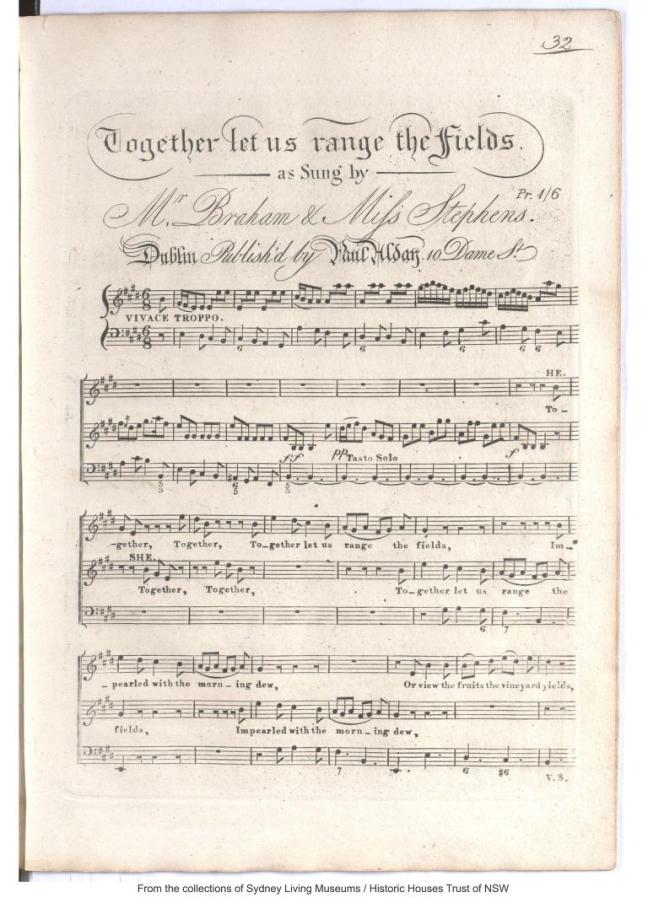
Opera in London was constantly surrounded by gossip and scandal. Moreover, claims of copyright were a tricky, controversial subject. Arias and songs were frequently removed from one opera and inserted into pasticcio. Such light-hearted theatre entertainments resembled a patchwork of favourite operatic numbers held together by a somewhat loose and generally absurd plot. While one arranger would oversee such a production, lyrics and occasionally the music were altered, blurring the lines between arranger, editor and composer. Expectations from singers added an extra complication since they frequently added their own unique flair to arias to ensure originality. If a singer was known for singing a particular aria, it was generally expected they would utilise it as a suitcase aria, inserting it into operas at their demand. The composer’s name usual appeared, even when a suitcase aria was performed, but when singers names were branded on title pages, often in a bigger font, it is not too far of a leap to assume the singer felt an equal sense of ownership.
Figure 2: Singers John Braham and Catherine Stephens names appear but in this example no composer is even listed. This was not an uncommon sight. Together let us range the fields [words by Edward Moore ; composed by William Boyce [c. 1815]. [Available from: https://archive.org/details/RangeTheFields46587 ]This is perhaps why the controversy between Rauzzini and fellow composer Antonio Sacchini became so heated. Not only had the two written an opera of the same name, L’eroe cinese, the similarity between the two was remarkable, leading to gossip that Rauzzini had ghost-written the original for Sacchini (Rice, 2015: 126). There was a further claim that Rauzzini had composed most of his own arias when playing the leading role in Sacchini’s operas. This was not uncommon, as Rauzzini often composed his own arias, though it was unusual that Sacchini should gain the credit. Neither benefitted from the controversy and afterward Rauzzini was far more diligent in claiming authorship over his work.
Michael Kassler’s comprehensive list of Music Entries at Stationers’ Hall, 1710–1818 reveals from 1795 onwards Rauzzini regularly entered his compositions into Stationer’s Hall including all 14 songs appearing in A Periodic Collection of Vocal Music published in two volumes in 1797. However, Rauzzini neglected to enter his Twelve Solfeggi or exercises to be sung by the voice (1808) – a final publication that provided a legacy for over forty years’ experience in vocal teaching. In his preface, Rauzzini writes:
I think that after a practice of thirty four years in England, during which time, I have had the opportunity of reflecting on the different dispositions and abilities of a great many Pupils professional as well as Dilettanti, my opinion may be relied on, and my advice followed, therefore, confiding on that Experience (1808: 1).
If this treatise was to be his legacy, why not enter it too? Did he not fear that his work could be stolen or claimed to be someone else’s work? The solfeggi are excellent examples of vocal exercises, but they lack an indicative style (which was perhaps the point of such exercises) that could make it more difficult to identify them as Rauzzini’s work. That being said, Rauzzini died just two years after this publication and before his second volume A second sett of solfeggi for the voice was published. Perhaps, he was simply too old to care. Or perhaps, there was a different attitude towards singing treatises in terms of copyright? Though there are some entries for music treatises listed by Kassler, compared to song compositions they are relatively few. This begs the question: why were music treatises not regularly entered?
While Rauzzini’s treatise continued to be recommended by other masters as late as the 1830s, his original treatises was manipulated and bastardised creating Exercises for the Voice, consisting of various solfeggi, collected from manuscripts of the late Venanzio Rauzzini (1817). While the title was careful not to claim Rauzzini as the creator a quick read of the preface reveals its origins – none other than Rauzzini’s 1808 publication with several alterations to make it more appealing to a ‘beginner’ consumer. This had never been Rauzzini’s intended clientele having written his original for more advanced students.
So what was the relationship between copyright and the education manual? I have to admit prior to this Stationer’s Hall project, I had not thought very much of it. Then again, treatises were being churned out at such a rapid rate with every teacher claiming a unique or original method of teaching perhaps it is an area that begs for further research.
References
Burney, Charles. 1775. The Present State of Music in Germany, the Netherlands and United Provinces, second ed. London: T. Becket, J. Robson and G. Robinson
Rauzzini, Venanzio. 1808. Twelve Solfeggi or Exercises for the Voice to be Vocalised, London: Goulding and D’Almaine
Rice, Paul 2015. Venanzio Rauzzini in Britain. Castrato, Composer and Cultural Leader, New York: University of Rochester Press
Brianna is Lecturer in Music (Historical Musicology) at the Royal Conservatoire of Scotland, and Course Convenor (MCLNC) and Performance Course Facilitator at the University of Glasgow.
Title page of Hommage a Clementi, by Pixis. Image from copy in Glasgow University Library Collection, with thanks
It feels like time for a quick update, so I’ll spend the last few minutes of the working day doing just that. Here’s a quick reminder of what the Claimed From Stationers’ Hall music research network is all about:-
The project is investigating the music deposited in the former British Copyright Libraries under the Queen Anne Copyright Act and subsequent legislation up to 1836, when most university libraries lost their legal deposit entitlement, receiving book grants instead. The repertoire largely dates from the late 1780s (when legal action clarified the entitlement of music to copyright protection) through to 1836.
The project aims to establish what exactly has survived; whether there are interesting survival patterns; and the histories of the music’s acquisition, curation and exploitation, not just in during that era, but also subsequently. It also aims to raise the profile of the material and to foster more engagement with it, both within and outwith academia; and the repertoire can be used to inform historical cultural perceptions which often became embedded into contemporary writings; for example, an idea very prevalent during the 19th century was that the English had no national music; and yet collections of national songs were very popular. Thus, both the fact that these books were popular, and our close reading of the paratext within individual volumes can be used to inform our modern-day understanding. But a nation’s music is not just “national songs”, of course – it’s the whole repertoire of music published within that country.
To date, I’ve visited the University Libraries of St Andrews, Edinburgh and Glasgow. I’ve been in touch with retired scholars from Aberdeen, and I’ve visited the National Library of Scotland. Next, I need to spread my wings south of the border, and hopefully after a few more such meetings, we’ll have a clearer idea of what we’d like to talk about when we plan a study day to be held in Spring 2018.
The exciting, and yet tantalising part of all these visits is the realisation that there is a lot to explore, but not being able to stop and do all the research then and there! For example, there are undoubtedly pieces of legal deposit music at the University of Edinburgh that aren’t labelled as such, but that appear in other copyright libraries and therefore probably arrived by the same means. I so long to find them all, or to encourage other people to find them! Similarly, the University of Glasgow has a very generous collection of copyright music – alluded to by the late 19th century author, W. P. Dickson amongst “works of fiction, juvenile literature, fugitive poetry, and music … issued yearly from the press” – but previously summarised by Divinity Professor Dr McGill in 1826 as “a great many idle books”. (Dickson, The Glasgow University Library, 1888 p.16) I’m eager to see if I can work out which volumes they might have been in before they were re-bound into their present volumes! Meanwhile, the National Library of Scotland has an online catalogue, a card catalogue, but also “the Victorian catalogue”. This I must see!
It is interesting to reflect that earlier musicologists have also had a hand in the arrangement and preservation of these materials. Cedric Thorpe Davie in St Andrews disbound some volumes, and moved pieces to different places in the library. Fourth Reid Professor Donaldson got involved with the Advocates’ collections in Edinburgh; Hans Gal had a go at listing some of the Edinburgh University Library Collections; and Henry Farmer spent some time in what for anyone else would have been retirement, as a music librarian at Glasgow University Library – one of the many careers in his portfolio! – and yes, he did some sorting out and rearranging, too. Whilst we sigh over the thought of original sources being shuffled, we also owe these chaps a debt of gratitude for taking care of them and ensuring that they were preserved at all.
Prof. John Donaldson, from the National Galleries of Scotland
Henry Farmer, from the Henry Farmer papers at Glasgow University
Hans Gal
Cedric Thorpe Davie
The Pixis Variations Challenge
I long to play, or hear performed, some of these long-forgotten treasures. I’ve been generously allowed by the Special Collections department of Glasgow University Library, to share a set of piano variations by the now forgotten German composer, Pixis: Hommage a Clementi, which are actually based on the National Anthem, ‘God Save the King’. I’m putting them on our Twitter feed and Facebook page, one page at a time. At page 3, my pianistic skills are already being stretched beyond their comfort zone! I wonder if anyone will get to the end …. ? PLEASE let us know if you do!
Other pieces were undeniably less interesting. I tweet “on this day” posts about some of the pieces that were registered, just to give a flavour of what was being published. These references come with no value-judgements whatsoever! Luckily for me, I don’t have instant access to all these pieces, so I would only go out of my way to hunt down something that looked particularly intriguing.
Here, for the record, is the start of Pixis’s variations – I’ll add the rest in due course. Please do keep following the blog! And I’m pleased to say that it’s not long before the first of our guest postings will appear – a welcome change of “voice” and a fresh insight into a different aspect of this fascinating topic.
During the reign of King George IV, Johann Peter Pixis wrote his Hommage a Clementi, a set of piano variations on ‘God Save the King’, op.101. Published in 1828 by S. Chappell, and also distributed by Henry Lemoine, copies went to all the copyright libraries. As I’m transcribing each item on the two Advocates’ Library music lists, I’m looking to see where copies survived, and it’s rare to trace such near-complete coverage as I did with this piece. Playing my game of ‘Happy Families’ with the list dated March 8th, 1830, I checked off an almost complete set still extant, in Aberdeen, St Andrews, Glasgow, Oxford, Cambridge and the British Library. Clearly, variations on ‘God Save the King’ were generally considered worth keeping. Indeed, St Andrews and Cambridge each hold two copies. The popularity of the tune is corroborated in a recent book, Taking it to the Bridge: Music asperformance, edited by Nicholas Cook and Richard Pettengill, p.114.
I don’t think the Advocates were selling theirs, after due reflection. Moreover, who knows what happened to the copy that presumably also went to the University of Edinburgh (aka ‘Edinburgh College’)? As for Sion College – I haven’t started investigating what happened to their music, yet. I hope to visit my counterparts in Lambeth Palace soon, but my travel plans are a bit up in the air at the moment …
“Difficult and devoid of interest” – Harmonicon, 1828
After several hours of transcribing grey, enlarged camera photos, I thought it might be fun to play this apparently desirable score. It’s lucky I was able to visit Glasgow University Library, because a quick search online didn’t turn up a digitised copy. Admittedly, I didn’t look very hard. However, I did find a review of the piece in The Harmonicon of 1828, the music magazine which was enormously popular with library users in St Andrews! Two of Pixis’ sets of variations are reviewed. Do I really want to bother with something fit only for ‘crazy amateurs of Vienna’, or nimble-fingered pianists with no judgement?
This posting sparked a veritable Twitter storm of enthusiastic commentary from German musicians and musicologists. I have saved the entire conversation as a Storify story, involving Clara Wieck, Scottish tunes and variations, piano prodigies and virtuosi, frothy ephemeral music and the abovementioned lovely concerto. Read on!
This is a link to an impromptu SoundCloud recording. Some will say I have no shame. My argument is that an average amateur pianist sight-reading the introduction to Pixis’ Hommage a Clementi, in a chilly November Edinburgh house, would probably have sounded no better! I promise to work at it …. Title page of Hommage a Clementi, by Pixis. Image from copy in Glasgow University Library Collection, with thanks.





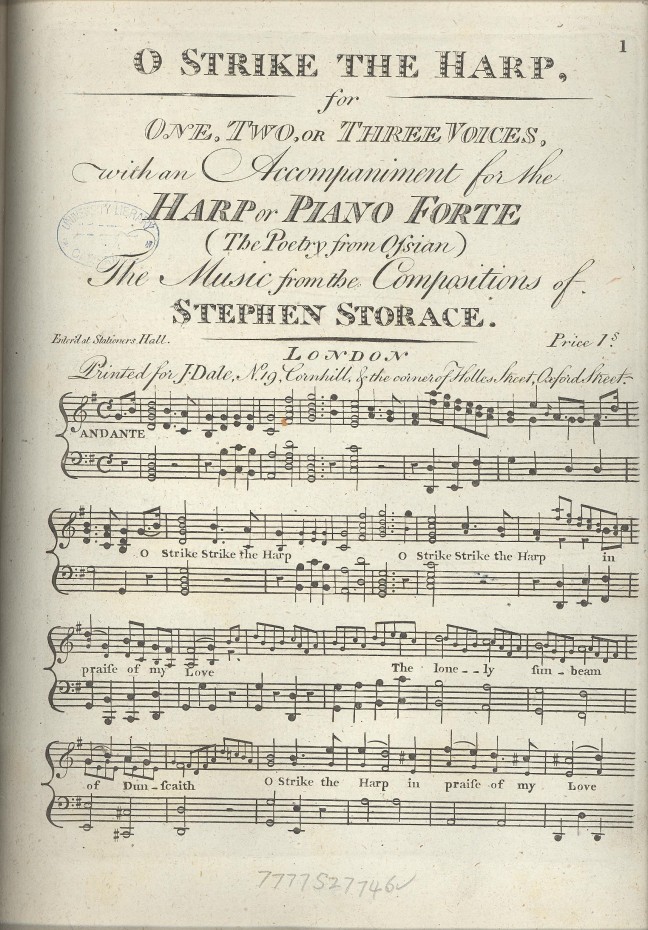 Well, yes! Coincidentally, I used an image of this very song in my write-up of Sandra Tuppen’s Big Data talk at IAML(UK & Ireland) 2015. See ‘ASW 2015: The Bigger, the Better – A Big Data History of Music’


 The title page of vol. 1 of the St Andrews copy of The Scots Musical Museum.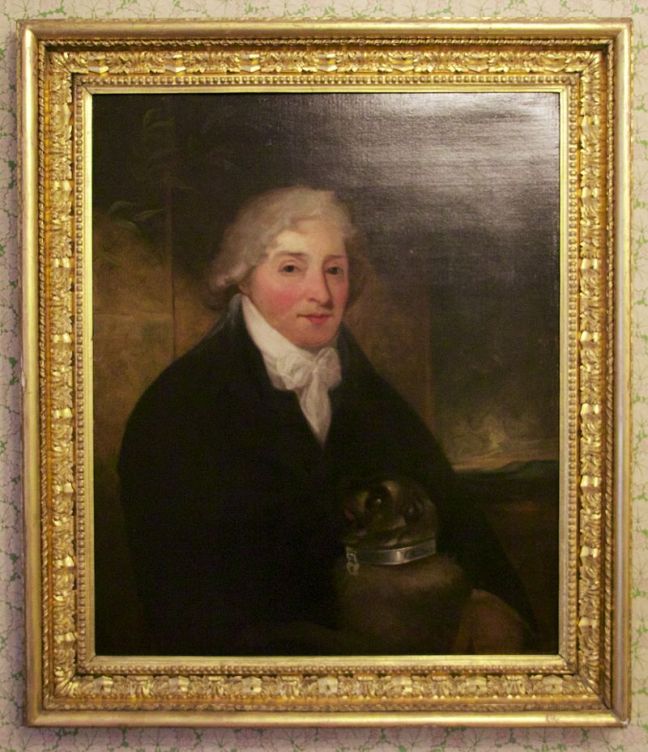


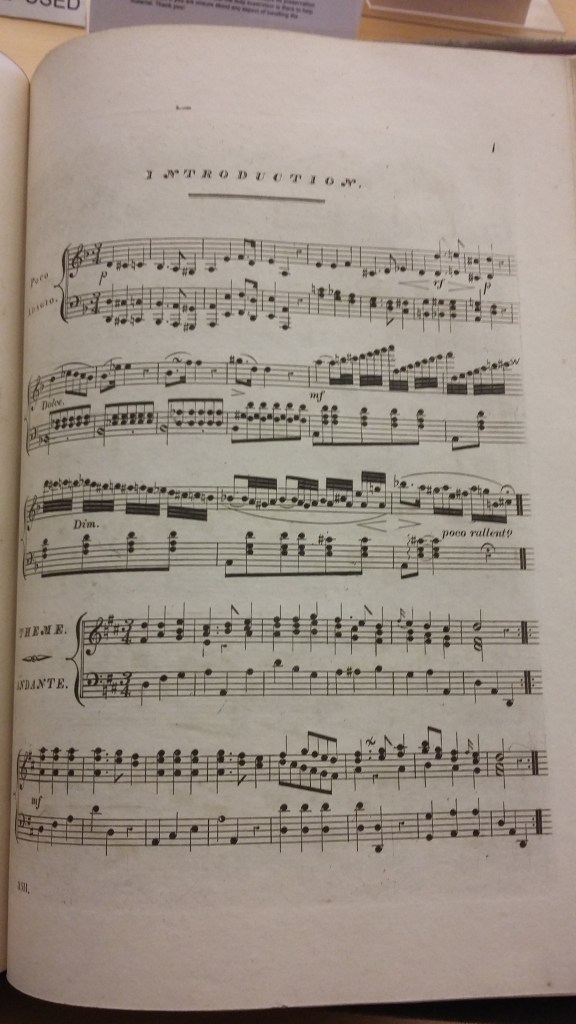

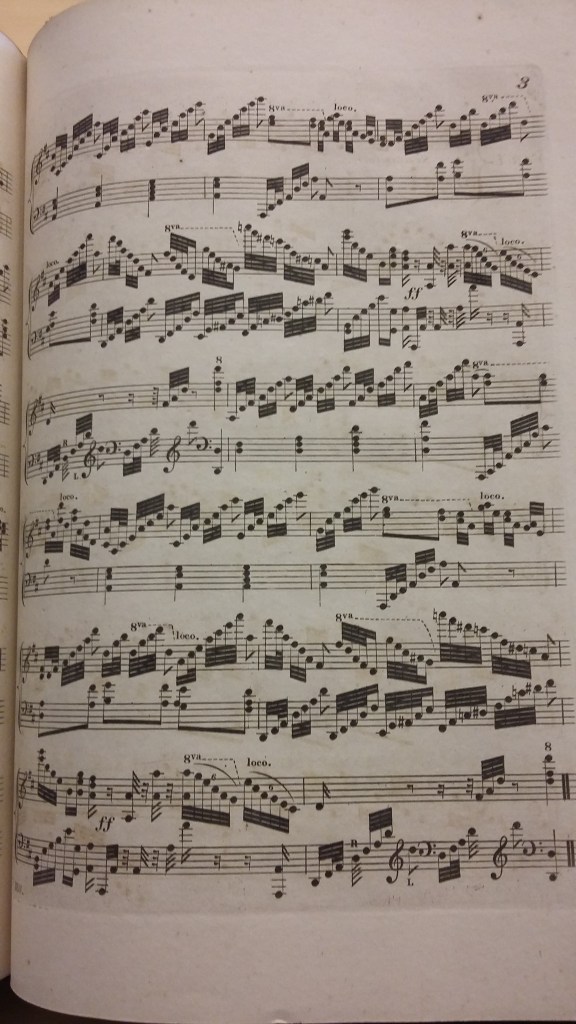
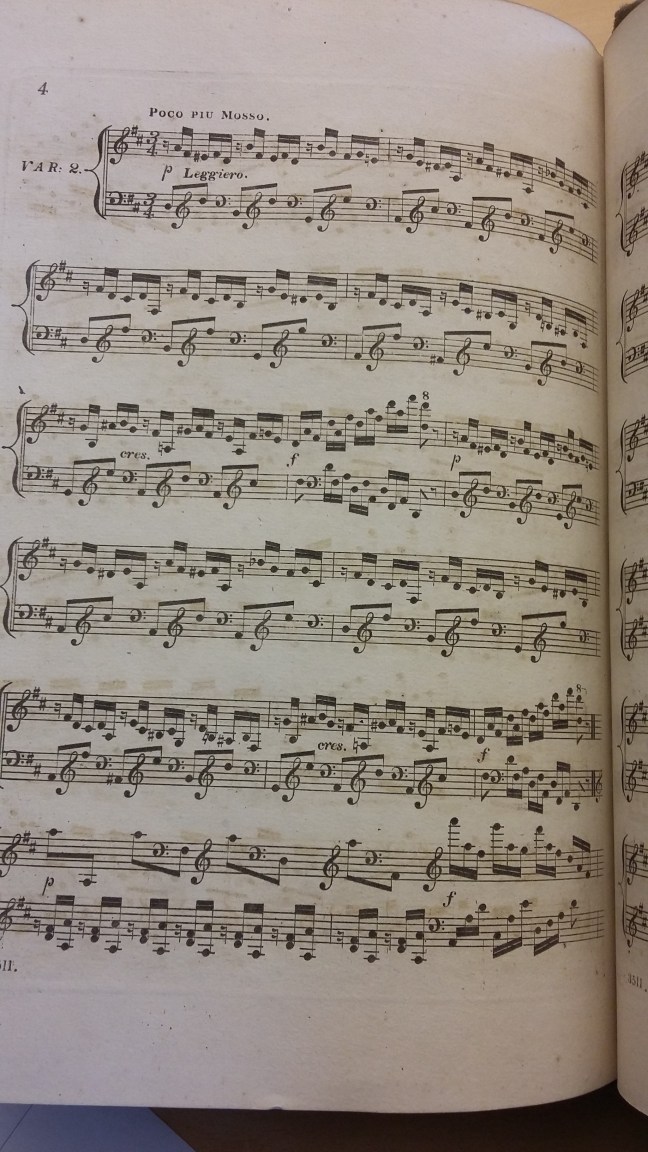


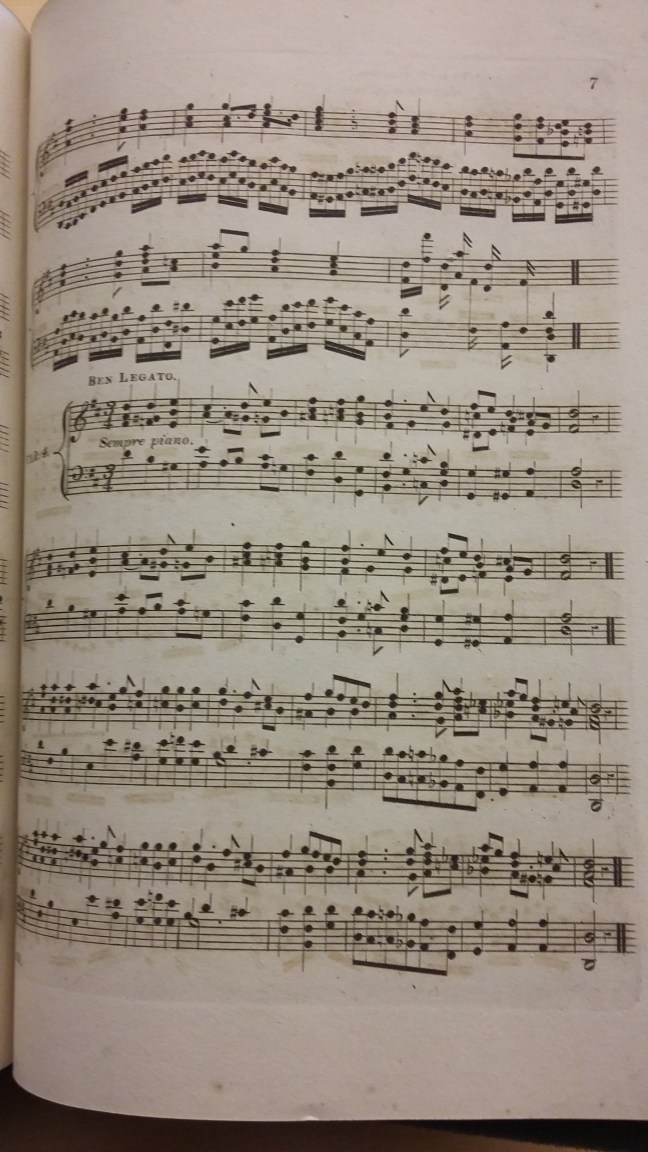
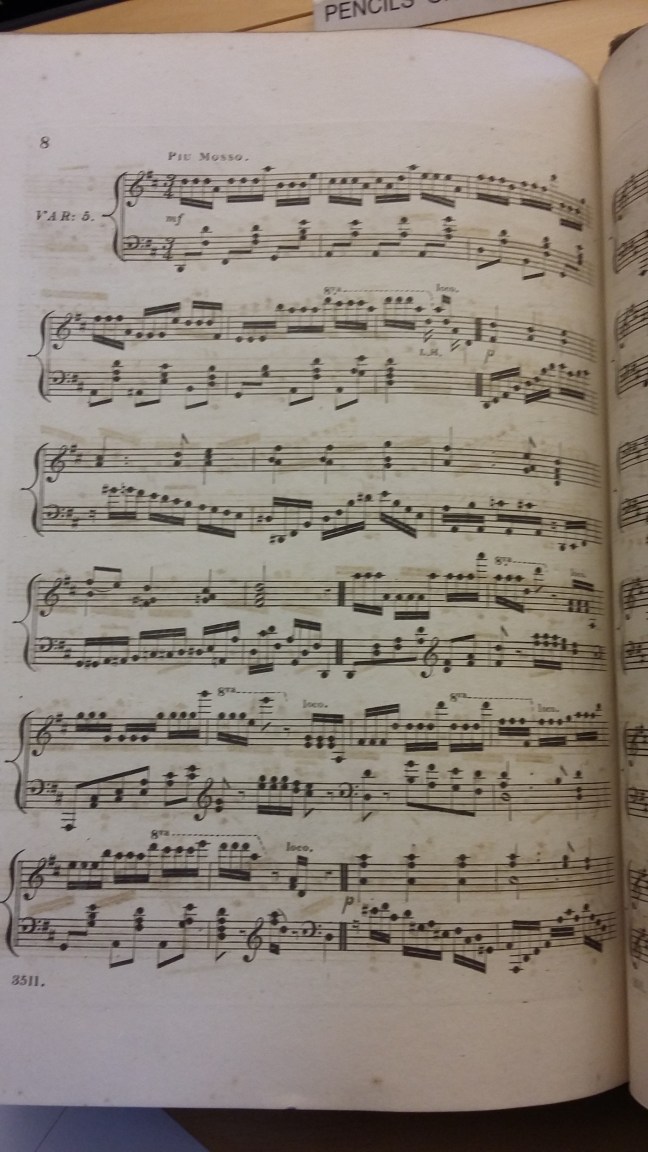
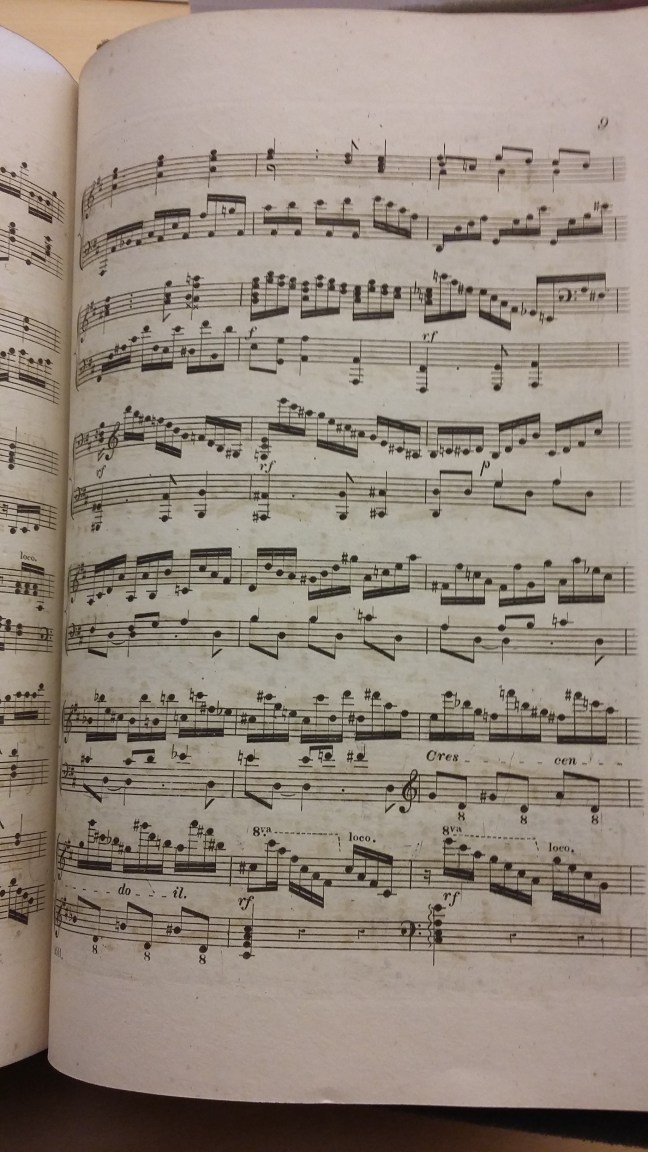
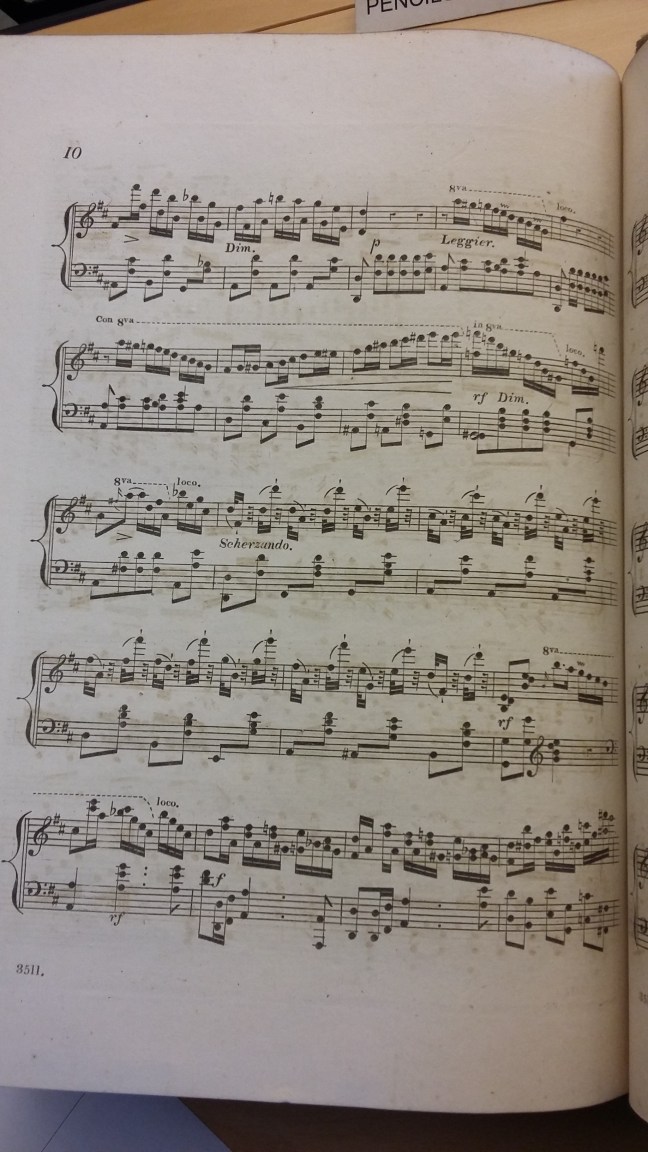
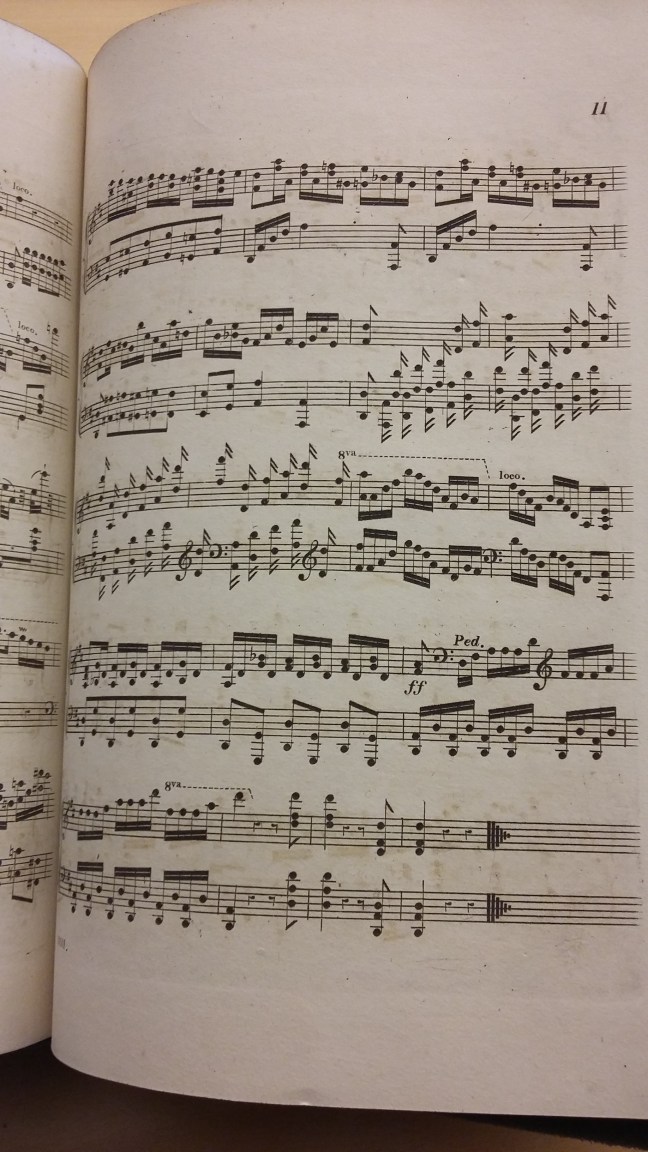
 During the reign of King George IV, Johann Peter Pixis wrote his Hommage a Clementi, a set of piano variations on ‘God Save the King’, op.101. Published in 1828 by S. Chappell, and also distributed by Henry Lemoine, copies went to all the copyright libraries. As I’m transcribing each item on the two Advocates’ Library music lists, I’m looking to see where copies survived, and it’s rare to trace such near-complete coverage as I did with this piece. Playing my game of ‘Happy Families’ with the list dated March 8th, 1830, I checked off an almost complete set still extant, in Aberdeen, St Andrews, Glasgow, Oxford, Cambridge and the British Library. Clearly, variations on ‘God Save the King’ were generally considered worth keeping. Indeed, St Andrews and Cambridge each hold two copies. The popularity of the tune is corroborated in a recent book,

 Karen McAulay, Musicologist