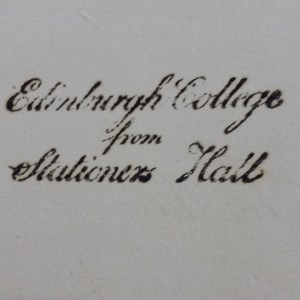
Yesterday was spent in Edinburgh, examining an armful of old bound music volumes in Edinburgh University Library. These are the volumes with “Edinburgh College from Stationers Hall” stamps – possibly NOT the only legal deposit survivors, but potentially the only identifiable ones at present. They also stand as a reminder that one should not leap to conclusions – every picture can be looked at from different angles and in different lights. So, we can’t – at present – say that the Edinburgh professors retained no instrumental music, but we do know that they kept some sacred music, some national songs, and a rather turgid-looking tome on the thorough bass. Other items could perhaps be bound in other volumes, unmarked and unrecognised – there isn’t a neatly ordered sequence of reasonably categorised copyright music, as in St Andrews, or a neatly ordered sequence of randomly-bound pieces, as in Aberdeen.
The instructional volume was A. F. C. Kollmann’s, A second practical guide to thorough bass. (It was printed for the author, who lived at Friary, St James’s Palace, in 1807, and was available either from Kollmann or “the principal music shops”), initialled by Kollmann on the title page. A similar copy in Copac is described as a “library copy”, which I think probably means it was a legal deposit copy. Kollmann was Organist of His Majesty’s German Chapel at St James, and this was the sequel to an earlier guide. It was dedicated to Her Royal Highness Princess Sophia Matilda. (How fortunate she was!) The bound volume contains further delights in the form of his Twelve Analysed Fugues, not to mention his Rondo on the Chord of the Diminished Seventh, and The melody of the hundredth psalm, with examples and directions for an hundred different harmonies, in four parts … op.9. The final Kollmann item in this book is An air from Handel’s lessons, with nine variations for the piano forte. There are numerous sacred pieces, not by Kollmann, but someone evidently felt there was room for a few more items before they sent Sacred Music Vol.1 (Shelfmark R.5) off to be bound.
I also saw a curious mishmash of an oratorio – a sad, bedraggled specimen by William Gardiner, who compiled Judah, a sacred oratorio in score, written, composed, and adapted to the works of Haydn, Mozart, and Beethoven (London: printed for the author and sold by Clementi, Birchall, Preston, Goulding, Chappell, & The Harmonic Institution &c, [1821]). It’s a full score, with brief instrumental interludes between larger choral sections, but strangely enough, the instrumental parts are not printed in score format, but one under another – they’d have had to be copied out. One wonders whether it ever saw the light of day after reaching the library – is it bedraggled through heavy use, or has it suffered a lengthy period of neglect in the past?! It is now at Shelfmark R.1, if you want to seek it out!
When less is more
When there’s apparently not much to look at, the only answer is to look more closely. I noted what was in each of the volumes, and a few key dates, establishing that the music all dates from the first three decades of the nineteenth century. I look for patterns of content, date or publisher, and when I’ve time, I check to see how many other libraries still have the same music.
The survival of several national song collections yet again confirm the popularity of this genre – Popular National Airs by Moore, Bunting’s A general Collection of the ancient music of Ireland, Kitchiner’s Loyal and National Songs of England and his The Sea Songs of England , and English-published collections of German and Russian songs – Arnim’s A Selection of Germany National Melodies, and the anonymous The Russian Troubadour. They’re interesting, not just as legal deposit specimens, but because of their paratextual commentary, revealing early 19th century views of English music – or, often, perceptions that the English had no national music!
It was strange turning the pages of these books and finding the same view emerging from three different authors, one after another. In 1818, Moore’s advertisement began,
“It is Cicero, I believe, who says “natura ad modos ducimur;” and the abundance of wild, indigenous airs, which almost every country, except England, possesses, sufficient proves the truth of this assertion.”
Only a couple of years earlier (1814-16), Arnim’s dissertation, “On National Music” goes through the national characteristics of a number of countries, until we reach England on page 4. Reader, there is good reason why the English have no national music – we’re apparently too busy!
“England may perhaps be said not to possess any national music at all. There are, no doubt, songs, yet it would be very difficult to recognise by them the character of the nation. To find out the cause of this singular phenomenon, in such a celebrated and great nation, will prove an interesting enquiry.”
It goes on, describing how national music reflects national character, and how English songs, “appear gay, although not very lively, and therefore pleasing, without producing a deep and lasting impression […] “But allowing the English to have strong passions, there exists another reason which explains the absence of national music in them; it is, they have no leisure to exhale their character in songs.”
Fortunately, in 1823, Kitchiner reports in his The loyal and national songs of England that although it has been said that, “the English have no national songs”, he can furnish a whole volume of them to disprove the theory. Two volumes, if you count the sea song book published the same year!
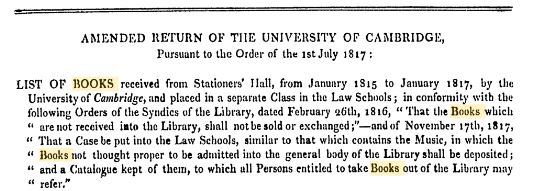
While there, I also looked at some archival documentation, though I didn’t get through as much as I had ambitiously hoped to survey. I did find the reference to Stationers’ Hall music and books being sold in 1793 – Finlayson and Simpson alluded to this in Guild and Law’s book about Edinburgh University Library. I had wondered if these sales were the tip of the iceberg, but after skimming through one and a half books of monetary receipts, I reluctantly concluded that the reference was either a one-off, or other sales must have been recorded elsewhere. Possibly not so much the tip of the iceberg, as a solitary ice-cube!
 Help!
Help!
I had intended to look at some library receipt books (loan registers), but ran out of time. Does anyone fancy a quick romp through Da.2.3 (1766-1812), Da.2.4 (1805-1815) or Da.2.6 (Surgeons and others beside the professors, 1770-1810, 1784-1809), to see if any music loans can be traced? In St Andrews, it was easy. Music loans are noted as such – eg., “Music Vol.116”, so they jump out and hit you. This may well not be the case in other libraries, and of course we also don’t know how much more – if any – of the copyright music was bound.


 Waiting with bated breath to see if I’ll make it to the antipodes, this week I continued my explorations closer to home, visiting the National Library of Scotland yesterday to investigate music committee meetings at the Advocates Library in 1831-2, and later in 1856. The Advocates Library (later to be absorbed into the National Library of Scotland) was one of the Scottish copyright libraries, so received the quarterly consignments of legal deposit materials, and indeed continued to receive them after the legislation had stripped most universities of legal deposit entitlements in 1836.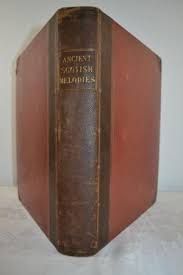
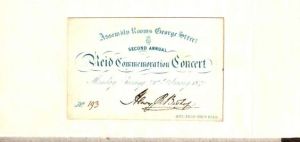 to be sure of his identity, though there certainly



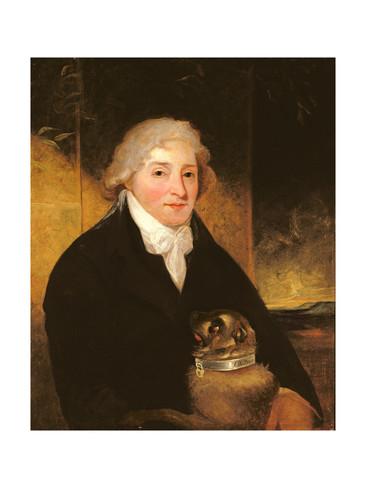 On 19th September 1797: Singer and singing teacher Rauzzini registered no.7 of his Periodical Collection of Vocal Music. Few copies survive, and it’s a bit hard to tell which volume contains no.7, though I know an expert who could probably locate it!
 Also OTD in 1797, Bland & Weller registered James Hook’s Vauxhall Gardens song, Maidens would you know?, along with Hook’s Welsh song, Jem of Aberdovey, and his When the sprightly fife and drum. It’s all pretty typical fare – a song by a popular Bath impresario, and some Vauxhall Gardens songs including a ‘national’ and a military song, by composers still (just) known today. As it happens, there were also imprints of another ‘Jem’ song by Hook under English, Irish and Scottish imprints – Jem of Aberdeen! – but that’s not part of the 19th September story. You can trace a few copies in Copac, but certainly not in all of the legal deposit libraries.
 Meanwhile, exactly two hundred years ago yesterday, Bath musician John Charles White registered his piano rondo, The Fairy Queen on 19th September 1817. There are seemingly three surviving copies in the UK. However, there could be further copies of any of the aforementioned titles, because not all of the early legal deposit music has been catalogued online. That’s the intriguing part of this story!

 Driving back through heavy showers, I was largely oblivious to the weather. I had a pageful of notes to think about and follow up, and the possibility of further future contact. The Aberdeen-Norfolk connection is indeed a good thing, and I’m delighted to have made contact again after a gap of several years.
 Karen McAulay, Musicologist