Networking with Other Networks: Romantic National Song

I’ve mentioned before that I am a member of the Romantic National Song network, spearheaded by scholars at the University of Glasgow. There’s a lot of new content on the website today, so I’m happy to share some links which you might enjoy.

The new content website includes the concert video, programme and gallery and two new blog posts reflecting on the concert.

Please do share with interested colleagues. If you use social media, please share or tag @UoG_RNSN!

Networking With Other Networks: Romantic National Song Network (Scotland)

Flower tile cream turquoiseAs I’ve mentioned recently, this is another network with which I’ve been involved.  Last week, the new website of the Romantic National Song Network was launched – and yesterday, my contributed guest blogpost about a Scottish song – Afton Water – went live. It draws heavily on my doctoral research into Scottish song-collecting, but I like to think that my present interest in the wider context (collecting, publishing, curating) has also influenced my approach.  I was certainly very glad of the National Library of Scotland’s Digital Gallery, which I can’t praise enough!

So here’s my blogpost:-

Romantic National Song Network – Scotland

My own personal thanks to Special Collections and Archives at James B. Duke Library, Furman University (Greenville, SC), for supplying one of the images used in my guest blogpost.

Networking with other Networks: Romantic National Song Network website

spider-web-with-water-beads-921039__340

Simultaneously with instigating the Claimed From Stationers’ Hall research network, I’ve also been involved with another network based at the University of Glasgow – the Romantic National Song Network.  The website has literally just gone live, and I’m delighted to share the announcement, sent to me by Dr Brianna Robertson-Kirkland, Research Assistant to RNSN.  Do visit the website and take a look – you’ll find some fascinating stories!

Homepage of the Romantic National Song Network: https://rnsn.glasgow.ac.uk/

As Brianna says,

“I  am pleased to announce that our website is now live and we have some fantastic content available.  Can I draw your attention to Kirsteen’s blog post which tells the story so far: https://rnsn.glasgow.ac.uk/rnsn-so-far/

Also – A wonderful blog by Isabel Corfe who was invited to attend the British Library meeting in June: https://rnsn.glasgow.ac.uk/erin-go-bragh/

And the first of our song stories; True Courage by Charles Dibdin created by our very own Oskar Cox Jensen: https://rnsn.glasgow.ac.uk/true-courage/

As we approach the concert which will be taking place at the Royal Conservatoire of Scotland on Monday 18th March at 6pm we will be releasing regular content, so please do share across your colleagues.

We also have a brand new Twitter page @UoG_RNSN so if you are a Twitter user, please do follow, share and retweet!”

BRK, Research Assistant, Romantic National Song Network

Caught Up With Mr Greenhill At Last!

St Pauls Silhouette

It’s about a year since I visited Lambeth Palace and the British Library, making a minor detour via St Paul’s and Stationers’ Hall (virtually in the shadow of St Paul’s) on the off-chance of making an impromptu visit to the Hall. I wasn’t surprised to be disappointed on that occasion; I hadn’t expected to have time to drop by, which is why I hadn’t made an appointment.

Today, I had booked an appointment in advance, and had the pleasure of poring over one of Mr Greenhill’s registers – I’d chosen the one that began at the end of June 1817, and I just had time to look at the records for one year. For all the complaints about Mr Greenhill and his inefficiency or inability to collect all the legal deposit copies for the receiving libraries, I now have one thoroughly good thing to say about him: his handwriting is beautifully legible! Everything nicely spaced out, not sprawling or squidged into the end of a line or bottom of a page. Indeed, there were some days when he must have done little else than sit or stand and carefully inscribe book details into his ledgers – there were so many detailed entries, even two hundred years ago!

If you’ve used Kassler’s index of Stationers’ Hall music, you’ll know that the last few years are less detailed, because they came from a different source – William Hawes’ abbreviated copy from the registers for 1811-1818. This is why I wanted to see a register from this era, because I guessed there would be more to see. There was!

I was also curious to know how long it might take to transcribe the music entries from 1819-1836. I didn’t try timing myself, though, because I got interested in other aspects of the registration process. It’s lucky I had taken my own copy of Kassler with me – the pages for late June 1817-1818 are now carefully annotated in pencil, and I have work to do when I get back to Glasgow. I’ve had an idea! More of this very soon. I might have found the data-slice that the network has been looking for – it fits in rather nicely with some other threads I’ve been pursuing.

This afternoon, I also paid a visit to my opposite number in the British Library to mull over possible future directions for the Claimed From Stationers’ Hall research network. Whilst “Big Data” is appealing, there are also other ideas worth considering – which might indeed help acquire the big data that we need. We’ll see!

Illustration
Tomorrow, I’m spending the day at the EFDSS (English Folk Dance and Song Society) conference, and giving a paper about national airs in Georgian British Libraries. It gives me a great deal of pleasure to have the opportunity to combine my doctoral interests in national song collecting, with my postdoctoral interest in repertoires and library collections on a national scale. Here’s my Powerpoint: National Airs in Georgian British Libraries(You’ll also find it listed on the Calendar page of this website.)

No archival pictures today, I’m afraid. I was far too busy annotating my copy of Kassler’s Hawes appendix! But, since a posting is dull without a picture, I’ve shared a familiar outline – and the image from the conference website – with you …. !

Expedition to Eire

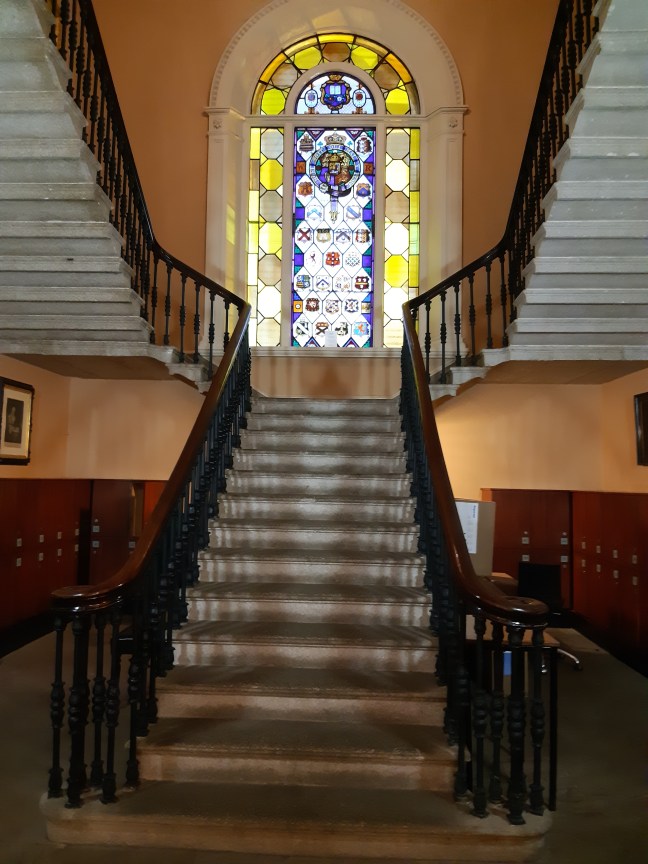
2018-11-06 16.36.40I’m writing this from Dublin! I’ve spent a fascinating day delving through absolutely enormous guard-books at King’s Inns Library – a historic legal library – and tomorrow I head to Trinity College Dublin.

I won’t write about what I found today, because I need to assimilate it and ask a few more questions about some of the volumes.  But to whet your whistle, I thought I’d share just a few striking pictures.


2018-11-06 13.39.36

2018-11-06 15.40.05
Long ago, a librarian used whatever tape came to hand …!

Nathan’s Hebrew Melodies, to words by Byron

Lord Byron-c.-1826-1828-by-Thomas-Sully-696x529
Image of Lord Byron, from Wikipedia. Artist: Thomas Sully

As I’ll be talking about “national songs” in my conference paper at Cecil Sharp House next weekend, I’ll be making the most fleeting of references to the poet Byron’s Hebrew Melodies, set to music by Isaac Nathan.  Fleeting, because despite Nathan’s claims, very few of the melodies (and it’s a very fat vocal score!) have the remotest connection with Jewish music.  There’s a long and well-referenced article about them on the Newstead Abbey Byron Society website, so there’s no need for me to summarise it all here.  The most pertinent sentences from my point of view are those giving lie to all Nathan’s claims of authenticity.  As I know only too well from my Scottish song-collections doctoral research, authenticity was frequently claimed but seldom genuine.*

I don’t know the name of the author who wrote the Society’s essay, but I’m happy to quote the link here, along with the extracts that I’ve selected to share:-

“There was nothing new in the project. Nathan, and to an extent Byron, were cashing in on a vogue for nationalist airs from minority cultures or oppressed peoples in all corners of the globe. The market was flooded with Scottish, Welsh, Indian, and of course, from Thomas Moore, Irish Melodies. The ethnic authenticity of none of such scores could be relied on.” (p.2)

““Wildness and pathos” are a long way off. Only seven of them have been identified as
having Jewish music in them. They are: She Walks in Beauty, Oh! Snatched Away in Beauty’s Bloom, The Harp the Monarch Minstrel Swept, My Soul is Dark, Jephtha’s Daughter, On Jordan’s Banks, Thy Days are Done.” (p.4)

Source (49 pages, published later than 2002, accessed 1 November 2018):-

http://www.newsteadabbeybyronsociety.org/works/downloads/hebrew_melodies.pdf 

I have also found a pdf of Nathan’s Hebrew Melodies, in a rather poor reproduction, but it’s better than nothing! There are 262 pages – I don’t think I’ll be printing them out!

http://ks.imslp.net/files/imglnks/usimg/0/08/IMSLP221262-PMLP365149-Nathan-HebrewMelodiesBW.pdf

If you’d like to read my own writing about authenticity in the Scottish song context, you can find my doctoral thesis online at the University of Glasgow, or read the augmented and improved book that followed a few years later!  (It’s available in paperback, hardback and as an e-book.)

  • Our Ancient National Airs: Scottish Song-Collecting from 1760-1888 (Thesis, 2009)
  • Our Ancient National Airs: Scottish Song-Collecting from the Enlightenment to the Romantic Era (Routledge, 2013)

“England has no National Music”? Chappell set out to refute this!

In yesterday’s posting, I quoted from William Chappell’s Collection of National English Airs (1838-1840), which explained the motivation behind his first big collection.  Twenty years later, he published his Popular Music of the Olden Time, and he was by now even more determined to refute the allegation.  Here he is in the Introduction to PMOT:-

“I have been at some trouble to trace to its origin the assertion that the English have no national music.  It is extraordinary that such a report should have obtained credence, for England may safely challenge any nation not only to produce as much, but also to give the same satisfactory proofs of antiquity.  The report seems to have gained ground from the unsatisfactory selection of English airs in Dr Crotch’s Specimens of various Styles of Music; but the national music in that work was supplied by Malchair, a Spanish violin-player at Oxford, whose authority Crotch therein quotes.  It is perhaps not generally known that at the time of the publication Dr Crotch was but nineteen years of age.  No collection of English airs had at that time been made to guide Malchair, and he followed the dictum of Dr Burney in such passages as the following:-

“It is related by Giovanni Battista Donado that the Turks have a limited number of tunes … till the last century, it seems as if the number of our secular and popular melodies did not greatly exceed that of the Turks …”

“Again, in Shakespeare’s Midsummer Night’s Dream … Burney inverts the stage direction and adds [here Chappell quotes a very derogatory list of old English national instruments!] …

“Dr Burney’s History is one continuous misrepresentation of English music and musicians, only rendered plausible by misquotation of every kind.”

(PMOT, Introduction, vi-vii)

Chappell’s book is a delight to read, because it is so informative about the contemporary view of so many aspects of music history – even if (as I’m reliably informed) he has got his facts wrong about Malchair’s ethnicity and Crotch’s age!  Moreover, even on the very first page, he writes about his sources, emphasising the importance of the British Museum (now the British Library collection), and acknowledging that he was also granted permission to examine and make extracts from the Registers of the Stationers’ Company to assist him in dating the airs.  (He was also familiar with the Bodleian and Ashmolean Libraries, the Society of Antiquities, the public library in Cambridge, Cheetham Library, Lincoln’s Inn Library, Marsh’s Library and Trinity College Dublin’s, the Advocates Library in Edinburgh, University of Ghent, and this is just a quick overview, not mentioning the many private individuals that he networked with.)

In both Chappell’s books, he writes about the era of “merry England”.  The era can be taken to encompass the fifteenth to seventeenth centuries, as is implicit in Ronald Hutton’s modern book, The rise and fall of merry England : the ritual year, 1400-1700 (2001).  Indeed, shortly after Chappell’s first collection appeared, George Daniel published Merrie England in the Olden Time (2 vols, 1842), which Chappell cited several times (inconsistently as “Merrie” AND “Merry” England) in PMOT, in a couple of instances specifically concerning the year 1691 .