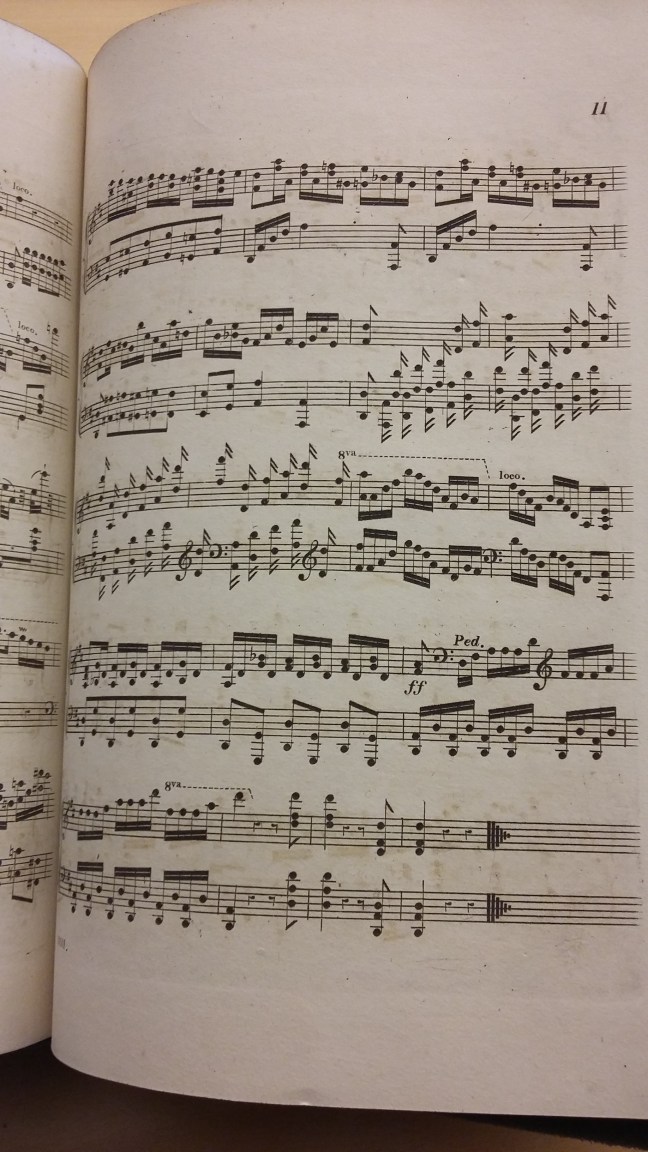
Curation and Documentation

In our research into the legal deposit music collected in British libraries during the Georgian era, a key thread is obviously the histories of individual collections between then, and now.  Two hundred years is a long time, so contemporary evidence is significant.

For example, in 1826, the pseudonymous Caleb Concord wrote in the (short-lived) Aberdeen Censor that the students at Aberdeen’s Marischal College should be more concerned about what had happened to the legal deposit music that had been claimed by Aberdeen’s other higher education institution, King’s College.  Corroborating this, Professor William Paul, who had once been librarian at King’s College, told an official commission in 1827, that he believed some of the music had been sold at some time before he went to the college, ie, before 1811.  (Commissioners for Visiting the Universities and Colleges of Scotland, Evidence, Oral and Documentary, Taken and Received by the Commissioners … for Visiting the Universities of Scotland.  Vol.4, Aberdeen (London: HMSO, 1837).  There is evidence for Stationers’ Hall music having been sold at Edinburgh University in the late eighteenth century, too.

In St Andrews, by contrast, there are not only archival records documenting senate decisions about the library, but also the borrowing records, which I’ve written and blogged about quite a bit over the past couple of years – not to mention the handwritten catalogue by a niece of a deceased professor of the University.  A payment was made to her in the 1820s, but the catalogue continued to be updated until legal deposits ceased to be claimed by the University in 1836, when the legislation changed. (Miss Lambert married and moved to London in 1832, so the later years were not completed by her.)

Bibliographic Control

In the middle few decades of the nineteenth century, some of the libraries began to attempt better control and documentation of their music.  However, I don’t propose to write about every legal deposit library in this posting, because my main reason in writing today is to share a small but interesting excerpt from William Chappell’s first book about English national songs.  Now, in my own doctoral thesis and subsequent book, I focused on Chappell’s later work, Popular Music of the Olden Time (1855-1859), and its later iteration, Old English Popular Music.  I mentioned that PMOT had grown out of his earlier Collection of National Airs (1838-1840), and I highlighted a few key features of that work.

A Rare Find
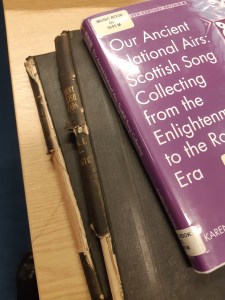
2018-08-17 11.12.52Today, sifting through a library donation of largely 20th century scores, I was astonished2018-08-17 11.15.05 to lift two obviously older volumes out of one of the boxes.  We’re now the proud owners of the third set of Collection of National Airs known to be held in Scotland.  Since I haven’t looked at this title for a decade or so, I leafed through both volumes briefly, to remind myself what they were like.  (The volumes had belonged to a Mrs Chambers, and either she or a young relative had practised their drawing skills on the flyleaves, but we’ll overlook those for now!)
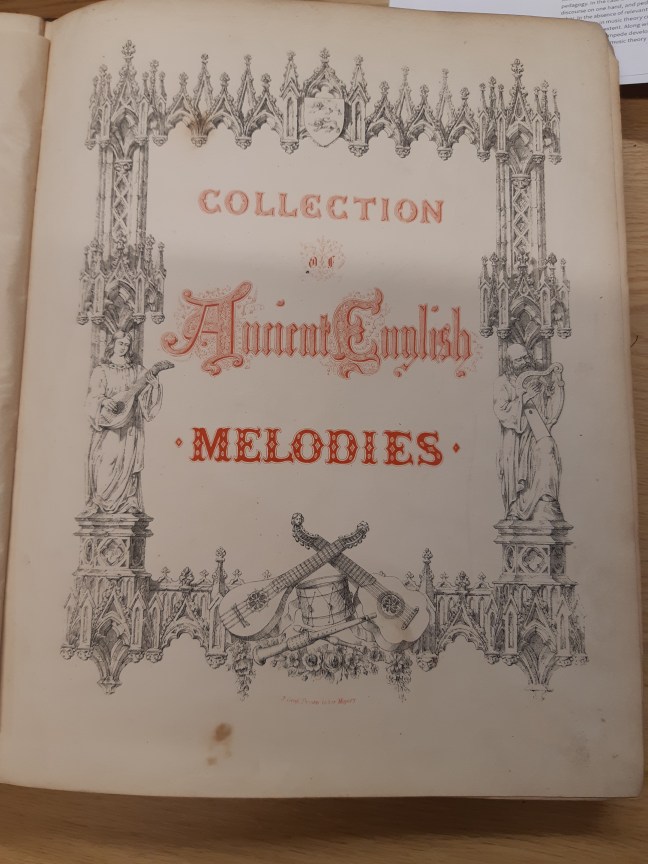
2018-08-17 11.13.56Chappell’s work is in two volumes: the first contains the subscriber’s list and a preface, with the rest of the volume devoted to the tunes themselves. The second volume contains commentary, winding up with a conclusion and then an appendix.

England has no National Music

The preface opens with the words which have echoed (metaphorically speaking) in my ears since I first read them:-

“The object of the present work is to give practical refutation to the popular fallacy that England has no National Music,- a fallacy arising solely from indolence in collecting; for we trust that the present work will show that there is no deficiency in material, whatever there may have been in the prospect of encouragement to such Collections.”

Of course, Chappell was preoccupied with national songs (“folk songs”) and ballads – as was I, at the time I first read it.  So I hadn’t paid attention to a footnote later in the Preface.  But, as I read on, there it was – William Chappell commenting on the legal deposit music in what is now the British Library!  It is clear that the music – in Chappell’s eyes, at any rate – was in need of organisation.  (We now know that  it was much the same in Oxford, Edinburgh or Edinburgh’s Advocates’ Library – the forerunner of the National Library of Scotland.)

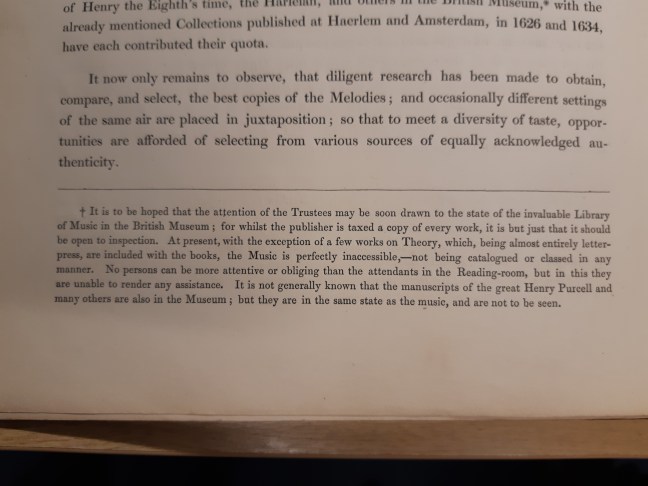
On page iv, Chappell named various key collections of British tunes, naming the British Museum (the forerunner of our British Library) as the repository for some of these collections.  A footnote afforded him the chance to make an aside about the contemporary custodial arrangements there.

Attentive, Obliging … Inaccessible, Not Catalogued

It is to be hoped that the attention of the Trustees may be soon drawn to the state of the invaluable Library of Music in the British Museum; for whilst the publisher is taxed a copy of every work, it is but just that it should be open to inspection.  At present, with the exception of a few works on Theory, which, being almost entirely letterpress, are included with the books, the Music is perfectly inaccessible, – not being catalogued or classed in any manner.  No persons can be more attentive or obliging than the attendants in the Reading-room, but in this they are unable to render any assistance.  It is not generally known that the manuscripts of the great Henry Purcell and many others are also in the Museum; but they are in the same state as the music, and are not to be seen.”
2018-08-17 11.09.45

Changing the subject, it’s interesting for us as modern readers to note that Chappell’s conclusion at the end of the second volume winds up with a sorrowful observation about the decline in musical education, since an unspecified time when music was a key part not only of a young gentleman’s education, but also of young children’s.

Merry England

“The Editor trusts, however, that he has already satisfactorily demonstrated the proposition which he at first stated, viz. that England has not only abundance of National Music, but that its antiquity is at least as well authenticated as that of any other nation.  England was formerly called “Merry England.”

Music taught in all public schools

“That was when every Gentleman could sing at sight;- when musical degrees were taken at the Universities, to add lustre to degrees in arts;- when College Fellowships were only given to those who could sing;- when Winchester boys were not suffered to evade the testator’s will, as they do now, but were obliged to learn to sing before they could enter the school;- when music was taught in all public schools, and thought as necessary a branch of the education of “small children” as reading or writing;- when barbers, cobblers and ploughmen, were proverbially musical;- and when “Smithfield with her ballads made all England roar.” Willingly would we exchange her present venerable title of “Old England,”, to find her “Merry England” once again.”

Chappell should read the commentary in today’s social media about the self-same topic!
 

Students but not at University?

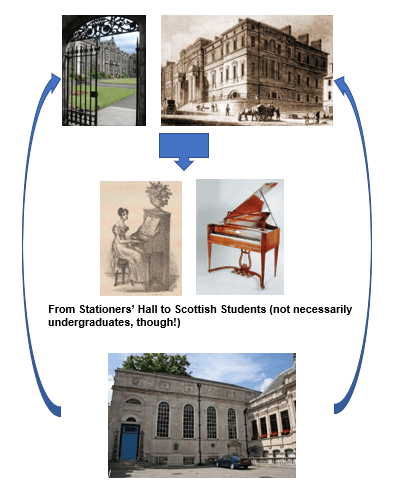
Stationers Hall to Scottish Students

Although, as we’ve seen, some Georgian legal deposit libraries didn’t actually want to retain music – after all, it wasn’t yet a university subject – the pattern of retention was varied to say the least.  The University of St Andrews kept quite a bit of music.  Meanwhile, the University of Edinburgh retained some but certainly not all that was on offer.  However, there’s one category of musical material that seems to have been deemed worth keeping, and that was pedagogical material.  I had already noticed quite a bit of it at the University of St Andrews, and I did a bit of research into who borrowed what kind of material.  Bear in mind that an ability to play the piano was quite desirable for the well-bred young Georgian miss.  When I started looking at the Edinburgh collection more recently, I was interested to see that music teaching books were popular there, too.   I wonder if the Edinburgh professors ever borrowed music for their daughters and friends in the same way the St Andrews chaps did?

I plan to see what I can identify on the Edinburgh spreadsheets, and see how it maps across with the St Andrews collections, just to see if there’s much overlap.  It’ll be a bit hit-or-miss, but a quick survey will tell me if there is an interesting story to be uncovered.  Coincidentally, I did once wonder if any students at my workplace might be interested in the history of piano pedagogy.  Little did I realise that I might eventually be the one getting interested in much earlier material in a research capacity!

If I got interested in all of the pedagogical material published between 1780 and 1840, it would be a bit like Alice disappearing down a rabbit-hole, so I’m inclined to focus on one category in particular: the teaching of “thorough bass” (aka “figured bass”) and harmony – in other words, on theory, more than instrumental technique.  And if I were to find a few observations about teaching music theory to girls and women, then that would be an added bonus, wouldn’t it?  You wouldn’t expect the approach to be different, but it would be interesting to notice any remarks made specifically to them.

Here’s a thought, to start with.  After his opening preface, Latour’s thorough bass tutor is heavy on musical examples and light on text, which is a little disappointing given my predeliction for paratext.  Nonetheless, in that opening preface, we learn that he aimed to teach “what a young Lady ought to know, viz: to be able to accompany the Voice with propriety, to play from a figured Bass, and to compose her own Preludes, Variations, &c.”  From this, we can tell that the “young Lady” was not expected merely to be a performer, but to compose (or improvise?) as well.  And the pages of examples that follow provide a good introduction to generating variations – perhaps on popular songs, such as the many sets of variations on national and operatic airs that abounded in the early nineteenth century.

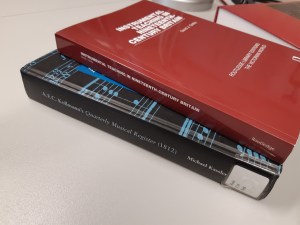
If one instructional treatise tells us this much, how much more might the others reveal?!  2018-08-30 10.28.25I have a new book that I need to start reading: David J Golby, Instrumental Teaching in Nineteenth-Century Britain (Routledge, 2016 ) – originally an Ashgate imprint, 2004.

 

They kept it WHERE? In a doocot?

Doocot Dovecote St Marys University of St Andrews
Image from http://www.saint-andrews.info/features.html

Tweeted today!  “At one point in the early 20th century, the #LegalDepositMusic @StAndrewsUniLib was in a doocot (dovecot) – would it be the one at 46 South Street, I wonder?”

— StationersHall Music (@ClaimedStatHall) April 18, 2018

I’ve been writing up notes from our March workshop. Surveying the list of unlikely places for music to be kept, I think St Andrews gets the prize for the unlikeliest – not in an attic or tower, nor in piles on the floor, but in a dovecot, of all places!  And I think this is it … at the School of Divinity, St Mary’s College, in the University of St Andrews.  Please correct me if I’m wrong!

Copyright ABCs – ‘The Scots Musical Museum’

Posted on the very excellent Echoes from the Vault blog by the capable and insightful Special Collections team at the University of St Andrews, another interesting article touching on the Copyright Collection there.  (And it’s about one of the seminal books in Scottish music, as I discussed in my book, Our Ancient National Airs …)

St Andrews Special Collections's avatarEchoes from the Vault

The Lighting the Past team share their highlights from the ‘M’ section of the Copyright Deposit Collection. You can see the previous posts in the series here.

Title page 1_1 The title page of vol. 1 of the St Andrews copy of The Scots Musical Museum. s M1746.J8S3 Vol. 1

While cataloguing the ‘M’ classmark (music) of the Copyright Deposit Collection, Lighting the Past discovered 5 volumes from The Scots Musical Museum, a 1787-1803 Edinburgh publication attempting to capture all Scots folk music and verse, amounting to 6 volumes once complete.

Robert Burns took a keen interest in the planned compilation project whilst in Edinburgh in 1787, writing ‘An Engraver, James Johnson, in Edin[burgh] has, not from mercenary views but from an honest Scotch enthusiasm, set about collecting all our native Songs and setting them to music.’ With Burns as the principal editor of vols. 2-4 (he died prior to the publication…

View original post 531 more words

Victorian Catalogues – This Might Help

Now

Copac searchWe tend to take catalogues for granted.  We expect them to tell us everything about a book, score or recording – author, title, publisher and publication date, pagination, unique identifying numbers (ISBN, ISMN or publishers’ code), and the contents of an album or collection of pieces. We look for the author or composer, the editor(s) – and expect to be able to know which is which.  In modern, online catalogues, this metadata is all carefully entered into special machine-readable fields as a “MARC record”.  That’s a MAchine-Readable Cataloguing record.
Not so Long Ago

When I began work as a librarian, I was taught how to catalogue onto pre-printed MARC data entry forms which the library assistants then entered into the library computer system.  Computer tapes were run overnight to upload the data to a cooperative system hosted in the Midlands, and shared by a number of libraries.  Things are more streamlined now!

A Couple of Centuries Ago

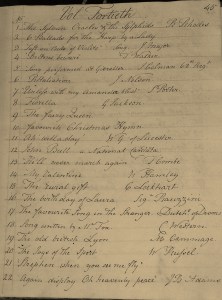
Vol 40 Miss Lambert catalogueBut what about our Victorian forefathers or the Georgians before them?  By the early 19th century, library catalogues of books were often prepared as printed volumes, but this wasn’t the case for the music I’ve been looking at.  Take the University of St Andrews’ handwritten catalogue made by Miss Elizabeth Lambert in the 1820s.  If there were (for example) three completely separate pieces making up a set of sonatas or songs, then it was not unusual for her to write a composite entry: “Three sonatas”, “Six Quadrilles on airs from Le Comte Ory” or whatever.
In 1831, a meeting of the Curators at the Advocates’ Library – the precursor to the National Library of Scotland – agreed that their copyright music had been handled with a worrying degree of laxity, and decided that things had to be tightened up by appointing a music committee.  Rules were drawn up regarding the handling and curation of this material, from arrival through to borrowing (yes, borrowing! It wasn’t yet a national reference library, after all) – not to mention calculating replacement costs and barring readers who had lost books, until they paid up!

However, it took until 1856-7 – by which time John Donaldson had become the Fourth Reid Professor at the University of Edinburgh – for the committee to decide that formal cataloguing rules were needed.  Donaldson was at least a musician. Several committee members seem to have been in the legal profession. They spent a week thinking about how to set about it, debating whether to enter items under the composers’ names, or the publishers.  And then they asked the experts at the British Museum.  They received, by return, the rules used for cataloguing music, and adopted them for their own use.

This week, I looked at the National Library of Scotland’s Victorian Catalogue.  I was trying to identify items on those two mysterious lists of music from 1830.  They presumably wouldn’t have been catalogued until after 1857, if I’m interpreting the facts right.  It took a little while before I realised just how far things have come since then!

Filing Systems

2017-12-06 15.28.25In the Victorian catalogue, music is entered alphabetically by composer, and then alphabetically by title within each composer’s output.  However, the alphabetical titles were often alphabetical by genre rather than by exact title, so Selected Marches might be followed by Fourth March then Fifth March and then would come Favorite Quadrilles on airs from Rossini’s Le Comte Ory.  (“Quadrilles” are alphabetically after “Marches”, and never mind about the words before them in the title!)  Today, we create “uniform titles”, which standardise titles for filing purposes.  By comparison, the Victorians had uniform titles in their heads but nothing like that on the catalogue slip!

Statements of Responsibility (aka, Entry Points)

This is modern library-speak for the names of people involved with creating the book or composition, whether they wrote, edited, or arranged it, or supplied some specialised service such as the fingering or bowing in a piano or violin piece, or indeed, writing an introduction or compiling an index at the end.  Things are sometimes a bit more complicated than that.

For example, if Halevy wrote a piece, then clearly he was the main author.  If he wrote a duet arrangement of themes in someone else’s overture, then in today’s parlance, he’d be the arranger.  If he wrote variations on a theme, then you could argue that he was an author in his own right – the variations wouldn’t exist without him writing them.  Thanks to online cataloguing, you’d find the piece regardless of what his contribution was, and in the case of sets of variations, the original composer of a theme would probably get a mention too.  (The rules are clear, but if you check Copac, you find that sometimes the same piece has been catalogued by different libraries with either composer as the main entry, because it’s admittedly a slightly grey area – it doesn’t matter hugely, so long as the piece can be found!)

IMAGES FROM AACR2 (Anglo American Cataloguing Rules 2nd Edition)

Now, in the days before online cataloguing, say, fifty years ago, an arranger or editor would have had an “added entry” with his name above the name of the original composer, so two catalogue cards would have been typed, and one filed under each individual’s name.

However, in the Victorian catalogue, you’d find Halevy’s compositions, sorted from A-Z, as I’ve just described, and then a second series of pieces sorted from A-Z, that he’d edited or arranged in some way.  And the second sequence weren’t always complete entries.  Sometimes, the card was just a cross-reference: it didn’t tell you which volume the piece was in, but the original composer’s name was underlined.  So you’d then go and look under their name, to find out which volume contained the piece you were seeking.

As for publication and physical details – most records in the Victorian catalogue seem merely to inform us that the work was published in London, and was folio size. Not really very informative!

Those two lists from 1830 contained some 147 pieces, a few of which I had been unable precisely to identify.  I made a valiant start trying to see how many of the identifiable ones could actually be traced in the Victorian catalogue.  I didn’t get to the end of the lists!  However, it did look as though the majority were there in some form.  Had I been prepared to spend quite a few more hours on the task, looking for cross-references and arrangements in other places, maybe I’d have found more of them.  I was at least able to establish that these lists seemed to be of pieces that the Advocates wanted to keep, rather than pieces they intended to sell.  The lists didn’t look like Mr Greenhill’s lists from Stationers’ Hall; the Stationers’ Hall lists came quarterly, in books, and more closely written, whilst the Advocates’ lists were on loose sheets of paper, more spaced out, and dated as consecutive months: February and March 1830.

Of the pieces that I managed to trace in my two-hour session, most appeared to be bound into music volumes numbered from 1 to 68.  I traced a handful in later-numbered volumes, but it was a bit difficult to be certain, when the handwritten lists themselves had given me little to go on!

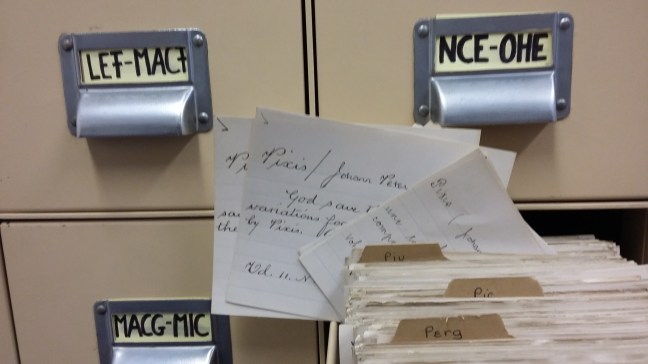
2017-12-06 15.27.11It always pays to enquire whether there are other old card catalogues that may not be on general public access.  The National Library of Scotland’s Victorian catalogue, and Glasgow’s main public reference library, The Mitchell’s Kidson collection, are just two examples.  Because they’re paper slips in long trays, you have to be a bit careful with them, and access may have to be arranged under supervision of a member of staff.  But these are valuable resources, and may be the only way of accessing a historical collection of music.  Who would have thought it, in these days of online catalogues – or OPACs*, as we fondly refer to them.

*Online Public Access Catalogues, to those in the trade!

We’re a research network! (And Scroll Down for the Pixis Variations Challenge!)

Pixis Hommage a Clementi TP
Title page of Hommage a Clementi, by Pixis. Image from copy in Glasgow University Library Collection, with thanks

It feels like time for a quick update, so I’ll spend the last few minutes of the working day doing just that.  Here’s a quick reminder of what the Claimed From Stationers’ Hall music research network is all about:-

The project is investigating the music deposited in the former British Copyright Libraries under the Queen Anne Copyright Act and subsequent legislation up to 1836, when most university libraries lost their legal deposit entitlement, receiving book grants instead. The repertoire largely dates from the late 1780s (when legal action clarified the entitlement of music to copyright protection) through to 1836.

The project aims to establish what exactly has survived; whether there are interesting survival patterns; and the histories of the music’s acquisition, curation and exploitation, not just in during that era, but also subsequently. It also aims to raise the profile of the material and to foster more engagement with it, both within and outwith academia; and the repertoire can be used to inform historical cultural perceptions which often became embedded into contemporary writings; for example, an idea very prevalent during the 19th century was that the English had no national music; and yet collections of national songs were very popular.  Thus, both the  fact that these books were popular, and our close reading of the paratext within individual volumes can be used to inform our modern-day understanding.  But a nation’s music is not just “national songs”, of course – it’s the whole repertoire of music published within that country.

To date, I’ve visited the University Libraries of St Andrews, Edinburgh and Glasgow.  I’ve been in touch with retired scholars from Aberdeen, and I’ve visited the National Library of Scotland.  Next, I need to spread my wings south of the border, and hopefully after a few more such meetings, we’ll have a clearer idea of what we’d like to talk about when we plan a study day to be held in Spring 2018.

The exciting, and yet tantalising part of all these visits is the realisation that there is a lot to explore, but not being able to stop and do all the research then and there!  For example, there are undoubtedly pieces of legal deposit music at the University of Edinburgh that aren’t labelled as such, but that appear in other copyright libraries and therefore probably arrived by the same means.  I so long to find them all, or to encourage other people to find them!  Similarly, the University of Glasgow has a very generous collection of copyright music – alluded to by the late 19th century author, W. P. Dickson amongst “works of fiction, juvenile literature, fugitive poetry, and music … issued yearly from the press” – but previously summarised by Divinity Professor Dr McGill in 1826 as “a great many idle books”.   (Dickson, The Glasgow University Library, 1888 p.16)  I’m eager to see if I can work out which volumes they might have been in before they were re-bound into their present volumes!  Meanwhile, the National Library of Scotland has an online catalogue, a card catalogue, but also “the Victorian catalogue”.  This I must see!

It is interesting to reflect that earlier musicologists have also had a hand in the arrangement and preservation of these materials.  Cedric Thorpe Davie in St Andrews disbound some volumes, and moved pieces to different places in the library.  Fourth Reid Professor Donaldson got involved with the Advocates’ collections in Edinburgh; Hans Gal had a go at listing some of the Edinburgh University Library Collections; and Henry Farmer spent some time in what for anyone else would have been retirement, as a music librarian at Glasgow University Library – one of the many careers in his portfolio! – and yes, he did some sorting out and rearranging, too.  Whilst we sigh over the thought of original sources being shuffled, we also owe these chaps a debt of gratitude for taking care of them and ensuring that they were preserved at all.

The Pixis Variations Challenge

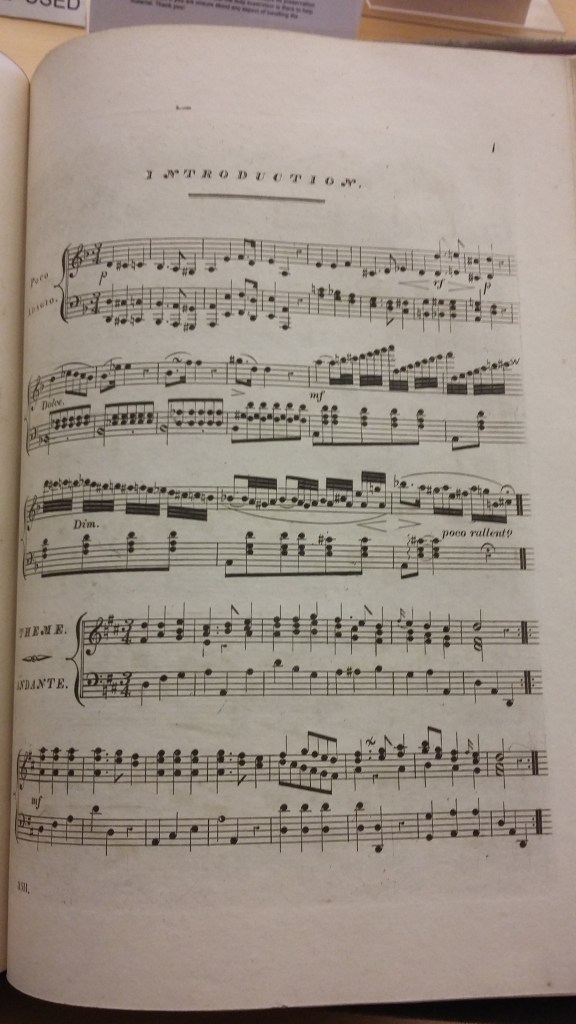
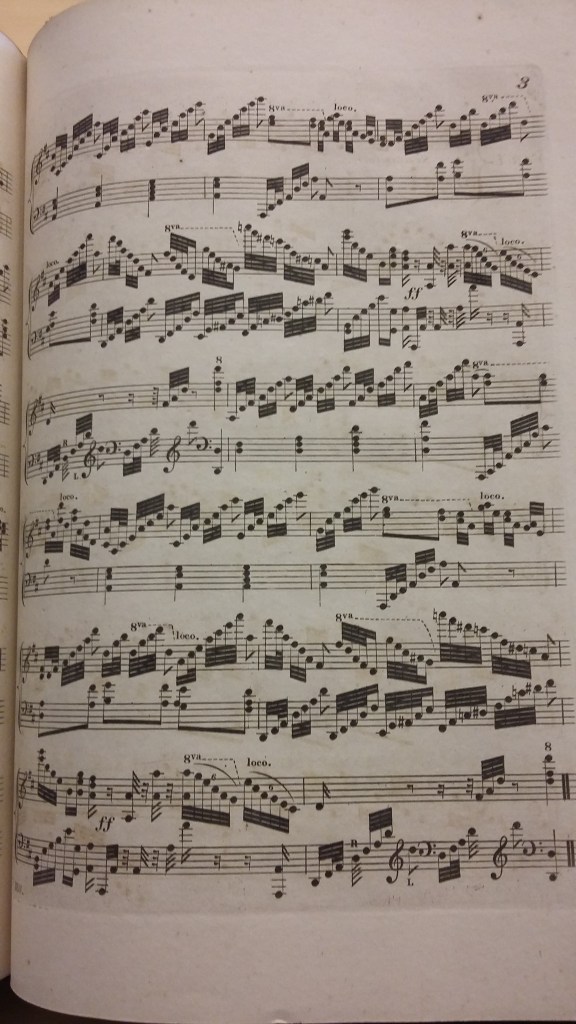
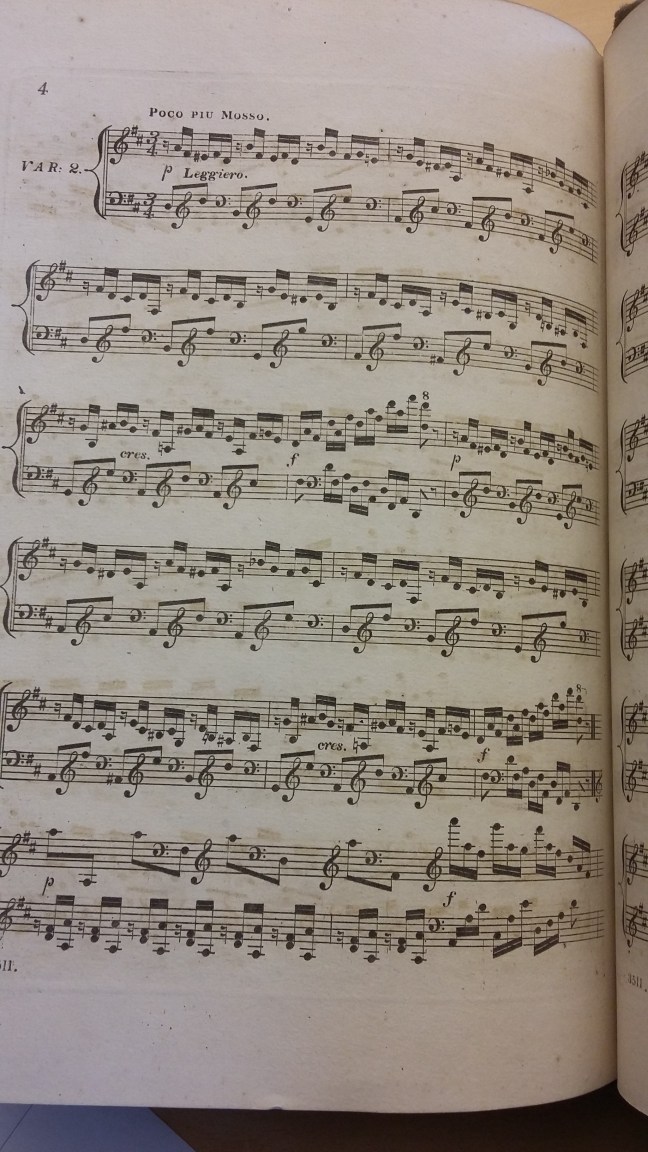
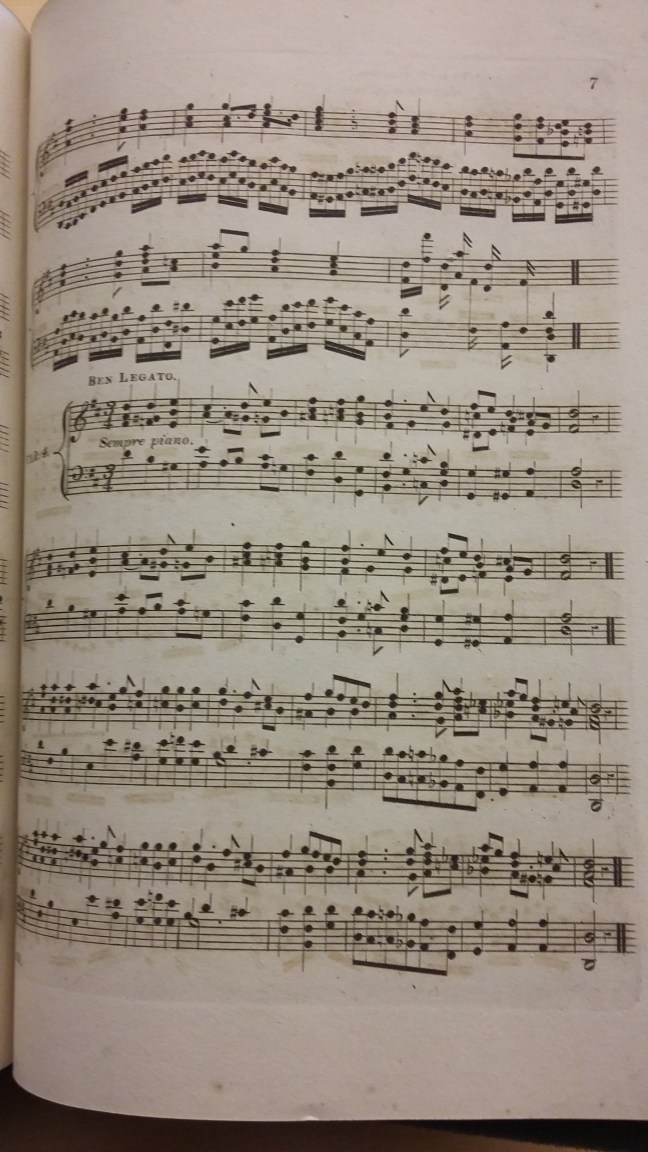
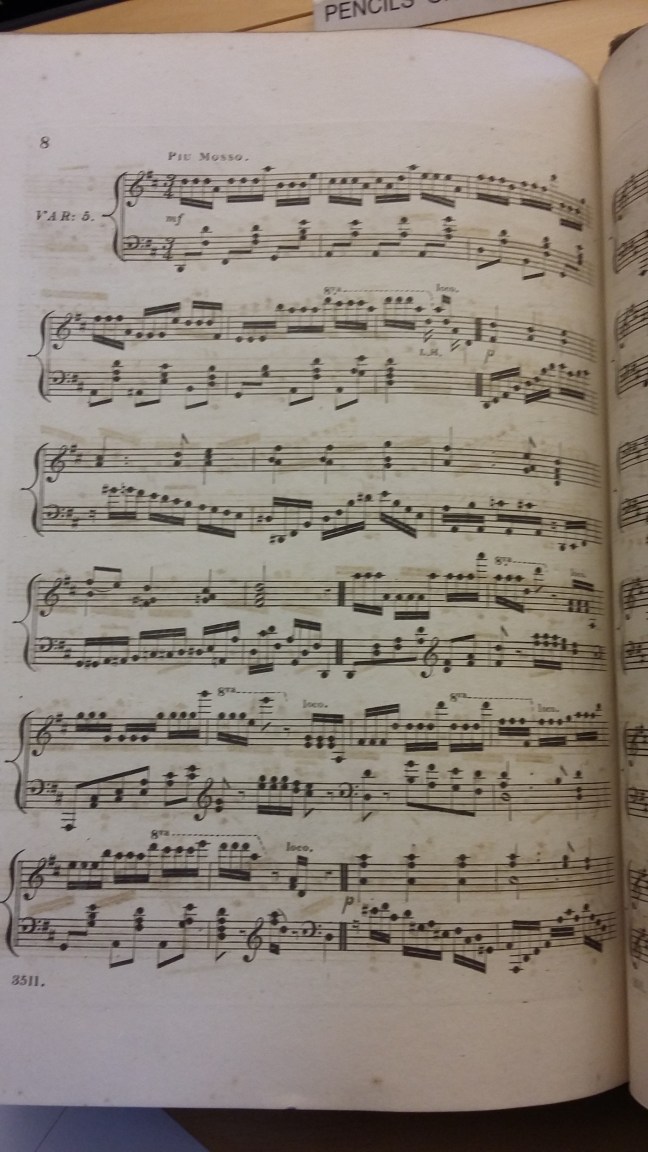
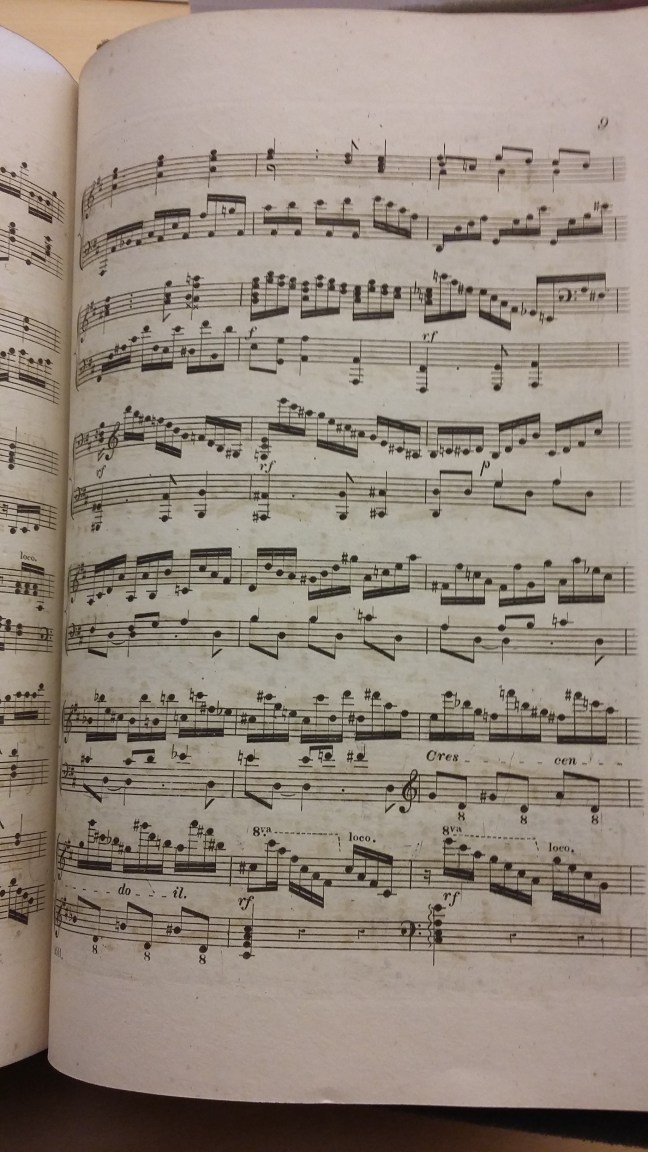
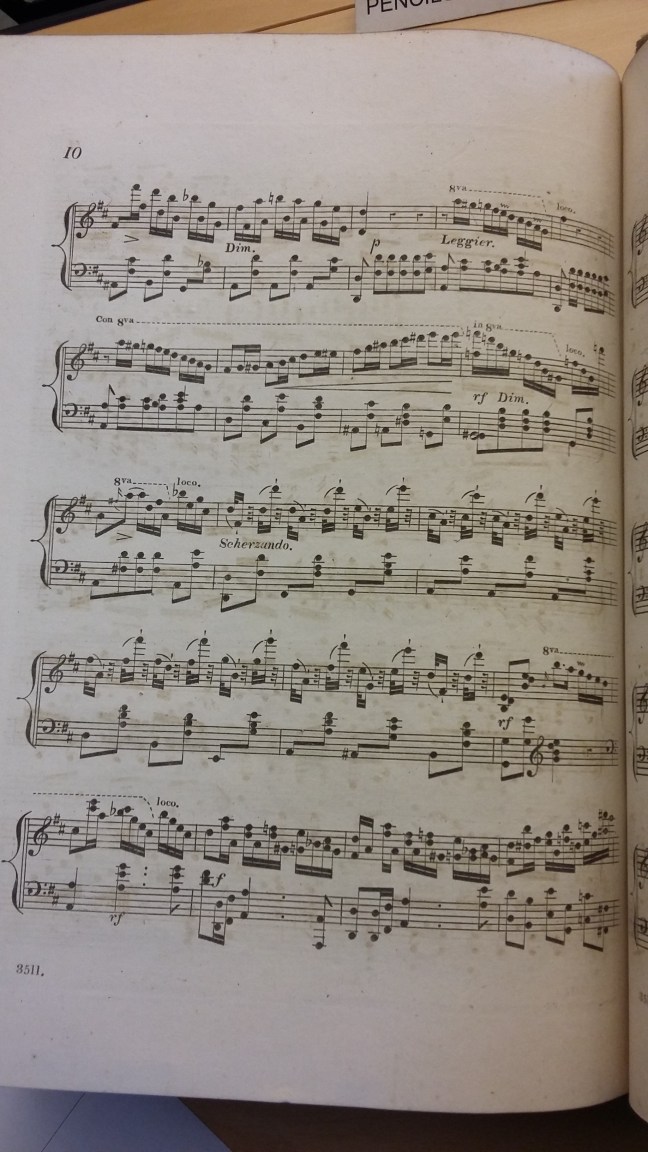
I long to play, or hear performed, some of these long-forgotten treasures.  I’ve been generously allowed by the Special Collections department of Glasgow University Library, to share a set of piano variations by the now forgotten German composer, Pixis:  Hommage a Clementi, which are actually based on the National Anthem, ‘God Save the King’.   I’m putting them on our Twitter feed and Facebook page, one page at a time.  At page 3, my pianistic skills are already being stretched beyond their comfort zone!  I wonder if anyone will get to the end …. ?  PLEASE let us know if you do!

Other pieces were undeniably less interesting.  I tweet “on this day” posts about some of the pieces that were registered, just to give a flavour of what was being published.  These references come with no value-judgements whatsoever!  Luckily for me, I don’t have instant access to all these pieces, so I would only go out of my way to hunt down something that looked particularly intriguing.

Here, for the record, is the start of Pixis’s variations – I’ll add the rest in due course.  Please do keep following the blog!  And I’m pleased to say that it’s not long before the first of our guest postings will appear – a welcome change of “voice” and a fresh insight into a different aspect of this fascinating topic.

Pixis Hommage a Clementi p1

Pixis Hommage a Clementi p2


Pixis Hommage a Clementi p3Pixis Hommage a Clementi p4Pixis Hommage a Clementi p5Pixis Hommage a Clementi p6Pixis Hommage a Clementi p7Pixis Hommage a Clementi p8Pixis Hommage a Clementi p9

Pixis Hommage a Clementi p10Pixis Hommage a Clementi p11


Professors as Gatekeepers

In my doctoral research, I encountered a few instances where learned individuals acted as informal gatekeepers, or intermediaries, between Scottish song (and custom) devotees on the one hand, and new knowledge on the other – I could name people such as George Paton or John Ramsay of Ochtertyre in the late 18th century, or John MacGregor Murray in the Georgian and Regency era, and of course David Laing, who became librarian to the Society of Writers to H. M. Signet in the 19th century.  These unofficial gatekeepers were seen as sources of information, and were often surprisingly generous in the sharing of it.

Today, in the latest University of St Andrews’ Special Collections blog, Echoes from the Vault, I was reminded of these luminaries.  The latest blogpost, ‘Banned Books at the University of St Andrews‘, shares early 19th century Senate discussions as to which books should remain banned to Divinity students; it also describes the Senate’s efforts to regulate public access to their library books.*

Banned books – be they novels or otherwise – are outwith the scope of the Claimed from Stationers’ Hall music research network, but public access is another matter entirely!

The loan records, you will recall, faithfully record every single loan of the copyright music volumes to anyone, professors or students, or the professors’ friends.  Between 1836-1839, Dr Gillespie even borrowed the music catalogue itself on several occasions!

Bearing that in mind, the Senate’s deliberations between 1820-21 to restrict the public’s direct access to library books are actually quite significant.  We learn that in 1820, the Senate decided,

to consider of the Propriety of restricting the Public at large in the use of books which they are at present allowed to have out on Professors’ pages  (Minutes of Senatus, 14 December 1820. UYUY452/13, p. 110)

The subsequent decision was clear: the public were neither to borrow directly, nor to send their servants to do so on their behalf:-

The committee farther recommend that all persons not members of the University whom the Professors may be desirous of accommodating with the use of Books should henceforth receive such books through the Professors themselves & not by going directly to the Library or sending their Servants to it for the purpose of taking out Books in the Professors’ names.  (Minutes of Senatus, 13 January 1821. UYUY452/13, pp. 114-116.)

So University Gates St Andrewswhat we actually have here, is the professors acting as intermediaries, or gatekeepers, to the collection.  Considering the materials were valuable, and many of them had been deposited under copyright legislation, this is quite understandable.
What it means, in terms of the music collection, however, is that if we are reading this correctly, and if the rules were subsequently interpreted strictly, then all the friends’ music loans after 1820 were actually made by the professors and not selected by individual townspeople standing at the shelves on their own account.  So, who chose the music?  We’ll never know.  We cannot tell how strictly the rules were enforced, nor for how long, and we certainly cannot guess how often Miss X asked for a particular kind of music, or a particular piece.  Unless they knew what was in individual volumes, it is quite probable that their professorial friends were asked to, ‘just find me some piano music’, or perhaps on occasions to ‘bring back something new’.  Who knows?

Does this drive a coach and horses through my analysis of who borrowed what, and when?  I don’t think it does.  We really don’t know the precise circumstances of all those hundreds and thousands of music loans.  Even if the professors were more involved in selecting music than we might have imagined, the statistics we’re left with give us a picture of what kinds of music different borrower types were exposed to.  Maybe the professors made assumptions about what their friends might enjoy singing or playing.  But they must have got something right, or the music wouldn’t have continued to fly off the shelves!  Moreover, a strict rule in 1821 wasn’t necessarily strictly enforced even a few years later.

The Senate’s restrictions do, however, serve to remind us that we need to keep an open mind about many aspects of the library’s lending patterns.  It does no harm to be reminded!

.

*Echoes from the Vault post,  29.09.2017, celebrating Banned Books Week

Claimed from Stationer’s Hall – Update

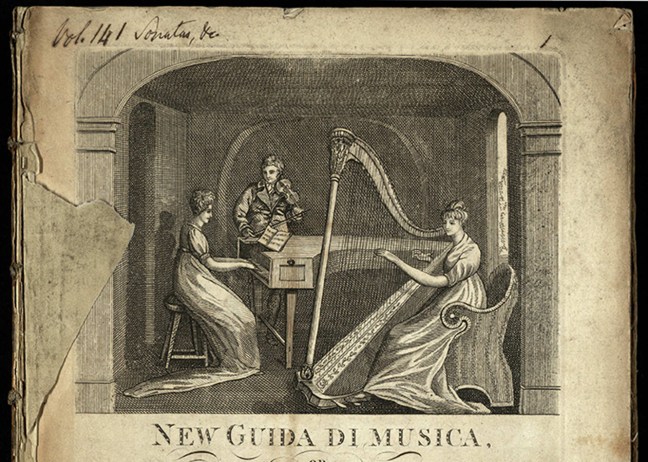
There’s a Scottish saying, “What goes around, comes around”. I didn’t realise, when we selected the image from Challoner’s New Guida di Musica for this University of St Andrews Echoes from the Vault blogpost, that I would encounter it again in a later stage of my research! Whilst tweeting for the new AHRC-funded music network, Claimed from Stationers’ Hall, I idly looked to see what was registered “on this day” a couple of hundred years ago. Stretching a point slightly, I chanced upon – yes, Challoner’s piano instructor, for that’s what it actually is – registered at Stationers’ Hall on 24 September 1812. Checking my records further, I learned that the volume containing it was actually bound – and borrowed – within three months’ of registration, and clocked up 14 loans between 1812 and 1849. If you really want to, you can even “play like it was 1812” because it has been digitised at Baylor University:- http://digitalcollections.baylor.edu/cdm/ref/collection/fa-spnc/id/149327

St Andrews Special Collections's avatarEchoes from the Vault

Earlier this year we published a blog post by Dr Karen McAulay of the Royal Conservatoire of Scotland about her research using the St Andrews Copyright Music Collection – https://standrewsrarebooks.wordpress.com/2016/08/18/claimed-from-stationers-hall-st-andrews-copyright-music-collection/

Copyright Music Collection in the stacks Copyright Music Collection in the stacks

An example of a volume in the copyright music collection - Challoner’s New Guida di Musica, ‘improved edition’ (London: Skillern, [1812]), St Andrews University Library sM1.A4M6; 141’] An example of a volume in the copyright music collection – Challoner’s New Guida di Musica, ‘improved edition’ (London: Skillern, [1812]), St Andrews University Library (sM1.A4M6; 141). Karen has continued her research and has now written an update, available on her blog at:

https://karenmcaulay.wordpress.com/claimed-from-stationers-hall/

Karen will be returning to St Andrews in due course – we look forward to welcoming her back to the Reading Room and to future updates as she continues to unravel the history of this collection.

View original post

Networking is the Name of The Game

Pinterest British Library Spiders Web

The first network steering group meeting took place a couple of weeks ago, and in the past week more networking has taken place.  I’ve already blogged about Monday’s highly satisfactory meeting with retired University of Aberdeen music librarian Richard Turbet, in Norfolk.

Back in Glasgow, on Friday I attended a collaborators’ meeting for another new network, this time at the University of Glasgow: the Royal Society of Edinburgh-funded Romantic National Song Network.  It is spearheaded by Principal Investigator Professor Kirsteen McCue and Postdoctoral Research Assistant Dr Brianna Robertson-Kirkland.  My own doctoral research was about late 18th and 19th century Scottish song-collecting; I had examined collections both with and without accompaniments.  The new network focuses largely on collections with accompaniments, and certainly – like my own research – on collections with music, aka, “songs with their airs”.

Although the focus of my research has changed slightly since my PhD, I can see that the work I did on the borrowing of “national song” collections from St Andrews University library could be pertinent in the context of the RNSN.  I am also enthusiastic about the possibility of revisiting some of my favourite nineteenth century Scottish song collections!

Mrs Bertram’s Music Borrowing: Reading Between the Lines

Moving on to another research network, I recently wrote a blogpost for the EAERN (Eighteenth-century Arts Education Research Network) .  “Mrs Bertram’s Music Borrowing” occupied quite a few evening hours when I stumbled across a reference to her in my perusal of the early nineteenth-century St Andrews University borrowing records, and I was very pleased to have the opportunity to write it up in to a coherent piece for EAERN.  Yes, I’ve stretched a point – we’re talking about the long eighteenth-century here!  Nonetheless, I think it will demonstrate the value of interrogating archival records in minute detail.  After my many years spent cataloguing music materials for the Whittaker Library, my endurance levels for dealing with repetitive detail are exceptionally high!  It’s very rewarding when hours of capturing data can be turned into a human story about someone who lived, breathed and – most importantly – borrowed music from the library!  Do visit the EAERN website.

And lastly – some more networking news about the Claimed From Stationers’ Hall network.  We now have a Facebook page:- https://www.facebook.com/ClaimedStatHall/ – and I’ve also set up a Jiscmail list, so at some stage this week I’ll be sharing details with people whom I think might be interested in joining in the discussion about this fascinating, but often overlooked body of music.

Podcast 2: The Borrowers

ThCollage soldiersere will be more on this topic in due course, but for now, why not listen to a podcast about a group of music borrowers united in a rather unusual way … in a collection of watercolour sketches!

Podcast 2: The Borrowers