Dr Karen McAulay explores the history of Scottish music collecting, publishing and national identity from the 18th to 20th centuries. Research Fellow at Royal Conservatoire of Scotland, author of two Routledge monographs.
Season’s Greetings to all followers of the Claimed From Stationers’ Hall music research project. I bring you pictures of Edinburgh in festive mode, after yesterday’s trip to the University Library! There’s a big posting coming up tomorrow – do check back in to see!
On the left – Dr William Kitchiner, lecturing on optics
Since my kitchen is littered with (most of) the ingredients for our Christmas cake, it seems appropriate to devote a short post to a significant publication from 1817 (yes, my new favourite year!) – Dr William Kitchiner’s The Cook’s Oracle. We’ve encountered Dr Kitchiner before, on account of his patriotic and sea song books. They weren’t particularly well-received.
Dr Kitchiner had other interests, though. He lectured on optics, and was a published expert on cookery and nutrition. He hoped that his cookbook would provide good, solid nutritional guidelines. Wikipedia reports that he was an exceptional cook, and his was a household name. I haven’t gone so far as to check this out, but I’ve found you a simple suet pudding to try!
You can read the ENTIRE book online, if you’re so inclined:-
(The 2nd edition even begins with an Anacreontic Song, if you please, combining his passions for music and food.)
Whilst checking the King’s Inns guardbooks for national songbooks, I naturally looked for Kitchiner, though I didn’t really imagine there would be much appetite for English national songs. I was unsurprised to find it absent from the catalogue – but there was clearly an appetite for Apicius Redivivus! There it was, in the guardbook under Kitchiner’s name. Perhaps struggling to decide where to shelve it, the Victorian librarians ended up putting it in the “literature” section – the same as the minstrelsy material.
But it wasn’t on the shelves. (Someone kindly checked for me!) Who borrowed the cookbook and didn’t return it? Or misshelved it? Or dropped it in the broth, or used it until it fell to bits? I have a good imagination, but maybe I should stick to hard facts. And, tempting as it is to try the recipes straight away, I should probably bake our own Christmas cake first! My family will probably be glad to learn that Dr Kitchiner only mentions Christmas in connection with the seasons for oysters and House Lamb – which differs from Grass Lamb , and is eaten from Christmas until Lady-Day. So their annual treat won’t be any different from previous iterations!
I’ve been a member of the Eighteenth-Century Arts Education Research Network for the past couple of years. Although I wasn’t able to attend the third and final Colloquium, I have followed with interest, so I thought I’d share the link to their latest blogpost here. It summarises the day’s activities – and makes me wish I’d been there!!
One of my more fanciful ideas about the legal deposit scores Claimed From Stationers Hall in the Georgian era, is the mental image of birds migrating – all those scores being registered at Stationers’ Hall and then disseminated around the country to the waiting libraries. When I saw Scott Waby’s video footage of the Aberystwyth starlings, on Twitter today, I was reminded of this image! Some ‘birds’ land and then take off again. Some jostle for space. They’re the scores that either didn’t get to their destination, or were dumped in an attic pending a decision as to whether they were allowed to stay. Or were sold later. Okay, it’s fanciful! Maybe I can’t do anything with the metaphor, research-wise. But let me share the footage with you anyway – it’s beautifully filmed, and I did spend a year in Aberystwyth many decades ago as a library school postgrad, so I have a particular affection for the place.
The photographer, Scott Waby, is head of digitisation at the National Library of Wales. I still have fond memories of many happy hours in NLS constructing a bibliography on Victorian education, as part of my postgraduate librarianship diploma!
A few clips from the short documentary I’m shooting on the Aberystwyth starlings. Not sure what I’m going to do with this project yet – so If you have any ideas, or want to collaborate, get in touch. pic.twitter.com/1DjTn8RcaN
I’m still sorting through my notes after my research field trip to Dublin a couple of weeks ago. I may have mentioned that I went armed with a list of national music compilations from the Georgian era (and a little beyond), to see if either King’s Inns Library or Trinity College Dublin Library had retained any such volumes during the 1801-1836 legal deposit era. (Neither received legal deposit materials before the Act of Union, and King’s Inns lost their entitlement after 1836, though Trinity retains it to this day.)
I already knew that King’s Inns had a handful of national songs, some musical (“songs with their airs”, as Georgian musicians would have said) – and some purely literary, such as Allan Cunningham’s Songs of Scotland (1825) – I alluded to it in my book, Our Ancient National Airs.
I also knew that Trinity College Dublin had instructed their agent NOT to supply music, novels or school-books, from 1817 onwards, and my opposite number in the library had warned me that there was very little music from the Georgian or even early Victorian era. Indeed, the earliest extant lists of legal deposit music there date from 1859-1860.
So, I knew I was probably just going to prove to myself that there really wasn’t much legal deposit music in Dublin at this time, and indeed, that it was hard to identify anything as positively having come from Stationers’ Hall. The rest of today’s posting will confirm just that!
In 1811, Stationers’ Hall music was being put “into MS Room in the press in the N.W. angle”, having previously been lying in the Library Room. (From Peter Fox’s book, Trinity College Library Dublin: a History (2014), I know that the Manuscript Room would have been the new MS room on the first floor, converted between 1802-1803.)
I found the same in July 1815, when music was sent from Stationers’ Hall in parcels. It went into the same press (ie cupboard). However, other materials were left on the table in the MS Room “until a list of them could be made out and entered in this book”. Clearly, no-one was planning to list the music!
By July 1817, their agent had been advised to send no music, novels or school books.
We know from the minutes that materials arrrived in baskets, bundles and chests, delivered to a Dr Nash. Dr Nash was an assistant librarian in the previous decade, and had other roles by 1810 and 1820, but perhaps he also kept an involvement with the library even when he was otherwise occupied. We don’t really need to know much more about him, anyway!
From comments in 1817, we see that on at least one occasion, the materials arrived in cases from “Mr Elliot’s men” without a list, and at least once the materials arrived damaged and irreparable. (In 1821, Edinburgh appointed the same Mr Elliot as agent – St Andrews strongly objected, as is minuted in a meeting there!)
After the decision not to take music, schoolbooks or novels, music doesn’t seem to have been collected until the 1850s. Armed with my trusty national songs list, I went through the 1872 printed library catalogue, which is now conveniently available online.
I wasn’t surprised to find that Trinity College Dublin seems actually to hold NO NATIONAL SONGS from my list, as regards printed music, between the Welsh collection, Musical and Poetical Relicks of the Welsh Bards by Edward Jones (1784, 1794), and Bunting’s Ancient Music of 1840. The situation does match a parallel interest in literary balladry, in King’s Inns (where there is only marginally more music from the 1801-36 era), for both libraries certainly hold literary balladry publications from this era – such as Motherwell’s Minstrelsy Ancient and Modern (1827-8). A little later in the century, I found that Trinity holds Drummond’s Irish collection, Ancient Irish Minstrelsy (1852) dedicated to Revd Richard MacDonnell, Provost of Trinity College Dublin. (There’s an online version here:- https://tinyurl.com/DrummondAncientIrishMinstrelsy)
It’s hardly surprising that literary minstrelsy trumps musical collections, though. After all, music is generally folio sized, and the London agents weren’t collecting it. Literary minstrelsy would just arrive along with other legal deposit books – if such WAS their provenance, for there’s nothing about the volumes I looked at, to indicate where they came from – and if there was an appetite for historical balladry, then it would be added to stock. (Later in the century, I have looked at William Chappell’s involvement in English national songs and ballads, and the amount of activity in England and Scotland certainly does suggest an enthusiasm for the genre amongst antiquarians and the like.)
So much for national songs-with-their-airs, and literary ballads. It’s just a small sampling of music, but I think it served my purpose. Books do trump scores, when it comes to Georgian music in two particular Dublin libraries. I did also look for pedagogical musical material, and stumbled across one or two music textbooks, but that can wait for another blogpost, I think!
I’ve referred to Charlotte before – as we know, her tragic death inspired people to write anthems, author poems, mass-produce commemorative porcelain ….
I’ve just found a Twitter link to a blogpost that Kyra C. Cramer wrote about her, so I thought I’d share it here:-
The library received a donation a couple of weeks ago. Commercially-produced Scottish songs and dance tunes, and a few pop ballads or songs from shows, all from the 1940s-70s. We’ll keep the majority of them. I’m conscious that these will be ‘history’ one day – indeed, they already are, since they were all produced long before today’s students were born.
(After all, the collections that I myself write about were current once – well over a century ago. This is just continuing forward in time!)
ON TO DUNDEE
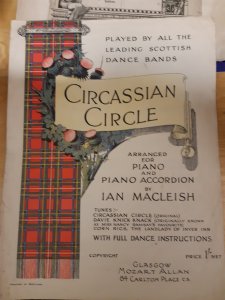
So it will come as no surprise when I say that I was in Dundee’s Wighton Centre yesterday, working on a different collection in a voluntary capacity: listing the music that the accordionist Jimmy Shand owned. I’ve already listed the historic material that the Friends of Wighton acquired at auction, but this secondary material is Shand’s working collection, the sourcebooks for his own repertoire. As such, it needs to be documented, so that’s what I was doing yesterday. I haven’t nearly finished the task! I can’t begin to categorise it until I have a complete list. I don’t think I shall be indexing each volume – it’s a big enough challenge listing the collection at book level. These images show just two items that caught my eye!
By doing what I’m doing, I like to think I’m helping preserve a little bit of 20th century musical history, for later generations. I think Dundee’s Andrew Wighton, and the late Jimmy Shand, would both approve! There’s a good chance I’ll write about these collections at greater length in due course, but first I must get the bibliographical details sorted out & respectably listed, so it won’t happen for a while ….
AND ANOTHER THOUGHT
I would urge music and rare books librarians to make efforts to conserve twentieth century national music editions. What to us might just seem to be rather dated repertoire, may have greater significance in the future. Don’t ditch them! Put them in a stack, make sure they’re catalogued and indexed appropriately, and maybe one day someone will bless you for your forethought! Similarly, if you know someone that was in a significant trad music ensemble – maybe now in retirement – ask them to give some thought to what they might do to ensure the survival of any archival documentation!
Rant over. I’m off to see if we have any more mid-twentieth century trad scores lying around!
Trinity College was the legal deposit library that did, initially keep legal deposit music (in the attic), but then by 1817, they had instructed their London agent not to collect sheet music, school books or novels. It seems virtually no music was retained before the 1850s, when they started keeping it again.
A full century later, in 1917, it’s minuted that “All the unsorted music which was filed in the West Attic … was sorted by the librarian.” Well, if the word “filed” slightly gladdened your heart, you’re about to be rudely disappointed! The minutes go on to record that,
“Several sacks filled with separate band parts and music-hall rubbish were sent to the wastepaper merchant.”
It went away in bin-bags! Nowadays, I suppose it would have gone in the shredder. (Let’s face it, loose band parts can be a bit of a pain, and who knows what state the music-hall material might have been in. Maybe the librarian saw no use for it, back in 1917.) The good news is that “Full scores were put in Dr Todd’s cabinet in the Librarian’s Room.” Ah, so it didn’t all get chucked out!
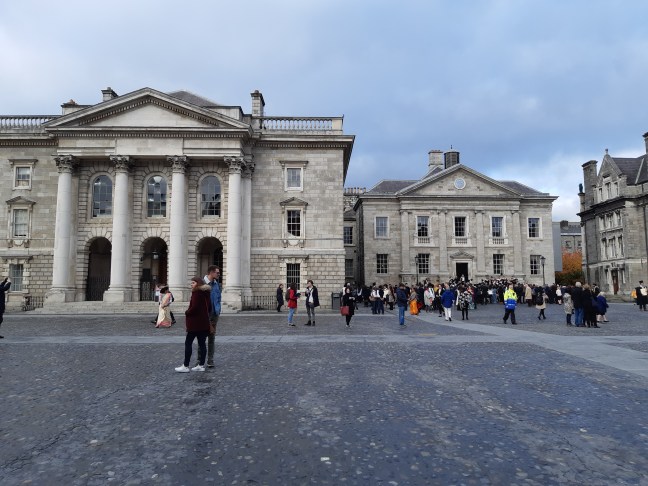
Notwithstanding the disappointment about the sacks of rubbish, I enjoyed a fruitful conversation with my “opposite number” at Trinity, had an atmospheric stroll through the galleries of the old library, perused the old minute books, and looked at a handful of surviving music textbooks and minstrelsy verses – not musical scores, certainly, but I was looking for ownership marks and library property stamps, and I did find those! Trinity has a whole run of The Harmonicon, a music magazine which was extremely popular at St Andrews – and I’m happy to say that Motherwell’s Minstrelsy is there in the 1827 edition, which has a bunch of tunes at the end.
I’m looking forward to giving a talk to students at the University of Edinburgh this week. The University Library was one of the recipients of legal deposit materials during the Georgian era, before the law changed in 1836. Amongst all the learned tomes and textbooks, they received sheet-music too. The interesting question, of course, is what they did with it!
Now, as you know, I’m a bit of an enthusiast when it comes to bibliographies, but this time I’ve prepared a very minimal bibliography in a novel format. Should you wish to share it, here’s an easy URL to the same animated bibliography:-


 I’m still sorting through my notes after my research field trip to Dublin a couple of weeks ago. I may have mentioned that I went armed with a list of national music compilations from the Georgian era (and a little beyond), to see if either King’s Inns Library or Trinity College Dublin Library had retained any such volumes during the 1801-1836 legal deposit era. (Neither received legal deposit materials before the Act of Union, and King’s Inns lost their entitlement after 1836, though Trinity retains it to this day.)


 Karen McAulay, Musicologist