Dr Karen McAulay explores the history of Scottish music collecting, publishing and national identity from the 18th to 20th centuries. Research Fellow at Royal Conservatoire of Scotland, author of two Routledge monographs.
Writing my paper for the IAML Congress which takes place in Leipzig later this month, I decided to reference a recording that I made with Dr Jane Pettegree for my blogpost on St Andrews’ Special Collections blog, Echoes From the Vault. I can hardly believe it’s two years since I wrote it! However, it was my research into the Copyright Music Collection at St Andrews, that led ultimately to the AHRC-funded research network that I’m currently leading.
So, maybe it’s not inappropriate to revisit the blogpost here, today?
Could you use a couple of absolutely miniscule videos to tell people about the Claimed From Stationers’ Hall research network?
Educationalists don’t entirely agree with the concept of learning styles these days, but in my librarian-as-educationalist capacity I have learned that people do value having access to a variety of formats when it comes to learning about new stuff. The other day, I was experimenting with a newly-discovered facility for creating very short animated videos. (Yes, I spend my weekends in odd ways.)
I can see potential uses for Biteable.com, but the major hurdle is deciding which template to use. Although you start by deciding the purpose of your video, it isn’t immediately apparent how many screens each template offers you, nor what the images are going to look like! Maybe it’s because I was playing around with the free version.
[PS a few days later – I now know that starting a video from scratch means you get to choose how many frames to use, and you can also choose which templates to use, though you lose the chirpy little animated people. Moreover, you can upload your own music. THAT makes things much more fun!]
Anyway, my playful Sunday evening resulted in two short videos about the Claimed From Stationers’ Hall network.
Next came Out of the Stacks, which is about the repertoire itself, and its value. Trust me, the videoclip is as short as can be and takes only seconds to view! I managed to get my own images into this one, which was a bonus.
I’ve a feeling I can only create a few videoclips a month for free, so you have my assurance I won’t be cluttering this blog with Biteable videos!
You may have wondered why our latest exhibition, in and around the Anderson Room, celebrating the work of female composers has the odd title of “Not worth a mention“. The idea for the exhibition came about through a chance conversation with a music librarian at another Legal Deposit library. Looking for some music that had been entered at Stationer’s Hall to show a researcher, the first score he plucked from the shelf had a piece by a little known nineteenth century composer, a Miss Heward. Researcher was delighted and wondered if the library had anything else by her. Librarian went confidently to the catalogue, and was puzzled to discover that there was NOTHING by Miss Heward, not even the piece he held in his hand. Perhaps it had been missed out of the electronic catalogue during the migration from cards? But no, there was no evidence of it…
Eamonn O’Keele tells me this incredible manuscript is ‘linked to a 1/34th Regiment fifer in India, c.1790-1805. Plenty of great tunes and watercolours…’
It’s amazing. Do take a look!
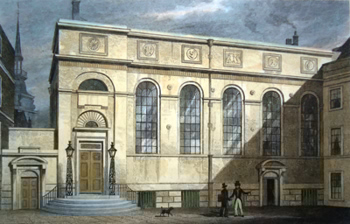
The image I’ve been using? I now have my own engraved, coloured antique print. It dates from 1831, was drawn by Thomas H. Shepherd, and engraved by W. Watkins. I treated myself to the print after our successful workshop last week. You must admit it looks lovely in colour!
Well, the arrangements are all in place. We have delegates, a board room to meet in, catering and other practicalities taken care of, and even lunchtime entertainment for our guests. I’m happy to say that we’ve made contact with ALL of the historical legal deposit libraries, and all but two of them will be represented at next Monday’s workshop, along with big data and digitisation experts and other interested scholars. I won an AHRC networking award last year, and here we have it – networking really bearing fruit. I’m so excited!
FLASHBACKS
TWO YEARS … To think that it’s two years ago since I presented this slide at the IAML (UK and Ireland) Annual Study Weekend: things have moved on quite a bit since then!
TWO HUNDRED YEARS … Lastly, I can’t resist sharing this – a snapshot of what was registered at Stationers’ Hall OTD (on that day) 26th March 1818. It really is a typical cross-section of music publishing at the time! Just look – three arrangements of contemporary or near-contemporary operatic works for domestic consumptions (let’s not argue about who had the copyright in what! – see the posting on this blog last month!), and flute duets by one of THE big names of the time, virtuoso performer and arranger Charles Nicholson:-
Bishop’s Overture and Songs in Zuma, Book 1; Burrowes’s arrangement of Airs from Il Don Giovanni [Mozart], Books 1-3; Paer’s Numa Pompilio Overture; and Nicholson’s Four Concertante Duetts for Two Flutes.
Causewayside, National Library of Scotland, where UK legal deposit is administered.
Asked, in connection with another project, where the legal deposit music is in Britain, it seemed a good idea to summarise the current position. What follows is a very broad outline, but it might prove helpful to anyone trying to track down an old British piece of music!
The British Library has always received legal deposit materials from the start, has the most complete collection and all are catalogued. The collection began as the Royal Collection, then formed the basis of the British Museum collection, from which the British Library evolved.
For the remainder of the legal deposit libraries, remember that historically, some form of library committee decided which music to keep. This varied widely:-
Bodleian Library, University of Oxford – has always received legal deposit materials, from the start right up to the present. Mostly all catalogued, though historical entries aren’t all full, in-depth records, having been digitised from old records.
Cambridge University Library – has always received legal deposit materials, from the start right up to the present. Not all historical materials are catalogued.
Aberdeen University Library – was a legal deposit library up to 1836. A very incomplete collection, but what survives is catalogued – not all catalogued online.
St Andrews University Library – again, a legal deposit library up to 1836. A more comprehensive collection, but only items post 1800 are catalogued online, and the paper catalogue records for the earlier items appear to be missing. Interestingly, the historical music collection was very much a working one, frequently borrowed by professors, students, and friends of the professors.
Edinburgh University Library – a legal deposit library up to 1836. A very patchy collection, but items that ended up in the Reid Music Library, established in the 19th century, are at least now listed on a spreadsheet.
Glasgow University Library – a legal deposit library up to 1836. A more comprehensive collection, and catalogued online.
National Library of Scotland – evolved from the Advocates Library in Edinburgh, and is a legal deposit library to this day. Historical music is catalogued in the Victorian paper catalogue; probably not as complete as the British Library, for various reasons. More modern materials are catalogued online.
Trinity College Dublin. Although a legal deposit library since 1801, there is little historical music copyright material to speak of, because it wasn’t collected. Still a legal deposit library.
Sion College, London, was historically a theological institution, with a legal deposit library prior to 1836. All holdings have more recently been transferred to Lambeth Palace Library, London, and little music survives. Not catalogued.
King’s Inns, Dublin – another historical legal deposit library 1801-1836, but music appears not to have been catalogued to any extent, except very popular publications which must have been added to stock individually as they made their way to the library.
National Library of Wales. Was not a legal deposit library until the 20th century. (Unlike the National Library of Scotland, it was a new establishment in 1907, not growing out of an earlier institution.
This fascinating blogpost about Isaac Nathan appealed to me because his Hebrew Melodies were very popular in their day. (I know – people were borrowing them from St Andrews University Library!)
A gift from Australia from one music librarian to another.
Sometimes you don’t always end up writing what you intended…This started out as a post for Australia Day 2018; but ended up as a rather different story. So how did MusiCB3 manage to travel from Poland to Sydney, via Canterbury and Cambridge, in the company of aristocrats, an intelligent woman, a notable disaster, and a superstar? Stopping off at London en route, and bumping into an expedition that went wrong, although it turned out right. Welcome to the sometimes topsy-turvy world of Isaac Nathan.
Batt-printed porcelain contemporary with the copyright music era
No disrespect to my day-job, but years of cataloguing have trained me to tolerate repetitive tasks to a very high degree! Cataloguing can be repetitive and, I’m afraid, monotonous. However, in terms of endurance training, this background stands me in good stead. I just keep on going, like the Duracell bunny in the battery ads!
My innocent vacation amusement this week has been the rather slow-moving exercise of comparing one database with another. Why would anyone spend hours, days, starting to go through a list that amounts to some 2000 pieces of music? Ah, for a very good reason. This is the list of Edinburgh University Library’s Reid Hall Cupboard collection, and I’m finding out how much legal deposit music was actually retained. First, I compared it with the entire registered output of 1810 as listed in Kassler. Very little was there. Then with the registered output for 1818, the last year listed there. Possibly one match. Then I compared the Reid Cupboard contents with the material listed by the Advocates in 1830 – twelve years after the period itemised in Kassler. Very little correlation there, either.
A Significant Sample: 68 Hits
However, at different periods, copyright music WAS selectively retained at the University of Edinburgh. I concluded that there was nothing for it but to go through that a significant sample of that spreadsheet, just to begin with. Some music is continental (mainly French or German) in origin, and some is in manuscript; these categories don’t form part of my investigation. The problem is that no single approach can be taken to the whole corpus. We’re not comparing like with like, and different listings cover different periods, apart from any other considerations:-
There is the option of checking Kassler’s listing (if Copac indicates that the piece was published before 1819); checking Kassler in digital format is generally easier than in the paper edition, because one can check by title in the e-book. The physical book has various indices, but there’s no alphabetical title listing, and only the composers’ names are listed, not their works.
The Advocates 1830 lists merely cover February to March of one year. Even if much of this material turns up in the Victorian catalogue at NLS, it’s not a huge sampling.
It’s marginally quicker checking the EUL Reid cupboard material against the St Andrews copyright music spreadsheet (which did arrive by the legal deposit route) than it is checking against Copac, but it has to be said that checking Copac is the more thorough way. Having said that, we can’t be totally certain that the Copac-listed material was registered at Stationers’ Hall if it postdates 1818, short of actually checking the Stationers’ Hall records. An item appearing in the British Library, and one or more of the other copyright libraries, was probably accessioned under legal deposit, but not categorically so. And not everything that should have been registered and legally deposited, actually was.
The St Andrews collection is only catalogued online for material dating from 1801 onwards, and of course, will not include items that were discarded rather than being bound in the big composite volumes.
After several lengthy sessions checking and cross-referring, I had nearly finished composers beginning with “G”!
Thursday – the brightness of a [rainy] new dawn …
Faced with a very large collection of Haydn publications, I concluded that although the most comprehensive approach would be a complete comparision of the EUL Reid Hall cupboard contents with Kassler, St Andrew’s online copyright collection, and items listed in Copac, maybe this isn’t necessary immediately. Instead, a few broad statistics give us an overview of what’s there.
Comparing Kassler’s listing for 1810 with the Reid Hall cupboard: a maximum of 9 matches, and possibly only 7.
Comparing Kassler’s listing for 1818 with the Reid Hall cupboard: possibly one match. It’s a very popular Irish selection, so it could have arrived by other routes than legal deposit, eg by donation.
Comparing the Advocates’ lists of February and March 1830 with the Reid Hall cupboard: only three matches, which are European editions.
Comparing an initial sample of 68 Reid Hall cupboard items matched either with the St Andrews copyright collection or Copac: obviously, percentages could only be calcuated if the entire list was compared; they’d be meaningless with a small sample. Nonetheless, we can observe that in Edinburgh, items seem to have been retained very intermittently between 1770 and 1811; there’s no real pattern. Between 1812 and 1821, noticeably more material was retained, although nothing like the St Andrews collection. After that it appears to be even more intermittent than in the earlier period.


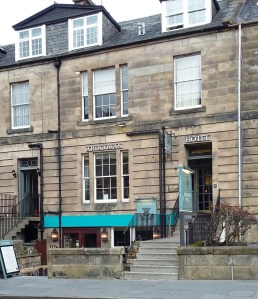

 Well, the arrangements are all in place. We have delegates, a board room to meet in, catering and other practicalities taken care of, and even lunchtime entertainment for our guests. I’m happy to say that we’ve made contact with ALL of the historical legal deposit libraries, and all but two of them will be represented at next Monday’s workshop, along with big data and digitisation experts and other interested scholars. I won an AHRC networking award last year, and here we have it – networking really bearing fruit. I’m so excited!
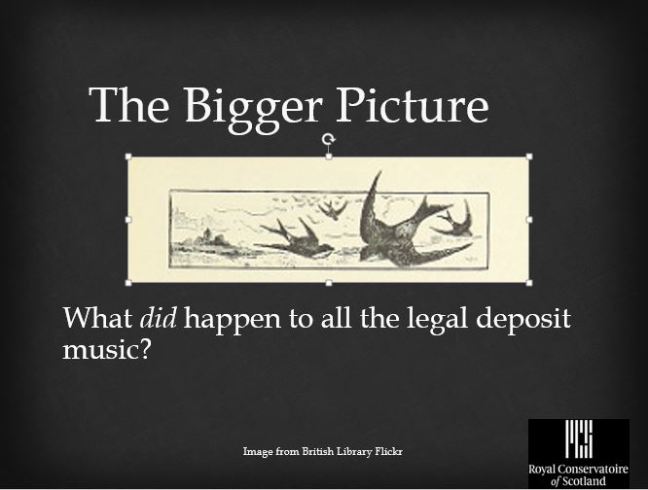 TWO YEARS … To think that it’s two years ago since I presented this slide at the IAML (UK and Ireland) Annual Study Weekend: things have moved on quite a bit since then!
 that day) 26th March 1818. It really is a typical cross-section of music publishing at the time! Just look – three arrangements of contemporary or near-contemporary operatic works for domestic consumptions (let’s not argue about who had the copyright in what! –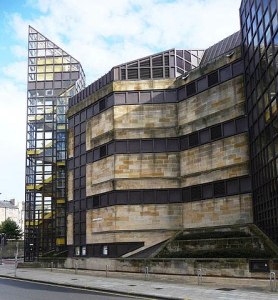


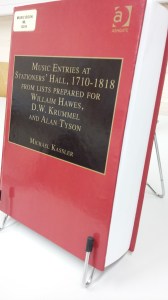 was published before 1819); checking Kassler in digital format is generally easier than in the paper edition, because one can check by title in the e-book. The physical book has various indices, but there’s no alphabetical title listing, and only the composers’ names are listed, not their works.
 Karen McAulay, Musicologist