Eamonn O’Keele tells me this incredible manuscript is ‘linked to a 1/34th Regiment fifer in India, c.1790-1805. Plenty of great tunes and watercolours…’
It’s amazing. Do take a look!
via Drawings


Dr Karen McAulay explores the history of Scottish music collecting, publishing and national identity from the 18th to 20th centuries. Research Fellow at Royal Conservatoire of Scotland, author of two Routledge monographs.
Eamonn O’Keele tells me this incredible manuscript is ‘linked to a 1/34th Regiment fifer in India, c.1790-1805. Plenty of great tunes and watercolours…’
It’s amazing. Do take a look!
via Drawings
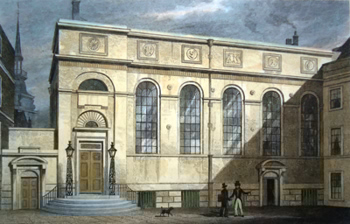
The image I’ve been using? I now have my own engraved, coloured antique print. It dates from 1831, was drawn by Thomas H. Shepherd, and engraved by W. Watkins. I treated myself to the print after our successful workshop last week. You must admit it looks lovely in colour!
 Well, the arrangements are all in place. We have delegates, a board room to meet in, catering and other practicalities taken care of, and even lunchtime entertainment for our guests. I’m happy to say that we’ve made contact with ALL of the historical legal deposit libraries, and all but two of them will be represented at next Monday’s workshop, along with big data and digitisation experts and other interested scholars. I won an AHRC networking award last year, and here we have it – networking really bearing fruit. I’m so excited!
FLASHBACKS
 TWO YEARS … To think that it’s two years ago since I presented this slide at the IAML (UK and Ireland) Annual Study Weekend: things have moved on quite a bit since then!
TWO HUNDRED YEARS … Lastly, I can’t resist sharing this – a snapshot of what was registered at Stationers’ Hall OTD (on  that day) 26th March 1818. It really is a typical cross-section of music publishing at the time! Just look – three arrangements of contemporary or near-contemporary operatic works for domestic consumptions (let’s not argue about who had the copyright in what! – see the posting on this blog last month!), and flute duets by one of THE big names of the time, virtuoso performer and arranger Charles Nicholson:-
Bishop’s Overture and Songs in Zuma, Book 1; Burrowes’s arrangement of Airs from Il Don Giovanni [Mozart], Books 1-3; Paer’s Numa Pompilio Overture; and Nicholson’s Four Concertante Duetts for Two Flutes.

Asked, in connection with another project, where the legal deposit music is in Britain, it seemed a good idea to summarise the current position. What follows is a very broad outline, but it might prove helpful to anyone trying to track down an old British piece of music!
The British Library has always received legal deposit materials from the start, has the most complete collection and all are catalogued. The collection began as the Royal Collection, then formed the basis of the British Museum collection, from which the British Library evolved.
For the remainder of the legal deposit libraries, remember that historically, some form of library committee decided which music to keep. This varied widely:-
Agency for the Legal Deposit Libraries – find out about today’s legal deposit system.
Introduction to Legal Deposit – a helpful introduction from the National Library of Wales.
Acknowledgement: image https://www.flickr.com/photos/yellowbookltd/ – https://www.flickr.com/photos/yellowbookltd/2875093931/, CC BY 2.0, https://commons.wikimedia.org/w/index.php?curid=7093190
This fascinating blogpost about Isaac Nathan appealed to me because his Hebrew Melodies were very popular in their day. (I know – people were borrowing them from St Andrews University Library!)
 A gift from Australia from one music librarian to another.
Sometimes you don’t always end up writing what you intended…This started out as a post for Australia Day 2018; but ended up as a rather different story. So how did MusiCB3 manage to travel from Poland to Sydney, via Canterbury and Cambridge, in the company of aristocrats, an intelligent woman, a notable disaster, and a superstar? Stopping off at London en route, and bumping into an expedition that went wrong, although it turned out right. Welcome to the sometimes topsy-turvy world of Isaac Nathan.
View original post 875 more words

No disrespect to my day-job, but years of cataloguing have trained me to tolerate repetitive tasks to a very high degree! Cataloguing can be repetitive and, I’m afraid, monotonous. However, in terms of endurance training, this background stands me in good stead. I just keep on going, like the Duracell bunny in the battery ads!
My innocent vacation amusement this week has been the rather slow-moving exercise of comparing one database with another. Why would anyone spend hours, days, starting to go through a list that amounts to some 2000 pieces of music? Ah, for a very good reason. This is the list of Edinburgh University Library’s Reid Hall Cupboard collection, and I’m finding out how much legal deposit music was actually retained. First, I compared it with the entire registered output of 1810 as listed in Kassler. Very little was there. Then with the registered output for 1818, the last year listed there. Possibly one match. Then I compared the Reid Cupboard contents with the material listed by the Advocates in 1830 – twelve years after the period itemised in Kassler. Very little correlation there, either.
However, at different periods, copyright music WAS selectively retained at the University of Edinburgh. I concluded that there was nothing for it but to go through that a significant sample of that spreadsheet, just to begin with. Some music is continental (mainly French or German) in origin, and some is in manuscript; these categories don’t form part of my investigation. The problem is that no single approach can be taken to the whole corpus. We’re not comparing like with like, and different listings cover different periods, apart from any other considerations:-
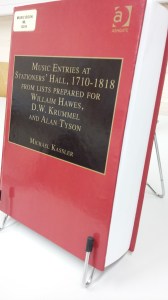 was published before 1819); checking Kassler in digital format is generally easier than in the paper edition, because one can check by title in the e-book. The physical book has various indices, but there’s no alphabetical title listing, and only the composers’ names are listed, not their works.
After several lengthy sessions checking and cross-referring, I had nearly finished composers beginning with “G”!
Thursday – the brightness of a [rainy] new dawn …
Faced with a very large collection of Haydn publications, I concluded that although the most comprehensive approach would be a complete comparision of the EUL Reid Hall cupboard contents with Kassler, St Andrew’s online copyright collection, and items listed in Copac, maybe this isn’t necessary immediately. Instead, a few broad statistics give us an overview of what’s there.
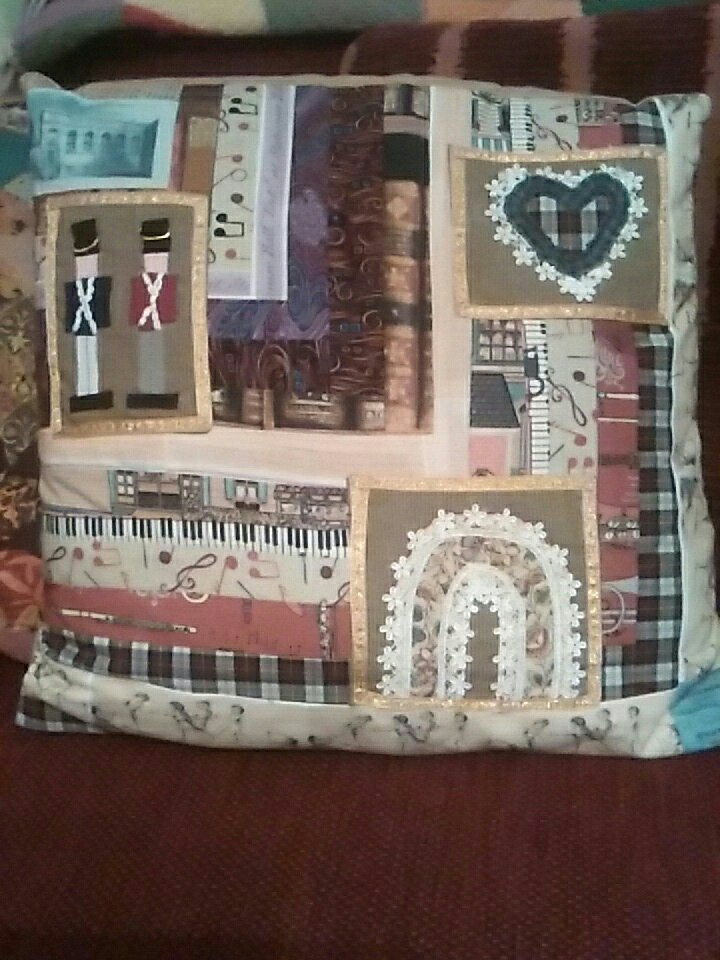
A few months ago, I sewed a collage representation of the music from the Georgian copyright music era. Different media appeal to different people; not everyone will want to read the musicological detail of our research, but they might like some of the cultural history we’re unearthing: Napoleonic songs, lovesongs, piano music, Vauxhall Gardens theatrical material …
 Then, a couple of weeks ago, I had another idea. This time, I whiled away some travelling time writing a short poem. Well, a verse, anyway. I can’t really privilege it by calling it a ‘poem’! Librarian B C Kaemper saved it as an image, which I share below:-

What do you think? Is there any merit in disseminating research findings this way in addition to the more conventional formats?
This is just a bit of fun – a WordPress challenge. I think my most meaningful project photo is probably the collage reflecting the variety of materials in the Saint Andrew’s copyright music collection. This is arguably not the ‘best photo’ in photographic terms! But it was another of my attempts to interpret research creatively.

 We tend to take catalogues for granted. We expect them to tell us everything about a book, score or recording – author, title, publisher and publication date, pagination, unique identifying numbers (ISBN, ISMN or publishers’ code), and the contents of an album or collection of pieces. We look for the author or composer, the editor(s) – and expect to be able to know which is which. In modern, online catalogues, this metadata is all carefully entered into special machine-readable fields as a “MARC record”. That’s a MAchine-Readable Cataloguing record.
When I began work as a librarian, I was taught how to catalogue onto pre-printed MARC data entry forms which the library assistants then entered into the library computer system. Computer tapes were run overnight to upload the data to a cooperative system hosted in the Midlands, and shared by a number of libraries. Things are more streamlined now!
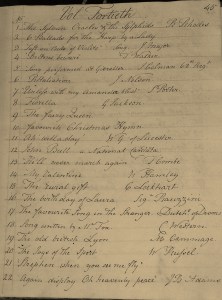 But what about our Victorian forefathers or the Georgians before them? By the early 19th century, library catalogues of books were often prepared as printed volumes, but this wasn’t the case for the music I’ve been looking at. Take the University of St Andrews’ handwritten catalogue made by Miss Elizabeth Lambert in the 1820s. If there were (for example) three completely separate pieces making up a set of sonatas or songs, then it was not unusual for her to write a composite entry: “Three sonatas”, “Six Quadrilles on airs from Le Comte Ory” or whatever.
In 1831, a meeting of the Curators at the Advocates’ Library – the precursor to the National Library of Scotland – agreed that their copyright music had been handled with a worrying degree of laxity, and decided that things had to be tightened up by appointing a music committee. Rules were drawn up regarding the handling and curation of this material, from arrival through to borrowing (yes, borrowing! It wasn’t yet a national reference library, after all) – not to mention calculating replacement costs and barring readers who had lost books, until they paid up!
However, it took until 1856-7 – by which time John Donaldson had become the Fourth Reid Professor at the University of Edinburgh – for the committee to decide that formal cataloguing rules were needed. Donaldson was at least a musician. Several committee members seem to have been in the legal profession. They spent a week thinking about how to set about it, debating whether to enter items under the composers’ names, or the publishers. And then they asked the experts at the British Museum. They received, by return, the rules used for cataloguing music, and adopted them for their own use.
This week, I looked at the National Library of Scotland’s Victorian Catalogue. I was trying to identify items on those two mysterious lists of music from 1830. They presumably wouldn’t have been catalogued until after 1857, if I’m interpreting the facts right. It took a little while before I realised just how far things have come since then!
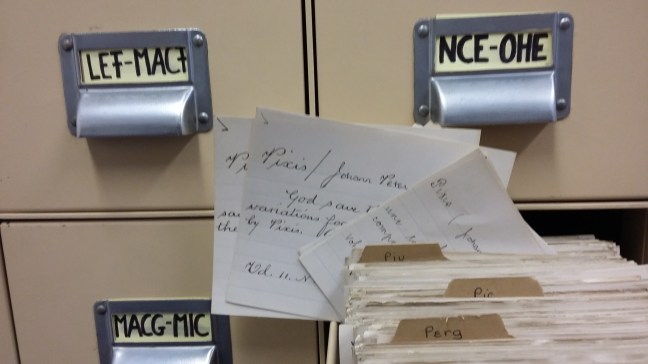 In the Victorian catalogue, music is entered alphabetically by composer, and then alphabetically by title within each composer’s output. However, the alphabetical titles were often alphabetical by genre rather than by exact title, so Selected Marches might be followed by Fourth March then Fifth March and then would come Favorite Quadrilles on airs from Rossini’s Le Comte Ory. (“Quadrilles” are alphabetically after “Marches”, and never mind about the words before them in the title!) Today, we create “uniform titles”, which standardise titles for filing purposes. By comparison, the Victorians had uniform titles in their heads but nothing like that on the catalogue slip!
This is modern library-speak for the names of people involved with creating the book or composition, whether they wrote, edited, or arranged it, or supplied some specialised service such as the fingering or bowing in a piano or violin piece, or indeed, writing an introduction or compiling an index at the end. Things are sometimes a bit more complicated than that.
For example, if Halevy wrote a piece, then clearly he was the main author. If he wrote a duet arrangement of themes in someone else’s overture, then in today’s parlance, he’d be the arranger. If he wrote variations on a theme, then you could argue that he was an author in his own right – the variations wouldn’t exist without him writing them. Thanks to online cataloguing, you’d find the piece regardless of what his contribution was, and in the case of sets of variations, the original composer of a theme would probably get a mention too. (The rules are clear, but if you check Copac, you find that sometimes the same piece has been catalogued by different libraries with either composer as the main entry, because it’s admittedly a slightly grey area – it doesn’t matter hugely, so long as the piece can be found!)


Now, in the days before online cataloguing, say, fifty years ago, an arranger or editor would have had an “added entry” with his name above the name of the original composer, so two catalogue cards would have been typed, and one filed under each individual’s name.
However, in the Victorian catalogue, you’d find Halevy’s compositions, sorted from A-Z, as I’ve just described, and then a second series of pieces sorted from A-Z, that he’d edited or arranged in some way. And the second sequence weren’t always complete entries. Sometimes, the card was just a cross-reference: it didn’t tell you which volume the piece was in, but the original composer’s name was underlined. So you’d then go and look under their name, to find out which volume contained the piece you were seeking.
As for publication and physical details – most records in the Victorian catalogue seem merely to inform us that the work was published in London, and was folio size. Not really very informative!
Those two lists from 1830 contained some 147 pieces, a few of which I had been unable precisely to identify. I made a valiant start trying to see how many of the identifiable ones could actually be traced in the Victorian catalogue. I didn’t get to the end of the lists! However, it did look as though the majority were there in some form. Had I been prepared to spend quite a few more hours on the task, looking for cross-references and arrangements in other places, maybe I’d have found more of them. I was at least able to establish that these lists seemed to be of pieces that the Advocates wanted to keep, rather than pieces they intended to sell. The lists didn’t look like Mr Greenhill’s lists from Stationers’ Hall; the Stationers’ Hall lists came quarterly, in books, and more closely written, whilst the Advocates’ lists were on loose sheets of paper, more spaced out, and dated as consecutive months: February and March 1830.
Of the pieces that I managed to trace in my two-hour session, most appeared to be bound into music volumes numbered from 1 to 68. I traced a handful in later-numbered volumes, but it was a bit difficult to be certain, when the handwritten lists themselves had given me little to go on!
 It always pays to enquire whether there are other old card catalogues that may not be on general public access. The National Library of Scotland’s Victorian catalogue, and Glasgow’s main public reference library, The Mitchell’s Kidson collection, are just two examples. Because they’re paper slips in long trays, you have to be a bit careful with them, and access may have to be arranged under supervision of a member of staff. But these are valuable resources, and may be the only way of accessing a historical collection of music. Who would have thought it, in these days of online catalogues – or OPACs*, as we fondly refer to them.
*Online Public Access Catalogues, to those in the trade!


