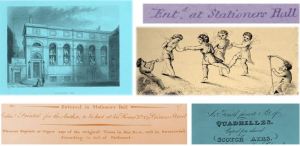
 Anyone with a research interest in early UK legal deposit music, its publication, its distribution or subsequent curation and use, can join the network. You can be added to the mailing list, if you let us know your email address. (You’ll find our contact details here.) You can also follow on Twitter, Facebook or Pinterest.
To take your involvement to the next level, why not consider joining our Jisc mailing list, which allows us to discuss with one another in a safe and supportive environment.
The AHRC-funded Claimed From Stationers Hall music research network gets a JiscMail Discussion List
JiscMail offers the facility to set up discussion lists about education or research interests on a particular topic, carried out by email. Correspondents generally have some connection with higher education, but this is not compulsory.
We have set up a list for sharing information about research interests in the historic British legal deposit music registered at Stationers Hall, and our groupname is MUSIC-FROM-STATIONERS-HALL.
How to subscribe? Basically, there are two ways of subscribing:-
- You can use this link: https://www.jiscmail.ac.uk/cgi-bin/webadmin?SUBED1=MUSIC-FROM-STATIONERS-HALL&A=1 New subscribers can complete their details to join the list.
- Subscribers can also join the list by sending an email to listserv@jiscmail.ac.uk as follows:-
Subject: Subscribe Message: SUBSCRIBE MUSIC-FROM-STATIONERS-HALL Firstname Lastname
You should receive a confirmation email; if it doesn’t pop up in your inbox, it may be worth checking “junk” or other filter folders. You then need to confirm the Jisc confirmation, quite promptly (otherwise they assume you didn’t mean to subscribe)! Please get in touch if you have any problems.
FAQs
- You’ll find instructions at the FAQ for Subscribers page: http://www.jiscmail.ac.uk/help/subscribers/faq.html.
- What is JiscMail? Visit http://www.jiscmail.ac.uk/about/whatisjiscmail.html
- Can I use institutional access? Certainly. If you’re in a British HE institution, you can use institutional access (Shibboleth), as you would with most electronic resources.
- Are there any rules? The JiscMail Service Policy document, http://www.jiscmail.ac.uk/policyandsecurity/ describes the way in which Jisc expects the service to be used, by list owners and subscribers.
Workshop
We’re also aiming to set up a workshop of some kind in early Spring 2018, so do watch this space.
Social Media Activity
Please feel free to tweet, “like” or share on Facebook, and generally make a big noise about this exciting new venture. (I made a Pinterest board, for what it’s worth – I read that it was a good marketing tool. At the moment I’m not quite sure …!)
Could You be a Guest Blogger?
I’m trying to blog at least weekly, and have also posted three podcasts to date, so do keep looking in. But this is a network – so we need more bloggers! Here’s your opportunity to raise your research profile. Could you offer a guest-blogpost to this blog on any topic that has some loose connection with early British legal deposit music, its libraries, the publishers, the composers or music users? Or do you know anyone who has any expertise about legal deposit in other nations in the eighteenth and early nineteenth centuries? This would all be exciting, too! (We’ve had two offers along these lines already, which we are very much enthused about.) If anyone has even a little half-idea about something that you could share, please do get in touch. Blogposts should be approximately 500-1000 words, but please run your idea past us first before you start writing it. We’re hoping to post a guest-blogpost roughly once a month, but more would be welcome, of course.


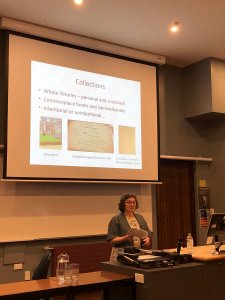 I returned from New Zealand yesterday morning. If you’d like to read about the University of Otago’s Centre for Book Research Seminar and the UNESCO Creative Cities Southern Hui, please follow this link. (And here’s a quick YouTube flick-through of my slides – don’t worry, it’s not the whole presentation!)
 During the reign of King George IV, Johann Peter Pixis wrote his Hommage a Clementi, a set of piano variations on ‘God Save the King’, op.101. Published in 1828 by S. Chappell, and also distributed by Henry Lemoine, copies went to all the copyright libraries. As I’m transcribing each item on the two Advocates’ Library music lists, I’m looking to see where copies survived, and it’s rare to trace such near-complete coverage as I did with this piece. Playing my game of ‘Happy Families’ with the list dated March 8th, 1830, I checked off an almost complete set still extant, in Aberdeen, St Andrews, Glasgow, Oxford, Cambridge and the British Library. Clearly, variations on ‘God Save the King’ were generally considered worth keeping. Indeed, St Andrews and Cambridge each hold two copies. The popularity of the tune is corroborated in a recent book,

 This week, I visited Elizabeth Quarmby-Lawrence at Edinburgh University Library, where we had a very useful discussion about library history, legal deposit, and the fate of the University’s legal deposit music. Some great ideas arose out of our chat, of which more anon! I now have more to read, more people to make contact with, and a brand-new copy of the University’s recent publication, Directory of Collections, edited by Head of Special Collections Joseph Marshall, and published by Third Millenium Publishing in 2016 (ISBN: 9781908990891).


 Karen McAulay, Musicologist