My Gift-to-Self

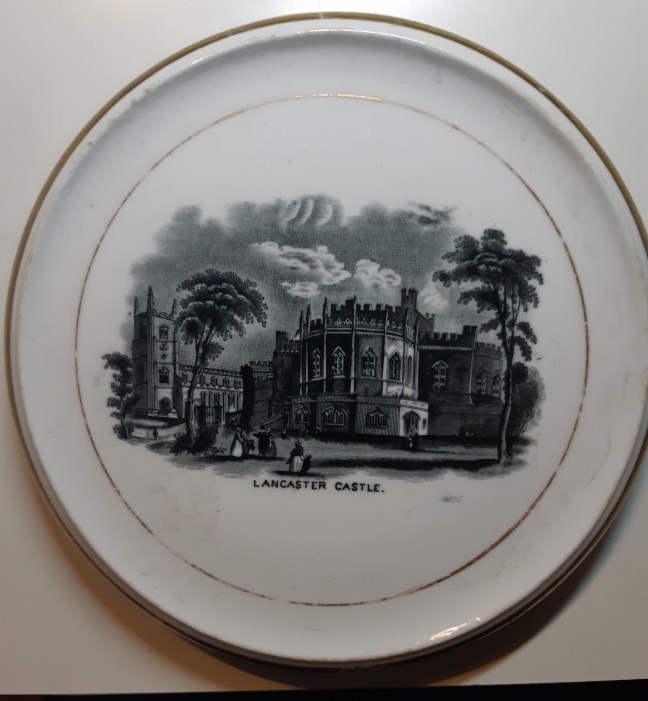
This is Lancaster Castle’s Shire Hall, built circa 1798, depicted on a teapot stand from – probably – around 1830. Earlier in the 1790s, ‘my’ lady music cataloguer, Elizabeth Lambert, was christened in St Mary’s Church, to the left of the picture. The Shire Hall hadn’t yet been built, and Elizabeth’s widowed mother had moved her young family to St Andrews to join her brother, a professor at the University there. Nonetheless, the church was there.

Fast forward to the mid 20th century. I was born in Lancaster and brought home to a flat at St Mary’s Gate, which was adjacent to the church.

Was there something in the water, that made both Elizabeth and me music cataloguers?! Anyway, this was just a wee bargain on eBay, and plainly I had to have it. Luckily for me, it was of huge significance to me, but not of high value to the vendor!

Why Provenance Matters in the Library

Some reading for me, later on this evening! I’ve been made aware of a potentially interesting article by Alice Wickenden:-

Things to Know before Beginning, or: Why Provenance Matters in the Library

(Inscription: the Journal of Material Text – Theory, Practice, History, June 2020)

Follow my Leader! Napoleon, Victoria and Albert …

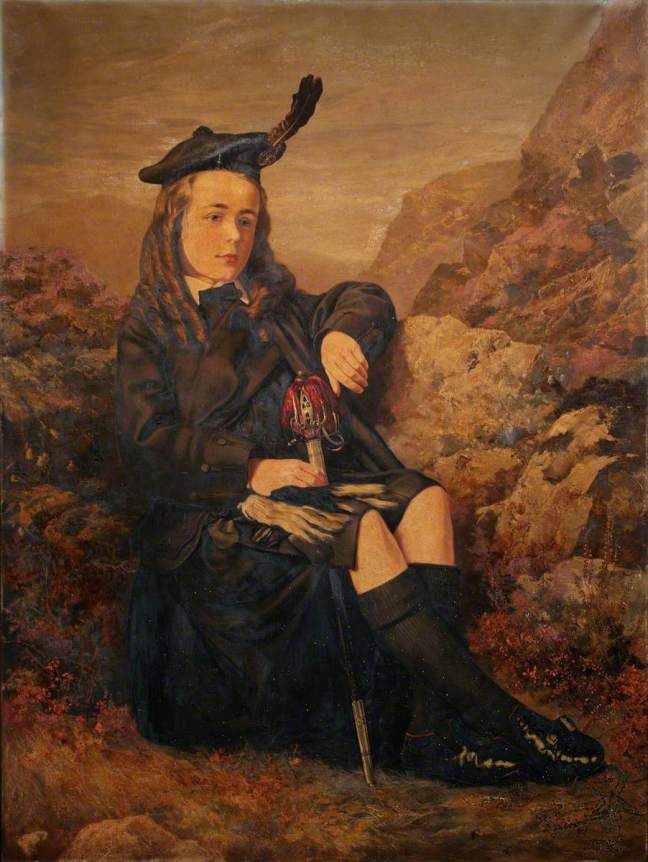
I’m just leaving this thought here, as a general observation. I was reading recently about Victoria and Albert, tartan and the phenomenon of “Balmorality”. It would be glib, and wrong, to pronounce that everyone loves tartan, but a lot of people certainly do.

Today, I’m reviewing a book about James Macpherson’s Ossian and its pervasive influence on culture not just in Scotland or Great Britain, but on the continent, too. Again, the actual facts are far more nuanced than this bald statement, but it is clear that, because Napoleon was an enthusiastic fan, a lot of people followed him.

So, there’s a parallel, isn’t there? How often has the approval, or disapproval, of a head of state led to a craze for something cultural, be it the warp and weft of a type of cloth, or the exploits of a misty distant hero?

Image: Child in a Scots Costume, sourced via Art UK. Painting by W H Prape, and now curated by Enfield Museum Service

A Crossroads

It’s my research day. I faced a choice: write a lecture for November, work on a book chapter for January, or get back to the Scottish music publishers project. I feel as though I’ve been away from the project for quite a while, writing papers on other things, so today is going to be a project day. I know the other things are important, but I need to reconnect with my main preoccupation, if it is to become a book at some stage in the future.

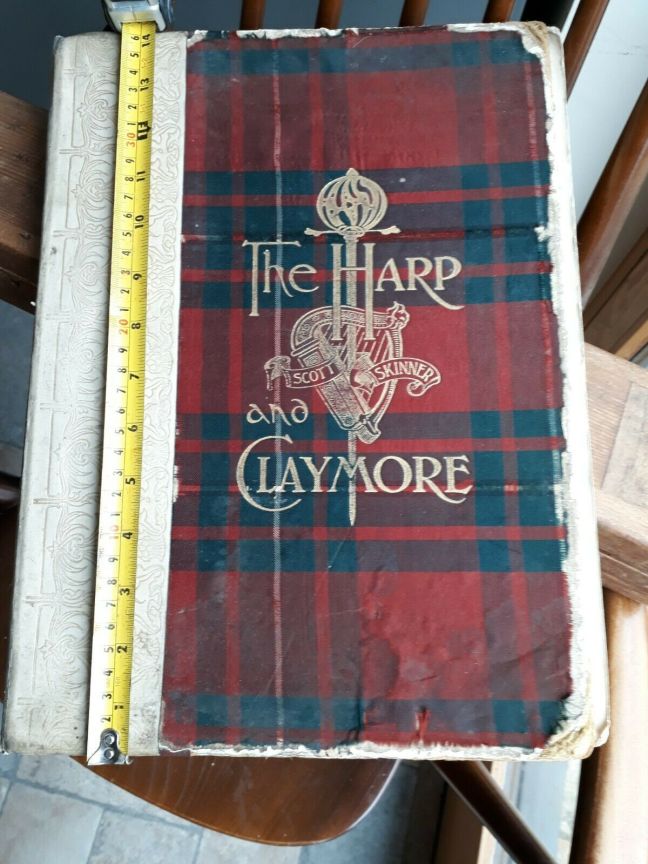
So … the question of the tartan book covers …..

[more anon!]

Video-Conferencing

Here’s another quick update, for the benefit of those who don’t follow the Facebook pages for The Claimed From Stationers Hall or Glasgow Music Publishers projects!

Next week, I’m giving a paper (well, I’ve already video-recorded it, but it’s being given next week) at a conference of cataloguing and metadata librarians. What else would I talk about but legal deposit music in libraries?! So this time, it’s called ‘The Cinderella of Stationers’ Hall: Music (and Metadata) in Georgian Legal Deposit Libraries’.
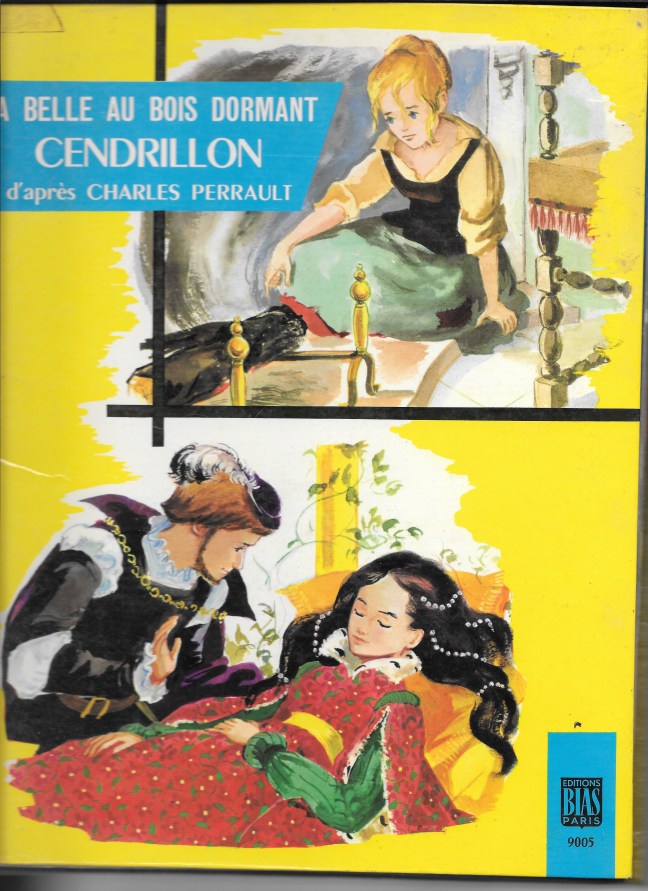
In a spirit of sheer whimsy, I’ve incorporated a picture of Cinderella as very pale background for the title page of my powerpoint – a volvelle picture from my favourite childhood book. This was a French picture-book of Cinderella, given to me by my late father when he taught on a teaching exchange in France. He died before I got my PhD, and wouldn’t half have been surprised to find his gift to seven-year old me, used as illustration for a perfectly serious presentation about a postdoc research project! You see it here in its technicolour glory. The conference will see it faded to near obscurity, but I know it’s there. A tribute to Pa!

A CAUTIONARY TALE: DO NOT LET IMAGINARY READERS LOOSE IN YOUR LIBRARY!

The first of my research papers to be video-recorded last weekend was a paper about some very old tunes, which appeared in one version in Scottish sources, and in a different but apparently related version in Borders ones. This is for the English Folk Dance and Song Society conference in a few weeks’ time. Well, with all these old sources on my mind, I inadvertently made things more difficult for myself at work today. We were ‘practising’ a new lIbrary lending procedure for when the students return, and it involved setting up fake readers and fake book requests, to make sure the routine worked in practice. I used fake names associated with my research paper, because I was sure they were unlikely to crop up as real people on our system. And then I started getting my imaginary readers to request genuine books as part of this practice session. I shouldn’t have done it – those imaginary readers had very specific requirements, ALL concerning some aspect of the Scottish Borders, Northumbria and Cumbria.

They had me running all round the library tracking down books from every corner, high and low. If I had had any sense, I’d have picked books from one single shelf! My Fitbit tells me I have walked further than I’ve done in months, today, and to judge by the calories expended, I’ve carried more weights ditto. That will teach me to use my imagination ….

Empty!

You know what happens when you empty a plastic carton, and it sort of collapses in on itself? After a weekend in which I recorded not one, but TWO conference papers, did sundry domesticity and not much else, I feel very much deflated!

Imagine my – ahem – joy that I have a day actually Working-At-Work tomorrow for the first time in six months. Just when I feel as though I could do with a quiet day at my home-desk with copious cups of tea …

But the good thing is that, apart from a third conference paper on a different topic, and a book chapter to start work on, I am currently up to date! I may yet get back to my late nineteenth- and early twentieth-century Scottish music publishers. Although the book chapter just might be rather time-consuming. Nonetheless, it’s a nice topic and will make a pleasant and RELATED change to my main focus, so I can’t complain too much.

Working From Home? It’s All Go!

I think my fingers should be tingling. You know I bought myself two scores published by Bruce, Clements & Co earlier this month? One of them was the opera by the publisher himself, W. B. Moonie.

And …I now have a copy signed by the composer!

However, such excitement has to be kept in check as I work on my second conference paper of the month.

I’m primarily working from home at present, both with my researcher and with my librarian hats on. Right now, in my research role, I have undertaken to give three conference papers in as many months, so I’m rather busy writing! I haven’t forgotten my Scottish music publishers – certainly not! – but I only officially have 1.5 research days a week (shhh, don’t mention all the evening efforts!) – so I need to focus on things with deadlines. The conference papers will be recorded and shared online.

Time will tell if I manage to make any visits to other libraries in the foreseeable future. Since lockdown, I seem to have purchased more books and music than I have room for, but some things aren’t available to purchase!

So he played the Banjo …

I researched flautist James Simpson, the father of Dundonian music publisher and seller Alexander Simpson, for some months  before starting my PhD.   In the mid-1800s, Alexander Simpson became a partner in Methven Simpson, which had stores in Dundee, St Andrews, Forfar and Edinburgh.

I was unaware of any links with musicsellers or publishers in Glasgow, but you can’t blame me for getting excited when I found out about Frank Simpson’s shop in Sauchiehall Street, a couple of years ago.  Indeed, there was another Frank Simpson selling music elsewhere in Glasgow at the start of the twentieth century.

Let me save you a long story.  The Sauchiehall Street Simpson established his shop in 1860 – not much later than Alexander Simpson’s early career in Dundee – and I wasn’t aware of Alexander having any brothers, or of the family having a Glasgow connection at all.  The low premises on the left-hand side of the postcard foreground (above) are the shop the older Frank Simpson later settled in, with the shop remaining there for well over a half-century.  Frank Simpson junior eventually joined him, importing banjos from S S Stewart in the USA, and teaching the instrument from the premises from the mid 1880s onwards.  The other Simpson was a competitor, no connection with the Sauchiehall Simpsons (as their adverts make amply clear!), and it seems there was no connection with Methven Simpson.

However, this apparent dead end may not be a complete cul-de-sac, since the Sauchiehall Street shop was demolished to make way for British Home Stores circa 1964, and the owner by that time was a famous singer of Scottish repertoire.  I believe the shop was subsequently combined with a couple of others, ultimately to form the Glasgow Music Centre, so … taking the links back in time again … it all forms part of my present research interest in late Victorian and Edwardian Glasgow music publishers.  It just doesn’t connect with the Methven Simpson story.  So many Simpsons!

During my perigrinations through the British Newspaper Archive (a present to myself, half-subsidised by Mum’s Christmas gift!), I caught Frank Simpson junior playing his banjo at a “minstrel concert” in Milton of Campsie, and twice at a Sabbath School Soiree in Kilbarchan.  Frank Simpson cheap novel soldI discovered that Frank Simpson also published cheap novels, and (from an advertisement whose provenance was uncited) -that the shop sold books, jokes and greasepaint as well as the thousands of pieces of sheet-music that Glasgow Herald adverts boasted of.  Sadly, the British Library only seems to have five songs – but this material was not high art music, so there’s the possibility that it didn’t get logged in sufficient detail for me to be able to trace Frank Simpson’s imprint.

To date, the genealogical database Scotland’s People has not yielded the significant dates of   Sauchiehall Street Frank Simpson senior – I could still look harder –  but I do know that Simpson junior was born in Airdrie on 24th May 1866, and  died in East Kilbride on 14 August 1936 at the age of 70.  For now, I’m leaving them in limbo, since this is an intriguing but time-wasting detour away from the bigger questions about what the other, more active publishers were actually publishing!


Echoes from Stationers’ Hall

I was delighted to read a brand-new posting by Dr Briony Harding for St Andrews’ University Library’s Echoes From the Vault, today.  The Copyright Music Collection again provides the backdrop in this posting,

Woelfl’s Third Grand Concerto for the Piano Forte

The music collection has had an interesting past – at one point it was shoved aside into a dovecote belonging to the University – but nowadays it sits in splendour, a vital resource for studying British publications of Georgian-era music.  It was the inspiration for the AHRC-funded ‘Claimed From Stationers’ Hall’ network.

With my other hat on …

Published this week in SCONUL Focus 71, an article summarising the PGCert project that I undertook a couple of years ago:-

Library support to students on blended-learning courses: some thoughts on best practice