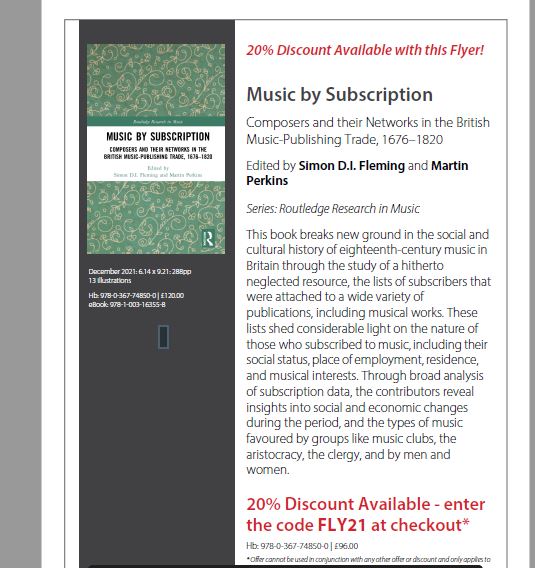
Get a Discount on Music by Subscription (forthcoming book of essays)


Dr Karen McAulay explores the history of Scottish music collecting, publishing and national identity from the 18th to 20th centuries. Research Fellow at Royal Conservatoire of Scotland, author of two Routledge monographs.
Back in 2013, I authored a blogpost for the Journal of Victorian Culture Online. Today, the Journal has been having a “Throwback Monday” of some kind, as they’ve found it in the archive and shared the link again. I had almost forgotten I’d written it, so it was nice to see it still considered of value.
Here it is again, first published 29 August 2013. ‘Teaching Cultural History Through National Song‘ by me, Karen McAulay (Royal Conservatoire of Scotland).
I must share the excitement – I’ve been elected a member of the Royal Historical Society! It’s an honour, and I’m proud to be a musicologist considered worthy for election. So much is happening these days with regard to how history is viewed by various sectors of society – I feel it is important to be part of the informed conversation.
Remember, my project into Stationers’ Hall copyright music included the erstwhile library of Sion College?
Anything surviving in that library went to Lambeth Palace, which now has a splendid new library building. Well, I have just seen this advert for a cataloguer posted. Knowing how little music is there, it’s a job for a rare books cataloguer really, but I can’t NOT share details, since I feel a tenuous connection with the library through our research project! AND if you scroll down, there’s another digital job, too …
Here goes – and good luck! :-
Project Cataloguer (Sion College Library) Lambeth Palace Library
Fixed term (two years) £26,954 p.a. rising to £28,983 p.a. after probation
Lambeth Palace Library, founded in 1610, is the historic library and record office of the Archbishop of Canterbury. Following the merger with the Church of England Record Centre in 2020 it is now the principal repository for the archives not only of the Archbishop of Canterbury but also of the National Church Institutions in London.
We are looking for a new team member to support the vision and mission of the Library by describing, developing, interpreting and promoting the Library’s collections for the benefit of readers, particularly the pre-1850 printed collections of Sion College Library (founded 1629).
Using your previous experience of cataloguing printed material and your understanding of cataloguing standards, you will create high-quality catalogue records for early printed books and other printed material, to agreed targets and standards.
Engaging with our readers and researchers, you will promote the use of the collections, answering enquiries and participating in outreach and engagement activities to support the Library’s vision to be accessible to all.
This post is offered on a fixed term contract expected to last for two years. Interviews are expected to be held on Tuesday 31st August 2021.For further details and to apply, please visit: https://pathways.churchofengland.org/…/project…. Informal enquiries may be made to archives@churchofengland.org.
Digital Officer, Lambeth Palace Library. Secondment/fixed-term contract until August 2022
Salary: £26,954 rising to £28,983 per year after probation (pro rata)
This is an excellent opportunity to join Lambeth Palace Library, the National Library and Archive of the Church of England. The post is offered on a secondment/fixed-term contract expected to last until the beginning of August 2022.
You will provide copies of manuscript, archive and printed materials in digital formats for users of the Library and for outreach and preservation purposes and administer the service on a day-to-day basis, keeping accurate records of orders and payments. You will also maintain the digital image bank, storing new images with standard metadata according to agreed procedures.
To be successful, you will need ability and experience in digital photography as well as strong customer service and IT skills. We’re also looking for someone who is able to prioritise, and work accurately and methodically, handling material with due care for preservation and security.
This is a part-time role, working 21 hours per week.
To arrange an informal discussion about the role, please contact krzysztof.adamiec@churchofengland.org
Interviews will be held the week commencing 6th September 2021. For further details and to apply, please visit: https://pathways.churchofengland.org/job/pathways/2579/digital-officer
I have contributed to the April 2021 ‘What are you reading?’ column in the Times Higher Education. My chosen book was Sean Reidy’s Dunbrody, A Famine Odyssey: How JFK’s Roots Helped Revive an Irish Town (Sean Reidy, 2020)
Follow this link:- https://www.timeshighereducation.com/books/what-are-you-reading-april-2021 – it’s easy to make a free account which entitles you to read a few articles a month.
Professor Porter has a new article in the Journal of Musicological Research, and I look forward to reading it at the earliest opportunity. Did you know an Englishwoman called Harriet Wainewright wrote an opera, Comala, in 1792?
Here are the article’s details, if you have access to this Taylor & Francis Journal:-
James PorterPublished online: 16 Feb 2021
I’ve done all the usual stuff – cooked and then enjoyed the dinner, snoozed in front of the TV, chatted with the family … and now I’m very tempted to open my research folders and continue pondering my latest conundrum, but I know that I shouldn’t! I shall wait at least until tomorrow before I continue to explore why this particular fiddler had fewer subscribers to his last collection (which ultimately turned out to have multiple flaws in the basslines, not that the subscribers would have known when they subscribed) …

Why am I posting a jigsaw puzzle? It’s for the Scottish Research Showcase on Friday 27 November 2020! See how quickly you can complete it. You’ll get the full context tomorrow when I tweet a link to my videoclip.
If you follow Twitter, these are the necessary names and hashtag to follow:-
See you there!
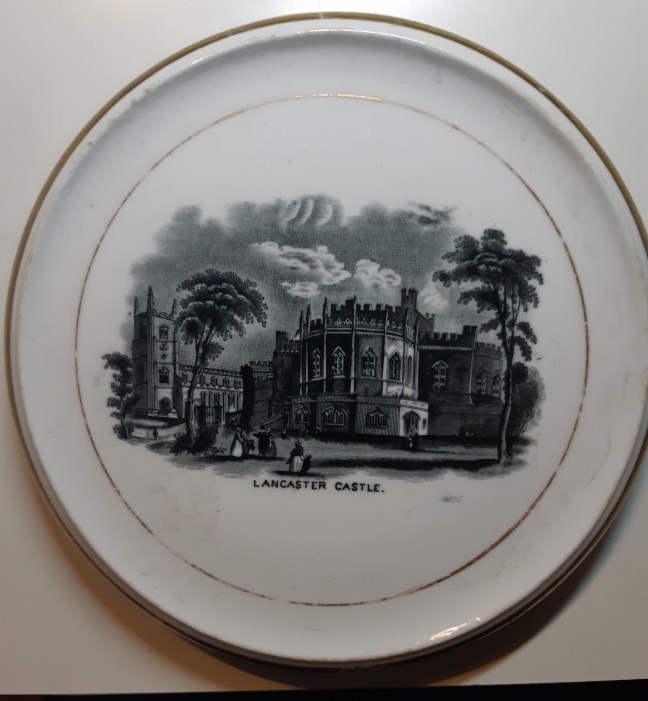
This is Lancaster Castle’s Shire Hall, built circa 1798, depicted on a teapot stand from – probably – around 1830. Earlier in the 1790s, ‘my’ lady music cataloguer, Elizabeth Lambert, was christened in St Mary’s Church, to the left of the picture. The Shire Hall hadn’t yet been built, and Elizabeth’s widowed mother had moved her young family to St Andrews to join her brother, a professor at the University there. Nonetheless, the church was there.
Fast forward to the mid 20th century. I was born in Lancaster and brought home to a flat at St Mary’s Gate, which was adjacent to the church.
Was there something in the water, that made both Elizabeth and me music cataloguers?! Anyway, this was just a wee bargain on eBay, and plainly I had to have it. Luckily for me, it was of huge significance to me, but not of high value to the vendor!
Some reading for me, later on this evening! I’ve been made aware of a potentially interesting article by Alice Wickenden:-
Things to Know before Beginning, or: Why Provenance Matters in the Library
(Inscription: the Journal of Material Text – Theory, Practice, History, June 2020)

