Book reviews in Brio Special Issue 56.2 (Claimed From Stationers’ Hall)

It occurred to me that you might like to know which books were reviewed in the special issue, since their titles don’t appear in the contents list:-

  • Derek Miller, Copyright and the Value of Performance, 1770-1911. Cambridge:
    Cambridge University Press, 2018
  • Book Parts. Edited by Dennis Duncan and Adam Smyth. Oxford: Oxford
    University Press, 2019
  • David Pearson, Provenance Research in Book History: a Handbook.
    New and revised edition. Oxford: Bodleian Library, 2019
  • Lee Marshall, Bootlegging: Romanticism and Copyright in the Music
    Industry.London: Thousand Oaks; New Delhi: Sage, 2005

Sion College: a Postscript

I have just learned that Anna James, who was for a few years cataloguer at Lambeth Palace Library, wrote her University College London Masters Thesis on Sion College’s history, in 2007.  Part of the dissertation became a paper given to CILIP’s Library and Information History Group in 2013, and that section formed the basis of an online paper on Anna’s Academia page.  Although music isn’t mentioned in this version, we nonetheless learn an enormous amount about the college, so this is a valuable contribution to the field.  I’ll add a link to our network bibliography at the earliest opportunity.

(It’s worth noting that Mr Greenhill (of Stationers’ Hall) sent lists of new publications to all the legal deposit libraries, and Sion College’s lists are still extant, like those at some of the other libraries.  But Sion’s music – as I’ve already noted – is long gone!)

Sion College Library: Vade fac similiter, by Anna James (2016)

(You do need to sign up to Academia to be able to download the pdf – however, there’s no need to populate your new account with your own writings if you don’t wish to!)

Image sourced from Lambeth Palace’s website.

Digital Humanities: a Strange New World

With Brio Vol.56 no.2 safely delivered, there aren’t any more big planned outputs from the Claimed From Stationers’ Hall network – and 2020 is the year for new grant applications.  Should I change the name of this blog, or start a new one? My gut feeling is to stick with this one until a new grant is won!  Digital humanities are likely to come into it somewhere along the line.  One application was submitted right at the start of November, and now I must think about the next one.

Since our Bass Culture project was essentially a digital humanities project (resulting in hms.scot), the realm of digital humanities isn’t entirely alien to me.  Nonetheless, on revisiting notes from a couple of meetings I attended last year, I realise there is terminology that I need to become more conversant with.  If I want the technology to help with my next project, the least I can do is make sure I can talk the lingo!

Triple IF

Today it’s “Triple IF”.  It sounds a bit like IVF without the Vitro, but it’s actually concerned with marking up images, and stands for International Image Interoperability Framework.  (Three I’s and an F, in fact.)  Who better to come to my rescue than the Bodleian Library, so here’s my next reading material:-

International Image Interoperability Framework:-

https://blogs.bodleian.ox.ac.uk/archivesandmanuscripts/2015/06/19/iiif/

Claimed From Stationers’ Hall: papers from an AHRC-funded network project (Brio Vol.56 no.2, Autumn-Winter 2019)

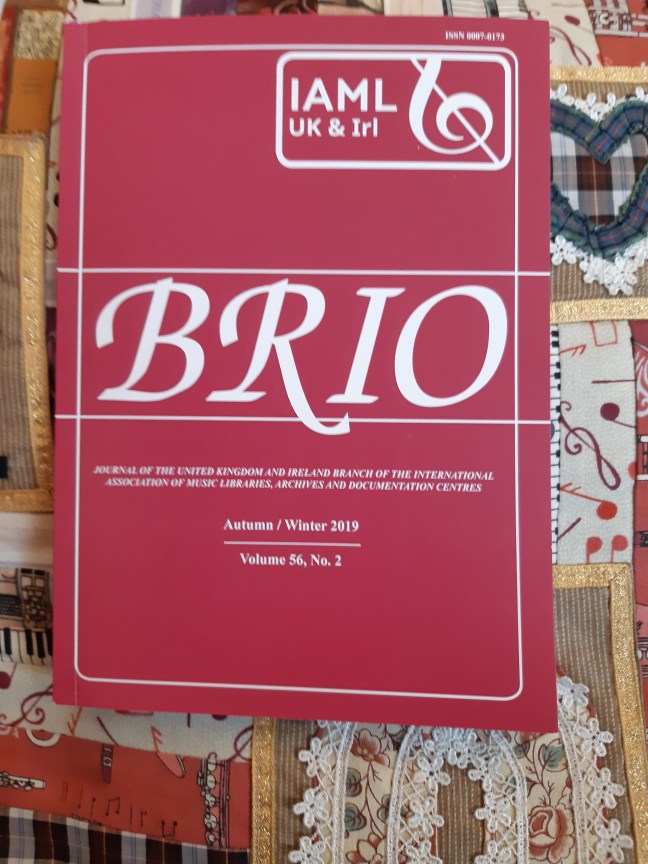
And it popped through the letter-box today: the latest shiny-new issue of Brio, our special issue dedicated to papers from the Claimed From Stationers’ Hall networking project.

If you or your library subscribe to Brio, put the kettle on and settle down to a fascinating read.  (Your library may have been closed for Christmas, so it might take a day or two for the latest issue to hit the shelves!)

I have added the entire issue to Pure, the Royal Conservatoire of Scotland’s institutional repository.  My thanks to IAML (UK and Ireland) for agreeing to this – it’s really important to us, as grant-funded research outputs need to be openly accessible.

If you contributed to the volume, but haven’t got access to Brio, please don’t worry – we’ll be sending you a copy in due course!

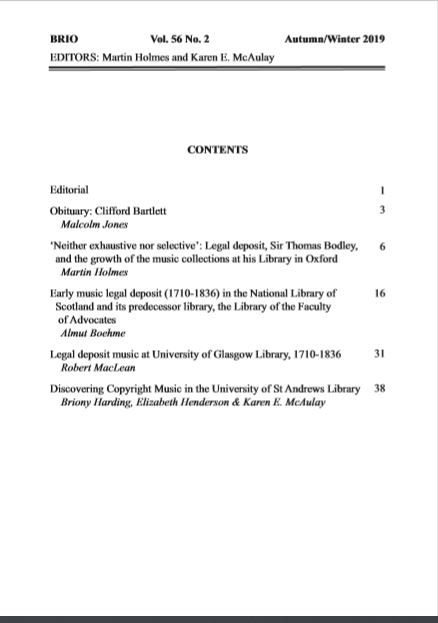
Meanwhile, to whet your appetite, here’s what you can look forward to!

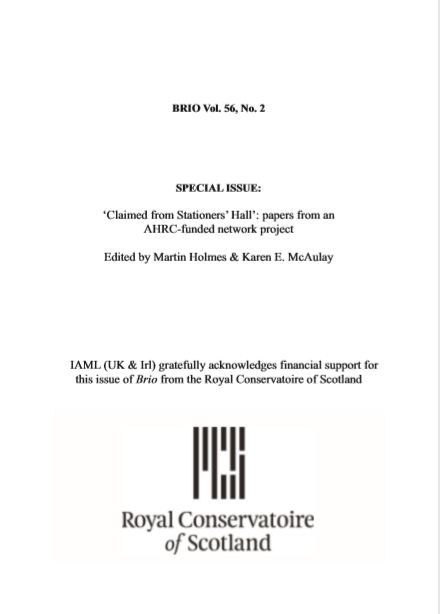
Brio 56 no 2 title page

Along with the workshop that we held at the Royal Conservatoire of Scotland in Spring 2018, this issue is the network’s biggest and proudest output.  So, congratulations to each and everyone in any way involved in the production of this issue.   My special thanks go to Editor Martin Holmes for his kind and gracious support, and of course to IAML (UK and Ireland) for allowing us to produce this special issue in the first place.  We’re very grateful indeed.

Brio 56 no 2 contentsBrio 56 no 2 more contents

A different track: Cambridge legal deposit disrupted by 2nd World War

From an era a century later than our project’s focus, we encounter legal deposit again – at Cambridge University Library. The practical impact of the Second World War? A disruption in the supply of legal deposit music!

mj263's avatarMusiCB3 Blog

This week, I have been busy laying out a small exhibition in the Anderson Room to commemorate the start of the Second World War.

I had a very clear idea in my head of what I was going to do – an exhibition based around some wartime favourites: There’ll be Bluebirds over the White Cliffs of Dover, Lilli Marlene, Moonlight Serenade, Bella Ciao, and the famous timpani version of Beethoven’s Fifth Symphony – Morse code for Churchill’s Victory V, the sound of the BBC broadcasting to Europe throughout the war years.

Due to circumstances beyond my control, and reflecting wartime conditions, the exhibition ended up being rather different to my original intentions. It is though, I believe, perhaps a truer reflection of the times.


View original post 990 more words

Excerpt from RMA Bulletin 2019

Hi, network members!  Not long now until the special bumper issue of Brio comes out!  I hope you’re telling all your colleagues and friends to look out for it …..

RMA Bulletin Nov 2019

A Flurry of Paratext!

Sorting through the late Jimmy Shand’s accordion music, I came across some curious pieces amongst the more predictable repertoire. One was William D. Hamilton’s Song of Arran with Strathspey (With Tonic Sol-fah). Mr Hamilton lived at Ailsa House, Adrossan – so Arran’s not that far away.

And you know how I love paratext? Well, I haven’t strayed into the twentieth century very much in my paratextual explorations, but this piece is positively DRIPPING with it!

“RESPECTFULLY DEDICATED

To MACKENZIE MURDOCH, Violinist and Composer, whose modest and kindly, yet transcendent genius has so notably enriched in abundant melody, fantasia, and arrangement, Scotia’s great Repertoire of National Music, and through him to his illustrious brother Celts of the Arran Society, Guardian Conservators of one of Scotland’s most noble possessions – the peerless Isle of Arran.”

Now, the tune was “written and composed by Wm. D. Hamilton”, but his friend Mackenzie Murdoch arranged the Accompaniment & Strathspey. Mr Murdoch apparently lived at 270 Great Western Road, Glasgow. (Imagine the raised eyebrows if the title page gave the composer’s full address nowadays, unless it was self-published! Data protection, dear chap!)

It would appear that Wm. D. Hamilton had a house in Ardrossan but traded from 59 Bath Street in Glasgow, whence he published this sheet-music in 1922.

Anyway, the tune appears first as a song and then as a dance-tune – a strathspey. And then, at the end, we find another chunk of paratext. Be still, my beating heart! This is an advertisement for another, larger piece by Mackenzie Murdoch. How often have we read allegations that Britain has no wworthwhile national music? Or that England is deficient in this regard? It’s less common to find someone refuting the suggestion that Scotland somehow falls short. But then, my investigations have mainly been into Scottish ‘national airs’, whereas this is about more serious composers. Interesting!

I’d llike to know more about Mr Murdoch!
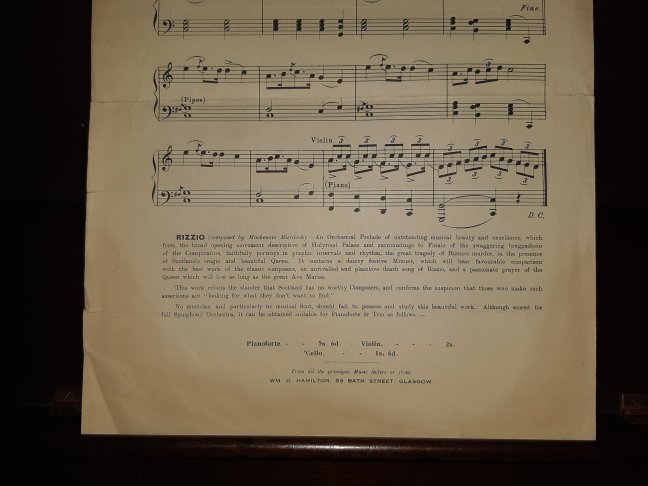
“RIZZIO (composed by Mackenzie Murdoch). – An Orchestral Prelude of outstanding beauty and excellence, which from the broad opening movement descriptive of Holyrood Palace and surroundings to Finale of the swaggering braggadocio of the Conspirators, faithfully portrays in graphic intervals and rhythm, the great tragedy of Rizzio’s murder, in the presence of Scotland’s tragic and beautiful Queen. It contains a dainty festive Minuet, which will bear favourable comparison with the best work of the classic composers, an unrivalled and plaintive death song of Rizzio, and a passionate prayer of the Queen which will live as long as the great Ave Marias.

This work debuts the slander that Scotland has no worthy Composers, and confirms the suspicion that those who make such assertions are “looking for what they don’t want to find”.

No musician and particularly no musical Scot, should fail to possess and study this beautiful work. Although scored for full symphony orchestra, it can be obtained suitable for pianoforte or trio …”

POSTSCRIPT

My thanks to Stuart Eydmann for alerting me to this mention of William Mackenzie Murdoch on the Rare Tunes website, where you can read more about him AND hear his fiddle playing – ‘The Drunken Piper’.  What a great resource!  https://raretunes.org/william-mackenzie-murdoch/

Facility, Steadiness and Precision: Mlle Merelle published a harp tutor

On this day, 10th October 1799, Broderip and Wilkinson registered Mademoiselle Merelle’s harp tutor at Stationers’ Hall. In two volumes, her New and Complete Instructions for the Pedal Harp … Containing all the necessary rules, with exercises, preludes, etc, calculated for acquiring facility, steadiness and precision on the instrument was a mere 50 pages in total, but it took the beginner from ignorance to an astonishing level of dexterity by the end of the second book! It was dedicated to her pupils, whom one would imagine must have taken quite some time to master the exercises until they could play the exotic flourishes that brought the tutor to its triumphant conclusion.

I am rather pleased to note that Mrs Bertram and her daughters appear to have borrowed a book containing this work, from the University Library at St Andrews. They ran a girls’ boarding school – who knows who actually played from this book!

A Seattle website called Harp Spectrum (2002-2014) contains an article by Mike Parker, in which he says that Mlle Merelle was a London harp teacher.(1) Whether she was the first woman to publish a harp tutor, is not something I’m in a position to comment upon at the moment. Hers does seem to be the first one authored by a woman and registered at Stationers’ Hall in London, but that’s no guarantee that others weren’t published elsewhere in the world – or published in the UK but not registered at Stationers’ Hall.
There are very few copies surviving. It was therefore with a small cry of triumph that I discovered a digitised copy in Denmark! You can look for yourself, here:-
New and Complete Instructions for the Pedal Harp. In two books.
There are lots of arpeggios and broken chords – and (at first glance) no national melodies, which is markedly different to piano tutors of the same era!
Mlle Merelle also published Les Folies d’Espagne, avec des nouvelles variations pour la harpe, registered by Broderip & Wilkinson on 13 June 1799, and a book of harp tunes, Petites Pieces pour le Harpe, registered by the same publishers at Stationers’ Hall on 24 March 1803. Again, few copies survive. The first is also in digital format at the British Library, but I believe only on-site.

(1) The Eighth Pedal – Fact or Fiction?
by Mike Parker

Interpreting Research In Textile Form

Karenmca's avatarKaren McAulay Teaching Artist

I recorded a vlogpost!  Interpreting Research in Textile Form

The free version of WordPress won’t let me upload the video here, but here’s a screenshot anyway!

Screencast snip but not live link

View original post

In the Name of Paratext (there’s a new,very covetable book!)

Edinburgh author Tom Mole’s The Secret Life of Books is published today. Guess I’ll be heading for Waterstones at lunchtime!

The Secret Life of Books