Dr Karen McAulay explores the history of Scottish music collecting, publishing and national identity from the 18th to 20th centuries. Research Fellow at Royal Conservatoire of Scotland, author of two Routledge monographs.
My latest eBay purchase will teach me to look more closely at the photos. (Of which there were a lot, I might add.) But the words DESCRIBING the pair of books nowhere said that one was a staff edition, and the other Tonic Sol-Fa!
The cover title was correctly transcribed, although the seller hadn’t indicated that the one without the words “School edition – Staff” was, in fact, the School edition in Tonic Sol-Fa. Had I looked right through the photos, I would have got to the picture of the Sol-Fa title page and an example of the Sol-Fa itself. My mistake!
However, in this case it’s not too much of a problem – I’m more concerned with the contents of the books and their paratext, than actually playing or singing the music. And if I want to practise my sol-fa reading skills, well, I now have another book to practise with!
I took a 2-volume book of part-songs home over Christmas, in connection with my Scottish music publishers research.
Our heroine’s church in Paisley
Just two women had contributed to the collection. Researching one of them occupied much of last week’s annual leave! But I ended up with a respectable article for a local newsletter. Not peer-reviewed, not likely to hit the headlines, but it got all my findings sorted into a narrative which I can draw upon again later. And I enjoyed my week!
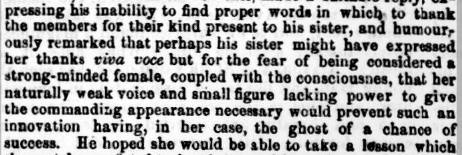
Moreover, I’ve just managed to get her a mention in Chapter 4 of my book. Her brother would think this most audacious! When she got a presentation, he stood up and accepted it for her … because …..
I still don’t know if this kind of post is helpful. To anyone who hasn’t many/any visible outputs, reading someone else’s list of what they achieved is probably the very last thing they need to brighten their day – and I apologise. You’ve probably achieved other, equally or even more important things, which didn’t take the form of words on a page!
From my vantage point, as a researcher who sentenced herself to a career in librarianship, not necessarily as a first choice but what seemed at the time to be a reasonable one, I look at other academics’ lists of achievements and struggle not to compare myself – although realistically I cannot achieve as much research in 1.5 designated days a week as the average full-time academic. My research line-manager is more than content, so maybe I should remind myself of that more often.
So, what have I achieved?
As a librarian, I have spoken at two conferences, a panel discussion and as staff training for another library, about EDI (Equality, Diversity and Inclusion) in our own library. I have a paper being published in an academic journal next year, on the topic of women composers in libraries; but my proudest achievement was actually in sharing a song by a Victorian woman teacher in the junior department of the Athenaeum, that I had discovered in a research capacity, and which a singing student eagerly learned and presented as one of their competition entries in a recent singing competition at RCS. Discovering something, having someone else declare it lovely, and hearing them perform it beautifully, is a very special privilege.
Still hatching
As a researcher, I have another paper forthcoming in an essay collection, though I can hardly list details here before it has even gone through the editorial process. And another magazine article which has been accepted for 2024. Can’t include that either. Nor can I yet include the monograph I’m halfway through writing. I’ve done a ton of work in that respect, but it doesn’t count in a retrospective list of successes!
I’ve also applied for a grant which I didn’t get, and a fellowship for which the deadline is just today, so no news on that front for a little while.
That leaves this little list, the last item of which appeared through my letterbox at the turn of last year, so I’ve cheekily included it here again.
Forthcoming
‘Representation of Women Composers in the Whittaker Library’, Journal of Perspectives in Applied Academic Practice. Arises from a paper given at the International Women’s Day Conference hosted by the University of the Highlands and Islands, 2022. Peer-reviewed and pending publication.
Arrived
‘Alexander Campbell’s Song Collecting Tour: ‘The Classic Ground of our Celtic Homer’, in Thirsty Work and Other Heritages of Folk Song (Ballad Partners, 2022), 180-192
‘Burns and Song: Four New Publications’, Eighteenth Century Scotland, no. 36 (June 2022),12-15.
‘Strathspeys, Reels and Instrumental Airs: a National Product’, in Music by Subscription: Composers and their Networks in the British Music Publishing Trade, 1676–1820, ed. Simon D. I Fleming & Martin Perkins. (Routledge, 2022), 177-197
Meanwhile, as an organist, I’ve completed my first year in Neilston Parish Church, which has been a very healing experience. I love it there! This Christmas has seen three of my own unpublished carols being performed, one in Neilston and two in Barrhead; and earlier in the autumn I contributed a local-history kind of article to the Glasgow Diapason, the newsletter published by the Glasgow Society of Organists. Another publication! Might as well add it to the list:-
‘Trains, Trossachs, Choirs and the Council: Neilston Parish Church’s First Organist’, in The Glasgow Diapason Newsletter
Confession time. Sewing is my relaxation of choice, often influenced by something I’m researching. This year’s project, a Festival of Britain canvas-printed linen piece, relates to the aforementioned chapter that I’ve contributed to someone’s book.
I know I would get more research writing done if I didn’t sew in my leisure time, but I need that for my mental health. Swings and roundabouts…
Sitting feeling somewhat sorry for myself with the aches-and-pains that follow a Covid booster vaccination (yes, I’m grateful really, but … owch!) – I sat bolt upright when I spotted this open access book title on social media. It looks irresistible, quite apart from the delight of finding it is free! I shall add it to our bibliography page, and find time to delve into it at the earliest opportunity. How did I not stumble across it earlier?
When I graduated with my PhD in 2009, there was a flurry of interest in me as a ‘mature’ postgraduate, and my ‘portfolio career’. There’s only one problem – it isn’t a portfolio career! I work in one place, full-time, on a full-time salary. I’m not self-employed, nor do I do a little bit of this and that for different employers. It’s correct that I spend 0.7 of my time as an academic librarian, and 0.3 of my time as a researcher. If I had any aspirations at the start of my librarianship career, it was to be a scholar librarian of some kind, and as you see, that IS where I’ve ended up. I don’t claim that it exactly reflects who I am now – in my head, I’m more scholar than librarian.
So, if I don’t consider myself a good example of a portfolio career, then here’s another conundrum: do I do interdisciplinary research? If at some times I’m writing about librarianship, and at other times I’m writing about nineteenth to twentieth-century music publishing, does that make my research interdisciplinary? I guess it probably does, even if the librarianship and the music publishing seldom meet! I’m often contemplating the social context of whatever I’m researching. And just occasionally – like my recent article about Clarinda Webster – I manage to mention librarianship, music publishing AND social history in one fell swoop.
At other times, my research finds its way into the librarianship quite naturally. This week, the RCS Library is having a series of events throwing a Spotlight on Diversity. I’ve written a short blogpost about Scottish Women Composers as one of my contributions. The names I’ve suggested are just a start – and I haven’t attempted to include every Scottish woman who wrote a tune, because I’m assuming our students are basically looking for recital repertoire. My research has led me to several more women who made their own unique contribution, but they’ll get a mention in the book I’m currently writing. Their pieces aren’t necessarily recital repertoire, or even easily sourced today.
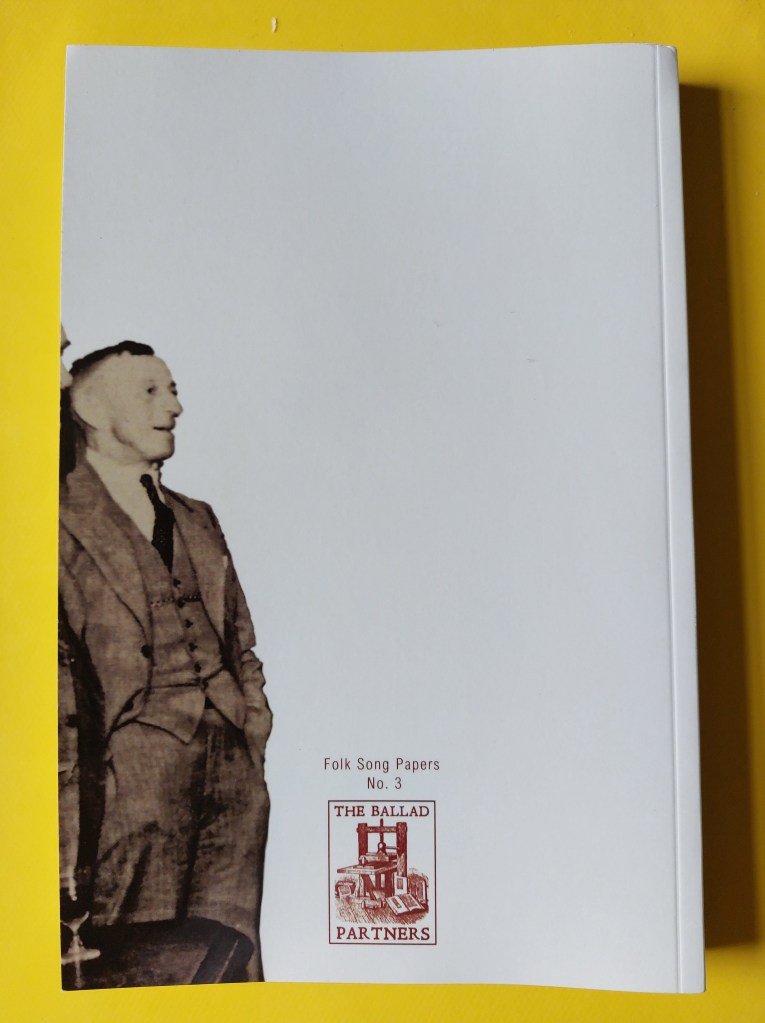
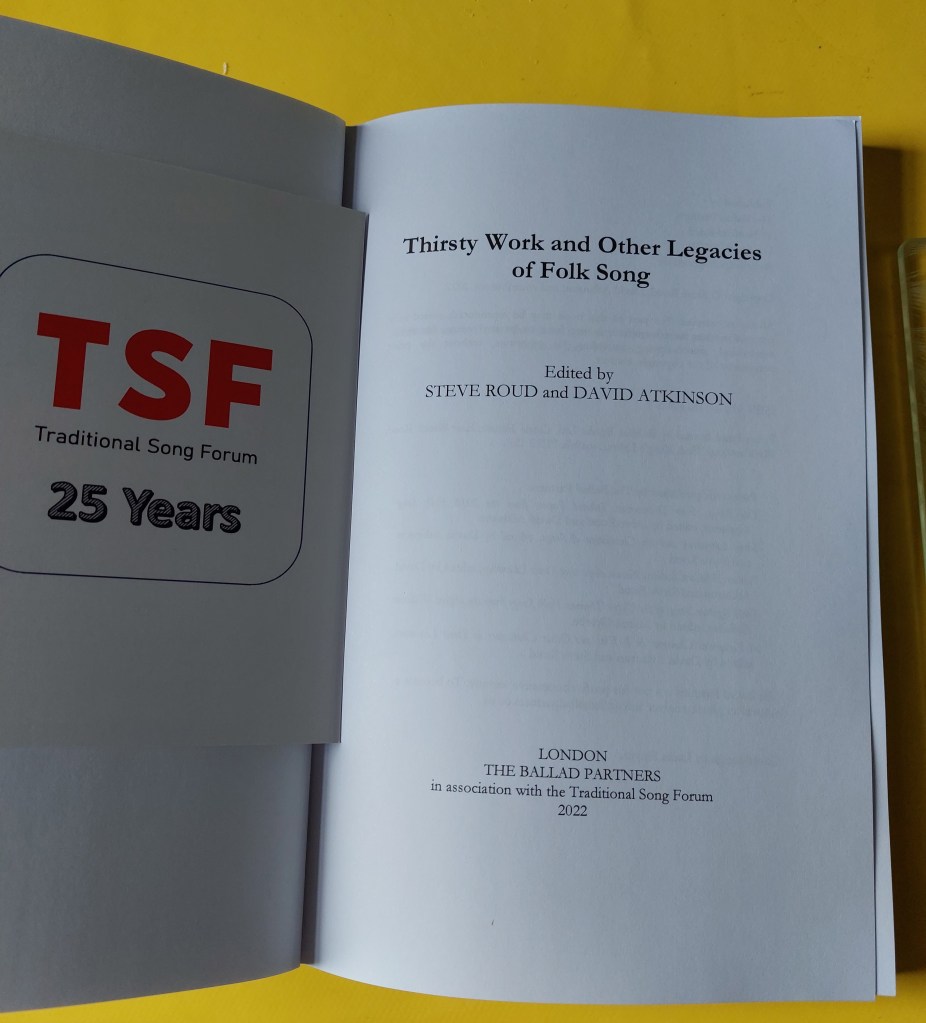
I’ve just received my own copy of a new publication by Ballad Partners, Thirsty Work and Other Heritages of Folk Song, which contains my most recent Alexander Campbell article: ‘Alexander Campbell’s Song Collecting Tour: ‘The Classic Ground of our Celtic Homer’. There’s a section on Campbell and his musicianship – an entirely new angle which I spent some time contemplating during lockdown.
I have just catalogued a copy for the Royal Conservatoire of Scotland Library – I listed the contents there, so I’ll repeat the list here for your interest. If you would like to purchase a copy of the book, please visit the Ballad Partners’ website. (I’m unconnected with the publishers – I am just one of the contributors!)
CONTENTS
Thirsty work: traditional singing on BBC Radio, 1940-41 / Katie Howson — From Tyneside to Wearside: in search of Sunderland songs / Eileen Richardson — Sam Bennett’s songs / Elaine Bradtke — Newman and Company of Dartmouth and the song tradition of Newfoundland’s South Coast / Anna Kearney Guigne — Railwaymen’s charity concerts, 1888-89 / Colin Bargery — Picturing protest: prints to accompany political songs / Patience Young — ‘That is all the explanation I am at liberty to give in print’: Richard Runciman Terry and Songs from the Sea / Keith Gregson — Drawing from the well : Emma Dusenberry and her old songs of the Ozarks / Eleanor Rodes — Alexander Campbell’s song collecting tour : ‘The Classic Ground of our Celtic Homer’ / Karen McAulay — ‘Don’t let us be strangers’ – William Montgomerie’s fieldwork recordings of Scottish farmworkers, 1952 / Margaret Bennett — ‘No maid in history’s pages’ : the female rebel hero in the Irish ballad tradition / Therese McIntyre — Who is speaking in songs? / David Atkinson
I have contributed an article about the first organist of Neilston Parish Church, to the Glasgow Society of Organists for the September 2022 issue of The Glasgow Diapason: Newsletter. It doesn’t really relate to my own musicological research, apart from its connection with amateur music-making in the West of Scotland in the late Victorian and Edwardian eras, but I thought I’d share it here as well, since I had a lot of fun writing it!
Trains, Trossachs, Choirs and the Council
Dr Karen E McAulay, Neilston Parish Church
Moving from an Allen organ in a post-war church, to Neilston’s historical tracker action instrument, I’m enjoying the new playing experience, and change of scenery getting there. My research interests in Scottish music history mean I’m also intrigued by the church’s long past. Although not everyone is enthralled by local history, I love finding out what mattered to people in their everyday lives, and I wondered what I could find out about the very first organist. As you’ll see, someone – the organist himself? – kept the local press well-informed about his activities.
Neilston Parish Church Organ
Neilston got its Conacher organ in 1888, when the church decided their three-year old harmonium wasn’t sufficiently supportive of congregational singing. Two ladies of the congregation made generous donations, the balance being found by the rest of the congregation. The organist, master grocer Hugh Gibson Millar (1859-1932), had inaugurated the harmonium, and now led a ‘select choir’ in a grand Friday inaugural musical entertainment, accompanied by Mr Fraser of Queen’s Park Church. The new organ occasioned a new pulpit being built, the old one banished to the manse! (The old manse has been demolished, and the pulpit disposed of before living memory. Maybe when the bachelor incumbent was promoted heavenward, his successor didn’t want this extra furniture.)
Neilston village had not only a flourishing church choir, but also a Tonic Sol-Fa Society. (Despite classically-trained musicians regarding the sol-fa system disparagingly, it was undeniably the means of many working and not-so-working class singers learning to perform music, at home or in a choir, from the late 19th century well into the 20th.) Some people were in both, causing problems when the same day was double-booked for a concert in December 1888. There was a flurry of angry “letters to the Editor” about this, with Neilston Parish Church Musical Association wading into the fray!
Millar was the son of a Kilmarnock shoemaker. Marrying in Kilmarnock, he lived and worked as a grocer in Glasgow for a couple of years, but they moved to Gertrude Place in Barrhead sometime between 1881-1883. By 1896, he had shops in Barrhead and Neilston, and the following year he was advertising for a boy to work in an ironmonger’s shop.
Ambitious and undoubtedly talented, he got a Mus. Bac. from the University of Trinity College, Toronto in 1896. This external qualification (early distance learning?!) was discontinued in 1897, and the University merged with the University of Toronto not long after. By the 1920s, degrees like his were dismissed as bogus by many. Nonetheless, the press reported significant exam successes by his pupils. (Millar’s degree was reported by the press in connection with any musical activity, but not with his trade.) The year he got his degree, one of his female pupils excelled in practical and ‘Musical Knowledge’ exams with Trinity College London, whilst in 1901 Robert Craig of Barrhead got top marks in Musical Knowledge, and was reported as studying organ, harmony, counterpoint and music history with Millar.
The newspaper reported a Christmas service led by Millar and the choir in 1898, including what was performed. The choral items later appear in the United Free Church of Scotland Anthem Book (1909), clearly popular choices.
Smith, R. A., How beautiful upon the mountains,
[Elvey or Hopkins] Arise, shine, for Thy light is come
Hatton, J. L., Let us now go even unto Bethlehem
Batiste, Édouard, Angelic voices [organ]
Handel, G. F., March in Scipio [organ]
Choir outings were popular in the two decades before the Great War. (You have only to look at eBay listings for choir trip postcards!) The Barrhead News reported an outstandingly successful choir outing by train to Callander and the Trossachs, led by Millar and the Revd. Robert Barr in June 1899. They had a great time, with unspecified high jinks in the railway tunnel between Queen Street and Cowlairs; a picnic by the banks of Loch Katrine, provided by the young ladies of the choir; and singing and violin playing on the way home, arriving back at 11pm. An evening party on another occasion seems to have ended after midnight! Being in a church choir plainly enhanced one’s social life.
Within a month, though, he was moving to play a Willis organ at Clark Memorial Church in Largs – reported as a step up, with a good organ and a better salary. Indeed, his census return in 1901 finds him living in a fine terraced house with a sea view on Aubery Crescent, Largs with his wife and thirteen-year old Andrew. Millar was described as an organist – not a grocer – and Andrew as an organist’s apprentice. Hugh and Sarah’s two older boys had clerking jobs, and were apparently staying with an ironmonger’s family back in Gertrude Place. The Millars seems to have had homes in both Largs and Barrhead from then on, as later confirmed by his death certificate.
He was barely at Clark Memorial two years, when the Barrhead News announced in September 1902 that he had left, and was resuming music teaching in Barrhead. His home, ‘Hughenden’ in Gertrude Place, by now had a Conacher organ of its own, available to pupils for practising; there’s no further mention of being a church organist.
1903 saw him becoming local secretary for an examination board called the International Music College, a one-man concern run by a music-teaching organist in London. Millar also made enquiries about the water supply for a water-powered chamber organ – another domestic instrument, or was he moving the Gertrude Place instrument? – in a house he proposed to build on Neilston Road. Described again as a grocer, 1904 saw him standing for election as a councillor in Barrhead. The following year, Councillor Millar, Mus. Bac., FRSM, did have all his qualifications reported! In time he became a bailie, and finally, Provost.
Millar died in 1932, in Aubery Crescent, Largs, but his death certificate gave his usual residence as ‘Sandringham’, Paisley Road, Barrhead. The Scotsman published his obituary:- ‘Hugh G. Millar carried on business in Barrhead, was a member of the Town Council for about 25 years, and served two terms in the civic chair. He also represented the burgh on Renfrewshire County Council for a long period. He had a residence in Largs for 30 years, and took a keen interest in local municipal affairs, being Chairman of the North Ward Ratepayers Committee. The ex-Provost, who was 73 years of age, is survived by a widow and three sons.’
A man of many talents, he seems to have had a comfortable, varied and interesting life. His shoemaker father would never have guessed that his tradesman son would end up probably the first Barrhead provost with a music degree, a diploma, two homes and his own chamber organ!
Yes, I’m a musicologist. No, there’s no music inside this wee publication, just Tonic Sol-Fa. (And no, I have not turned teetotal. Everything in moderation, that’s my motto!) In library-land, this would be termed ‘grey literature’, just an ephemeral little pamphlet – not the kind of thing that generally ends up in library catalogues.
Band of Hope Sol-Fa booklet of songs
I bought this on EBay a few days ago, because I’ve been following a possible link between some Glasgow publishers and the Victorian Temperance movement. You won’t find “my” publishers here, not even amongst the advertisements. It’s just because it’s a Glaswegian publication and I was curious to see if I might spot any unexpected connections. (Spoiler alert: I don’t think there’s any obvious link! But it’s still a nice curio to have, and there’s one slight hint of a thread that might yet be fruitful!)
My conscious mind was tempted to protest that this isn’t actually notated music, so why would I find it interesting? And yet, and yet …
Finally it dawned on my why I I should be interested. I’m writing a book which foregrounds amateur music-making. Sol-fa democratised music-making by removing the necessity to learn to read staff music notation. We musicians certainly acknowledge Sol-Fa’s limitations for notating complex modern music, and I am not turning into an apologist for Tonic Sol-Fa. However, it made music-making accessible to a lot of people who would not otherwise have even tried to read music.
Yes, this booklet is important. And that’s before you start thinking of music’s role in the temperance movement. But that’s another conversation for another day.










 Karen McAulay, Musicologist