Dr Karen McAulay explores the history of Scottish music collecting, publishing and national identity from the 18th to 20th centuries. Research Fellow at Royal Conservatoire of Scotland, author of two Routledge monographs.
And it popped through the letter-box today: the latest shiny-new issue of Brio, our special issue dedicated to papers from the Claimed From Stationers’ Hall networking project.
If you or your library subscribe to Brio, put the kettle on and settle down to a fascinating read. (Your library may have been closed for Christmas, so it might take a day or two for the latest issue to hit the shelves!)
I have added the entire issue to Pure, the Royal Conservatoire of Scotland’s institutional repository. My thanks to IAML (UK and Ireland) for agreeing to this – it’s really important to us, as grant-funded research outputs need to be openly accessible.
If you contributed to the volume, but haven’t got access to Brio, please don’t worry – we’ll be sending you a copy in due course!
Meanwhile, to whet your appetite, here’s what you can look forward to!
Along with the workshop that we held at the Royal Conservatoire of Scotland in Spring 2018, this issue is the network’s biggest and proudest output. So, congratulations to each and everyone in any way involved in the production of this issue. My special thanks go to Editor Martin Holmes for his kind and gracious support, and of course to IAML (UK and Ireland) for allowing us to produce this special issue in the first place. We’re very grateful indeed.
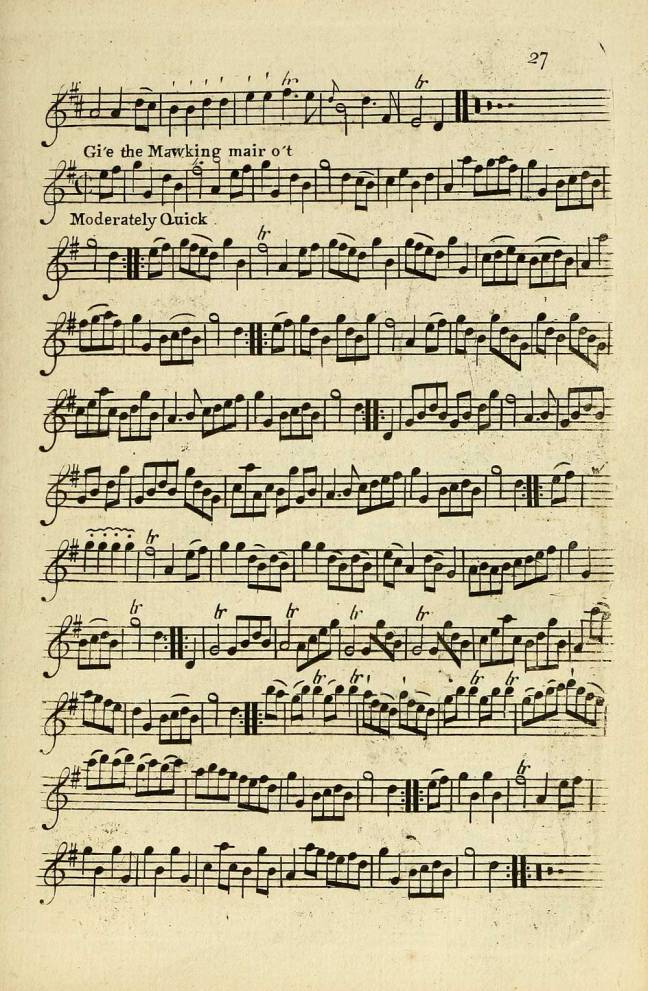
Before establishing the Claimed From Stationers’ Hall network, I was a postdoctoral researcher on the Bass Culture project, which looked at Scottish fiddle tune collections largely from the Georgian era. In that context, I read a paper at Musica Scotica in Spring 2014, about a couple of London-published music collections. It has finally been published in Scottish Music Review Vol.5 (2019), 75-87, this week.
Sometimes when we look back at earlier work, we wonder if we’d have written it differently today, but I’m still pretty happy with this article. If anything, I think it justifies my claim that the history of this kind of collection does indeed deserve to count as “book history”, even if it is music rather than literature. So, here it is for your enjoyment:-
Followers of the Claimed From Stationers’ Hall research network are probably already aware that there’s an extensive bibliography of writings to do with legal deposit and copyright, most specifically historical music legal deposit and copyright – but also a bit of library history, book history, cultural history of various kinds, and bibliography.
It has been updated periodically, and is now in its 7th edition, but when the special issue of Brio (vol.56 no.2) rolls off the printing press, a significantly extended 8th edition of the bibliography will be posted on this website. It’ll include every article and review in the special issue, and virtually every reference or footnote cited by each author of ditto. I wouldn’t be so bold as to say that not one citation concerning historical music legal deposit has been missed, but the chances of having missed anything significant are probably fairly slender!
That’s it, folks. Martin and I have given the Brio “Special Issue” proofs the final thumbs up, and they’ve gone off to the printer. No going back now … your special issues are well and truly on their way. (They look slightly different to those pictured here, but I won’t spoil the surprise!)
From an era a century later than our project’s focus, we encounter legal deposit again – at Cambridge University Library. The practical impact of the Second World War? A disruption in the supply of legal deposit music!
This week, I have been busy laying out a small exhibition in the Anderson Room to commemorate the start of the Second World War.
I had a very clear idea in my head of what I was going to do – an exhibition based around some wartime favourites: There’ll be Bluebirds over the White Cliffs of Dover, Lilli Marlene, Moonlight Serenade, Bella Ciao, and the famous timpani version of Beethoven’s Fifth Symphony – Morse code for Churchill’s Victory V, the sound of the BBC broadcasting to Europe throughout the war years.
Due to circumstances beyond my control, and reflecting wartime conditions, the exhibition ended up being rather different to my original intentions. It is though, I believe, perhaps a truer reflection of the times.
Hi, network members! Not long now until the special bumper issue of Brio comes out! I hope you’re telling all your colleagues and friends to look out for it …..
The story of a very early female music cataloguer at the University of St Andrews
by Dr Karen E McAulay, Royal Conservatoire of Scotland
Introduction
Prior to her marriage to George Williams, Elizabeth Lambert (1789-1875) produced a handwritten catalogue of the University of St Andrews legal deposit music collection, which was accumulated by legal entitlement from the 1790s to 1836. Elizabeth was paid a nominal sum (one shilling) for producing the first catalogue volume in 1826, and continued adding to it, commencing a second volume which someone else presumably completed after she married and moved to London in 1832. [1] This youthful involvement with the University of St Andrews’ Library music collection is more significant, and had a more far-reaching effect, than has hitherto been recognised, for her catalogue would have significantly contributed to the use and enjoyment of the University Library’s music collection. Her subsequent married life in London is minimally documented.
This article would have been added to the Wikipedia Wiki Project, Women in Red, which is promoting entries about women to redress the current male/female balance; however, since the present narrative is based on new research – and there are no books with biographical details of Miss Lambert – it does not fit into the remit of that admirable project.
Childhood
Born in 1789, the year of the French Revolution, Elizabeth Lambert was the firstborn child of clergyman, Revd. Josias Lambert and Dorothea Lambert (née Rotherham). She was christened in St Mary’s Parish Church in Lancaster (Lancashire) on 13 June 1789. [2] Two brothers and two sisters followed in close succession, the youngest being born a few months after their father’s death in 1799. Their widowed mother sold their Yorkshire home, Badger Hall in Burneston, to Col. W R L Serjeantson that year, [3] and relocated the family to St Andrews in Scotland. There, they lived with her brother, Professor John Rotherham, until he died in 1804.
House in South Court, South Street, St AndrewsElizabeth’s mother originally hailed from Northumbria, but remained living in a house at South Court, South Street in St Andrews until her death in 1839. [4] Both of Elizabeth’s sisters died at St Andrews in childhood.
Teens and young adulthood
South Court from South Street, St Andrews
Elizabeth’s brothers attended the University, making use of the library facilities, but Elizabeth and her mother were also able to borrow from the library through the good offices of professorial friends. Elizabeth borrowed widely:- books on conchology, botany and horticulture, divinity and travel, as well as novels and music, and she continued to borrow on a visit to Scotland after her marriage. [5]
She borrowed sacred and secular vocal music – returning to borrow Mozart’s Masses more than once, and also enjoying operatic arias, and Irish, Scottish and Welsh songs – as well as piano music and piano duets. Instrumental music seems to have attracted her – one such book that she borrowed contained concertos, harp and guitar music as well a piano instructor by Cramer, and this wasn’t the only instrumental volume to have appealed to her. She also enjoyed a music journal called The Harmonicon, which enjoyed a brief but very popular run from 1823-33, and borrowed a book about Haydn and Mozart.
Elizabeth’s interest in conchology went beyond reading about the subject, for she was cited in several textbooks for having identified a particular shell (Patellaelongata) inProfessor John Fleming’s cabinet collection in 1814. [6]
Elizabeth built up a shell collection of her own, giving her collection of British and foreign shells to the Natural History Society of Northumbria in 1873 (foreign shells) and 1874 (British and foreign shells). The Society still has a record of her donation, although the collection has been integrated into their own larger collection and can no longer be identified. [7]
Involvement with the University of St Andrews Library
Elizabeth’s uncle John Rotherham had taken responsibility for organising an earlier book catalogue in the library, though it is unlikely that he would have done the cataloguing himself. Nonetheless, his interest, added to Elizabeth’s interest in conchology, does suggest a family disposition towards organising and codifying things!
Sederunt Dr Buist Rector, Principal Haldane, Drs Hunter, J. Hunter, Jackson and Briggs. University Library 29th August 1826. “There was laid upon the Table by the Rector a Manuscript Catalogue of the Music belonging to the Library made out by Miss Lambert. The Rector was requested to convey to her the thanks of the University for the great pains she had been at in making it out. [signed] Geo. Buist Rector. [8]
It is probably worth noting, as an aside, that 1826 was also the year in which the University of St Andrews published a proper catalogue of the entire library holdings – excluding the music, that is! See their Catalogus librorum in Bibliotheca Universitatis Andreanae, secundum literarum ordinem dispositus online via the Wellcome Collection website. (I noticed that the library had the 1788-93 edition of Linnaeus’ Systema naturae, a book which would have enabled Elizabeth to identify that sea-shell in Professor Fleming’s cabinet: “Patella Elongata”, aka “Ansates Pellucida” is none other than a special kind of limpet …)
Although Elizabeth was paid for cataloguing the St Andrews University copyright (legal deposit) music in 1826, the second catalogue book continued to be added to, presumably by someone else and with rather less care after she had married and moved away, until a change in legislation meant that the Library ceased to claim legal deposit books in 1836, instead being awarded a book budget, in common with the other Scottish universities.
Entries in the borrowing registers for 16 October 1827 and 22 May 1828 record Elizabeth taking music ‘to be arranged’, which can be interpreted as an involvement in assembling the music into usable volumes which would then be bound by a commercial bindery. [9] Different volumes were compiled for instrumental music, piano music, songs, harp music and so on.
Marriage
Elizabeth married George Williams in Islington in 1832, where they lived with his mother and brothers. [10] They had no children. George died in Halton Street Islington in 1853. [11] Elizabeth Williams died at 18 Well-Walk Hampstead, Middlesex, 23 years later on 16 February, 1875. [12] There is very little documentation of her life after her marriage.
Significance of Elizabeth’s Music Catalogue
Elizabeth was clearly not a University employee, but was nonetheless entrusted with the task of compiling this catalogue of the music, listing the contents of each numbered bound volume. This is very early documented evidence indeed, of a woman being involved in any way with the organisation of a university library sub-collection. Contributing factors are likely to have been the fact that she was a niece of a deceased professor who, himself, had taken an interest in the library, and also the fact that families and friends were entitled to borrow from the entire collection through association with the professors. Her reading matter shows her to have been an educated woman, and the library’s borrowing records [13] provide ample evidence of both unmarried and married women making use of the music collection – a category in which some of the other legal deposit libraries seemingly took little enough interest for much of the nineteenth century.
Elizabeth’s catalogue was hardly a detailed bibliography, generally listing only composer and title, and sometimes conflating several linked separate publications into one entry. There are occasional spelling errors, which led researcher Elizabeth Ann Frame to suggest that Miss Lambert was dictating entries to another individual. [14]. This cannot be conclusively proven either way. Nonetheless, it would have been very difficult for readers to select music with any degree of precision until the catalogue was written, presumably instead reliant on serendipity, or searching out the latest bound volumes back from the bindery.
Indeed, in this context Miss Lambert’s catalogue represents a kind of endorsement of the University of the value that they attributed to their music collection, since the catalogue facilitated the use of the entire music collection by professors, a few quite young male undergraduates, and friends and family of the professors. There is evidence of the catalogue itself being borrowed by a few keen male borrowers, whether for their own perusal or for consultation by their family or friends, and the music collection was heavily borrowed during the first four decades of the nineteenth century.
The present website was set up for the the British AHRC (Arts and Humanities Research Council) funded postdoctoral network, Claimed From Stationers Hall, which supported further research into legal deposit music collections across Georgian Britain. This research followed on from the present author’s research at the University of St Andrews Library, which has excellent archival documentation to support a well-organised collection.
If you have enjoyed this posting, you might also like to read about another Library reader from St Andrews – Professor Playfair and his family. He appears in another article about the Claimed From Stationers’ Hall network, on the Library’s Echoes From the Vault website.
And there’s more! A boarding school proprietress, and her three teacher daughters, also made use of the library. You can read about Mrs Bertram on another network blog, this time curated by EAERN (Eighteenth-Century Arts Education Research Network): Mrs Bertram’s Music Borrowing: Reading Between the Lines.
University of St Andrews Library Muniments UYLY108/1 – Music Catalogue, 1826
Dorothea’s obituary appeared in The Gentleman’s Magazine and the Perthshire Courier. She was described as the widow of the late Rev Josias Lambert, M.A., of Camp-hill Yorkshire. South Court, her address off South Street in St Andrews, is now passed by visitors to the famous Byre Theatre.
University of St Andrews Muniments UYLY 206/8 (1821-1832)
Professor John Fleming was a member of the Royal Society of Edinburgh and was later cited by Darwin (not in connection with shells). ArchivesHub describes him as Scotland’s first zoologist. An ordained minister, he was also appointed as a professor at Aberdeen in 1834. Edinburgh University holds his papers.
Transactions of the Natural History Society of Northumberland, Durham, and Newcastle upon Tyne. Vol.5 p.368. [List of donations], A collection of British and Foreign Shells. Mrs Elizabeth Williams, Well Walk Hampstead.
Senate Minutes, University of St Andrews Muniments UY452/14/145 University Library 29 August 1826.
University of St Andrews Muniments UYLY 206/8 (1821-1832)
13 September 1832: ‘George Williams, of the Parish of St Mary, Islington, married by Rev Dr Haldane, Principal of St Mary’s College, University of St Andrews’. Old Parochial Register, St Andrews and St Leonards, via Scotland’s People.
Probate. Effects under £6000. The Will with a Codicil of Elizabeth Williams late of 18 Well-walk Hampstead in the County of Middlesex Widow who died 16 February 1875 at 18 Well-walk was proved at the Principal Registry by Henry Cardew a Major in the Royal Artillery stationed with his Battery at Newhaven and Thomas Francis Leadbitter of 158 Leadenhall-Street in the City of London Gentlemen the Executors. Ancestry England & Wales, National Probate Calendar (Index of Wills and Administrations), 1858-1966, 1973-1995. https://www.ancestry.com/
University of St Andrews Muniments UYLY206/5 (1801-16), UYLY 206/6 (1814-19), UYLY 206/7 (1817-21), UYLY 206/8 (1821-1832)
Elizabeth Ann Frame, ‘The Copyright Collection of Music in the University Library, St Andrews: a brief account’, in Edinburgh Bibliographical Society Transactions, Vol.5, issue 4 (1985), pp.1-9
Of course, it’s a highly competitive world out there. I can’t attempt to rate my chances. But I rewarded myself for getting it written and submitted on time, by ordering a wee Victorian Glaswegian souvenir jug. And we’ll see what unfolds!
Where are they now?
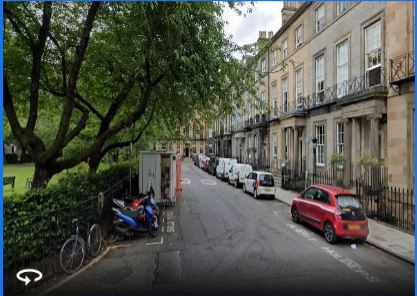
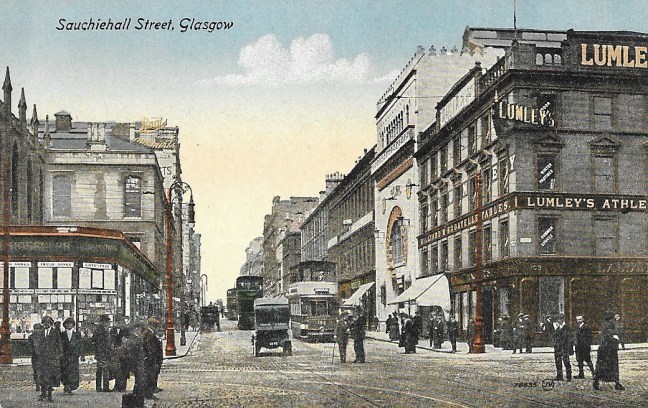
Meanwhile, I have amused myself by checking out some old Glasgow music publishers’ addresses. I wasn’t sure where they all were. And although the streets are still on the map, it was a strange feeling to see that places where businesses once thrived, have generally been replaced or kind of left behind by the passing of time. Only three addresses seem generally unchanged. Another – just a green patch of land – is on my morning bus-route, right beside an old public library. (Physical and cultural landscapes have one big thing in common – they do change as the years go by!)
In collaboration with Corrina Readioff (University of Liverpool), I’m one of the founder members of the Eighteenth Century Paratext Research Network. Corrina has been doing most of the hard graft in setting up this network! Do take a look, and if you’re interested in any aspect of paratextual research (Corrina researches epigraphs, illustration and chapter headings, whilst mine is musicological research into music of the same era – and other members’ interest span a wide range of topics) – do get in touch. The more the merrier!
First up – a call for papers for a forthcoming eighteenth-century conference. A panel will be convened ….
Sorting through the late Jimmy Shand’s accordion music, I came across some curious pieces amongst the more predictable repertoire. One was William D. Hamilton’s Song of Arran with Strathspey (With Tonic Sol-fah). Mr Hamilton lived at Ailsa House, Adrossan – so Arran’s not that far away.
And you know how I love paratext? Well, I haven’t strayed into the twentieth century very much in my paratextual explorations, but this piece is positively DRIPPING with it!
“RESPECTFULLY DEDICATED
To MACKENZIE MURDOCH, Violinist and Composer, whose modest and kindly, yet transcendent genius has so notably enriched in abundant melody, fantasia, and arrangement, Scotia’s great Repertoire of National Music, and through him to his illustrious brother Celts of the Arran Society, Guardian Conservators of one of Scotland’s most noble possessions – the peerless Isle of Arran.”
Now, the tune was “written and composed by Wm. D. Hamilton”, but his friend Mackenzie Murdoch arranged the Accompaniment & Strathspey. Mr Murdoch apparently lived at 270 Great Western Road, Glasgow. (Imagine the raised eyebrows if the title page gave the composer’s full address nowadays, unless it was self-published! Data protection, dear chap!)
It would appear that Wm. D. Hamilton had a house in Ardrossan but traded from 59 Bath Street in Glasgow, whence he published this sheet-music in 1922.
Anyway, the tune appears first as a song and then as a dance-tune – a strathspey. And then, at the end, we find another chunk of paratext. Be still, my beating heart! This is an advertisement for another, larger piece by Mackenzie Murdoch. How often have we read allegations that Britain has no wworthwhile national music? Or that England is deficient in this regard? It’s less common to find someone refuting the suggestion that Scotland somehow falls short. But then, my investigations have mainly been into Scottish ‘national airs’, whereas this is about more serious composers. Interesting!
I’d llike to know more about Mr Murdoch!
“RIZZIO (composed by Mackenzie Murdoch). – An Orchestral Prelude of outstanding beauty and excellence, which from the broad opening movement descriptive of Holyrood Palace and surroundings to Finale of the swaggering braggadocio of the Conspirators, faithfully portrays in graphic intervals and rhythm, the great tragedy of Rizzio’s murder, in the presence of Scotland’s tragic and beautiful Queen. It contains a dainty festive Minuet, which will bear favourable comparison with the best work of the classic composers, an unrivalled and plaintive death song of Rizzio, and a passionate prayer of the Queen which will live as long as the great Ave Marias.
This work debuts the slander that Scotland has no worthy Composers, and confirms the suspicion that those who make such assertions are “looking for what they don’t want to find”.
No musician and particularly no musical Scot, should fail to possess and study this beautiful work. Although scored for full symphony orchestra, it can be obtained suitable for pianoforte or trio …”
POSTSCRIPT
My thanks to Stuart Eydmann for alerting me to this mention of William Mackenzie Murdoch on the Rare Tunes website, where you can read more about him AND hear his fiddle playing – ‘The Drunken Piper’. What a great resource! https://raretunes.org/william-mackenzie-murdoch/