Empty!

You know what happens when you empty a plastic carton, and it sort of collapses in on itself? After a weekend in which I recorded not one, but TWO conference papers, did sundry domesticity and not much else, I feel very much deflated!

Imagine my – ahem – joy that I have a day actually Working-At-Work tomorrow for the first time in six months. Just when I feel as though I could do with a quiet day at my home-desk with copious cups of tea …

But the good thing is that, apart from a third conference paper on a different topic, and a book chapter to start work on, I am currently up to date! I may yet get back to my late nineteenth- and early twentieth-century Scottish music publishers. Although the book chapter just might be rather time-consuming. Nonetheless, it’s a nice topic and will make a pleasant and RELATED change to my main focus, so I can’t complain too much.

Working From Home? It’s All Go!

I think my fingers should be tingling. You know I bought myself two scores published by Bruce, Clements & Co earlier this month? One of them was the opera by the publisher himself, W. B. Moonie.

And …I now have a copy signed by the composer!

However, such excitement has to be kept in check as I work on my second conference paper of the month.

I’m primarily working from home at present, both with my researcher and with my librarian hats on. Right now, in my research role, I have undertaken to give three conference papers in as many months, so I’m rather busy writing! I haven’t forgotten my Scottish music publishers – certainly not! – but I only officially have 1.5 research days a week (shhh, don’t mention all the evening efforts!) – so I need to focus on things with deadlines. The conference papers will be recorded and shared online.

Time will tell if I manage to make any visits to other libraries in the foreseeable future. Since lockdown, I seem to have purchased more books and music than I have room for, but some things aren’t available to purchase!

Good Intentions

I was going to write a bit about Cedric Thorpe Davie today. However, the day simply didn’t pan out as intended!

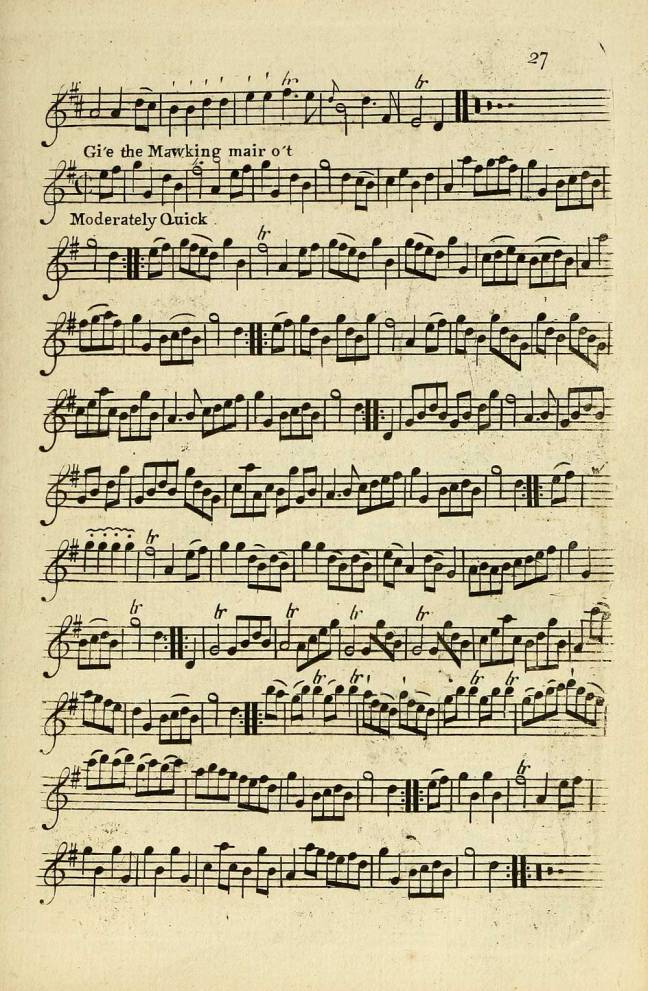
Instead, I finished a conference paper about metadata in rare music cataloguing, started gathering facts for another conference paper about a lowland pipe tune, broke off to deal with a library-related query, and played the pipe tune on a concertina to unravel my head after so many disjointed activities!

I do still intend to write something about Cedric Thorpe Davie at some point!

Bruce, Clements and Co.

This is another posting that I put on the Facebook Glasgow Music Publishers page a couple of days ago. I wonder if anyone can provide any pointers to this firm, currently a bit of a mystery to me?!

A QUESTION FOR EDINBURGHERS!

My study of historical Glasgow music publishers may need to embrace other Scottish music publishers too. (A metaphorical, socially distanced embrace, obviously.)

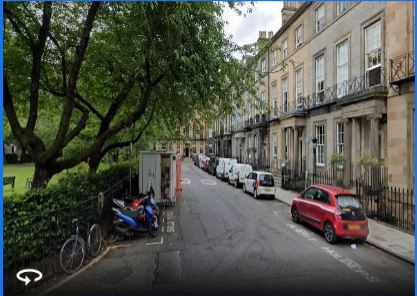
So. The first question is, who WERE Bruce, Clements & Co, who traded in Edinburgh circa 1921-1937, published quite a bit by W. B. Moonie and a significant work – Dirge for Cuthullin – by Cedric Thorpe Davie? I’ve only looked at Jisc Library Hub Discover and the British Newspaper Archive so far, but although I can find out what they published, I don’t know who they were – sometimes they called themselves Bruce Clements & Co., and other times Bruce, [COMMA!] Clements & Co. – though I do know they traded from 30 Rutland Square.

W. B. Moonie – YouTube of “Perthshire Echoes” played by pianist P. Sear

I don’t have access to Post Office Directories in Libraries – and they’re too “modern” to be in the National Library of Scotland Digital Gallery – though appropriate directories might yet tell me more about Mr Bruce or Mr Clements! At the moment, it’s just a question arising from my insatiable curiosity, but I should still like to know, because you never know what connections firms had with other firms or individuals.

I have had a couple of responses – Jack Campin tells me that Davie’s son was Tony Davie, computer scientist at the University of St Andrews.  And I am sure there will be plenty of material about Cedric Thorpe Davie himself at St Andrews’ research repository, so that could be an interesting angle to pursue.

Meanwhile, another respondent pointed me in the direction of a couple of directories available via the Internet Archive, so I now have their address, (You’d be surprised how many firms I’ve traced at Rutland Square, which plainly housed more than one company at a time. The Boy Scouts Association were there, for starters. But I digress!

Interestingly, Thorpe Davie’s choral work, Dirge for Cuthullin, published in 1937 and admired by Vaughan Williams (four letters survive at VaughanWilliams.uk), was subsequently taken over by Oxford University Press in 1946. (See notes on manuscripts at St Andrews University Library.) I have a feeling Bruce, Clements and Co published very little, if anything else, by Thorpe Davie, and I believe the firm fizzled out in the very early 1940s. (I’d still like to know who they were!)

Mozart Allan in Glasgow, Allan & Co in Melbourne …

TRUTH IS STRANGER THAN FICTION

So … about the Melbourne Allans that I mentioned the other day? I shared this postscript on Facebook, but omitted to upload it here. The Glasgow “Mozart Allan” firm is highly unlikely to have a family connection with “Allan & Co” Down Under.

The Glasgow Mozart Allan advertised quite often in Australian papers in the early years of his business (the late 19th century).

But, as for his Reels, Strathspeys and General Dance Music being distributed by Allan’s in Melbourne? They just had the same surname. The Australian George C. Allan’s father (George Leavis Allan) came from London, and their ancestors may even have had a Cornish connection. No obvious link with our man.

Image: Butler, Graeme Allans Music, 276 Collins Street, Melbourne. 1982-1985

Jigs, Quicksteps, Reels and … Hang on a Minute! (Kerr’s Merry Melodies)

A textile interpretation of the Merry Melodies logo

In June 2020 I had just posted a new article on my Glaswegian Music Publishers Facebook page.

Jigs, Quicksteps, Reels and … Hang on a Minute!

I had promised to write about some of the Victorian Glaswegian James Kerr’s music publications. The entire posting is going to turn into a chapter in the monograph I’m working on, so I’m taking it down from the blog – I’ve continued working on dates and the intricacies of Kerr’s trading career, and there’s every chance that slight details may now be different from what I wrote last year. I wouldn’t want inaccurate information or ideas that I have since developed, to survive publicly online.

Call it an Encore: The Green Room

The blogpost that I originally wrote for the Cultural Capital Exchange, has also now been posted in a series of postings by the Research Exchange at my own institution, the Royal Conservatoire of Scotland.

Here it is again, then:-

THE GREEN ROOM: DR KAREN MCAULAY (10th June) – Stepping out of the Georgian Era into a Pandemic

Glasgow Music Publishers Facebook Page

This afternoon, I joined the Victorian Glasgow Group on Facebook. What a great group! But I hastily made a new Facebook page for my researches into Glasgow music publishers – after all, the group was set up to discuss Victorian Glasgow, whilst my current researches range roughly between 1880 and 1950. Since I don’t want to drag my new Victorian friends into modernity which is beyond the scope of that group, I’ve made this new page for discussions that aren’t quite Victorian. (I deliberately opted for a page rather than a group, as I like being part of a more interdisciplinary group – I don’t want to start another separate “silo”, aloof from all the other interesting stuff.)

Glasgow Music Publishers

The Cultural Capital Exchange: Stepping out of the Georgian Era into a Pandemic

I’ve just written a blogpost for the Cultural Capital Exchange – you can read it here.

I discuss the ethical issues posed in ethnographical research during the Covid-19 pandemic.

So he played the Banjo …

I researched flautist James Simpson, the father of Dundonian music publisher and seller Alexander Simpson, for some months  before starting my PhD.   In the mid-1800s, Alexander Simpson became a partner in Methven Simpson, which had stores in Dundee, St Andrews, Forfar and Edinburgh.

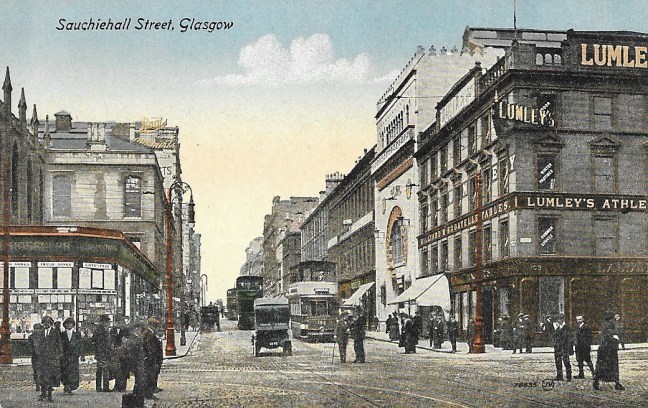
I was unaware of any links with musicsellers or publishers in Glasgow, but you can’t blame me for getting excited when I found out about Frank Simpson’s shop in Sauchiehall Street, a couple of years ago.  Indeed, there was another Frank Simpson selling music elsewhere in Glasgow at the start of the twentieth century.

Let me save you a long story.  The Sauchiehall Street Simpson established his shop in 1860 – not much later than Alexander Simpson’s early career in Dundee – and I wasn’t aware of Alexander having any brothers, or of the family having a Glasgow connection at all.  The low premises on the left-hand side of the postcard foreground (above) are the shop the older Frank Simpson later settled in, with the shop remaining there for well over a half-century.  Frank Simpson junior eventually joined him, importing banjos from S S Stewart in the USA, and teaching the instrument from the premises from the mid 1880s onwards.  The other Simpson was a competitor, no connection with the Sauchiehall Simpsons (as their adverts make amply clear!), and it seems there was no connection with Methven Simpson.

However, this apparent dead end may not be a complete cul-de-sac, since the Sauchiehall Street shop was demolished to make way for British Home Stores circa 1964, and the owner by that time was a famous singer of Scottish repertoire.  I believe the shop was subsequently combined with a couple of others, ultimately to form the Glasgow Music Centre, so … taking the links back in time again … it all forms part of my present research interest in late Victorian and Edwardian Glasgow music publishers.  It just doesn’t connect with the Methven Simpson story.  So many Simpsons!

During my perigrinations through the British Newspaper Archive (a present to myself, half-subsidised by Mum’s Christmas gift!), I caught Frank Simpson junior playing his banjo at a “minstrel concert” in Milton of Campsie, and twice at a Sabbath School Soiree in Kilbarchan.  Frank Simpson cheap novel soldI discovered that Frank Simpson also published cheap novels, and (from an advertisement whose provenance was uncited) -that the shop sold books, jokes and greasepaint as well as the thousands of pieces of sheet-music that Glasgow Herald adverts boasted of.  Sadly, the British Library only seems to have five songs – but this material was not high art music, so there’s the possibility that it didn’t get logged in sufficient detail for me to be able to trace Frank Simpson’s imprint.

To date, the genealogical database Scotland’s People has not yielded the significant dates of   Sauchiehall Street Frank Simpson senior – I could still look harder –  but I do know that Simpson junior was born in Airdrie on 24th May 1866, and  died in East Kilbride on 14 August 1936 at the age of 70.  For now, I’m leaving them in limbo, since this is an intriguing but time-wasting detour away from the bigger questions about what the other, more active publishers were actually publishing!