Home and Away

NLS Advocates Committee on Music 1856Waiting with bated breath to see if I’ll make it to the antipodes, this week I continued my explorations closer to home, visiting the National Library of Scotland yesterday to investigate music committee meetings at the Advocates Library in 1831-2, and later in 1856.  The Advocates Library (later to be absorbed into the National Library of Scotland) was one of the Scottish copyright libraries, so received the quarterly consignments of legal deposit materials, and indeed continued to receive them after the legislation had stripped most universities of legal deposit entitlements in 1836.

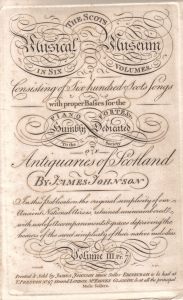
Dauney cover
Dauney – Ancient Scotish Melodies

Who should I immediately encounter but my old friend William Dauney?  He was to author Ancient Scotish Melodies in 1838, before he emigrated to British Guyana (as it was then).

He was in good company – John Donaldson was also on the committee.  Donaldson had started out as a music teacher in Glasgow, trained as a lawyer in Edinburgh, and eventually (on his fourth application) became fourth Reid Professor of Music at Edinburgh University in 1845.  (You can find out much, much more on the excellent Edinburgh University Reid Concerts database, here.)  But all this was well in the future, in 1831-2.  It was good to know that the music’s future wellbeing was in safe hands.

Dauney and Donaldson were joined by a Mr Monro – too common a name in Edinburgh Reid Concertto be sure of his identity, though there certainly was a Mr Monro in the tenor section of the 1842 Reid Concert, and he might have been a partner in the music-sellers Monro and May, who traded for a time in London.

I discovered that – horror! – prior to the establishment of the  music committee, the Advocates had apparently not been taking particularly good care of their copyright music.  But before we gasp in righteous indignation, let’s remember that the legal deposit libraries had been receiving mountains of light popular music along with the more ‘worthy’ compositions – for example, on this very day in 1787, publishers Longman and Broderip made one of their very frequent trips to Stationers’ Hall to register Jonas Blewitt’s song, sung at Bermondsey’s Spa Gardens by Mr Burling – ‘Where are my Jolly Companions gone? A favourite drunken song.’  It is sadly understandable that many scholarly libraries couldn’t see the need for this material, whether or not they had a legal and moral obligation to take it.  There are still copies catalogued online in two libraries in the UK, if you’re curious to see how awful – or otherwise – the song might have been!

John Donaldson
Prof. John Donaldson

 John Winter Jones

As a librarian myself, I smiled to read that after a week of deliberations, this committee couldn’t agree whether to classify music by composers’ names, or by publisher.  Small wonder they requested rules from the British Museum, which was somewhat ahead of them in terms of music librarianship!  John Winter Jones, Assistant Librarian at the Museum, took the lead in creating a catalogue there, and later became Principal Librarian.  I believe the “Ninety-one rules” originated during his time there.  (Ninety one! If he had only seen AACR2, Marc cataloguing, RDA and all the other cataloguing protocols now available …)

There remains one further excitement.  There are a couple of lists of music dating from February and March 1830.  Was it sold or retained? It’s very tempting to transcribe the lists and see what remains elsewhere in the country!

Dreams of Distant Places

aircraft-123005_640

This week’s news is cautiously optimistic.  I have the opportunity to speak at a conference in New Zealand if I can secure the funding to get me there! I’ve applied for funding – so watch this spot.

What about the Colonies?

Meanwhile, however, it set me wondering about legal deposit in the colonies in the nineteenth century.  This is not something that I’d thought about before.  Obviously, early printed music in New Zealand or Australia would generally have come from Europe, whether as new imports, brought by emigrants or sent to them by their families.  (See the excellent work being done by Sydney Living Museums in Australia, or – as an example of an early immigrant musician’s life – Michael Kassler’s fascinating paper, ‘The remarkable story of Maria Hinckesman‘, in Musicology Australia (2007).  I really don’t know much about the nineteenth century music trade beyond Britain.  I seized my copy of Partridge’s The History of the Legal Deposit of Books (1938) for a quick overview, where I learned that New Zealand’s own legal deposit legislation came much later.  It would still be nice to know more about the publication of music actually composed there during the 19th century!   Has anyone studied this?

You can’t beat a good bibliography

Over the past couple of years, I’ve compiled quite an extensive bibliography covering legal deposit (both at the general and music-specific level), and the nineteenth-century histories of the British legal deposit libraries.  I’m sure I haven’t yet listed everything that’s out there, but progress is being made.  I’m currently tidying up this listing, then I’ll post it online.  What I need more of, are links to finding aids, published or online, outlining what archival information is available for the different libraries.  Once I’ve got it into a shape fit for public consumption, I’d love to receive any further suggestions for suitable additions.  A student at the University of Edinburgh made a great listing of catalogues, accounts, and borrower loan records (“receipt books” in eighteenth- and nineteenth-century terminology) this summer, and I’ve currently got a copy of it on my desk to peruse closely.  Next week, I’m going to consult a couple of resources recommended to me by the National Library of Scotland’s Music Librarian – these will hopefully fill in my knowledge about what’s available there.  In this age of the internet, it pays to remember that not everything is online, and it’s invaluable to know about the existence of earlier finding aids that remain in their original print format.  I’m quite well clued-up about the resources in St Andrews, and I’ve got several useful links for Sion College’s holdings, now in Lambeth Palace Library.  Any further suggestions about other libraries, anyone?!

Official Commissions

At various times, official commissions looked into the legal deposit libraries’ handling and curation of the legal deposit materials, and library provision for universities in general. I really do need to capture details of all surviving documentation.  Partridge  mentions that after the 1814 Copyright Act, returns were requested from the legal deposit libraries (1st July 1817), which resulted in the Return of the Libraries, ordered to be printed by the House of Commons on 6 March and 9 April, 1818 [BM.515 l 20] (Partridge ibid, p.73].*  This contains a table of rejected items from Oxford or Cambridge – I have also found an amended return from Cambridge, which has of course been added to the bibliography!

Amended Return Cambridge - see mention of music

Similarly, from 1826 onwards, there was a Royal Commission investigating library provision to the University Libraries in Scotland. I’ve seen one of the huge tomes emanating from this exercise, regarding the Aberdeen responses, and transcribing interviews with individual professors.  Revd. William Paul remembered the sale of some legal deposit music, a couple of decades earlier.  Oh, really? This is interesting stuff!!

Great Britain. Commission for Visiting the Universities and Colleges of Scotland  W. Clowes and Sons, 1837

It’s fair to say that bibliographic control of this material is sometimes slightly inconsistent, but it would appear desirable to track down each Scottish university’s response, and to look at the other responses from St Andrews, Edinburgh and Glasgow!

Evidence Oral and Documentary Commissions 1837 top page

Evidence Oral and Documentary Commissions 1837 middle page

Evidence Oral and Documentary Commissions 1837 bottom page


Guest Blogposts Ahead!

We now have five offers of guest blogposts for this blog, two of them scheduled for the beginning of December.  Embracing technology, I’ve set up a Doodle poll for other interested guests.  The link has been sent to everyone signed up to the Jisc Music from Stationers’ Hall mailing list.  Completing a Doodle poll is simplicity itself, and I’ll get to see any responses to the poll. If you’re on the list, please check your email inbox!  (If you’re not on the list, here’s how to sign up!  Open Invitation to Join the Conversation)

And More Visits

When I only have one and a half days a week for research, even scheduling visits to all the former legal deposit libraries is just a touch more tricky, but I’m doing my best.  Every week, I try to think ahead and start planning another trip, so we’ll see where I end up visiting next! Which reminds me … time to tie up some arrangements …

  •  House of Commons, Extracts of so Much of the Returns Made by the Universities of Oxford and Cambridge, (pursuant to the Orders of the 1st July 1817 and 20th February Last) as State, Whether Any of the Books Claimed under the Late Copyright Act Have Been Omitted to Be Placed in their Respective Libraries, and how otherwise disposed of.  (1818) [Paper no.98. Available via database, UK Parliamentary Papers (ProQuest)]

Planning Ahead

If Research Days were like Saints’ Days, then my Tuesdays would be Research Day Eves! The arts in daily life - Mrs Playfair of Dalmarnock's journalNormally, I’m busy being a librarian on a Tuesday, but since I have a day’s leave, I can look ahead to what’s in store tomorrow.

  1. Firstly, we’ve had several offers of blogposts, so to help with the planning, I’m contemplating setting up a Doodle-poll (or something similar) so that interested people can commit themselves a bit more definitely, and we get some sense of what’s next.  Research Doodle-poll.
  2. I need to set up some more meetings, after last week’s very productive mission to Edinburgh.  Quite a few meetings, in fact.
  3. I need to tidy up the rest of my bibliography – or what I’ve got so far – so that I can post it online and share it more widely.  I’d love to be notified of any other useful reading that I’ve missed.
  4. Bibliographer to the last, I need to check out the various commissions to examine universities and their libraries, in the Georgian/early Victorian era.  I need precise citations for reports for ALL the legal deposit libraries involved in those commissions.  Not quite sure how I’ll get round to reading them all, but the first objective is to identify them all.  They aren’t always all that easy to trace, and sometimes library copies don’t have title pages – a bit of a setback, you could say!

My apologies that no podcast has happened for a couple of weeks; inspiration hasn’t descended upon me, and at present I’m hoarse, if not speechless.  A podcast will happen soon, rest assured.  (At least 21st century scholars have more effective cold remedies than our early 19th century forbears!)

A Breathless Whirl

Edinburgh_-_University_Library_01-e1478712223864This week, I visited Elizabeth Quarmby-Lawrence at Edinburgh University Library, where we had a very useful discussion about library history, legal deposit, and the fate of the University’s legal deposit music.  Some great ideas arose out of our chat, of which more anon!  I now have more to read, more people to make contact with, and a brand-new copy of the University’s recent publication, Directory of Collections, edited by Head of Special Collections Joseph Marshall, and published by Third Millenium Publishing in 2016 (ISBN: 9781908990891).

This morning, I have made a start on the bibliography that will be one of the outcomes of the Claimed From Stationers’ Hall music research network project.  The coverage is already looking good, but bibliographical pride prevents me from putting it online quite yet!

And if all that isn’t breathless enough, then the press release about a new Adam Matthew Digital online resource, Literary Print Culture: The Stationers’ Company Archive, is enough to make any bibliographer’s heartbeat race.  There’s a video about the database, here.

Sion College Library Provenance Project

Followers of the Claimed From Stationers’ Hall music research project may be aware that Sion College (in London) was one of the original legal deposit libraries, and Karen is planning to pay a visit to Lambeth Palace Library, where the Sion College library holdings ended up, in the next few months.

It is therefore of HUGE interest to note that Lambeth Palace Library is working on a really significant project tracing provenance of the Sion College Library collections.  A circular was emailed to rare books librarians today, explaining precisely what this project is all about.  We have permission to share this notification here, and are more than happy to spread the joy!

“Lambeth Palace Library is pleased to announce the re-launch of the Sion College Library Provenance Project, which has been migrated to a dedicated WordPress account. The new site allows you to search through galleries of hundreds of images (which are being regularly uploaded), including an array of armorial bindings, bookplates, inscriptions and much more from the Sion College Library collection.

“All the pre-1850 material from Sion College came to Lambeth Palace Library in 1996 and is now the focus of a major cataloguing project which is uncovering a wealth of provenance evidence. Viewers are warmly invited to not only search the database to discover its fascinating contents, but are encouraged to actively contribute by helping us identify marks of provenance within the collection, providing information with which to supplement and enrich our detailed catalogue records. Please do have a look and try your hand at some transcriptions and identifications. We look forward to hearing your comments!”

Sion College Project

Open Invitation to Join the Conversation

Stationers Hall fabricAnyone with a research interest in early UK legal deposit music, its publication, its distribution or subsequent curation and use, can join the network.  You can be added to the mailing list, if you let us know your email address.  (You’ll find our contact details here.)  You can also follow on Twitter, Facebook or Pinterest.

To take your involvement to the next level, why not consider joining our Jisc mailing list, which allows us to discuss with one another in a safe and supportive environment.

The AHRC-funded Claimed From Stationers Hall music research network gets a JiscMail Discussion List

JiscMail offers the facility to set up discussion lists about education or research interests on a particular topic, carried out by email.  Correspondents generally have some connection with higher education, but this is not compulsory.

We have set up a list for sharing information about research interests in the historic British legal deposit music registered at Stationers Hall, and our groupname is MUSIC-FROM-STATIONERS-HALL.

How to subscribe?  Basically, there are two ways of subscribing:-

  1.  You can use this link: https://www.jiscmail.ac.uk/cgi-bin/webadmin?SUBED1=MUSIC-FROM-STATIONERS-HALL&A=1 New subscribers can complete their details to join the list.
  2. Subscribers can also join the list by sending an email to listserv@jiscmail.ac.uk as follows:-

Subject: Subscribe Message: SUBSCRIBE MUSIC-FROM-STATIONERS-HALL Firstname Lastname

You should receive a confirmation email; if it doesn’t pop up in your inbox, it may be worth checking “junk” or other filter folders.  You then need to confirm the Jisc confirmation, quite promptly (otherwise they assume you didn’t mean to subscribe)!  Please get in touch if you have any problems.

FAQs

  1. You’ll find instructions at the FAQ for Subscribers page: http://www.jiscmail.ac.uk/help/subscribers/faq.html.
  2. What is JiscMail?  Visit http://www.jiscmail.ac.uk/about/whatisjiscmail.html
  3. Can I use institutional access?  Certainly.  If you’re in a British HE institution, you can use institutional access (Shibboleth), as you would with most electronic resources.
  4. Are there any rules?  The JiscMail Service Policy document, http://www.jiscmail.ac.uk/policyandsecurity/ describes the way in which Jisc expects the service to be used, by list owners and subscribers.

Workshop

We’re also aiming to set up a workshop of some kind in early Spring 2018, so do watch this space.

Social Media Activity

Please feel free to tweet, “like” or share on Facebook, and generally make a big noise about this exciting new venture.   (I made a Pinterest board, for what it’s worth – I read that it was a good marketing tool.  At the moment I’m not quite sure …!)

Could You be a Guest Blogger?

I’m trying to blog at least weekly, and have also posted three podcasts to date, so do keep looking in.  But this is a network – so we need more bloggers!  Here’s your opportunity to raise your research profile.  Could you offer a guest-blogpost to this blog on any topic that has some loose connection with early British legal deposit music, its libraries, the publishers, the composers or music users? Or do you know anyone who has any expertise about legal deposit in other nations in the eighteenth and early nineteenth centuries?  This would all be exciting, too!  (We’ve had two offers along these lines already, which we are very much enthused about.)  If anyone has even a little half-idea about something that you could share, please do get in touch.  Blogposts should be approximately 500-1000 words, but please run your idea past us first before you start writing it.  We’re hoping to post a guest-blogpost roughly once a month, but more would  be welcome, of course.

Professors as Gatekeepers

In my doctoral research, I encountered a few instances where learned individuals acted as informal gatekeepers, or intermediaries, between Scottish song (and custom) devotees on the one hand, and new knowledge on the other – I could name people such as George Paton or John Ramsay of Ochtertyre in the late 18th century, or John MacGregor Murray in the Georgian and Regency era, and of course David Laing, who became librarian to the Society of Writers to H. M. Signet in the 19th century.  These unofficial gatekeepers were seen as sources of information, and were often surprisingly generous in the sharing of it.

Today, in the latest University of St Andrews’ Special Collections blog, Echoes from the Vault, I was reminded of these luminaries.  The latest blogpost, ‘Banned Books at the University of St Andrews‘, shares early 19th century Senate discussions as to which books should remain banned to Divinity students; it also describes the Senate’s efforts to regulate public access to their library books.*

Banned books – be they novels or otherwise – are outwith the scope of the Claimed from Stationers’ Hall music research network, but public access is another matter entirely!

The loan records, you will recall, faithfully record every single loan of the copyright music volumes to anyone, professors or students, or the professors’ friends.  Between 1836-1839, Dr Gillespie even borrowed the music catalogue itself on several occasions!

Bearing that in mind, the Senate’s deliberations between 1820-21 to restrict the public’s direct access to library books are actually quite significant.  We learn that in 1820, the Senate decided,

to consider of the Propriety of restricting the Public at large in the use of books which they are at present allowed to have out on Professors’ pages  (Minutes of Senatus, 14 December 1820. UYUY452/13, p. 110)

The subsequent decision was clear: the public were neither to borrow directly, nor to send their servants to do so on their behalf:-

The committee farther recommend that all persons not members of the University whom the Professors may be desirous of accommodating with the use of Books should henceforth receive such books through the Professors themselves & not by going directly to the Library or sending their Servants to it for the purpose of taking out Books in the Professors’ names.  (Minutes of Senatus, 13 January 1821. UYUY452/13, pp. 114-116.)

So University Gates St Andrewswhat we actually have here, is the professors acting as intermediaries, or gatekeepers, to the collection.  Considering the materials were valuable, and many of them had been deposited under copyright legislation, this is quite understandable.

What it means, in terms of the music collection, however, is that if we are reading this correctly, and if the rules were subsequently interpreted strictly, then all the friends’ music loans after 1820 were actually made by the professors and not selected by individual townspeople standing at the shelves on their own account.  So, who chose the music?  We’ll never know.  We cannot tell how strictly the rules were enforced, nor for how long, and we certainly cannot guess how often Miss X asked for a particular kind of music, or a particular piece.  Unless they knew what was in individual volumes, it is quite probable that their professorial friends were asked to, ‘just find me some piano music’, or perhaps on occasions to ‘bring back something new’.  Who knows?

Does this drive a coach and horses through my analysis of who borrowed what, and when?  I don’t think it does.  We really don’t know the precise circumstances of all those hundreds and thousands of music loans.  Even if the professors were more involved in selecting music than we might have imagined, the statistics we’re left with give us a picture of what kinds of music different borrower types were exposed to.  Maybe the professors made assumptions about what their friends might enjoy singing or playing.  But they must have got something right, or the music wouldn’t have continued to fly off the shelves!  Moreover, a strict rule in 1821 wasn’t necessarily strictly enforced even a few years later.

The Senate’s restrictions do, however, serve to remind us that we need to keep an open mind about many aspects of the library’s lending patterns.  It does no harm to be reminded!

.

*Echoes from the Vault post,  29.09.2017, celebrating Banned Books Week

Following Other Networks: EAERN

Followers of the Claimed from Stationers’ Hall music research network might also be interested in EAERN, the Eighteenth-Century Arts Education Research Network.  We’re taking the liberty of sharing a fascinating series of workshops that commences next week!  Maybe we’ll see you there?


Claimed from Stationer’s Hall – Update

There’s a Scottish saying, “What goes around, comes around”. I didn’t realise, when we selected the image from Challoner’s New Guida di Musica for this University of St Andrews Echoes from the Vault blogpost, that I would encounter it again in a later stage of my research! Whilst tweeting for the new AHRC-funded music network, Claimed from Stationers’ Hall, I idly looked to see what was registered “on this day” a couple of hundred years ago. Stretching a point slightly, I chanced upon – yes, Challoner’s piano instructor, for that’s what it actually is – registered at Stationers’ Hall on 24 September 1812. Checking my records further, I learned that the volume containing it was actually bound – and borrowed – within three months’ of registration, and clocked up 14 loans between 1812 and 1849. If you really want to, you can even “play like it was 1812” because it has been digitised at Baylor University:- http://digitalcollections.baylor.edu/cdm/ref/collection/fa-spnc/id/149327

St Andrews Special Collections's avatarEchoes from the Vault

Earlier this year we published a blog post by Dr Karen McAulay of the Royal Conservatoire of Scotland about her research using the St Andrews Copyright Music Collection – https://standrewsrarebooks.wordpress.com/2016/08/18/claimed-from-stationers-hall-st-andrews-copyright-music-collection/

Copyright Music Collection in the stacks Copyright Music Collection in the stacks

An example of a volume in the copyright music collection - Challoner’s New Guida di Musica, ‘improved edition’ (London: Skillern, [1812]), St Andrews University Library sM1.A4M6; 141’] An example of a volume in the copyright music collection – Challoner’s New Guida di Musica, ‘improved edition’ (London: Skillern, [1812]), St Andrews University Library (sM1.A4M6; 141). Karen has continued her research and has now written an update, available on her blog at:

https://karenmcaulay.wordpress.com/claimed-from-stationers-hall/

Karen will be returning to St Andrews in due course – we look forward to welcoming her back to the Reading Room and to future updates as she continues to unravel the history of this collection.

View original post

Legal Deposit of Music – a Soundscape

2017-05-25 09.47.08
Parliament Hall & the Advocates’ Library, Edinburgh – one of the old legal deposit libraries.

I should confess at the outset, that this is a reflective piece, rather than a seriously documented aspect of the legal deposit music research.  It outlines what can best be described as a playful attempt to describe the legal deposit process by evoking the imagined sounds of the early nineteenth century.  I was contemplating different ways to bring the story alive to an audience unfamiliar with the context of my research.  After I’d told the story in what I hoped was an accessible and reasonably lively way, I continued to reflect upon ways of utilising other media to enliven things another time.

I offer you two SoundCloud recordings today, firstly a podcast update, which goes on to outline my experimentation with making a playlist of appropriate sound-effects.

  1. Claimed From Stationers’ Hall: Podcast no.3
  2. Legal Deposit of Music – a Soundscape

For the purposes of transparency, the individual audio-clips in the Soundscape are listed below, acknowledging the sources and durations.  My thanks go to their creators.  I particularly thank Alessandro Cesaro and Simone Laghi for uploading their beautiful performances to SoundCloud.  They’re wonderful!

Only by listening to the podcasts will you be able to discern why the other audio-clips – all sound effects – were chosen!

  • Michelle’s Pen on Paper (0:10) / Kate Baker Music
  • Wrapping Parcel (0:31) / SoundMods
  • Sound Effect of Door Opening 0:06) / Switcher12
  • Door Slamming Shut (0:02) / Amy-Jane Wilson 1
  • Footsteps Sound Effects (0:08 ) / l13hk
  • Horse on Cobbles at Münster (0:30) / Simon Velo
  • Boat at Sea (1:58) / Misha Rogov
  • In Bruges / Clip & Clop (0:30) / Bib-6
  • Door Open And Close Puerta Abriendo Y Cerrando 2 (0:50) / FX Sounds
  • Turning Pages (0:05) / Angela Morris
  • L. Dussek Rosline Castle with variations, piano (5:02) / Alessandro Cesaro
  • Ensemble Symposium – Gioacchino Rossini – Quartetto Originale n. 3 – Andante (3:09) / Simone Laghi
  • Countryside Birds – Ambisonics sound effects library (1:30)/ A Sound Effect