Dr Karen McAulay explores the history of Scottish music collecting, publishing and national identity from the 18th to 20th centuries. Research Fellow at Royal Conservatoire of Scotland, author of two Routledge monographs.
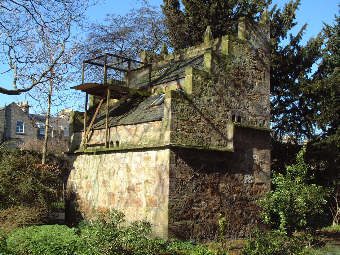
Image from http://www.saint-andrews.info/features.html
Tweeted today! “At one point in the early 20th century, the #LegalDepositMusic@StAndrewsUniLib was in a doocot (dovecot) – would it be the one at 46 South Street, I wonder?”
— StationersHall Music (@ClaimedStatHall) April 18, 2018
I’ve been writing up notes from our March workshop. Surveying the list of unlikely places for music to be kept, I think St Andrews gets the prize for the unlikeliest – not in an attic or tower, nor in piles on the floor, but in a dovecot, of all places! And I think this is it … at the School of Divinity, St Mary’s College, in the University of St Andrews. Please correct me if I’m wrong!
Eamonn O’Keele tells me this incredible manuscript is ‘linked to a 1/34th Regiment fifer in India, c.1790-1805. Plenty of great tunes and watercolours…’
It’s amazing. Do take a look!
Before you get too excited about the idea of an immoral daughter, I should let you down gently: the moral doesn’t concern this young lady at all – rather, it’s a warning of what a few holiday hours’ google-searching can turn up!
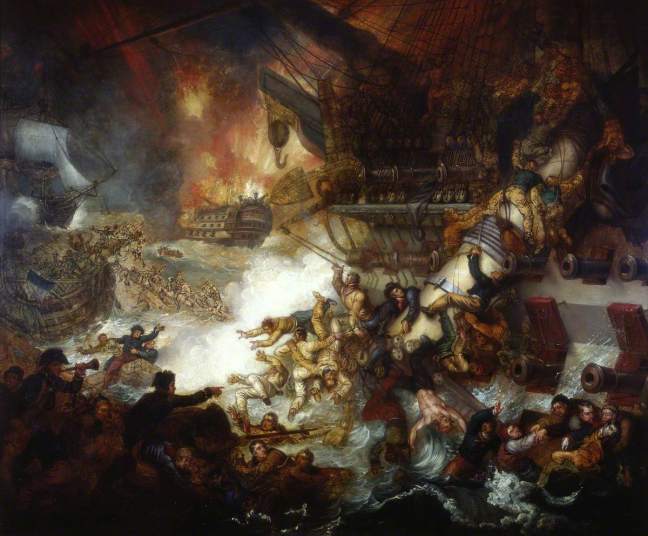
Battle of the Nile, destruction of L’Orient 1.8.1798, by Mather Brown (Artuk.org)
All I wanted was to find out was the identity of the young lady music teacher who composed a particular song. A colleague and I are working on a paper about women who composed Napoleonic songs, and I found another which looked chronologically timely, and potentially interesting. Musically, it truly isn’t a great song in the slightest regard. The lady didn’t appear to have much clue about harmony, harmonic progressions or satisfactory cadences, and expected her singer to reach a top B twice, not to mention five As! The British Library has it online – I don’t think anyone will want to perform it, which leaves musicological detectives like me to pore over it and explore its context!
I was curious as to who she was, nonetheless, and equally curious as to the poet who supplied her with the words. (He probably also published it, since it was later advertised in a novel that he’d published.) It referenced the Battle of the Nile, and – in a nutshell – the poet believed he’d be able to forget his wounds when his beloved shed tears over them. It’s a sentimental, human take on the horrors of war – I imagine our young composer would have enjoyed the thought that the protagonist was simply yearning for the sympathetic embrace of his sweetheart.
How the composer encountered the publisher/poet is something we’ll never know. He was based in London, she in Edinburgh. Along with literature and a bit of poetry by famous names, he had also already carved a reputation for himself as the pseudonymous “Thomas Little”, editing and publishing illustrated books about – ahem! – romantic love and reproductive anatomy. (I’m trying not to attract the bots here!) Shall we just say that the illustrations were detailed, and some years later, one of his books was found being circulated and well-thumbed by the occupants of a prison. There was also a court-case about the Hansard reporting of this. Another of his disreputable triumphs was the publication in 1826 of a very famous courtesan’s autobiography. Harriette Wilson had been one of Wellington’s mistresses. So now you know where the phrase, “publish and be damned” comes from – Wellington said it when his identity was revealed.
What does this have to do with a young music teacher composing a setting of a Napoleonic song? Absolutely nothing! Her publisher/poet’s first troublesome publication had been released in 1811; perhaps she knew nothing about it. Her own song was published five years later in 1816. She married an Edinburgh artist in 1818, probably lived near Dollar in Clackmannanshire when he became art professor at Dollar Academy in 1824, and was widowed in 1829, with three young daughters to look after. (Their only son had died in infancy.)
During her lifetime – before and after marriage – she published ten musical pieces, at least a couple of hymn-tunes, and a melodrama. Four of her pieces were settings of Scottish songs, and one of them was dedicated to Sir Walter Scott’s daughter, a distant relative. It’s possible that one of the other songs may also have a Napoleonic theme, but until I go and see the sole surviving copy, I can’t really be sure. I discovered that she was “a very fine harpist”, but the observation was unreferenced. (As we all know, you need a CITATION!)
One of the hymns – appropriately named with an Edinburgh location – was “Howe Street”, which appeared in Sacred Harmony for the Use of St George’s Church Edinburgh. You can find this book on IMSLP, or see an abc transcription of the tune on Jack Campin’s Embro, Embro website. But – as final demonstration that I’ve probably spent too long on the internet today – you can also find the tune used for a psalm-like modern interpretation of a Georgian herbal by scientist Elizabeth Blackwell – with musical adaptation by Frances M. Lynch. If our lady music teacher doesn’t turn in her grave at the exposure of her Napoleonic poet for what he was, then she will certainly rise to haunt the imaginative interpreters of her psalm-tune!
And the moral of the tale? Sometimes it’s better to take the evidence at face-value. A composer, a poet, a Napoleonic song – the rest makes for a great day’s Googling, but really has little bearing on the topic in hand!
This weekend, it’s the Annual Study Weekend for British and Irish music librarians, members of IAML(UK and Ireland). The study weekend is at the University of Edinburgh, so it’s not far for me to travel!
I was invited to talk about my research project, but I needed a new slant on it, since I gave a presentation about my St Andrews research (“Ghosts of Borrowers Past”) back in 2016. This time, therefore, I’ll be talking about the whole process of finding grant funding for projects. My talk (“Pathways, Outputs and Impacts”) is at 20.45 on Friday – after dinner, news and updates and another paper – so I hope I can be sufficiently entertaining to keep everyone interested. (In my mind’s eye, I see myself doing a quick tap-dancing routine, but sadly, I cannot dance at all …)
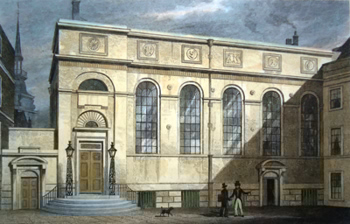
The image I’ve been using? I now have my own engraved, coloured antique print. It dates from 1831, was drawn by Thomas H. Shepherd, and engraved by W. Watkins. I treated myself to the print after our successful workshop last week. You must admit it looks lovely in colour!
At today’s highly successful Claimed From Stationers’ Hall music research network workshop, we mentioned some songs written by women during the Napoleonic era.
This reminded me of Oskar Cox Jensen’s monograph on Napoleonic songs, which I bought for the Whittaker Library a year or so ago. Whilst checking the details of that book, I found Oskar’s SoundCloud. Do have a listen! Admittedly, Oskar’s book doesn’t mention the three songs that Brianna and I performed, so you won’t find our songs on his SoundCloud – but maybe one day we’ll record ours ourselves. Who knows?!
I’ll be blogging about our own workshop in the very near future, once I’ve gone through my (rather extensive) notes properly! I’ve typed up the minutes of the morning session, but there’s still more to do and to think about before I should share further!
Well, the arrangements are all in place. We have delegates, a board room to meet in, catering and other practicalities taken care of, and even lunchtime entertainment for our guests. I’m happy to say that we’ve made contact with ALL of the historical legal deposit libraries, and all but two of them will be represented at next Monday’s workshop, along with big data and digitisation experts and other interested scholars. I won an AHRC networking award last year, and here we have it – networking really bearing fruit. I’m so excited!
FLASHBACKS
TWO YEARS … To think that it’s two years ago since I presented this slide at the IAML (UK and Ireland) Annual Study Weekend: things have moved on quite a bit since then!
TWO HUNDRED YEARS … Lastly, I can’t resist sharing this – a snapshot of what was registered at Stationers’ Hall OTD (on that day) 26th March 1818. It really is a typical cross-section of music publishing at the time! Just look – three arrangements of contemporary or near-contemporary operatic works for domestic consumptions (let’s not argue about who had the copyright in what! – see the posting on this blog last month!), and flute duets by one of THE big names of the time, virtuoso performer and arranger Charles Nicholson:-
Bishop’s Overture and Songs in Zuma, Book 1; Burrowes’s arrangement of Airs from Il Don Giovanni [Mozart], Books 1-3; Paer’s Numa Pompilio Overture; and Nicholson’s Four Concertante Duetts for Two Flutes.
Causewayside, National Library of Scotland, where UK legal deposit is administered.
Asked, in connection with another project, where the legal deposit music is in Britain, it seemed a good idea to summarise the current position. What follows is a very broad outline, but it might prove helpful to anyone trying to track down an old British piece of music!
The British Library has always received legal deposit materials from the start, has the most complete collection and all are catalogued. The collection began as the Royal Collection, then formed the basis of the British Museum collection, from which the British Library evolved.
For the remainder of the legal deposit libraries, remember that historically, some form of library committee decided which music to keep. This varied widely:-
Bodleian Library, University of Oxford – has always received legal deposit materials, from the start right up to the present. Mostly all catalogued, though historical entries aren’t all full, in-depth records, having been digitised from old records.
Cambridge University Library – has always received legal deposit materials, from the start right up to the present. Not all historical materials are catalogued.
Aberdeen University Library – was a legal deposit library up to 1836. A very incomplete collection, but what survives is catalogued – not all catalogued online.
St Andrews University Library – again, a legal deposit library up to 1836. A more comprehensive collection, but only items post 1800 are catalogued online, and the paper catalogue records for the earlier items appear to be missing. Interestingly, the historical music collection was very much a working one, frequently borrowed by professors, students, and friends of the professors.
Edinburgh University Library – a legal deposit library up to 1836. A very patchy collection, but items that ended up in the Reid Music Library, established in the 19th century, are at least now listed on a spreadsheet.
Glasgow University Library – a legal deposit library up to 1836. A more comprehensive collection, and catalogued online.
National Library of Scotland – evolved from the Advocates Library in Edinburgh, and is a legal deposit library to this day. Historical music is catalogued in the Victorian paper catalogue; probably not as complete as the British Library, for various reasons. More modern materials are catalogued online.
Trinity College Dublin. Although a legal deposit library since 1801, there is little historical music copyright material to speak of, because it wasn’t collected. Still a legal deposit library.
Sion College, London, was historically a theological institution, with a legal deposit library prior to 1836. All holdings have more recently been transferred to Lambeth Palace Library, London, and little music survives. Not catalogued.
King’s Inns, Dublin – another historical legal deposit library 1801-1836, but music appears not to have been catalogued to any extent, except very popular publications which must have been added to stock individually as they made their way to the library.
National Library of Wales. Was not a legal deposit library until the 20th century. (Unlike the National Library of Scotland, it was a new establishment in 1907, not growing out of an earlier institution.
We’ve just had our attention drawn to a wonderful blogpost on Houghton Library Blog, uploaded on 24th June, 2016. The author, Andrea Cawelti, is a Rare Music Cataloguer at Harvard, and she had just attended Ian Gadd’s course on The Stationers’ Company to 1775, at Rare Book School – a summer school at the University of Virginia.Andrea spotted the registration of an additional verse to “God Save the King”, just three weeks after an assassination attempt. She mentions George Greenhill at Stationers’ Hall – the man who managed to get himself paid multiple times, but still struggled to keep on top of the job – and patriotic songs during the Napoleonic Wars. We know all about them too! Read on …
Well, what else would you do if you were snowbound for a third day?! The bibliography has been updated considerably. This is not to say that I’ve read every single reference, which would be difficult in my part-time research existence, but hopefully there will be plenty of inspiration for anyone embarking on any aspect of the research network’s interests.
There’s a permanent tab on this blog for the bibliography, but you can go to it directly here.


 Another of his disreputable triumphs was the publication in 1826 of a very famous courtesan’s autobiography. Harriette Wilson had been one of Wellington’s mistresses. So now you know where the phrase, “publish and be damned” comes from – Wellington said it when his identity was revealed.
 One of the hymns – appropriately named with an Edinburgh location – was “Howe Street”, which appeared in Sacred Harmony for the Use of St George’s Church Edinburgh. You can


 workshop, we mentioned some songs written by women during the Napoleonic era.
 Well, the arrangements are all in place. We have delegates, a board room to meet in, catering and other practicalities taken care of, and even lunchtime entertainment for our guests. I’m happy to say that we’ve made contact with ALL of the historical legal deposit libraries, and all but two of them will be represented at next Monday’s workshop, along with big data and digitisation experts and other interested scholars. I won an AHRC networking award last year, and here we have it – networking really bearing fruit. I’m so excited!
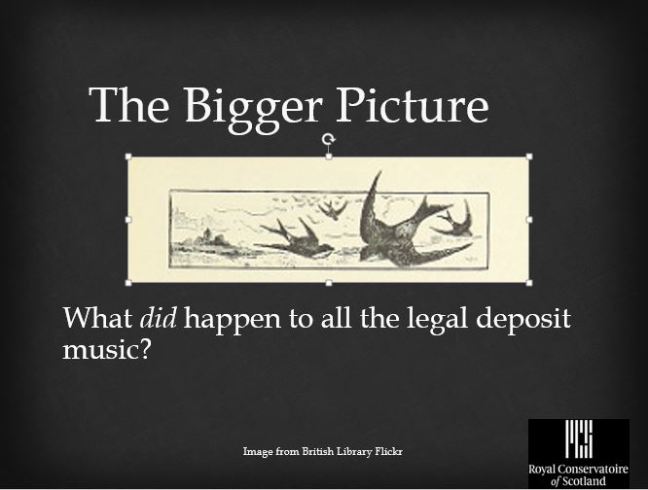 TWO YEARS … To think that it’s two years ago since I presented this slide at the IAML (UK and Ireland) Annual Study Weekend: things have moved on quite a bit since then!
 that day) 26th March 1818. It really is a typical cross-section of music publishing at the time! Just look – three arrangements of contemporary or near-contemporary operatic works for domestic consumptions (let’s not argue about who had the copyright in what! –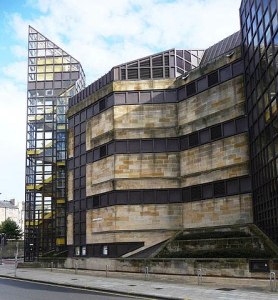


 Well, what else would you do if you were snowbound for a third day?! The bibliography has been updated considerably. This is not to say that I’ve read every single reference, which would be difficult in my part-time research existence, but hopefully there will be plenty of inspiration for anyone embarking on any aspect of the research network’s interests.
