Mystifying Timewarp Challenge

It’s not as though I’m unaccustomed to what I’ve been doing in odd moments for the past few days.  Over the years, I’ve opened dozens, indeed hundreds of old song books and other music publications, trying to read their prefaces, annotations and harmonic arrangements as though I were a contemporary musician rather than a 21st century musicologist.  Looking at music educational materials is likewise not new to me.

Enter Dr Walford Davies and his The Pursuit of Music

He was the first music professor at the University of Aberystwyth, but he was also hugely popular in the 1920s-30s through his broadcasting work – fully exploiting the new technology of wireless and gramophone for educational purposes, and to share his love of music with the ordinary layman wishing to know more about all they could now listen to. This book was written after he’d mostly, but not entirely retired.
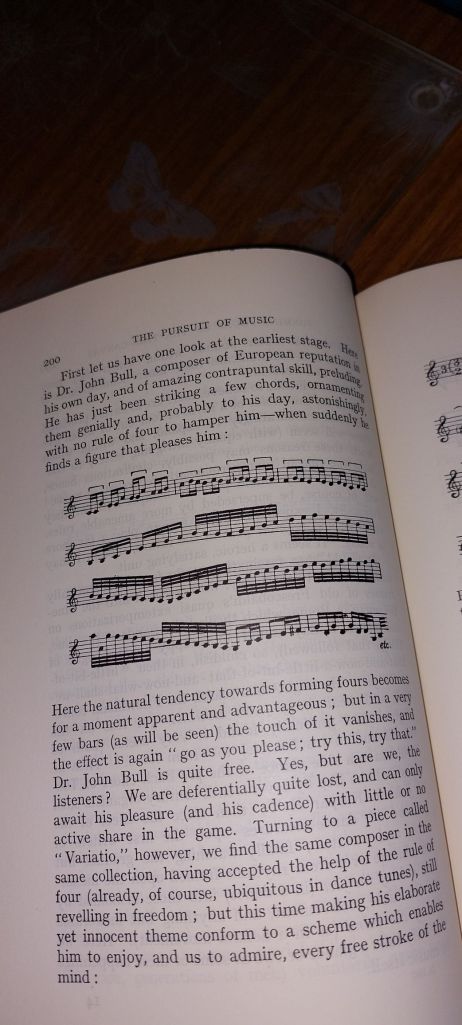
It wasn’t exactly what I expected! If I thought he would write about what made the Pastoral Symphony pastoral, or Die Moldau describe a river’s journey, I rapidly had to change my expectations. 

His audience was apparently not just the average layperson, but also young people in their late teens, not long out of school. If the reader didn’t play the piano, they were urged to get a friend to play the examples for them.  (Considering the book is over 400 pages, you can imagine how long they’d be – erm – captive!)

Dedication

And this was aesthetics, 90 years ago. I struggled to get into the mindset of a layperson wanting to know what music (classical, in the main) was ‘about’, without knowing what a chord was, or realising that music occupies time more than space. Would I have benefited from that knowledge? Would being told in general terms what the harmonic series was, have helped me appreciate the movements of a string quartet? Or Holst’s The Planets?

It wasn’t about musical styles over the years. I didn’t read it cover to cover, but neither did it appear to explain musical form and structure as I would have expected.

Davies’ biographer, H. C. Colles, did comment that it was a mystifying book, and suffered from the fact that the author’s strengths were in friendly and persuasive spoken, not written communication.

I’ve only heard snatches of his spoken commentary, so I can’t really say.  Apart from which, Colles made an observation about Davies’ written style. Colles was a contemporary authority who knew Davies personally – and he may have been picking his own words carefully, so as not to cause offence. My own disquiet is more a matter of content:  was it what his avowed audience needed, to start ‘understanding music’?

I think I have been mystified enough.

I wonder what the Nelson editors made of this book by one of the great names of their age? They published it, and I think regarded him as a catch, but what did they actually think?!

And did the layperson, assuming they got through the 400+ pages, lay it down with a contented sigh, feeling that now they understood music?

She Started Something! Bamboo Pipes – then the Pipers’ Guild

Front of The Pipers' Guild Handbook

Folks, I got distracted again tonight – beguiled by bamboo pipes, in fact. Let me explain!

Have you heard of Margaret James (1891-1978)? I wouldn’t be surprised if not, but believe me, she really started something in the 1920s. Someone gave the Gloucestershire school teacher a bamboo pipe from Sicily, and she realised this was something that kids could make at school.  They weren’t expensive to make, either.  (I read an observation that they were made from materials readily available in many homes.)**  It apparently took off! Kids liked actually making an instrument then learning to play it.  It was certainly another means of practical music-making. Crafting bamboo pipes briefly became the latest thing in classroom music, or so the literature would have us believe.  Although unmentioned in the Board of Education’s Handbook of Suggestions for Teachers in 1927, either in the music or the handcrafts sections, by 1933 the idea was being recommended in Board of Education literature and by HMIs (His Majesty’s Inspectors).  I do tend to wonder how many pipes were actually being made across the country – did the numbers match the rhetoric? Anyway, Margaret organised courses, wrote books and made at least one recording.  Judging by the number of publications, there surely must have been sufficient interest. This is a quick, but not exhaustive, list of works Margaret had a hand in:-

  • The adjusted treble pipe : the rhyme & reason of it, how to make it (Pipers’ Guild, 1933)
  • Directions for making the bass pipe, with diagrams by N. Gibbs (1936)
  • Directions for making the extended treble and alto pipes (Cramer, 1942)
  • Exercises and airs for pipes (Curwen, 1941)
  • Folk dance tunes : for bamboo pipes / transposed by Margaret James (Novello, 1934)
  • How to make a bamboo pipe [Diagram] (Published for the Pipers’ Guild, ca.1933)
  • The Pipers’ Guild handbook / Margaret James; with drawings and a chapter on decoration / by Nora Gibbs. Cramer, [1932]
  • Supplement 1 to the above, [1932-5]

Indeed, Vaughan Williams even wrote a Suite for Pipes (Oxford University Press, 1947), a quartet which was certainly more difficult than the average school pupil could attempt. Here it is, albeit played by a recorder quartet:-

The bamboo pipes do sound sweet, pastoral, traditional – very ‘English’. (I say that in inverted commas, because the question of what sounds ‘English’ is a whole dissertation in itself. I’m not going there.) Which makes it all the more ironic that her original gifted pipe was Sicilian! Anyway, we can agree that their folksy sound is part of their appeal.

Margaret herself started the Pipers’ Guild, which lasts to this day.  I did wonder if her bamboo pipe-making movement made it as far as Scotland  – was it something Scottish teachers were also doing? Judging by newspaper evidence, the Guild did have a small presence up here, but perhaps not quite as enthusiastically as in England. I won’t hunt further. 

Since my research interests are currently in a Scottish publisher producing educational music materials for a widespread market, then I thought maybe I should see if, or how often pipe-making got a passing mention – because their music editor/advisor was nothing if not on the ball. However, by 1939/40, it appears the humble (and ready-made!) recorder had gained supremacy. See this observation by one of Thomas Nelson’s authors:-

[…], who has done a lot of work on pipe playing in schools, composed pieces for them, and might be asked to write a first book on recorder playing, since they’re attracting more interest than pipes now. […] My own opinion is that there is already sufficient pipe music but not sufficient first stage recorder music.’

Similarly, Thomas Nelson’s four classroom books of My Music Guide (1953) mention recorders, but are silent on the question of pipes or pipe-making. Bamboo pipes evidently remained a minority interest, albeit for a long time.

** Glancing at my own garden canes, I doubt they’re wide enough to do anything with.  I don’t know if our toolbox is equipped for such a project, anyway.

Picture of Pipers’ Guild Handbook sourced from eBay. (I didn’t buy it.)