A Non-Research Event

Remember un-conferences? They were popular a few years ago.

Well, now I’m co-ordinating a Scottish song event, but it’s for entertainment, and not remotely connected with my research. Does that make it an ‘un-research’ event? Anything I might say about these songs will have been learned during my research career.  (I  grew up in England – it wasn’t my childhood repertoire.) 

Community Singing

It’s interesting, all the same.  For a start, I am interested in community singing in an early-twentieth-century sense, but my own practical experience of secular community singing is limited. The forthcoming gig may well trigger new trains of thought. (Let’s discount leading congregational singing from the organ, which I’ve done for decades.)

Repertoire

The preparation has been interesting, too. We have collectively chosen the repertoire: some old, some from the 1950s and 60s, and some that our children would have learnt at school.  It bears out my findings that the repertoire of favourite Scottish songs does change with every generation. 

We’re also channelling Sir Hugh Roberton and his Orpheus Singers for a couple of choral items, but an even earlier choral arrangement felt too dated.  You have to know about the west of Scotland’s intimate acquaintance with Roberton’s repertoire to appreciate why those settings go down so well to this day.  Somehow, his particular brand of close SATB singing has endured in a nostalgic kind of way, where earlier settings have fallen by the wayside.

Authenticity

It gets better.  We’ve debated different versions of the lyrics, and odd discrepancies in tunes.  In other words, we re-enacted all the chatter about authenticity and correct versions that has been rolling on for, shall we say, 250 years or more?

And the Squeezeboxes?

Accordion

I debated with myself whether to go all authentic with an accordion accompaniment in appropriate songs, but I don’t think I’m that brave.  Singing a solo is brave. A couple of concertina tunes is positively reckless. But the accordion is probably getting left at home. (Although, if you listen carefully between now and then, you might catch me attempting a few strains of ‘The Song of the Clyde’ in private … Jimmy Shand I’m certainly not!)

This is a new adventure for me.  More anon.

Memorable Accordions

When I was invited to come and listen to our accordionists’ final recitals, it struck me that this would be a great way to mark my 36th anniversary here. And it was!

We heard solo pieces, mixed ensembles, and one with dancers and a speaker. I only heard the first and second players, sadly – I heard my cataloguing calling me, after that  – but I thoroughly enjoyed what I heard. Truly, those recitalists must have had six fingers on each hand, they played such fiendishly difficult pieces!

I was talking to a couple of teaching colleagues recently about the ‘diverse’ music I’ve been acquiring. They were both keen to tell me that it IS beginning to make a difference in concert programming. That makes me a bit happier! Indeed, I recognised one woman composer’s name today, that I wouldn’t have known of, five years ago.

So, there’s another memorable morning in my last weeks as a performing arts librarian. Not many more days!

Four Concerts to Remember? Best Laid Plans!

Despite some depressing occurrences whilst I wasn’t working last week, there was plenty of music to brighten my mood.

I have mentioned before that working at the Conservatoire brings the advantage of lots of concerts to choose from.  Lunchtime recitals suit me, from a personal point of view (it saves trying to rush home for a family evening meal and then back out again), but they aren’t ideal from an operational point of view! Anyway, I planned to attend lunchtime recitals on Monday and Friday. 

However, I was too late for the Monday recital. The doors closed promptly at 1 pm. I wasn’t inside.

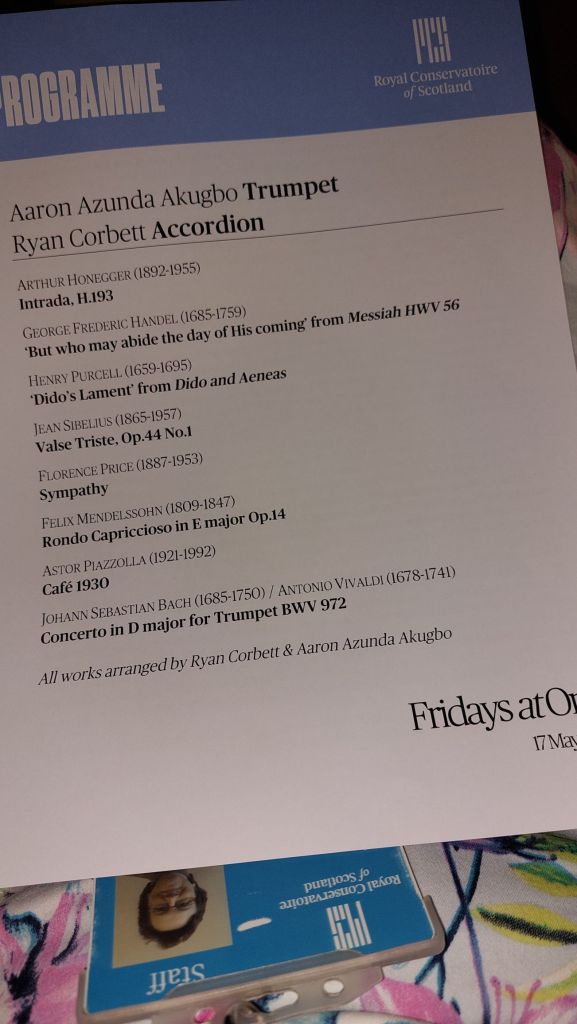
So that left three concerts. I made it to the Friday recital – trumpet and accordion, absolutely fantastic.  Feeling a bit like Cinderella rushing to beat the clock,  I made it back to my desk for 2 pm, so all was well.  (There are aspects of my impending semi-retirement that have considerable appeal!)

Friday – Trumpet and Accordion

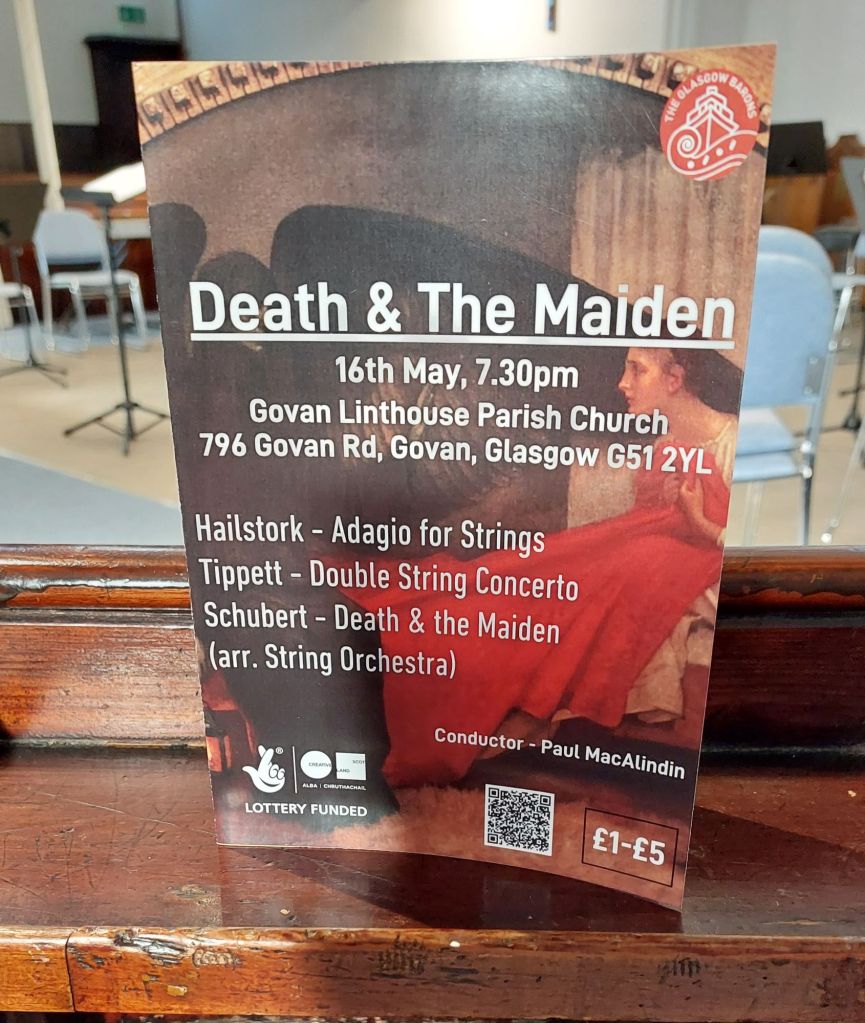
The Thursday evening concert was in my home neighbourhood, on a day when I was working from home.  I discovered that the Glasgow Barons were doing an orchestral concert. The first piece was by Hailstork, a BIPOC composer whose name I had literally just encountered that week whilst sourcing music repertoire: how could I resist?  And Schubert’s ‘Death and the Maiden’ quartet arranged for string orchestra was sure to be enjoyable.  The Tippett, though? I think I need to gain familiarity with it, to appreciate it fully. It probably grows on one.

It was a glorious evening, even before the concert started. I met someone I knew, so I even had company to sit beside me.

And then this afternoon, we went to a Bearsden Choir concert in Glasgow City Halls.  Arvo Part’s Salve Regina, a new work by Swann, and Puccini’s operatic Messa di Gloria. I sang that in Exeter University Choir back in 1980-2, and I recognised it instantly.  It was a great concert; the choir goes from strength to strength, and the two soloists (an RCS alumnus and a student, both on the opera course) were excellent.

Bearsden Choir concert

And here we are, Monday again.  Now, the big question is whether to try to get to today’s lunchtime recital! We’ll see…

Post Script. I didn’t make it.

Flower Pots! How to Brighten a Music Librarian’s Day

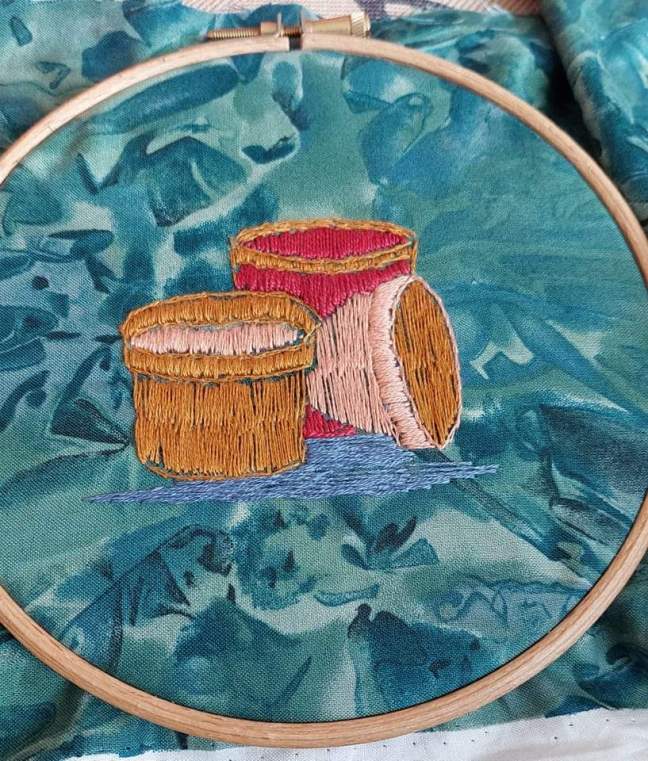
Embroidered picture of flower pots

I’ve mentioned before how, for the past four or five years, I’ve particularly focused on getting more music by women and composers of colour into the Whittaker Library. By the time I reach retirement age, there will be a good, up-to-date selection of such works for students to choose from. (I’ve also mentioned my rationale for this activity – if we introduce this music to today’s students, then whether they go out and perform it, or teach it, or combine these with other activities, there’s hope that they’ll pass on a wider, more receptive approach to repertoire-building to the students that follow on behind them.

Today, I was invited to attend a recital by one of our students. Two of the pieces were pieces by women composers, that their teacher had recommended us to acquire. It was a great recital – innovative, exciting and impressive. One particular piece involved a percussionist playing a counterpart on – wait for it – an assortment of carefully-chosen, differently pitched flower pots. You didn’t think flower pots were pitched? No, they aren’t deliberately tuned, but they can be chosen for the sound they make when you hit them! I bet you none of the audience had ever heard flower pots in a recital before, but it was great. Another piece had been written with piano accompaniment, but this time it was played on accordion. (From a personal point of view, this was of considerable interest. I got an accordion a few months before the pandemic, and a concertina a few weeks before. I get a lot of enjoyment out of my beginner’s attempts with two inexpensive instruments. But to sit and hear a truly excellent instrument in expert hands – and a “button box”, too; completely baffling to me! – well, that was something else. If you think accordions are just about ceilidhs and the good old days of Jimmy Shand, then believe me, you’ve missed so much.)

I and my colleagues even got a mention in the programme “credits”, for having obtained the music. It makes all the difference to feel that we were part of the programme-planning in our own small way. Sometimes, in a performing institution, it’s easy to feel that our hidden-away, behind-the-scenes work is really very insignificant and unnoticed. Obviously, we research and source the materials, catalogue and index them, then sit back and wait to see what happens. Our job is effectively done, one score or resource at a time, and the performers then go off and do the hard work, putting together a balanced programme and practising hard. We don’t always get to hear the results, though, which is why this morning’s recital was so lovely.

I have already expressed my opinion on – and weariness of – repetitive cataloguing. Processing CD after CD, all in the same genre and series, is mind-numbing. The mental exercise in cataloguing and indexing fresh, contemporary sheet music is definitely more enjoyable! Nothing can be ‘discovered’ in a library unless it has first been carefully catalogued, indexed and assigned the correct place on the shelves.

Seeing and hearing the results reminds me of the importance of music librarianship. A timely reminder!