Dr Karen McAulay explores the history of Scottish music collecting, publishing and national identity from the 18th to 20th centuries. Research Fellow at Royal Conservatoire of Scotland, author of two Routledge monographs.
A Woman with Opinions, and a Man who Resigned more than Once
Whilst waiting to get started with my next project, I’ve been doing a bit more research into individuals who only had a marginal role in my previous projects, but looked interesting in their own right, too.
But if I have one quality which is sometimes a failing, it’s my refusal to accept that sometimes the information is simply not there to be found. My librarianship background is somewhat to blame. If I can’t find something, it feels tantamount to an admission of defeat. And I don’t like being beaten.
Like Believing in Fairies
I’ve been on a wild goose chase this afternoon, though. I knew the poetry collections I was seeking were rare. It was totally improbable that I would walk into a couple of secondhand bookshops and find either of them. Yes, they were published in Scotland – 150 years ago. The poet (‘poetess’ or ‘authoress’ in her own day) comes across as an interesting woman with informed opinions about women’s status, and since she was the mother of one of ‘my’ woman composers, I thought she merited more attention. However, there was no trace of her this afternoon. Luckily, I have tracked down library copies, so all is not lost. I will get to see them – I just won’t have my own copies!
Even the consolatory coffee was a bit of a damp squib. I had the choice of standing and waiting in a haphazard queue, or going elsewhere to squeeze into a seat between people who really needed the space my seat was occupying. Oh, well. I had an outing. And I managed not to spill my coffee when I got bumped by the customers on either side!
However, I’ve had more luck at home, with my other quest.
‘Beyond a few slender facts [ … ], virtually no information about him seems to have survived.’
So said the authors of a book celebrating the 150th anniversary of our institution, a few years ago.
Of course, we have more information at our fingertips these days, so I’ve been trying to build up more of a profile of the Athenaeum Principal who only stayed in post for two years. I now know a lot more about him – though not yet the reason for his resignation. He was well qualified, a good pianist, and was the organist for several churches in England, Scotland and overseas.
Resigned as Principal, Resigned as Organist …
His resignation from the Athenaeum wasn’t the only time he resigned from a post. Indeed, one church went into a little more detail, saying he lacked tact. Their choir had already reportedly a hard time with his predecessor, though – maybe the choir itself was tricky!
I haven’t ruled out discovering more. But I am rather gratified by what I have found so far!
Who said weekends were restful?! Apart from the usual domesticity, and the organ-playing, I put in some more work on this blog.
Finished radically updating my Bio page to better reflect my two career strands.
Balanced my historical copyright page (Claimed from Stationers’ Hall) with a new one: Copyright Today. My career trajectory means I take a keen interest in copyright, intellectual property, plagiarism and so on. I might as well keep useful material handy, for myself or anyone else stumbling across this blog.
This is an article that I wrote whilst on vacation at the New Year, for the Glasgow Society of Organists’ newsletter, The Glasgow Diapason. I’m reproducing it here, because it may become hard to find copies of a newsletter with a comparatively small circulation, in years to come. I’ve added some information to Table 2, indicated as Addenda, and I’ve added two scans from The National Choir Vol.1.
The image above is (was) St George’s Church in Paisley – it has now been converted into flats.
The citation details of my article are as follows:-
Karen E McAulay, ‘‘Our Heroine is Dead’: Miss Margaret Wallace Thomson, Paisley Organist (1853-1896)’, The Glasgow Diapason, March 2023, 10-15.
I’m currently writing a book about Scottish music publishers and amateur music-making. Thinking to do a little light research over Christmas, I borrowed J & R Parlane’s The National Choir, a collection of part-songs published first in separate numbers from 1887, and subsequently in two volumes by ca. 1895. This Paisley firm was a significant producer of all kinds of books, including educational music in staff and Tonic Sol-Fa notation. The collection met the need for straightforward choral material for a growing number of amateur choirs; with over 100 contributors, it bore out the editor’s boast that it afforded opportunities for many local professionals and amateur composers and arrangers to make contributions. Containing predominantly Scottish song settings, the second volume also set out to broaden the scope a little further by including national songs from elsewhere in Britain, amongst other items.
Let us now praise famous men … (Ecclesiasticus XLIV)
Only a musicologist would sit down and tabulate every single contributor in 768 pages of music, and only a musicologist with an interest in women composers would count the number of female contributors. Margaret Wallace Thomson of Paisley was one of only two women represented, with an arrangement of Burns’s ‘The smiling spring’ and a song of her own, ‘The weary day’. (The other lady was Mrs R. Broom, a songwriter who had contributed the melody for one song, ‘Over the sea’.) Both ladies appeared in the first volume, the prefatory notes informing us that Miss Thomson was a Paisley pianist and organist, whilst Mrs Broom had written several popular songs. The latter remained an enigma, but there were numerous mentions of Miss Margaret (or Maggie) Thomson in the local press; she had a good reputation as an organist, piano accompanist and music teacher. Indeed, accompanying the Paisley Choral Union for some two decades, she received a gift of a gold watch and chain after her first three years with them, and generous tributes upon her untimely death at the age of 42.
I was particularly curious about her, since I was once a Paisley organist myself. Once I started looking, I found out more and more – another musical woman who had been forgotten through time, her lack of publications probably partly to blame.
Margaret’s father Alexander was an Irishman, who had seemingly come to Scotland before he met Susan Wallace, a Paisley girl. They both worked in the weaving trade as pattern setters. Susan still did this in 1851, when they had started their family, but seems not to have been doing it by 1861. Later, Alexander was a flower lasher, carrying out an intricate weaving process for Paisley shawls. Three sons and a daughter came along before Margaret’s birth, although her nearest brother died when she was only three. Alexander, the firstborn, became a manufacturer by trade; a violinist, he conducted the Paisley Musical Association orchestra in his spare time. Her sister Isobella became a qualified teacher, and was the first woman teacher at Paisley Grammar School before she left to marry. Margaret herself would attend that school. They had a younger brother, James Paterson Thomson, who also became an organist, violinist and music teacher.
By the time she was 20, in 1873, Margaret was advertising her services as a music teacher, working from home. She continued to advertise as a music teacher until 1895, the year before she died. Appointed organist at St George’s Parish Church in Paisley in 1876, she had already acquired experience at Paisley’s Trinity Episcopal Church. James was organist at North Church from 1884. Margaret’s adverts always identified her as ‘organist of St George’s’, but James’s1895 teaching advert did not allude to his being an organist that year. When he died of alcoholic poisoning in 1897, the records say that he was a violinist; maybe he had stopped playing in church.
The many press notices of Margaret’s appearances bear witness to a number of regular activities. In her capacity as organist, she gave annual concerts with St George’s choir. As accompanist to the Paisley Choral Union, she accompanied a number of the Saturday Afternoon Concert series taking place in the George A. Clark Town Hall. She was also involved with the massive annual summer outdoor concerts commemorating Tannahill at “The Glen” on the Gleniffer Braes, contributing arrangements of Scottish songs for choir and band, for performance under the direction of Mr J. Roy Fraser, a Paisley music-seller. Proceeds were being saved towards a statue for Robert Burns’s impending centenary in 1896. (As an indication both of the popularity of these concerts, and the enthusiasm for choral singing, it is worth noting that on a rainy summer’s day in 1889, it was regretted that the audience was uncharacteristically probably under 10,000, and that the choir sadly numbered under 200 singers!)
She provided music for other entertainments and talks; including accompanying children in music exams; accompanying the Wallneuk Mission Choir; and, ironically, participating in a concert for inmates at Riccartsbar Asylum, where she herself would later die. She seems to have played piano, harmonium or organ depending on the engagement, but is never recorded as having conducted a choir; this was probably considered unseemly for a genteel woman of the time.
The choral repertoire that she was accompanying was is a mixture of established ‘greats’ still performed today, and other works now long forgotten:-
William Bradbury (1816-1868)
Esther: cantata
Alfred R Gaul (1837-1913)
Ruth: cantata
Gounod
Jesus, Word of God
Handel –
Judas Maccabaeus: oratorio (excerpts)
Handel
The Messiah
Handel
Samson (excerpt)
Haydn
Creation
Henry Lahee (1826-1912)
The building of the ship: cantata
Mendelssohn
Elijah: oratorio (excerpts)
Mendelssohn
St Paul (excerpts)
Mozart
12th Mass (excerpts)
John Owen (1821-1883)
Jeremiah: oratorio
T Mee Pattison (1845–1936)
The Mother of Jesus: cantata
Scotch Selections
(piano contribution)
Sullivan
Oh, love the Lord
Sutcliffe
The voice of Jesus
Table 1: Repertoire
Such as found out musical tunes
Maggie probably falls into the category of amateur contributors to The National Choir. Her musical arrangements and occasional compositions are very slight. She provided an arrangement of a Burns song, and one original piece; each occupy only one side, and are competent, but not outstandingly original. The titles of a few more of her Scottish song settings can be gleaned from press reports of the Tannahill concerts, and the only other extant musical item is a setting of Tennyson’s ‘Break, break, break!’, which was a collaboration with Alexander Wallace Waterston – another Paisley musician, who could conceivably have been a relative. Her own song, ‘The voice of the deep’, remains untraced.
Break, break, break!, by Wallace Waterston, piano accompt by MWT (1894, published Paterson’s) – [addendum: copy in British Library – catalogue entry here.]
Gala Water, arr. MWT [choir & band?] (1884)
The garb of the Gaul, arr. MWT for choir & band (1883)
The lass o’ Ballochmyle, arr. MWT for choir and band (1885)
The lassie wi’ the lint-white locks, arr. MWT for choir and band (1885)
She’s fair and fause, arr. MWT for choir and band (1895)
The Maid of Islay, arr. MWT for choir and band (1895)
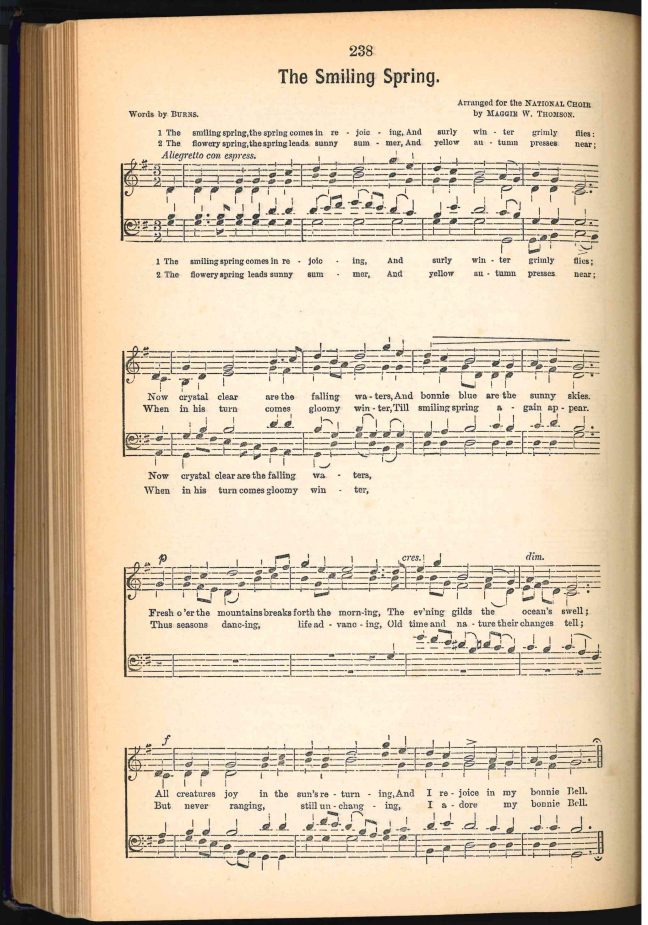
The smiling spring, words by Burns, arr. by MWT for The National Choir [Addendum: Vol.1 p.238 (Parlane, 1891)]
The voice of the deep (1883), bass song, written and composed by MWT [Addendum: referenced in a newspaper report of a concert that took place in St George’s Church, Paisley. A positive review!]
The Weary day, original words and music, by MWT for The National Choir [Addendum: Vol.1 p.312 (Parlane, 1891)]
Table 2: Compositions and Arrangements
‘The Weary Day’ by Margaret Wallace Thomson, as published in National Choir 1‘The Smiling Spring’ by Margaret Wallace Thomson, published in National Choir 1
And recited verses in writing
Ca.1889, Maggie’s name was included in a book, Robert Brown’s Paisley poets: with brief memoirs of them, and selections from their poetry, revealing another facet of this seemingly very modest but quite talented young woman. Five of her poems are included, two of which are on musical subjects: ‘Alone with the organ’, and ‘Verses suggested by a happy musical evening.’ Her poems were noteworthy enough to feature in A History of Scottish Women’s Writing (Douglas Gifford, Dorothy McMillan, 1997). Furthermore, she is on record as having exhibited amateur watercolours in Paisley, although there are no further details of what she painted.
And some there be which have no memorial?
As a spinster, Maggie would probably have been the main carer for her elderly mother; her married sister lived in Bonnybridge, a distance away. Her mother died of senile debility on 20 February 1896 aged 77. Grief-stricken, Maggie died on 12 April the same year, of exhaustion, nervous debility and ‘mania’, having fallen out of her bed in Riccartsbar Asylum. A lengthy, and adulatory obituary appeared in the Paisley and Renfrewshire Gazette. To quote but a fraction of it,
Her well-known musical talents suffered from the wise old proverb, “a prophet”, she was held in high respect by the whole community, and yet it is no less true that in any other community than her native one, she would have commanded higher financial rewards. [She] was very successful as a teacher, and though a stranger would probably have asked and received higher fees, she always commanded a fair share of patronage.
A week later, the same newspaper published the eulogy delivered by the Revd. John Fraser at St George’s Church (‘We make no moan, we utter no cry; we say our heroine is dead’), echoing praise of her many musical talents, and applauding a modest and Christian life well-lived.
Woodside Cemetery has two lairs belonging to the family, bought by Maggie’s father Alexander Thomson. Today’s online database tells us who lies where, but there is no gravestone erected by the family. However, Maggie’s passing did not go unnoticed. The Paisley Choral Union subscribed to erect an imposing marble tombstone, topped with a nine-foot obelisk. (This has sadly fallen off, and lies in two pieces behind the gravestone, on the hillside behind Woodside Crematorium.)
Margaret W Thomson
Died April 12th 1896.
Erected by present and former members of the Paisley Choral Union, as a mark of their esteem and appreciation of her musical services.
(Margaret Thomson’s Gravestone)
To have been commemorated in such generous style gives us some indication of the affection in which Maggie was held, and the talent which she clearly displayed. On a damp, January morning, I paused silently for a few minutes, as squirrels scampered past me, and water gently leaked into my trainers. There was no-one in earshot as I murmured, ‘Maggie, you are not forgotten.’





 Karen McAulay, Musicologist