

I’m delighted to introduce today’s blogpost by Andrea Cawelti, who is the Ward Music Cataloger at Houghton Library, Harvard University. Andrea attended a course at the American Rare Book School a couple of years ago, and is keen for everyone to know what a wonderful opportunity it would be for anyone who could attend this year’s course. I shared a link to Andrea’s reflections on the course, which she authored for the Houghton Library blog last year – you’ll find the link in the posting below. Now you can read more about it – if you manage to get there, do please consider sharing your own experiences here!

Fellow readers of Claimed from Stationers’ Hall may be aware that the American incarnation of Rare Book School has offered a course on the Stationers’ Hall since Peter Blayney, one of the stalwart fathers of research on the Stationers, taught the course in the 1990s. But I see that applications have been opened today for this summer course, now taught by Professor Ian Gadd, so I’d like to share a bit about my excellent experience in taking this course in 2016, as prompt applications are usually the most successful.
This term, as in 2016, the course will be held in Philadelphia, June 2-7, at the Kislak Center for Special Collections, Rare Books and Manuscripts at the University of Pennsylvania, with reasonably-priced and comfortable dorm space available within easy walking distance through the picturesque Penn campus. As this course represented my first experience at the Kislak Center, I was delightfully surprised by our genuine welcome, and helpful assistance by the staff, both of the library and those in attendance from the Rare Book School, even though this wasn’t their turf. The Center holds significant hand-press material for examination and project fodder, and Penn Libraries holds a complete set of microfilms of the Stationers’ Company registers and archives, which we consulted extensively for our work.
As with all RBS courses, ample opportunities are presented for individual discussion, questions, and networking, including regular morning and afternoon breaks, lunches, and receptions. Evenings often include programmed activities from lectures to film presentations, and during my course, there was an excellent presentation by Lynne Farrington, senior curator at the Kislak, on American subscription publishers and their German-American readers. Dr. Farrington provided a fascinating overview of the American subscription publishing industry, and how it was utilized for foreign-language titles to be sold through the subscription network. The lecture was accompanied by a hand-on exploration of subscription samples from several of the Kislak’s collections.
Enough of that, you may say, what about the course itself?!?!?! Well, first of all, I should mention that I arrived with a specific agenda, which was to familiarize myself with the Registers, what was in them of a music format, and to learn how to use the microfilms most effectively (Harvard, too, holds a complete set of these microfilms).
Like many of you I’m sure, I’ve had cases where I’d hoped to find a specific date in the 18th century when something had been published, or to establish some kind of sequence for several publications, and had been frustrated by my inability to harness these resources. Now of course, newer products are available, including the Literary Print Culture online access, which Professor Gadd has now incorporated into the course. Still, the navigation of this product isn’t straightforward, and one really needs to know what one is doing before attempting to use, or it is easy to get completely lost.
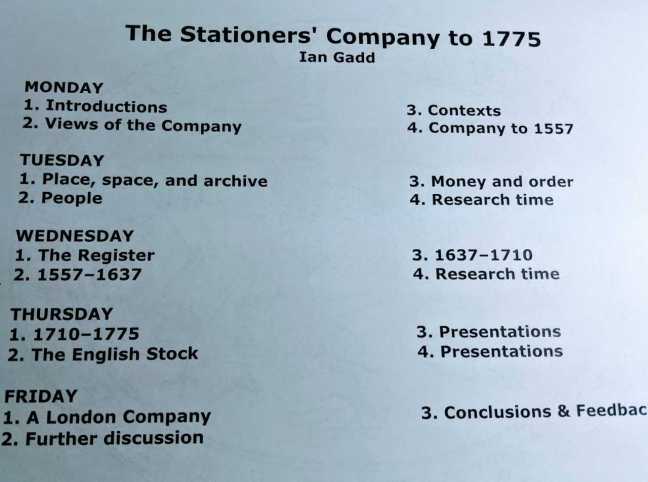
As you can see, the schedule was laid out to allow us a proper introduction to the history of the company and its archives: Professor Gadd offered spirited presentations on each aspect, as well as providing references to online and printed documentation which would be of use later in our explorations. Each of us was then tasked to research and present on some topic of particular interest to us (see “research time” and “presentation time” in the daily schedule). I chose a particular segment of time and explored all of the Registers chronologically to gain an idea of what music was being brought to the Stationers for registration between 1799 and 1804. Several of my discoveries ended up in our Houghton Blog, which presents a bit more information for those who are interested.
I had honestly come into this course completely unaware of how extensive the Stationers’ archives were apart from the Registers! Learning more about the “people” documentation was particularly eye-opening, and quite helpful in my cataloging. The online index to the London Book Trades for instance, based on the Stationers’ archives is great for finding more information on printers when researching, creating authority records, or for investigating connections between people. As always, Professor Gadd provided helpful hints: don’t use the “search” box, just go directly to the “index – names”. There were so many trails of bread crumbs offered to us, that who could remember them all (certainly not I!) Knowing this, the professor provided us with an extensive workbook to take home, complete with bibliography and most useful for me after the fact, an overview of the most important copyright legislation affecting just what was registered with the Company.

While this course only goes up to 1775, and consequently doesn’t cover some of the most influential music-related legislation, suggested readings within provide an appendix as it were, and after going through the history before 1775, reading forward into the 1790s was not difficult. Additional revealing segments covered what species of books were included in the English Stock and why this was important, and an introduction to Edward Arber’s term catalogues – keyword-searchable, and covering (among others and appendices) periods into the 18th century. A mind-boggling amount of work, which doesn’t include that much music but is well worth a look.
Two and a half years later, am I glad I took the course? You bet I am; it has proved to be perhaps one of the most useful courses I’ve taken at RBS. Possibly more so for me, because I was essentially ignorant of so many details of the Stationers’ history, but I would heartily recommend this to anyone preparing to work with, or already working with 17th to 18th century music. The context will provide you with an invaluable overview of how printing functioned in Britain, and how and why and what was registered. I hope that I’ve given something of the flavor of the course, and if anyone has questions about how RBS works, please do ask the RBS:-
https://tinyurl.com/RBS-ApplyTo-Courses
There are links throughout the site, and you’ll find that the RBS is prompt and efficient in their communications.
- Rare Book School homepage
- If you’re considering attending, you can find out more about the RBS on their website. The homepage explains, “Rare Book School provides continuing-education opportunities for students from all disciplines and skill levels to study the history of written, printed, and digital materials with leading scholars and professionals in the field.”
- Be quick! The early bird catches the worm, as they say.
Good luck and good researching!
Andrea Cawelti
Ward Music Cataloger
Houghton Library
Harvard University
 Karen McAulay, Musicologist