


I was going to add another exclamation mark there, but one exclamation mark is enough. Otherwise, it looks panicky, and that’s not what I want.
Over the years, I have come to realise that when you feel you’ve reached a block of some kind, it’s time to take a deep breath, go and do something else, and wait for inspiration to strike. This profound truth falls into two parts. The first key thing is to stop thinking about the block. (I’ll come to the second shortly!) If you’ve just completed a huge project – or a thesis – you might need a significant break. In my present project, it wasn’t on that scale. I just needed to step back for a weekend.
Is That It?
So, here I am, realising that soon I’ll have looked at most of the roughly contemporaneous archives relating to the Nelson’s Scots Song Books, meaning that I won’t be able to extract much more quotable content from these papers. And oh, I do enjoy the thrill of the chase! I can continue trawling through papers – or databases – for hours, if I’m hunting for particular details. An initial feeling of disappointment – no more discoveries? – left me wondering if I should start writing up what I do know, now?
But There Is More!
This is the second key thing. Don’t assume that you’ve ground to a halt. And try to avoid doom predictions; don’t fall into the trap of thinking you’ll never manage to get back on track again. Instead, regard the hiatus as a time to regroup (if an individual can be said to regroup) and permit new ideas to surface.
I remind myself that I do have a couple of new ideas to pursue, leading on from what I’ve unearthed so far. This is certainly not the end.
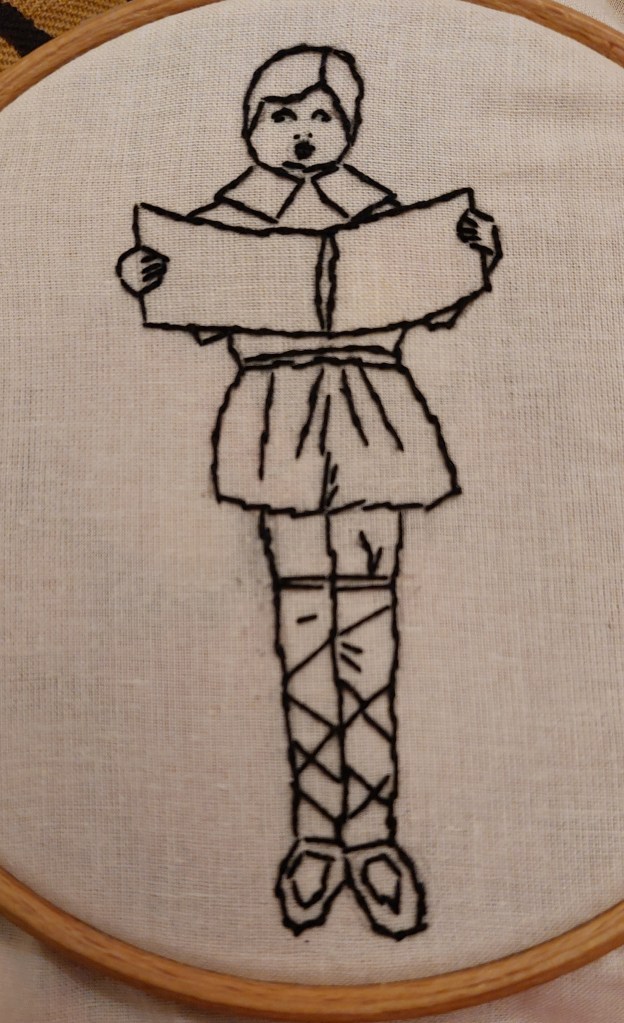
Moreover, as I picked up my embroidery needle for some weekend distraction, the sewing project itself reminded me that I haven’t yet explored every angle that I wanted to cover whilst I have access to the archives.
Weekend Pause for Reflection
Remember the little engraving of a child singing from a book? It was used for several of Nelson’s song books, although I think not for the Scots ones. (Only the four Scottish pupils‘ books have illustrations, and they tend to illustrate the songs they accompany – whereas the singing child is just that – a child singing.) I like it, though, and I decided to see if I could reproduce it in stitched form.
And that set me thinking about MacMahon’s New National and Folk Song Books – which include just a few Scots songs. Not to mention the other music books I’ve encountered along the way.
Actually, that’s another piece of advice. Take a long, hard look at your initial plan, and ask yourself if you’ve done all you intended to do. There may be other angles that have slipped to the back of your mind.
Looking back at my avowed intentions, at the start of this project, there are several more books I’d like to do a little research into. Not as much as I’ve done into the Scots books, but certainly, to see if I can find any more interesting detail around the times when these other titles were being published. I went back to see what I had written for my Fellowship page on the IASH website. Look:-
“Project title: From National Songs to Nursery Rhymes, and Discussion Books to Dance Bands: investigating Thomas Nelson’s Musical Middle Ground
So, how could I NOT devote some thought to nursery rhymes or aspiring amateur dance musicians? Even if it’s only a quick look?
“My recently-published monograph focused mainly on specialist music publishers, but I also made some comparisons with output by contemporary Scottish book publishers, including Thomas Nelson’s. Exploring the extensive Nelson archive will offer me the opportunity to investigate Nelson’s modest music-related output in depth.
“The Edinburgh publisher Thomas Nelson’s historical output can be broadly characterised into four categories:- religious; educational; attractive reprints of literary classics; or series for the intelligent layman. In this project, I shall explore the publishing histories of Nelson’s comparatively limited catalogue of music books and scores, to determine how these titles justified their existence in predominantly non-musical lists. I’m curious about the publishing histories of all Nelson’s music titles, whether notation or text; and the relative success of different titles. I’m also interested in the working relationships with compilers and authors.”
Well, I said it there!
- “The publishing histories of all Nelson’s music titles, whether notation or text.” I can’t compile extensive histories for all of them – there’s more than I thought – but I can certainly explore some that caught my attention. As I have for a couple already, as it happens.
- As for the relative success of different titles? Well, I can already name a few successful ones, and one a little less successful!
- And the working relationships? I have plenty of detail, but exploring a few more titles might yield other, unexpected discoveries – all the more reason to keep going!
“I’ll be exploring the background to Nelson’s national song collections, also contemplating their educational music materials in the era ca. 1927-40; books specifically aimed at the layman; and music publications for the Commonwealth.”
- So – yes, I can justify a bit more time spent looking for the months before MacMahon’s book was published.
- Maybe I can’t be as thorough as I have been in the 1948-55 era, but I should certainly dip my toes in the water!
- And – music publications for the Commonwealth? Yes, I can amplify what I know there, too. (Indeed, I’ve just reached out to a college in Nigeria, although it relates to a quest for a picture, rather than anything to do with music.)
So – am I finished? Far from it! I just need to shine a light on different parts of the archive.
(Meanwhile, I’ve finished my wee embroidery – I have no idea what I’ll do with it. But it did get me thinking.)
IASH courtyard, May blossom at its best!


 Karen McAulay, Musicologist