


Unless you’re Scottish, you may not have come across Clifford (Cliff) Hanley. He was a Glasgow journalist, writer and sometimes lyricist, born in 1922 and dying in 1999. Dancing in the Streets was first published by Hutchinson in 1958. My own eBay copy is a 1983 reprint by Edinburgh’s now defunct Mainstream Publishing. Amusingly, it came secondhand all the way from a library in Ilford, Essex!
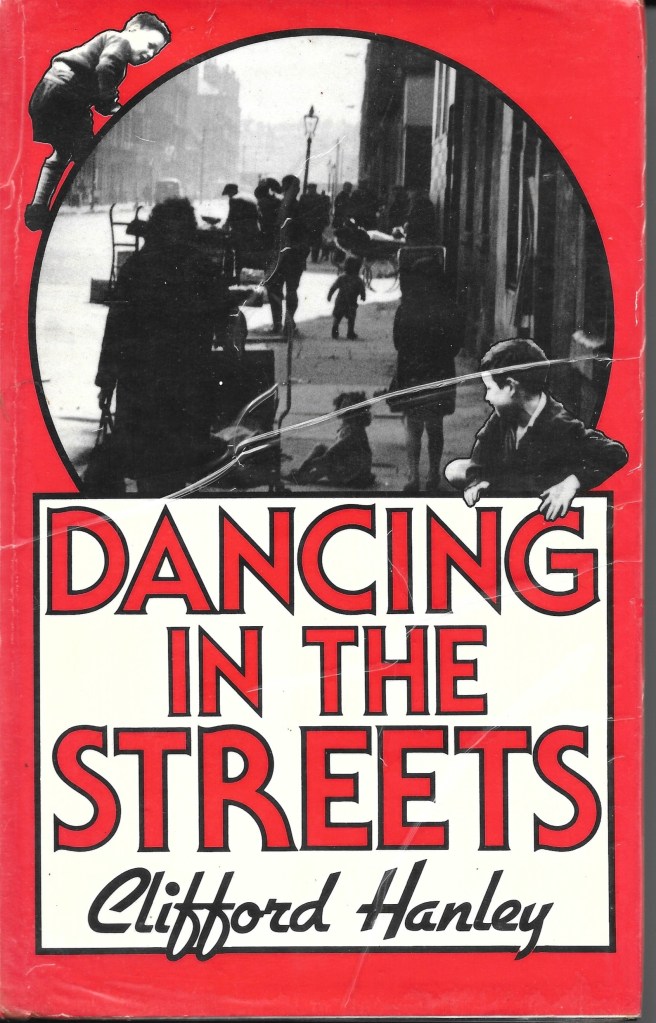
On the second day of my indisposition with Covid, I picked it up, decided that even Glasgow autobiography and social history was beyond me, and turned to Audible. Don’t judge me! But yesterday and today, feeling closer to my normal self, I picked it up again, and read the whole thing cover to cover. This is a man who knew Glasgow inside out, as a local journalist. (You’d like to read his obituary, maybe? Here it is in The Guardian, 14 August 1999.)
Subject heading: Glasgow (Scotland) Social life and customs
Hanley wrote well, and entertainingly. There’s lots of local colour – not to mention wee reminders that times have changed since then. (Go to a party on the night your wife’s in hospital having your firstborn? I think not! I imagine husbands weren’t allowed in the delivery room in those days, but this is still barely a mitigating factor!)
I bought Dancing in the Streets in the hope of tracking down some elusive information – which I didn’t find, as it happened. (It was, admittedly, a long shot!) However, I did recognise names that I’d already encountered, and I was to discover different gems that filled me with some excitement, because odd little passages foreshadow things that I, as an incomer to Glasgow, had later discovered through diligent research, and these convinced me that what I have written in my forthcoming monograph is certainly born out by someone who was actually there in inter-war and postwar Glasgow. I’m quite glad I hadn’t read it until now. It’s useful background, but it’s not on the subject of Scottish music publishing or amateur music-making, so I don’t feel I was negligent in not considering it earlier. However, in bearing out truths that I had to learn the hard way, there were several ‘Yes! See? That’s what I found!‘ moments, amongst the laughs that I couldn’t stifle between coughing!
For example –
In my forthcoming book, I’ve written about Emigration and Homesickness
Hanley took a holiday job on a cattle-ship from the Clyde to Montreal, as a very young teenager. On page 95 of his book, he meets some Glaswegian expat women there:-
‘How is Argyle Street, son?’ one of them asked kindly. ‘Fine – still the same, big crowds on a Saturday night an’ buskers playin’ the flute.’ ‘Oh, my God!’ She started weeping, but took a hold of herself. ‘It’s that nice tae hear a good Scotch voice. Could you no’ take me hame on your boat, son?’ ‘I wish I could’, I said in desperate pity. ‘Ah know, ah know, son, ah wish you could tae. Don’t you ever leave your hame, son, it’s the best place in the world. Ah wish tae God ah had never left dear auld Glesga.’
You can see how sentimental old (or more recently manufactured) Scottish songs would go down well with such fond emigrants!
In my new book, I mention Newer Approaches to Folk Song in the 1950s
I have certainly not suggested that the folk revival started, like flicking on a light switch, in a certain year, but I have highlighted new trends, and the influence of Edinburgh University’s new School of Scottish Studies. It’s fair to say that Hanley was not in this new movement. On the contrary, he seems to be poking gentle fun at it, on pages 208-10 of his book. At the abovementioned party, he describes an actor who ‘wanted everyone to sing folk songs, or Hebridean mouth music’, and a girl who was a potter, who wanted to ‘dance some kind of reel in her bare feet’. Later, she was ‘doing something stooping down and stamping, which apparently was meant to represent walking [sic] the tweed’.
WAULKING not Walking
Clifford and the potter were both, I’m afraid, wrong. The word is ‘waulking the tweed’ and Hebridean women used to thump urine-soaked cloth on a table, to soften it. Yes, I know – it sounds gross, put that way! (Feel the same about your genuine old Scottish tweed now?) Anyway, here Clifford has encountered one individual who is more aware of the new trends, and another who has a vague delusion that she understands it! Neither are seen as kindred spirits. Hanley wrote for a living, including the aforementioned song-lyrics, and had occasionally dabbled in performing on stage and radio. Probably a little younger, these partygoers were not part of his usual scene at all.
I’ve written about Teenagers and Gramophones and American Influences
And on page 242, Hanley writes about the decline of variety theatre, about teenagers’ musical tastes, and a new preference to listening to music at home on gramophones rather than go out to a variety show.
Don’t be Shy to read ‘Non-Academic’ Books!
So, unexpectedly, reading this book came as welcome vindication for some of the points I’ve made – a feeling which is always nice, of course. It’s hardly surprising that a book like this actually functions as useful background reading for a study in popular musical culture. But it also came as a welcome reminder that sometimes there’s benefit in stepping back and reading more widely. A book doesn’t have to be a scholarly tome – no index or bibliography here – to contain worthwhile background information. Information, in fact, that I wouldn’t even have recognised as valuable before I embarked on my research, but which came as validation of the most welcome kind.
My own book’s been copy-edited, the proofs have been corrected, and it’s well on its way to being published. I believe orders can be placed at the end of October. But for now, you might just find me heading to the local library to see if I can pick up anything else by Clifford Hanley. You can get Dancing in the Streets very cheaply secondhand, if you’d like to read it for yourself.

 Karen McAulay, Musicologist