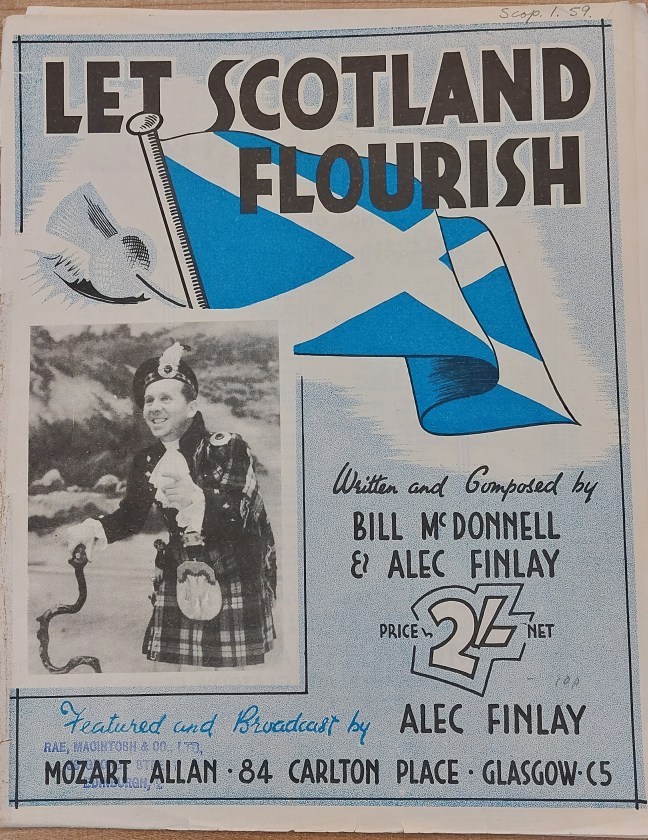
Alec Finlay: the ‘Pocket Harry Lauder’

This blog post is an edited excerpt from the research Exchange Talk I gave at the Royal Conservatoire of Scotland on 11 November 2024.

Inside the song-book, The Glories of Scotland, the foreword was followed by a full-page signed photo of a popular Scottish singer and comedian, Alec Finlay. The University of Glasgow’s Scottish Theatre Archive, characterises the latter as, ‘The pocket Harry Lauder’, and ‘Scotland’s gentleman’, describing his comedy as, ‘delightful, couthie and kindly’.

His was an international variety act; significantly, he toured America in late 1950.

If he was known as the ‘pocket Harry Lauder’, it was for a logical reason: a colleague of mine pointed out that Finlay, who clearly modelled his act on the variety superstar, Harry Lauder, even went so far as dressing like him, ‘wiggly stick’ and all.

Harry Lauder, from Wikiwand.com

A song is linked to the signed photograph of Alec Finlay at the front of the book. The photo is captioned ‘Scotland’s own comedian’, with Finlay in typical pose, full Highland dress, wiggly stick, and a blurred Scottish vista behind him. Beneath the photo, and alongside his signature, is the name of a song, ‘Let Scotland flourish’, composed and sung by Alec Finlay.

Sure enough, opposite a picture of Edinburgh’s Princes Street supplied by the Scottish Tourist Board, page 71 bears the words of the chorus – not the music, just the lyrics!:-

‘Let Scotland flourish / In all the years to be / The land that I was born in / Will aye be dear to me / Caledonia I adore you / Tho’ I travel the wide world o’er / My home is where my heart lies / Scotland ever more.’

It’s there, ‘by kind permission of Alec Finlay’, and it was written and composed by Bill McDonnell and Alec Finlay. At the foot of the page, we read that the ‘complete words, music and Solfa are available for 2/- from all music-sellers.’ It was published by Mozart Allan – who also published The Glories of Scotland.  The British cover appears at the top of this blog post.  (There was another for the overseas edition. )

‘Let Scotland flourish’ is a typical Scottish waltz of the era.  Finlay was a hit in America in 1950; and  selling the song as a single piece of music would make commercial sense.

In the recording of the song, published by Scottish Clan Records in New York, Finlay sings in the broad Scottish brogue that contemporary American listeners would have expected to hear.

YouTube audio – enjoy!
Not the best Song: ‘Glasgow’s Tuppenny Tram’, by a Variety Artiste

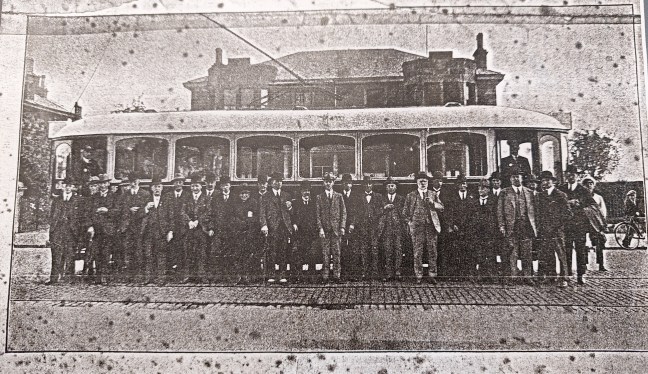
We think this is the City Council?

At least a couple of decades ago – long before I was interested in the social history of amateur music-making in Scotland – I came across a curious piece of sheet music. Knowing that my other half is more than a little interested in Glasgow trams, I made a photocopy and kept it safe. Every so often, we would joke that I’d get someone to sing it when it came to ‘final curtains’ time. (It would make a nice change from ‘Abide with me’ and the 23rd Psalm, after all!)

My Insatiable Curiosity

I hadn’t looked at ‘Glasgow’s Tuppenny Tram’ in years, but whilst I was proofreading my forthcoming book, I decided I really should look to see who had published that song. James S. Kerr? Mozart Allan? Galbraith’s in Renfield Street? Certainly not Bayley & Ferguson or Paterson’s. So I looked. The song was self-published in 1926 by the author and composer, an entertainer called R. F. Morrison. The song was actually arranged by Carleton H. Smyth, who was secretary and treasurer of the Glasgow Masonic Burns Club. (You’ll see that Morrison was also the author of ‘Just a wee Deoch-an-Doris’ and ‘Suvla Bay’. Which is interesting, since Harry Lauder’s songsheet of ‘A Wee Deoch-an-Doris’ seems not to mention Morrison at all – but I couldn’t access Morrison’s version without going to the British Library, so I shall have to remain mystified.)

There’s no’ much wrang wi’ Glasgow, auld Glesca on the Clyde;
St Mungo’s name is known to fame, ower a’ the world wide.
There’s bonnie places roon aboot, that thousands never see,
You need no ship to make the trip, so be advised by me.
CHORUS.
Take a trip on a tuppenny tram, and happy you will be,
From daylight till dark, there’s many a park, awaitin’ for you & me,
Don’t use your hoard for a Daimler or Ford, Like the workers of Uncle Sam,
Since Maister Dalrymple made motorin’ simple, wi’ Glasgow’s Tuppenny Tram.

Glasgow’s Tuppenny Tram / R F Morrison, 1926

‘Since Maister Dalrymple made motorin’ simple, wi’ Glasgow’s Tuppenny Tram’

Whilst we remembered the closing lines of the song (after all, we knew that Mr Dalrymple was a significant name in the history of Glasgow’s tram system, until he disappeared off to Sao Paulo in Brazil as a transport consultant), it’s fair to say we hadn’t looked properly at the whole song.

I’ll spare you the second verse! It lists a number of places you could visit by tram. (As the chorus says – see above – no need to waste money on a car!) Meanwhile, the back page is a large advertisement reminding you that there are 32 parks to visit in Glasgow (and still get home in time for tea), and reminds the reader to take care crossing the road …

It’s rubbish! It does incorporate some bits of Scottish song-tunes, but Carleton H. Smyth’s setting was very humdrum. Only one actual mistake in a chord, to be fair. My book is missing NOTHING AT ALL by not referencing this song.

Oh well, it’s a nice reminder of what Glaswegians would do on a sunny Sunday afternoon, or during Fair Fortnight if they had a bit more time. (Apart, of course, from going to variety concerts to hear the likes of R. F. Morrison! I wonder what the other acts were like?)

Meanwhile, I have now been positively begged not to have the song performed when it comes to the final curtain! What’s it worth … ?!

Back page of song - advertising and a safety reminder
Back page of song – advertising and safety first