

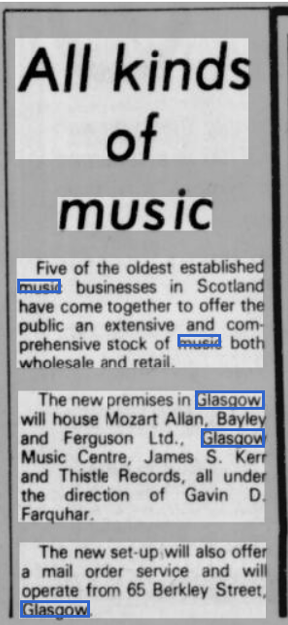
News item from St Andrews Citizen (9 August 1980)
I’ve recently highlighted a new published article focusing on the business history of Kerr’s music shop and publishing business. Kerr died near the end of the nineteenth century, and his wife Mary died in the early twentieth. These early trading years are the focus of the article’s authors:-
Renzo Cordina, Rosa Michaelson & David Power (08 Jun 2026): ‘Pianos, profit and provinciality: a microhistory of a Victorian entrepreneurial firm‘, Management & Organizational History.
As I’ve mentioned, there is a mass of very useful and informative detail about business history, and piano sales in Scotland in this era.
Corrections
However, I’m perturbed by the final paragraph of section 4, the Case Study, which precedes the next section 5, Discussion. It is regrettable if misinformation creeps into the story of this significant Glasgow firm.
The Shop in Berkeley Street
The paragraph begins,
The legacy of the James S Kerr business was both the music shop which continued to operate until the 1970s, and perhaps, more lastingly, music publishing which continued into the 21st century.
- No mention is made of the purchase of the firm by a group of entrepreneurs including singer Robert Wilson, in the mid-20th century.
- A Berkeley Street shop continued later than the 1970s, as the Glasgow Music Centre. The article contradicts its own statement above, when it references a 1980 news item in the Aberdeen Press & Journal (7 August 1980). (Kudos to the Aberdeen paper for quoting a woman, Ruby Anderson, who was co-director. Hers is a new name to me!). However, the St Andrews Citizen (9 August 1980) is more informative:-
The new premises will house Mozart Allan, Bayley & Ferguson Ltd, Glasgow Music Centre, James S Kerr and Thistle Records, all under the direction of Gavin D Farquhar. The new set-up […] will operate from 65 Berkley [sic] Street.
Addresses: 79 and 65 Berkeley Street
The subsequent information a couple of sentences on, is technically correct – 79 Berkeley Street is still the registered address, as we can see from the Gov.uk company information. And the shop certainly was at no.79 in the 1930s. This is all accurate.
The current company also has its address at 79 Berkeley Street, the same address as the music shop of the mid-1930s and it is still possible to buy copies …
However, this is also just a little misleading, as I can demonstrate, because there were actually two Berkeley Street addresses:-
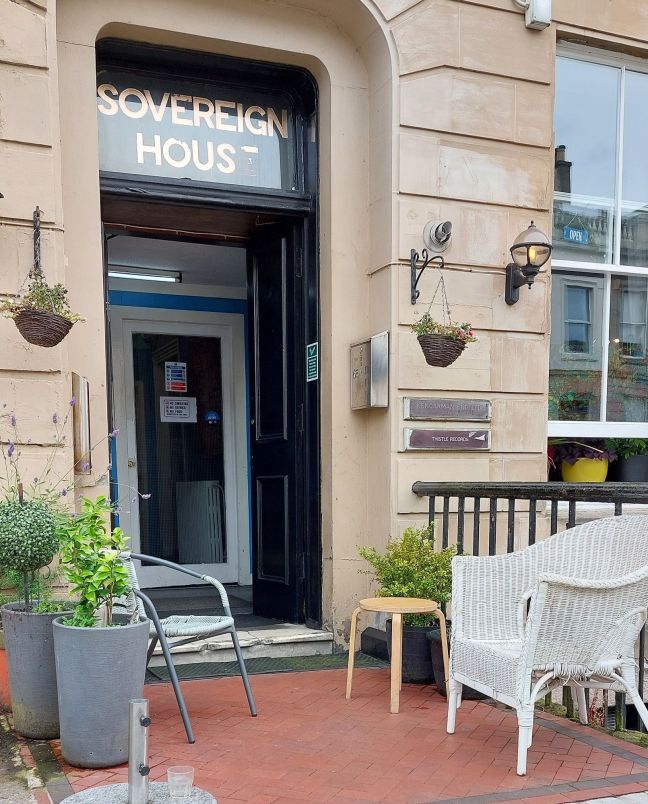
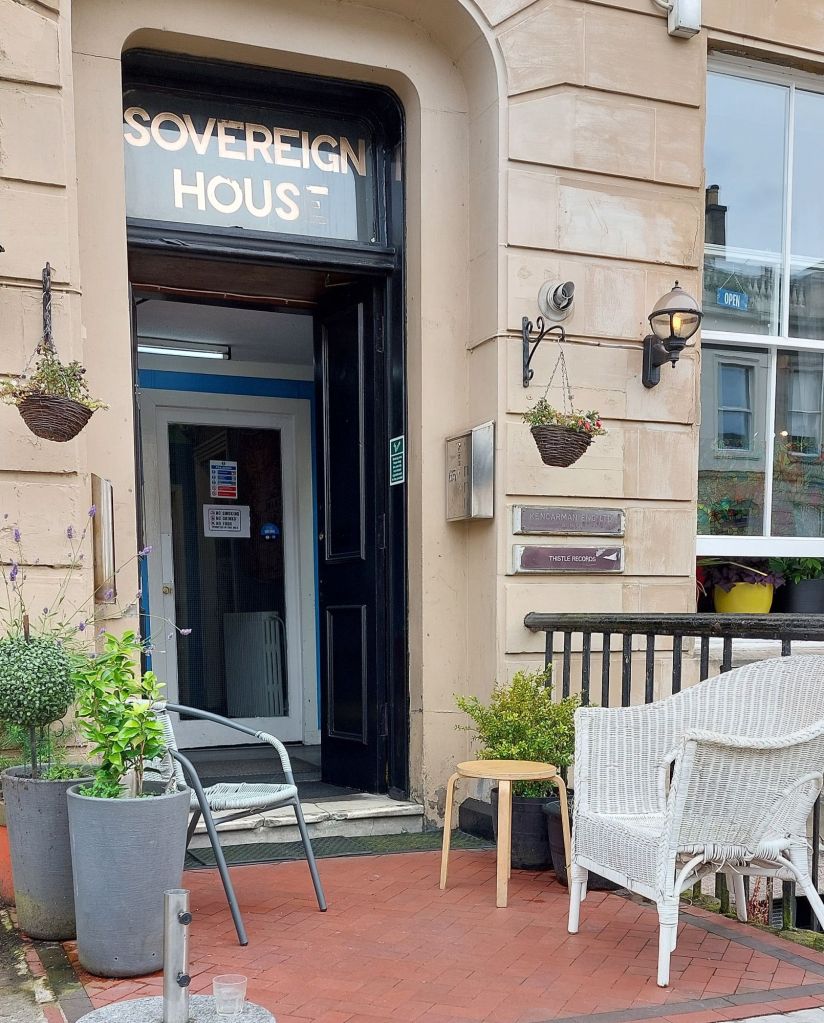
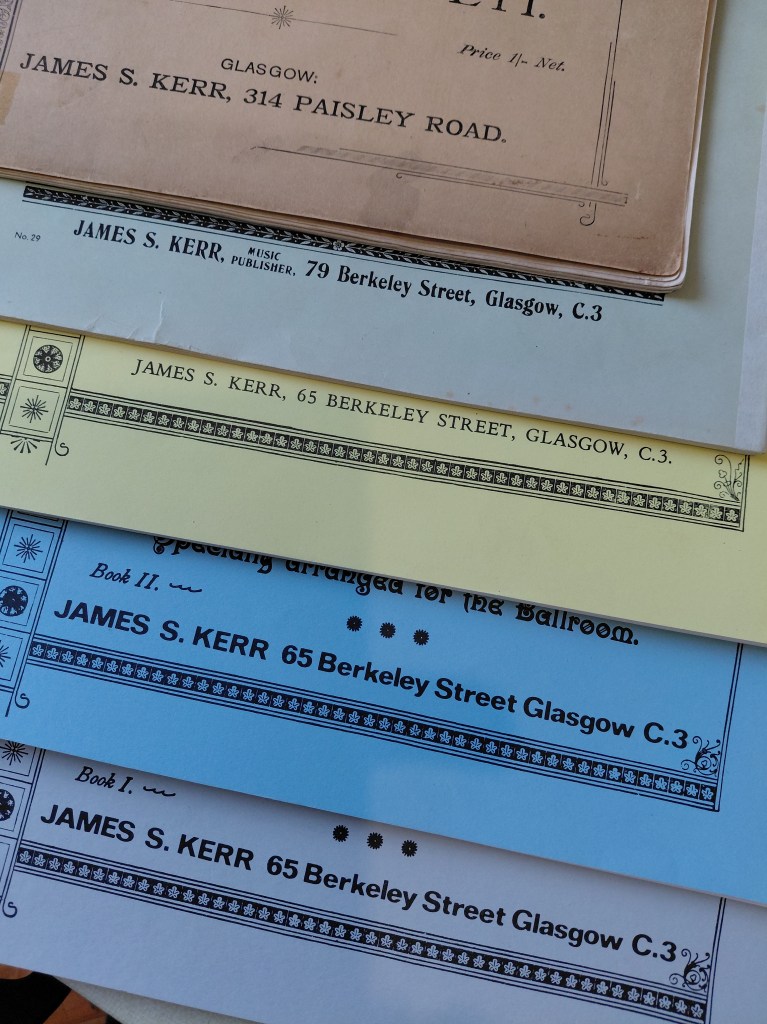
- 79 Berkeley Street was the address purchased by the individual who acquired the firm after the Kerr family. To this day it remains the registered address. It did appear at the foot of early publications after Kerr’s had moved from 314 Paisley Road. However, the shop was operating from 65 Berkeley Street, certainly by 1980. See the image at the top of this post.
- The shop operated into the 21st century, not the 1970s, although latterly the retail side had no connection with Kerr’s Corporation.
- I did visit the shop in the 1990s, long before I started my research. And to this day, a small Thistle Records sign is still there, a ghostly legacy from the past (just above the railing):-
Publishing History
- Music publishing did not really continue into the 21st century. It dwindled away within a few years of Wilson’s untimely death. Whilst copies of Merry Melodies can indeed be purchased, they’re merely reprints. There has been no publishing of new music for many decades.
- Sheet Music Plus has a couple of reprinted titles in stock, one being Kerr’s Second Collection of Merry Melodies. The cover art is unchanged, apart from the new sans serif font of ‘Kerr’s Second’ at the head of the cover, and sans serif again for ‘James S. Kerr, 65 Berkeley Street Glasgow C.3’ at the foot. (The Third Collection reprint uses a different font for the same address.) But note that although the postcode actually changed from ‘C.3’ to G3 7DX in the late 1960s, it still appears on the reprints.
Evidence for my Assertions
What’s my evidence for my assertions? Quite apart from a lot of research, I’m very proud to know the last owner of the music shop; have spoken at length with a member of Wilson’s family, and I’ve also corresponded with the last surviving board member of Kerr’s Corporation:-
‘In terms of publishing it is a zombie company in that no additions to the catalogue have been made for many years.’
I’ve written quite a lot about the later history of the firm, in three publications: my monograph; my History Scotland article, and the RMA Research Chronicle article about the Scottish women musicians.
- A Social History of Amateur Music-Making and Scottish National Identity: Scotland’s Printed Music, 1880-1951 (Routledge, 2025)
- ‘The ‘Scottish Soprano’ and the ‘Voice of Scotland’: the Importance of Nationality to Flora Woodman and Robert Wilson’, History Scotland Vol.25 no.1 (Spring 2025), 74-81 (accessible online via public library e-magazine apps, or you may be able to order a paper copy online.)
- Article, ‘Women Pursuing Musical Careers: Finding Opportunities in Late 19th- and Early 20th-Century Scottish Music Publishing Circles‘, Royal Musical Association Research Chronicle , Volume 56, April 2025, pp. 97 – 118

