James S. Kerr, Victorian: the Subsequent History of his Music Business

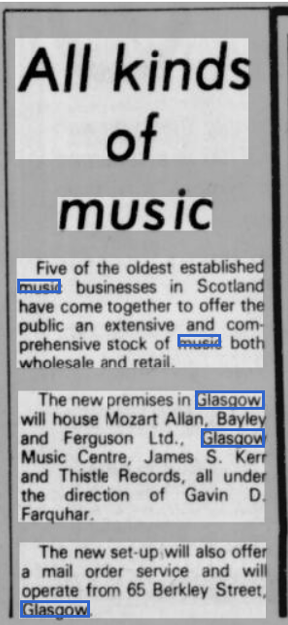
St Andrews Citizen Saturday 9 August 1980, newsclip about the Glasgow Music Centre.

News item from St Andrews Citizen (9 August 1980)


I’ve recently highlighted a new published article focusing on the business history of Kerr’s music shop and publishing business. Kerr died near the end of the nineteenth century, and his wife Mary died in the early twentieth. These early trading years are the focus of the article’s authors:-

Renzo Cordina, Rosa Michaelson & David Power (08 Jun 2026): โ€˜Pianos, profit and provinciality: a microhistory of a Victorian entrepreneurial firmโ€˜, Management & Organizational History.

As I’ve mentioned, there is a mass of very useful and informative detail about business history, and piano sales in Scotland in this era.

Corrections

However, I’m perturbed by the final paragraph of section 4, the Case Study, which precedes the next section 5, Discussion. It is regrettable if misinformation creeps into the story of this significant Glasgow firm.

The Shop in Berkeley Street

The paragraph begins,

The legacy of the James S Kerr business was both the music shop which continued to operate until the 1970s, and perhaps, more lastingly, music publishing which continued into the 21st century.

  • No mention is made of the purchase of the firm by a group of entrepreneurs including singer Robert Wilson, in the mid-20th century.
  • A Berkeley Street shop continued later than the 1970s, as the Glasgow Music Centre. The article contradicts its own statement above, when it references a 1980 news item in the Aberdeen Press & Journal (7 August 1980). (Kudos to the Aberdeen paper for quoting a woman, Ruby Anderson, who was co-director. Hers is a new name to me!). However, the St Andrews Citizen (9 August 1980) is more informative:-

The new premises will house Mozart Allan, Bayley & Ferguson Ltd, Glasgow Music Centre, James S Kerr and Thistle Records, all under the direction of Gavin D Farquhar. The new set-up […] will operate from 65 Berkley [sic] Street.

Addresses: 79 and 65 Berkeley Street

The subsequent information a couple of sentences on, is technically correct – 79 Berkeley Street is still the registered address, as we can see from the Gov.uk company information. And the shop certainly was at no.79 in the 1930s. This is all accurate.

The current company also has its address at 79 Berkeley Street, the same address as the music shop of the mid-1930s and it is still possible to buy copies …

However, this is also just a little misleading, as I can demonstrate, because there were actually two Berkeley Street addresses:-

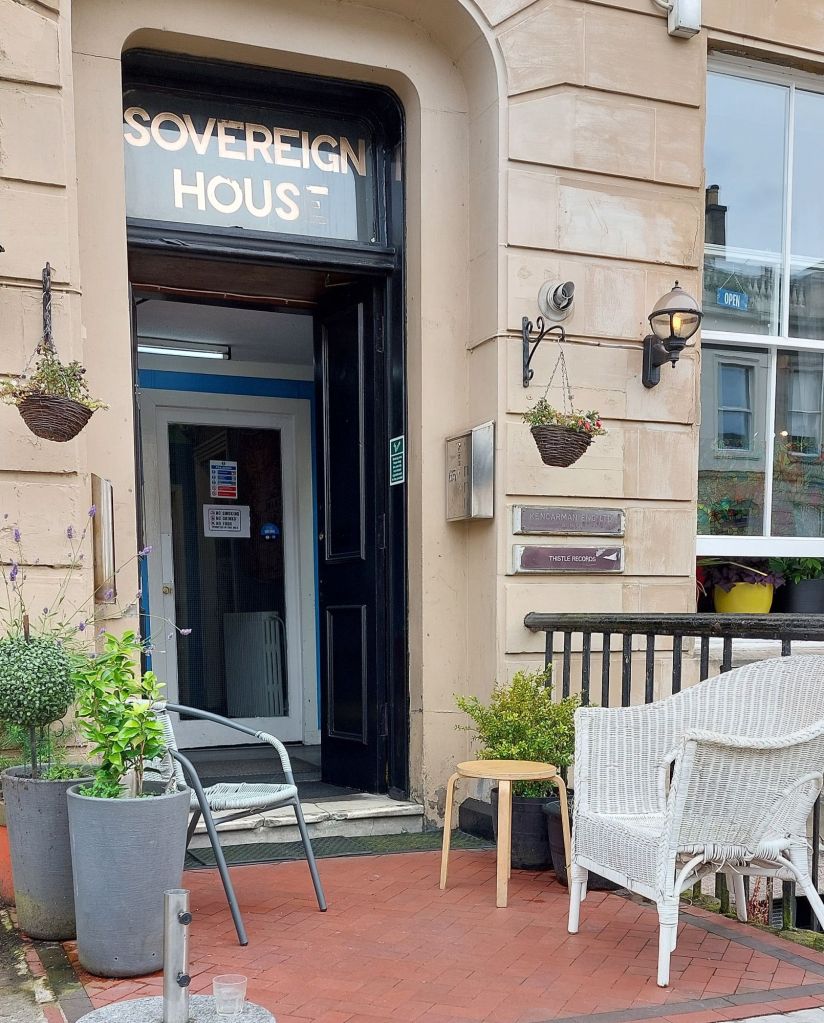
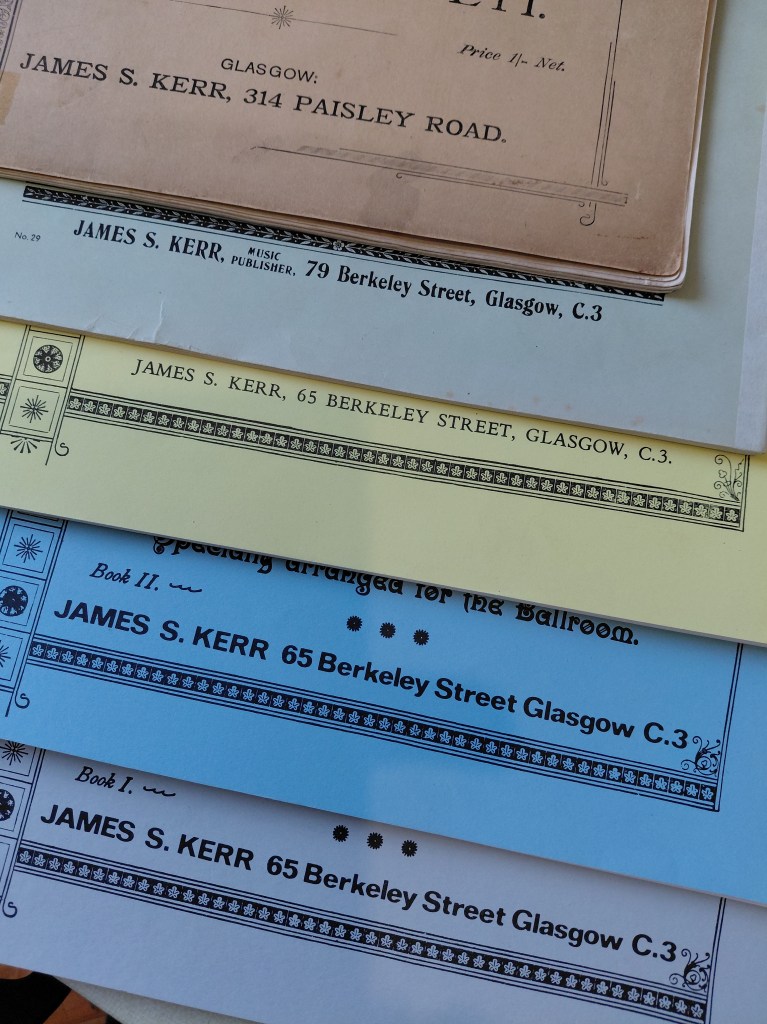
  • 79 Berkeley Street was the address purchased by the individual who acquired the firm after the Kerr family. To this day it remains the registered address. It did appear at the foot of early publications after Kerr’s had moved from 314 Paisley Road. However, the shop was operating from 65 Berkeley Street, certainly by 1980. See the image at the top of this post.
  • The shop operated into the 21st century, not the 1970s, although latterly the retail side had no connection with Kerr’s Corporation.
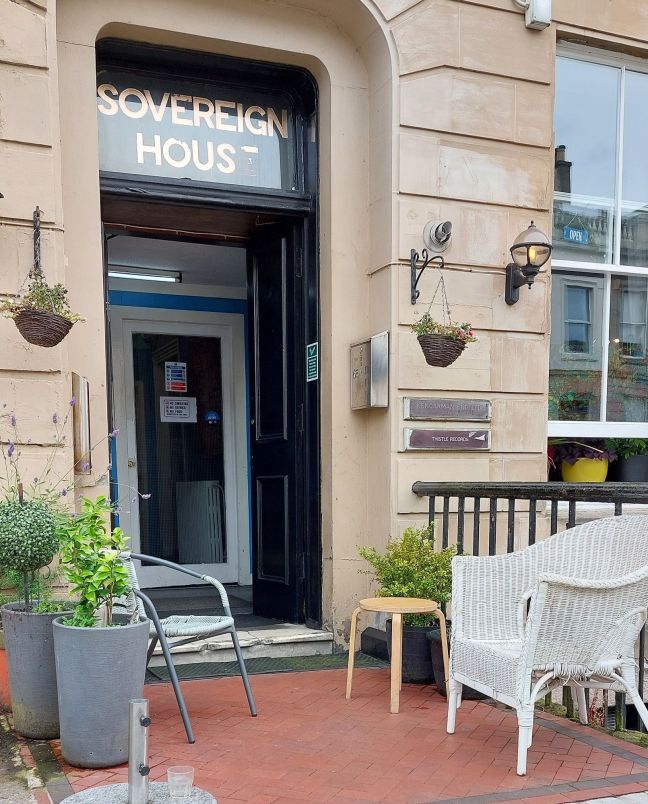
  • I did visit the shop in the 1990s, long before I started my research. And to this day, a small Thistle Records sign is still there, a ghostly legacy from the past (just above the railing):-
Publishing History

  • Music publishing did not really continue into the 21st century. It dwindled away within a few years of Wilson’s untimely death. Whilst copies of Merry Melodies can indeed be purchased, they’re merely reprints. There has been no publishing of new music for many decades.
  • Sheet Music Plus has a couple of reprinted titles in stock, one being Kerr’s Second Collection of Merry Melodies. The cover art is unchanged, apart from the new sans serif font of ‘Kerr’s Second’ at the head of the cover, and sans serif again for ‘James S. Kerr, 65 Berkeley Street Glasgow C.3’ at the foot. (The Third Collection reprint uses a different font for the same address.) But note that although the postcode actually changed from ‘C.3’ to G3 7DX in the late 1960s, it still appears on the reprints.
Evidence for my Assertions

What’s my evidence for my assertions? Quite apart from a lot of research, I’m very proud to know the last owner of the music shop; have spoken at length with a member of Wilson’s family, and I’ve also corresponded with the last surviving board member of Kerr’s Corporation:-

‘In terms of publishing it is a zombie company in that no additions to the catalogue have been made for many years.’

I’ve written quite a lot about the later history of the firm, in three publications: my monograph; my History Scotland article, and the RMA Research Chronicle article about the Scottish women musicians.

  • A Social History of Amateur Music-Making and Scottish National Identity: Scotlandโ€™s Printed Music, 1880-1951 (Routledge, 2025)
  • โ€˜The โ€˜Scottish Sopranoโ€™ and the โ€˜Voice of Scotlandโ€™: the Importance of Nationality to Flora Woodman and Robert Wilsonโ€™, History Scotland Vol.25 no.1 (Spring 2025), 74-81 (accessible online via public library e-magazine apps, or you may be able to order a paper copy online.)
  • Article, ‘Women Pursuing Musical Careers: Finding Opportunities in Late 19th- and Early 20th-Century Scottish Music Publishing Circles‘, Royal Musical Association Research Chronicle , Volume 56, April 2025, pp. 97 – 118
Noted! More Scholars have Written about James S. Kerr’s Music Business

Piano tuner at work

If you were interested in James and Mary Kerr, proprietors of James S. Kerr’s piano and music publishing concern, then you’re spoilt for choice today.

Amateur Music-Making

Not only do they feature in my book (now two years old), A Social History of Amateur Music-Making and Scottish National Identity: Scotland’s Printed Music, 1880-1951 … (where you’ll also find out more about dance instructor and dance hall lessee Mr Orr Robertson, not to mention the later history of Kerr’s firm, including the years when it was no longer owned by the Kerr’s!) …

Scottish Women Musicians

But Mary also gets her own significant mention in my RMA Research Chronicle open access article, ‘Women Pursuing Musical Careers: Finding Opportunities in Late Nineteenth- and Early Twentieth-Century Scottish Music Publishing Circles’ … along with Kate Logan, whose connection with the Logan publishing firm diverged after her brother-in-law and husband’s publishing firm went bankrupt; not to mention Euphemia Allan (of Mozart Allan fame) and Rose Smith.

Scottish Professional Artistes

The later history of Kerr’s firm, after it became Kerr’s Corporation, is mentioned in my book, but also in my 2025 History Scotland article:-

‘The โ€˜Scottish Sopranoโ€™ and the โ€˜Voiceย ofย Scotlandโ€™: the Importance of Nationality to Flora Woodman and Robert Wilson’, History Scotland Vol.25 no.1 (Spring 2025), 74-81 (accessible online via public library e-magazine apps, or you may be able to order a paper copy online.)

Management & Organizational History

But I have just discovered that there’s now a new article about Kerr’s business, from an organisational, management perspective, in a Routledge journal which hasn’t crossed my radar up until now. This time, it emanates from the School of Business, University of Dundee, United Kingdom:-

Renzo Cordina, Rosa Michaelson & David Power (08 Jun 2026): ‘Pianos, profit and provinciality: a microhistory of a Victorian entrepreneurial firm‘, Management & Organizational History.

It’s a different kind of article to my own writings, naturally, because the authors’ focus is on Victorian business and piano sales, whilst mine is more about music publishing and individual editors. There’s a wealth of background information about the trade side of piano-selling, which I heartily recommend – that’s not my focus at all.

The basic factual outline of Kerr’s dates and addresses probably do draw on the same sources.

But if you want to know more about the later life of the ‘Kerr’s’ brand, then I have to say my work will offer you more detail; similarly with the Logan firm. Kerr’s are not still publishing; the last surviving very elderly board member advised me that it is now essentially a ‘zombie firm’. Merry Melodies can certainly still be purchased as reprints, but not from Kerr’s, whose business documents are now ‘in a box in a cupboard’.  The premises are no longer a music shop – and the last person who did own the retail business was unconnected with Kerr’s. Again, I know them.

And, let’s be accurate, Baptie’s Musical Scotland (1894) is correctly cited in the references, but incorrectly cited in the text as ‘Scottish Musicians’ (1894), but the page numbers cited are those in Musical Scotland. I’m not aware of a second book with the same date but a different title.

It’s great that Kerr is finally, decisively on the map. (Well … a gap on the map … see my 2023 blog post showing where the first shop was!)

Image by stalkerreklats from Pixabay

Like Buses, Pre-Publications seem to come in Threes

Three blue double decker buses, one behind the other

Since Friday, I’ve been sent three exciting emails:-

  • the proofs of one chunky article that’s due to be published next year;
  • the proofs of a contributed chapter with probably a similar timescale,
  • and another even chunkier article that has now been accepted – but needs a couple of final touches before I send it back to the editor.

Not bad, in two working days with a weekend in between!

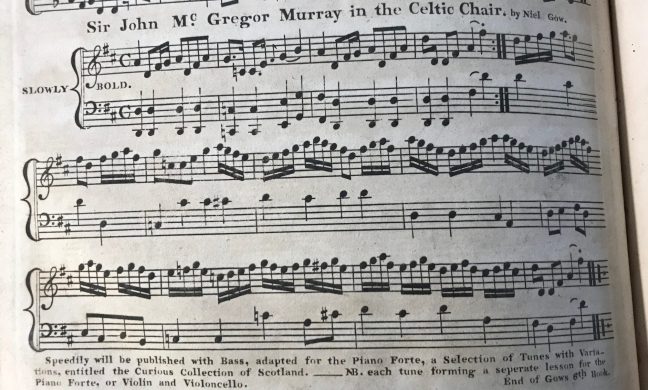
It’s just the way things turn out, but the first article is a late-in-the day return to a paper that I originally gave in 2019 – I waited to be sure that the original conference organisers wouldn’t be needing it. Not only that, but the paper itself had been a return to, and development of, a topic I researched for my PhD and subsequent first monograph, so it has been a long time brewing! I first ‘encountered’ the ghost of Sir John MacGregor Murray some twenty years ago, and a fascinating ghost he turned out to be. He deserves his article in Folk Music Journal next year. Proofs checked and returned already.

Meanwhile, the book chapter expands on work that I did for my own recent second monograph, A Social History of Amateur Music-Making and Scottish National Identity, focusing on a song collection published in time for the Festival of Britain. And the other article picks up on very different threads from that monograph, but also represents a considerable amount of detailed research since then. I look forward to checking the chapter and dealing with the article.

I do have another article due to be published later this year, too. More of that anon.

When you consider that I’m just beginning to think about a third monograph, it’s all a bit dizzying. Mind you, that won’t be happening immediately. I’m still exploring ideas. (Would it be disloyal to say that this is all so much more fun than cataloguing jazz CDs in my earlier existence …?)

Buses photo: Image by Jm TD from Pixabay

Scholarly Rejection? Get Back in the Saddle!

Brown horse with empty saddle.

Today, after submitting an article to a journal, I suddenly realised that I hadn’t added to my ‘activity log’ for a while. It has been a sombre summer; I went down south twice; did nothing scholarly at all for some five weeks of the summer; and promptly went down with some virus or other when I got back to Glasgow for the second time – so it’s hardly surprising if I took my eye off the ball. Nonetheless, I decided there was no harm in looking out the activity log and updating it. I got quite a surprise. The two rejections earlier this year, coming close after one another, had hurt. I feel a bit sore about the piece I had genuinely thought was accepted one or two years ago, but more recently turned out to be very much not so; and even more sore about the piece that was requested and then kindly but firmly declined. I felt misunderstood!

But it appears that this scholarly year hasn’t been as bad as I thought, notwithstanding those two knocks. I’ve had an article published; and I’ve given a conference paper and two talks. To any ambitious American academic, this probably seems like pathetically small beer, but I’m a British musicologist, I’m 67, and I’m not trying to secure tenure in terms of a full-time academic contract, so it’s all okay. (I could get a dozen articles published in a year, and it would make no difference to my age or status.)

I have a book chapter and a couple more articles accepted and pending publication. Another article accepted subject to revisions, which I’ve submitted – fingers crossed this time! And today’s article just submitted. That doesn’t seem too bad to me. I now have a couple of half-promised articles which I really ought to get on with; another idea for a collaborative article; and the conundrum of a possible third book. (I’m nowhere near writing this illusive thing, but I do have angles to explore, before I can formulate a precise way forward.)

But what I do know, is that the more irons I have in the fire (yes, more cliches – sorry!), the less I mind about the rejections. Maybe I just directed them to a subject area more dissimilar to my own than I realised, so didn’t hit the targets that were expected? In any case, having other things submitted and under consideration at least offers the hope that next time I might be successful.

More irons in the fire …

I wonder what my activity log will look like by the end of the year?!

Image by JamesDeMers from Pixabay

International Women’s Day – a Flashback

As well as my recent article in which I compare Flora Woodman’s career with Robert Wilson’s …

It’s time for a flashback to this time last year.ย  I went all-out to share a lot of research and resources about women musicians, so this year, I think I’ll share it again!ย  I’ve written quite a bit on the subject, as you’ll see.

Women’s History Month 2024 – Musicians