Dr Karen McAulay explores the history of Scottish music collecting, publishing and national identity from the 18th to 20th centuries. Research Fellow at Royal Conservatoire of Scotland, author of two Routledge monographs.
Yesterday was a bit unusual. I gave a talk about research using library resources – nothing unusual there. Then I sorted out arrangements for the Exchange Talk I’m giving online from the Royal Conservatoire of Scotland on 29th January. It’s all about how new educational and technological innovations affected the Scottish music publishing industry ca.1880-1951.
We’ll come back to the phone-call that I so nearly mistook for a cold call (luckily, I didn’t!), and then I finalised details for another lecture in the spring. this time about Scottish song books over an even longer era.
FOUR ‘appearances’ (or arrangements for appearances) in one day? Librarians don’t often get that. But as it happens, only the first of them was really library related. I wrote an article about my hybrid role, over the weekend, and yesterday simply underlined the truth of it.
The ‘cold call’ turned out to be from the BBC! Just before 7 am today, I was a guest of BBC Radio Scotland for their Good Morning Scotland programme, talking about the top ten most popular Scottish songs in Visit Scotland’s recent survey. You should have seen me last night, surrounded by song-books much more recent than my usual fare! I needed to get an idea of the chronology of that ‘top ten’. I now have a beautiful document, halfway between a mind-map and a spreadsheet, which I stared at until I had memorised an overview of what I might find myself talking about.
The Evening Times published the top-ten list last night. One Burns song (‘My heart’s in the Highlands’), and one by Walter Scott – ‘Scots wha’ ha’e’. Visit Scotland’s recent survey rest were much more modern, but almost all combined a catchy tune and a humorous ‘story’.
In the research part of my role (the 1.5 days a week when I am seconded to be a researcher), my path was very clear before Christmas – I was revising my monograph. Having submitted the revisions (on the Twelfth Day of Christmas, no less), what’s next?
Easy, I thought to myself. Whilst I wait for feedback, I’ll just put in a couple of article proposals, then get on with some more research about some interesting elements that I focused on in my book. I have a book to review. And in due course, there’ll be copy-editing and indexing – that’ll keep me occupied! Not to mention looking for grants for which to apply.
Things are Seldom what they Seem!
Four days later, and I now also have two peer-review tasks to do within the next three weeks, and I need to make a recording of my Exchange Talk, just as a back-up in advance of what I hope will be a live Zoom event …
I have 5.5 days in which to do all this. It’s just possible that anything without a deadline might get put to the end of the queue!
I’m a Librarian and a Postdoctoral Researcher. (My secret skill is, basically, finding things!) I’ve just finished writing my second book – and I guess I’m lucky. I wasn’t dependent on the British Library. It’s too far away for me to visit more than infrequently.
I keep coming across social media comments that “the British Library is doing nothing.” That they’re not taking the situation seriously. That “nobody knows what’s happening.” I don’t work at the British Library, but I do feel heartily sorry for anyone working there. They’ve been victims of a serious cyber crime, for heaven’s sake, and I’m sure that they’ve been taking the best advice about cyber security in light of the attack. It’s the kind of thing where they won’t want to divulge too much of what has been done, for fear of copycat crimes, but at the same time, we the public (especially scholars and academics) all know the end result. We can’t use their catalogue or their e-resources. Visitors have to wait whilst librarians look things up in paper and card catalogues, and with the best will in the world, the service isn’t quite what we’re used to. It’s devastating.
It’s not that the British Library hasn’t tried to keep us up to date:-
Rachel Cooke’s letter to the Observer, link retweeted by the Guardian
Chief Executive Sir Roly Keating has since released an update (11 January 2024) on Restoring our Services
Additionally, a recent Computer Weekly feature provides some of the technical information that many people have been waiting for: British Library cyber attack explained: What you need to know (By Alex Scroxton, Computer Weekly Security Editor, 9 January 2024)
I think what worries me is that people may not know about other ways of finding information. Certainly, if the British Library is the only holder of a particular document, then you’re up the creek without access to that document. If the only way you can access a database, or a digitised copy of a rare document, is via the British Library, then similarly, you really are in a bind at the moment. I know. As a researcher myself, I know.
We’re Here to Help
But are researchers and students asking their own institutional librarians? And conversely, are library organisations saying, often enough (on social media and elsewhere), that librarians are happy to help wherever they can? OK, ‘often enough’ is as long as a piece of string, but say, several times a week? Are we the librarians telling our own patrons in our own libraries?
And if you’re stuck looking for information, are you aware where else you can look?
Options and Alternatives
If you’re at an academic institution in the UK, there is SCONUL Access. That gets you into other libraries as well as your own.
Anyone can look at Jisc Library Hub Discover to find out whether there are copies of books elsewhere in the country. You can find books in the British Library, sure, but also in dozens of other academic libraries, and other big libraries. Yes, databases and other online resources like journals etc, are generally restricted by licence to people AT a particular institution, but you can still sign up to SCONUL Access and go to look at books and other hard copy material in other universities etc.
Have you tried your big city public library?
Are you aware that inter-library loans can be obtained from nearly all libraries except the ones that have a legal deposit responsibility? They don’t just come from the British Library. Your university or college library can organise this. Public libraries do inter library loans too.
Have you looked on Internet Archive or Hathi Trust for digitised copies of older material? Even Google Books?
Ask a Librarian!
Have you consulted your own specialist librarian to see if they can think of other ways you can get to see that crucial book or article?
Have you looked at ResearchGate and reached out to scholars directly, if there’s a particular article that even your librarian hasn’t been able to source?
Now, I’m just one small academic librarian/postdoctoral researcher in one small academic institution. I can’t help everybody! But please, please, do reach out to your librarians. We can’t replace the invaluable, much-loved and extraordinarily well-resourced British Library, but we can certainly help you make sure that you haven’t left other stones unturned, that might be able to provide at least some of what you need?
Well, folks, I have a preface, revised introduction, seven revised chapters and a revised conclusion … all in a zip file. I finished my revised book manuscript last night, ready to go off this morning. And it feels – Strange. I wondered if I’d feel triumphant when I clicked ‘Send’. But, at the moment, it’s cautious relief with a side of exhaustion. Let’s put the kettle on.
I did my PhD part-time, in my spare time, between 2004-09. Then there was more spare-time work turning it into a monograph, published in 2013.
From 2012-15, I was part-time RA to a major AHRC grant (but still 80% a librarian), and then – there’s a common thread here – I was awarded an AHRC networking grant (which I did part-time) on a different topic, before my hybridity changed to 85% librarian as I started research for this, my second monograph. The initial draft was submitted last summer, a decade after the first book was published.
It was with some envy that I read about an academic starting their research leave this year. I’m sure it’s well-deserved. I’m just wistful, because, apart from being allowed a month for writing up my PhD (yes, I know – we all know – it took much longer than that!), I’ve basically taken annual leave whenever I needed it. That’s what happens when you are more of a librarian than a researcher.
Apart from a brief visit home last summer, I didn’t take a proper break, because I was writing. I only took a week’s pause for Christmas, before jumping back into book revisions. It’s not surprising I’m knackered.
I can’t pretend I’m a full-time academic. I cannot, and should not, compare myself with people in a fully academic role. I’m mostly a librarian – admittedly, an academic librarian – but I’ve been a research fellow (part-time plus some annual leave), and I’ve just finished writing a second scholarly monograph (ditto). Given the time constraints, and the fact that I can’t be researching or writing when I’m being a librarian, I’m modestly proud of that.
Never Mind the Partridge …
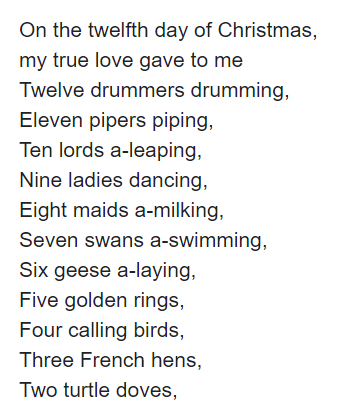
Exhausted but provisionally exhilarated … it’s the Twelfth Day of Christmas. After the obligatory drummers drumming, etc, etc, never mind the partridge!
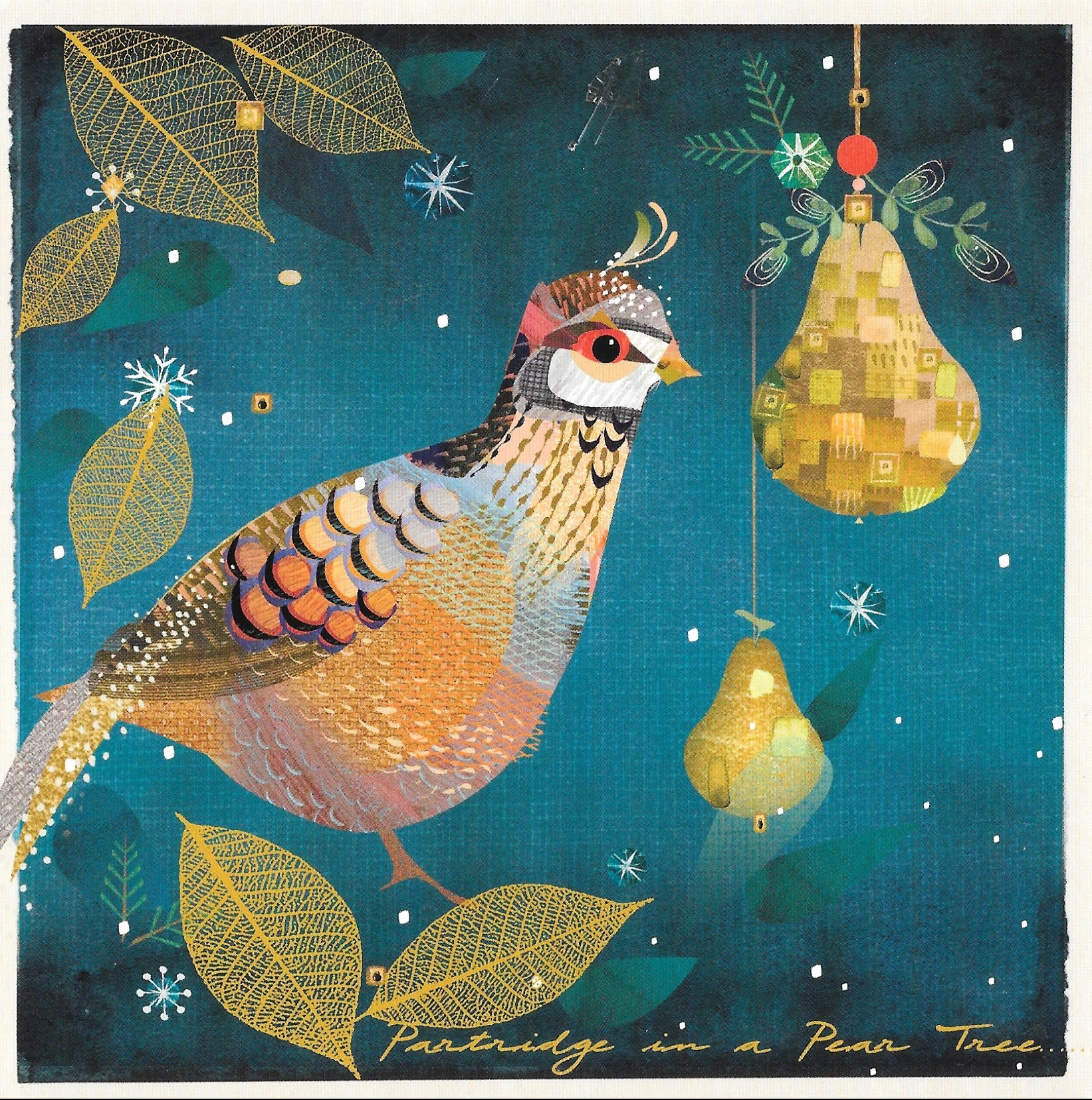
Partridge in a Pear Tree (greetings card from Motor Neurone Association, image courtesy of Advocate Art)
Seriously, why do we do year-end reviews? To show the world what we’re most proud of? Quite possibly. To convince ourselves – and the world – that really, we’ve been very busy and deserve a pat on the back? Perhaps so. I took to the internet to find out why businesses do reviews, and why a career-minded individual might do one of their own.
Consulting the Experts
Braze.com said that year-end reviews offer the chance to ‘create distinctive content’; to ‘build loyalty’ and to remind the world what your particular business does best. To that end, obviously you log milestones, achievements and events. You use multimedia formats, and draw upon customer data. This all makes sense, although I don’t know that I, as an individual, can do all these things. (No customers, for a start!)
I tried again, and found a Harvard Business Review posting about, ‘How to create your own “Year in Review“. There’s plenty of sound advice here, suggesting that I should pause and reflect upon successes and failures; lessons learned; proudest achievements; who has helped me most; how my strengths have helped me to succeed; and whether there’s anything I wish I’d done differently. This is much more introspective, and certainly valuable advice. Whether I’d want to blog about all these headings is a moot point, though.
For me, I have an extra conundrum. I shall be retiring from the Whittaker Library at the beginning of July. I hope to continue the research element of my work, though. So – in one sense I’m writing a career-end review, as far as librarianship is concerned, but it’s not a career-end review for me as a researcher.
The Harvard Business Review suggests using your diary to capture key events on which to reflect. I spent a few minutes doing just that, yesterday. Immediately, I realised that there’s one thing I’m proud of over everything else, and that is that although I spend 85% of my time as an academic librarian, my 15% as a postdoctoral researcher is actually highly productive.
What do I do best? I get things done.
‘She’s a Librarian’
I confess, I don’t like hearing this! It makes me feel as though my research activity is dismissed as dilettantism – that I don’t do badly, considering research isn’t my main role. On the other hand, a fly on the wall would point out that yes, I do spend the majority of my time as a librarian.
Jazz CDs – not a Highlight
So, what did my diary exercise reveal? I’ve catalogued a lot of jazz CDs. This causes me to feel quite a bit of resentment, because I know our readers don’t generally listen to CDs as a format, so all my efforts are to very little avail indeed. Maybe that’s one of the things that I wish I’d done differently. It’s not a high-priority task; however, I am conscious that I don’t want to leave the backlog to my successor. And that’s why I do this dreadfully tedious and repetitive activity!
Retrospective Post Script: that jazz CD cataloguing was indeed a waste of time. I did it because the promise had been made that those CDs (thousands of them) would be catalogued. I didn’t make the promise, but I did feel the obligation to fulfil the promise. My resentment was because it used so little brainpower and expertise, provided so very little fulfilment in the moment, and so little benefit in the long-term.
Equality and Diversity: Stock Development
What I’m more proud of is my efforts to get more music by women and composers of colour, into the library, and most particularly, to ensure that our staff and students know just how much of it there now is in our stock. With a colleague from the academic staff, I’m concocting a plan to raise the profile of this material.
I also suggested maybe there might be a prize for diverse programming …
And I just heard – there is going to be such a prize – it really is happening. A red letter day!
For me, a particularly proud moment was being invited to attend a Masters student’s final recital in June, at which one of these new pieces was played. It was a piece requested by a member of staff – I don’t think it was me that actually stumbled across it – but I certainly sourced it, catalogued and listed it. Whilst I’m heartily sick of cataloguing, I do take pleasure in stock development, and in ensuring there are ample means of discovering the music once we have it.
In September, I was gratified that one of our performance departments reached out to me to request more materials by under-represented composers – a sign that the message is getting through, and that staff appreciate that the library really is trying to help.
Since October, I’ve also been broadening the stock of music inspired by climate change and ecology, including songbooks for school-children, since we have a number of music education students. That pleases me, too.
What else? Dealing with donations to the library, some eagerly received and others needing sifting through. Weeding stock to ensure there’s room for new material, and ensuring that tatty material is removed or replaced depending on how much it’s likely to be used.
User Education
Some things are cyclical – most particularly providing initial library introductions, and later talking to different year-groups about good library research practice. In June, I gave a talk about bibliography to the Scottish Graduate School of Arts and Humanities, which attracted far more of an audience than I’d ever dreamt of!
Queries, and Research-Related Activity
I’ve also dealt with queries – such as one from a Polish librarian, or another from an elderly enquirer wanting to trace music remembered from childhood. And I talked about my research activities at a library training session, even though I was rather afraid of wasting colleagues’ time going on about something that might not feel very relevant. (This autumn, I also obtained and catalogued – in detail – a book of Scottish songs that I have written a book chapter about. It would be dreadful, wouldn’t it?, if someone read the chapter but couldn’t find the song-book in the library!)
Professional Activity
Professionally, I managed the comms for the IAML Congress in Cambridge this summer (with a little bit of help from mascots Cam, Bridge and Don and a couple of fellow IAML (UK & Ireland) librarians, and I think it went quite well. The stats for the blog and Twitter (“X”) rose gratifyingly during this period. I went to a couple of days in Cambridge, but I didn’t speak this time.
IAML Congress mascot Don
A Researcher with Determination
Early on in 2023, I was gratified to receive an LIHG (Library and Information History Group) Bursary to attend a conference at the University of Stirling between 17-19 April, which was about Reading and Book Circulation 1650-1850. This was to be the first of two major successes this year, for I was also elected the inaugural Ketelbey Fellow in the Institute of Scottish Historical Research at the University of St Andrews. I’ve written extensively about this experience in other blog-posts, so I won’t duplicate it here. However, I can’t resist reminding myself of highlights!
Researching key documents in Martyrs’ Kirk Reading Room
Attending both fortnightly research lectures, and ISHR pub lunches on alternating weeks
Many enjoyable hours concentrating on my book revisions – with a view of the sea!
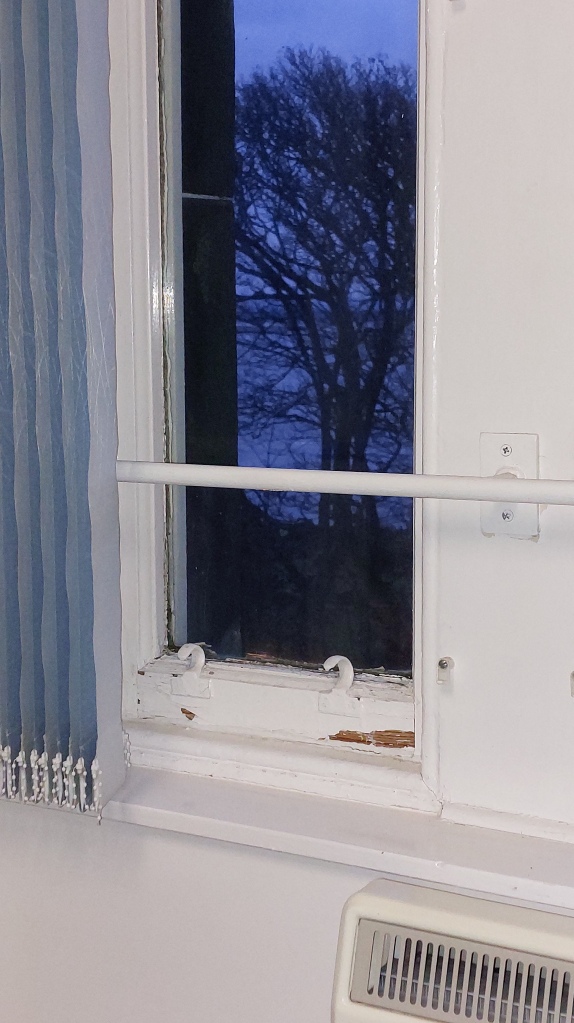
Twilight from my window, St Katharine’s Lodge, St Andrews
We’re not going on a (sniff!) Summer Holiday …
Being a researcher for 15% of the time is not easy – there simply isn’t the time to do all I want to do. Far from ‘dabbling’ in research, I take this side of my work very seriously indeed. I might have been a librarian most of the time, but I have devoted far more than the designated 10.5 hours a week to my research activity! I took annual leave in the summer to get my book draft completed, and took more annual leave to enable me to spend two, rather than 1.5 days researching in St Andrews. I’m doing it again next week; the book revisions must be completed and submitted very soon, and if the only way I can do it is by taking holiday, then that is what I must do.
In January, I wrote an article for the Glasgow Society of Organists, about a Paisley woman organist and accompanist whom I’d discovered during research over Christmas 2022. Even though it wasn’t for a scholarly journal, it was research done to my usual standard, and I’ve drawn upon that research in one of the chapters in my forthcoming monograph.
I’ve peer-reviewed an article, a book manuscript and a grant application. Considering all that I’ve had on my plate this year, I’m quite proud that I did manage to do these things. I don’t attend reading groups, and I’m not always able to attend research-related events that fall in ‘library time’ – I don’t want to give the impression I’m skiving off library work! But I do want to feel part of the research community, and that was precisely what was so magical about my Fellowship in St Andrews. For those two days a week, I was a researcher, pure and simple.
Roll on 2024! What am I going to do differently?
I’m looking forward to the summer. I feel I’ve been a librarian long enough. I’ll miss doing the user education, and rising to the challenges posed by unexpected or unusual queries. I shan’t be sorry to quit cataloguing, particularly jazz CDs!
I don’t actually have any ‘retirement’ plans as such. Apart from having more time to spend on my role as Honorary Librarian of the Friends of Wighton in Dundee. Whilst I live on the other side of Scotland, at least I shall have more opportunities to leap on a bus or train to get to Dundee Central Library to look after the repertoire that I love.
Little old lady? Not me!
Not Entirely Retiring!
I don’t feel remotely like a little old lady! I hope I’ll continue as a postdoctoral researcher in my present institution, but I’m also keeping my eyes open for any other part-time opportunities that I could pursue alongside that. ’Actively looking’, is the phrase, I think.
With a colleague in another institution, we’re cautiously planning a new research idea. And I also have strands of research that I commenced for my book, but hope to pursue in greater depth once this book is safely further along the publication process. Watch this space.
When I’m not occupied as a researcher or a librarian, I’m the organist at Neilston Church of Scotland. I’m not exactly a serious composer, but I do compose occasional Christmas carols, both lyrics and music. This year, because the church choir is few in numbers, I felt that a bit of instrumental backup would help. The Salvation Army band led Wednesday night’s carol service, so I politely requested two cornets to accompany me on the organ. Wow! That certainly brightened things up.
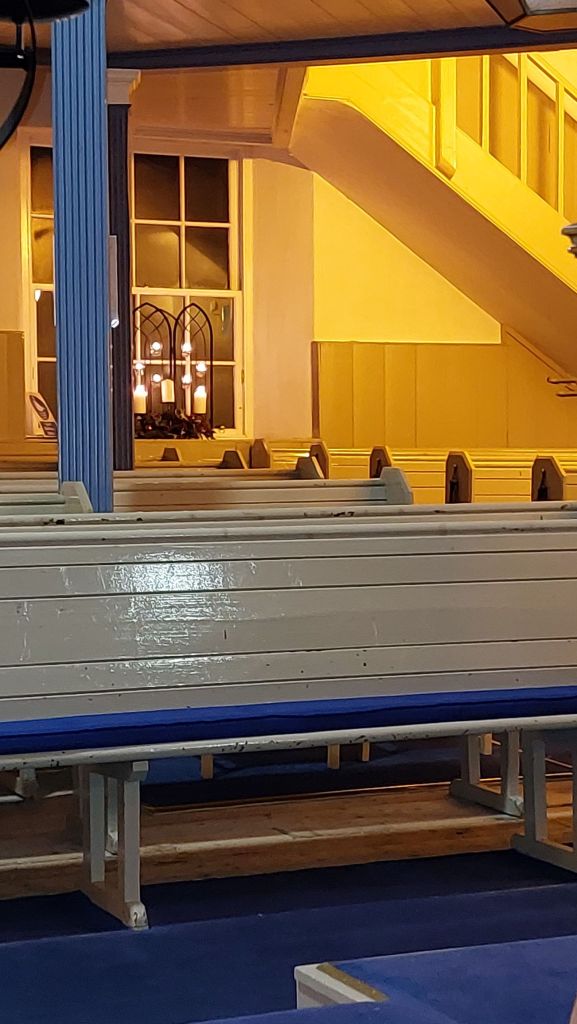
Neilston Parish Church
By and large, the carol was well-received. Although I sensed from one comment that I need to make next year’s effort more upbeat! Someone else thought it sounded Scottish. I suppose there IS a gapped scale in the verse part of the melody, though I didn’t set out to use a Scottish idiom!
Women at the Inn in Bethlehem
My composition was inspired by my thoughts that the traditional story focuses on men – shepherds and wise men – but there must have been women in the Inn. There must! In Biblical times, women didn’t generally have a high profile. Who helped Mary give birth in the stable? Hard to imagine that Joseph manfully rolled his sleeves up to help, if there were women around.
Neilston used to be a weaving village, so my allusions to the warp and weft of fabric are a gentle reference to the past of our locality.
By the flickering light, they were led to the stable, In Bethlehem simply by order of Rome; Did the swaddling bands come from the innkeeper’s wife, Kindly showing compassion to a girl far from home? CHORUS Oh, sing for the maidservant fetching the linen, Oh, sing for the woman who’d worked at her loom, Their linen scraps swaddling the Christ-child so helpless, With the Virgin young mother at the inn with no room.
Not the greatest of starts, in a stable so lowly, The carpenter’s wife cradling Jesus with care, Such a fragile young life, and dependent on strangers, With shepherds and kings paying homage right there. CHORUS
For that flickering light lit a life so amazing, His radiance the whole world could not fail to see, And the linen bands foretold the grave-clothes they gave Him, Before on the third day, rising triumphantly. CHORUS
4. For the warp and the weft, Careful hands moving deftly, Made linen our Saviour to wrap and enfold, As we pause to reflect how the humblest endeavours Can be holy in ways that could scarce be foretold. CHORUS
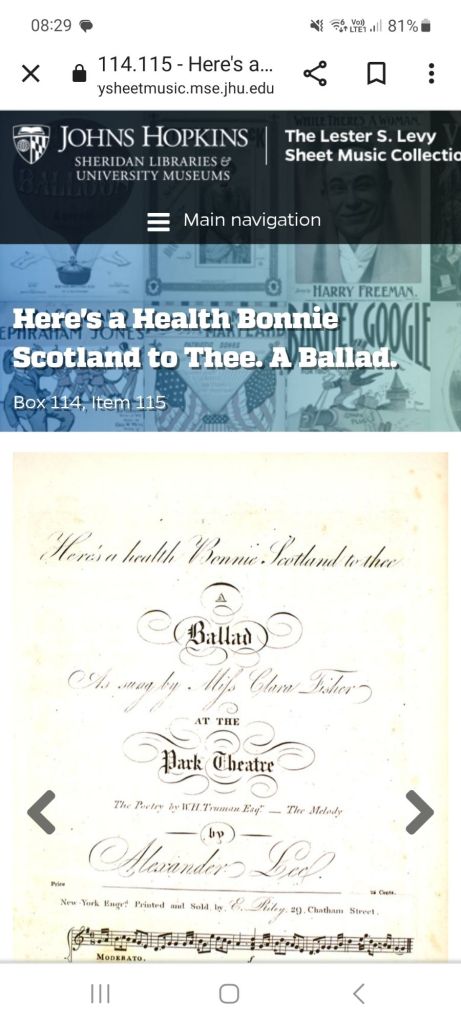
George Alexander Lee published this ‘Scottish song’ in America with A. Fleetwood in New York ca. 1830, whilst this London publication by Alex. Lee & Lee is estimated at 1832 by the National Library of Scotland.
I’ve been wondering how old the expression ‘Bonnie Scotland’ actually is – certainly, this song is sixty years older than the alleged instance in the novel cited on LiveBreatheScotland.com. (I did a search and found ‘bonnie’ but not ‘bonnie Scotland’, so I won’t perpetuate the apparent fallacy by naming the book.)
Has anyone encountered the expression prior to 1830? A friend has suggested the date would be consistent with the years between George IV’s trip to Scotland and before Victoria and Albert’s later acquisition of Balmoral.
National Pride and Expats: Scottish themed songs in the Diaspora
A bit of early morning Googling does suggest that the phrase has been popular with visitors and nostalgic expats. Am I right in reaching this conclusion? The fact that the ostensibly Scottish song was first published in New York and London, not Edinburgh or Glasgow – would appear to bear this out. The song appears in Scottish publications a couple of decades later.
In the Lester S Levy Collection at Johns Hopkins Sheridan Libraries and University Museums
For your enjoyment, here’s a Victor recording of 1912, from the Library of Congress. (My understanding is that it is now in the public domain.)
I never really understood Flow State Theory, beyond knowing that it has something to do with being deeply immersed in what you’re doing, and achieving your best work as a result. (People will have written theses and books about it, but I’m afraid that’s the extent of my understanding of it.) It certainly means having a calm and single-minded focus, in an environment without distractions. Concentration was easy in St Andrews, which is why the Fellowship was such a delight.
Anyway, there I sat at home in my alcove yesterday afternoon, working away at my book revisions and getting on just fine – in the flow, you could say – when Someone sat down beside me and started watching this:-
My state of flow screeched to a halt. Static. To say I felt traumatised and misunderstood is hardly an overstatement. ’Surely you’re not so easily distracted?!’, scoffed the perpetrator. But when you’re trying to weave in links between chapters, and to strengthen a historical thread, you do need all your wits about you, and all your concentration on the task in hand.
I regret to say that, with all the other festive domesticity needing attention, I think my state of flow had diverted itself elsewhere. I wonder if I’ll find it again this side of Christmas?
Because I am retiring from the Library next summer, this is the last Christmas I’ll be working full-time in the run-up to the Christmas holiday. And I have a book deadline. It’s self-inflicted – I was asked when I thought I could get the revisions done by. And I said …
The start of January.
Am I insane? December has always been the busiest month for us. Our Christmas is low-key, but we’re also church organists, and that brings its own challenges. I’ve had the Ketelbey Fellowship in St Andrews as well. The experience was fabulous, but I covered approximately 2700 miles in Scotland in 3 months, which all takes time.
There was only one solution: I tried to ignore Christmas for as long as I could. Did it wait for me? No. ‘You knew it was coming’, said the critic at my shoulder. ‘You should have been more organised.’ (Don’t get me started! Why should WOMEN be more organised? Particularly those who are working *and* keeping everything in the home afloat!) I bought the Christmas pudding and the Paxo stuffing ages ago, anyway!
My Christmas circular was written at the weekend, and most of my Christmas cards were sent. I ordered some presents online, and told myself there was plenty of time.
Mishaps come in Threes
Don’t you just love it when you try so hard to get everything right, and then a different thing goes wrong? I recorded my new carol for the two instrumentalists who had kindly agreed to play with me and the choir … and crashed my Finale software creating cornet parts in Bb. (It wasn’t the cornets’ fault that I accidentally left a file open when experience should have reminded me to close it properly – but it took a five hour system-restore to get the audio back …)
I’ve been taking odd bits of annual leave to get writing done (an alternative definition of ‘working at home’), which meant I could justify doing a supermarket shopping order at 9 am yesterday. I felt guilty, even though it was my time, because I knew I should be writing… and yes, I was too late to book a delivery slot. I have to go and collect it tomorrow evening. But the veg box came by van. It was on the doorstep early this morning, neatly draped in plastic to protect it from the rain. Phew!
Chapters 2, 3 and 4 are the biggest chapters, and as I revised, I found myself adding in stuff that I’d discovered during the Fellowship. Chapter 4, which I most enjoyed (and was pleased with – always fatal) led me a merry dance. I splurged on more old teaching materials on eBay. The critic at my shoulder balefully watched small jiffy bags periodically being delivered. Only yesterday, I received a very expensive scan of a delightful new find. (Thankfully, it wasn’t in yet another jiffy bag.) Anyway, it resulted in a new paragraph. Just one, but it was worth it!
I revised Chapter 5 yesterday. Chapter 6 was just about done today – little has had to be done. It’s just a question of weaving in loose ends …
Second Mishap
But we had a service at church tonight, accompanied by Govan Salvation Army Band. It was time for something else to go wrong. This time, in my anxiety not to be late, I misread the clock and inadvertently fed the family an hour early. I’ll never live it down! However, I did get there in plenty of time, and all went well. My carol (about the women who must have been present at the Nativity) met with almost universal approval – well, from the people who were kind enough to comment, at any rate!
And a Third
Finally, home again, can I catch a break? Well, no. I missed some items off the Sainsbury’s order. I’m twirling like a top …
Being a Fellow has been a sheer delight. I’ve met a lot of interesting people; heard interesting research papers; given a public paper (in the Laidlaw Music Centre) and a research paper for the Institute of Scottish Historical Research (ISHR); and availed myself of the invaluable resources of the University Library. As a result, I’ve been able to explore a couple of specific aspects of my research topic – resulting in facts and findings that I’ve incorporated into my book revisions.
Desk cleared …
I said I would get on with monograph revisions, and I have done so – I’ve written a new Preface, and revised the Introduction and first four chapters. There are three more to go, but I’ve broken the back of it, because Chapters 2, 3 and 4 are the longest ones.
Those are tangible outputs. But for me personally, the Fellowship has also been an opportunity to embrace my research scholar identity a bit more, before I retire from the Whittaker Library in July 2024 and become solely a (part-time) researcher. The experience has in that sense given me a powerful sense of endorsement: that another insitution has embraced me as a scholar, and given me a chance to enjoy that status. For that I am very grateful indeed.
Farewell to St Katharine’s Lodge
Here for the final day, I’ve nipped into the Martyr’s Kirk Research Library to look at a couple more old classroom music texts. (I had a little argument with myself about the dates of a few titles advertised on the back of one particular text, but finally concluded that the date of a preface inside a book doesn’t mean that everything advertised on the back outside cover was available at that date. The copy in my hand could, after all, have been printed several years after the text itself came out, and the adverts might well have reflected the later date when the copy was printed, not the date when the text was published.)
I was looking for Scottish song texts, whether ‘folk songs’ or fin-de-siecle songs written for educational purposes. I must confess, I expected to find more than there actually were in these two sources. Still, with glee, I pounced upon ‘My heart’s in the Highlands’.
Too soon. The compiler had set it to … a tune by Mozart! (Very curious, considering the patriotic attitudes of that particular compiler! Why ever did they think that was a good idea?)
I met a colleague and one of their friends for lunch, to discuss a research idea.
And (besides taking my library books back), I started a preliminary check of Chapter 4 of my book, which has grown a little during its revisions.