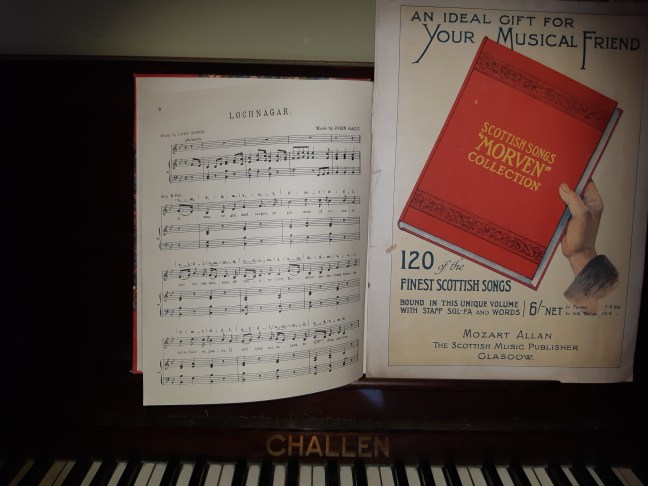
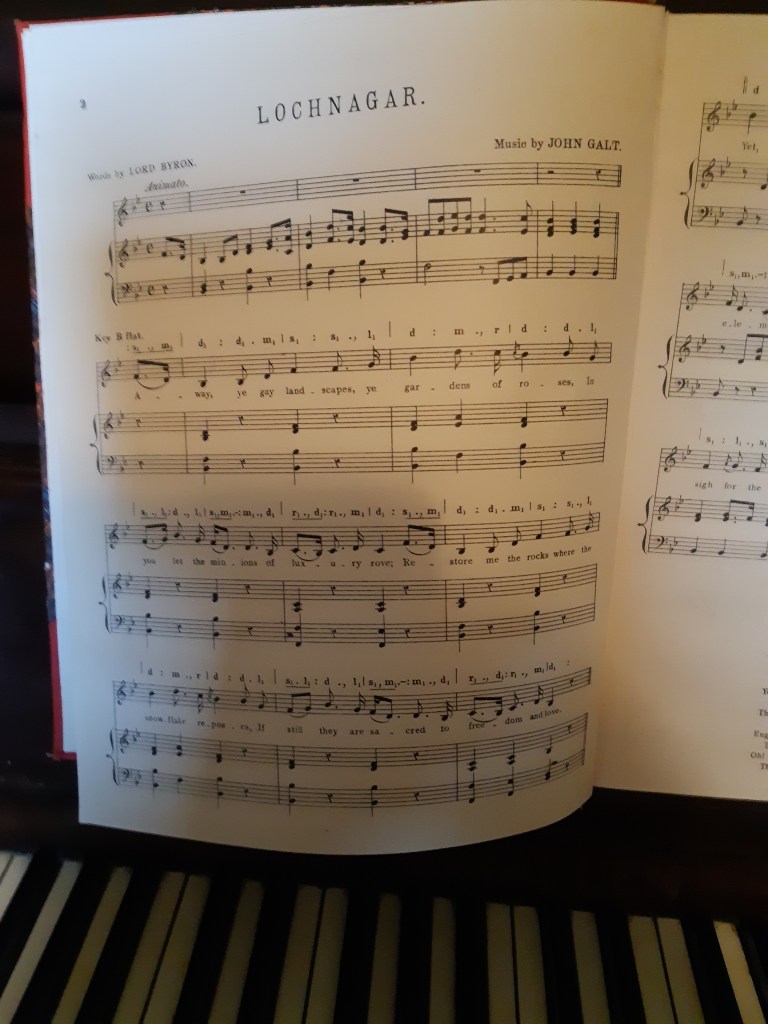
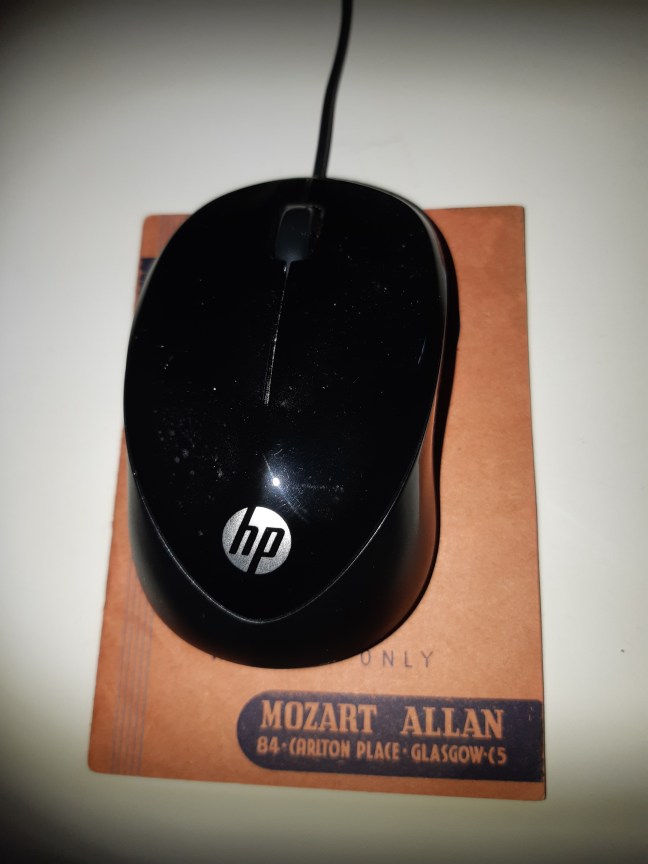
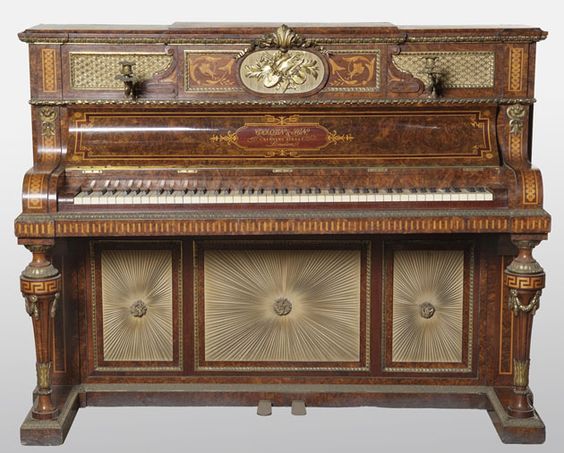
Mozart Allan in Glasgow, Allan & Co in Melbourne …

TRUTH IS STRANGER THAN FICTION

So … about the Melbourne Allans that I mentioned the other day? I shared this postscript on Facebook, but omitted to upload it here. The Glasgow “Mozart Allan” firm is highly unlikely to have a family connection with “Allan & Co” Down Under.

The Glasgow Mozart Allan advertised quite often in Australian papers in the early years of his business (the late 19th century).

But, as for his Reels, Strathspeys and General Dance Music being distributed by Allan’s in Melbourne? They just had the same surname. The Australian George C. Allan’s father (George Leavis Allan) came from London, and their ancestors may even have had a Cornish connection. No obvious link with our man.

Image: Butler, Graeme Allans Music, 276 Collins Street, Melbourne. 1982-1985

Jigs, Quicksteps, Reels and … Hang on a Minute! (Kerr’s Merry Melodies)

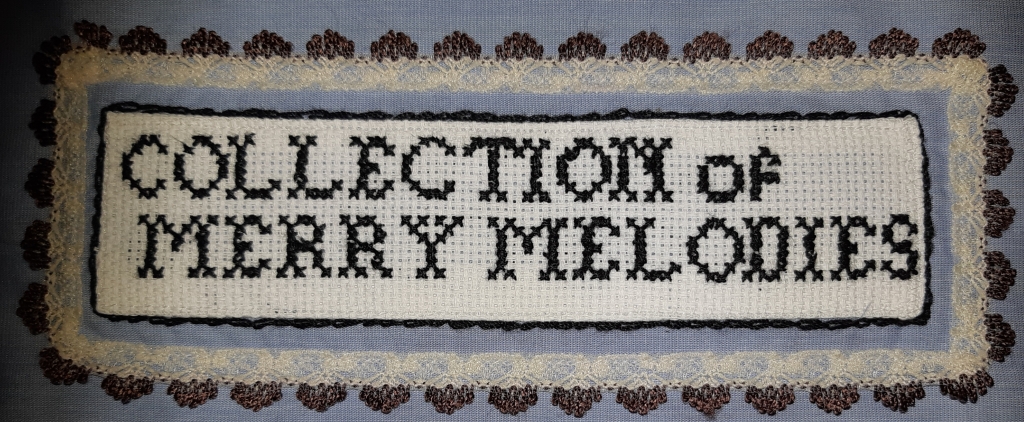
A textile interpretation of the Merry Melodies logo

In June 2020 I had just posted a new article on my Glaswegian Music Publishers Facebook page.

Jigs, Quicksteps, Reels and … Hang on a Minute!

I had promised to write about some of the Victorian Glaswegian James Kerr’s music publications. The entire posting is going to turn into a chapter in the monograph I’m working on, so I’m taking it down from the blog – I’ve continued working on dates and the intricacies of Kerr’s trading career, and there’s every chance that slight details may now be different from what I wrote last year. I wouldn’t want inaccurate information or ideas that I have since developed, to survive publicly online.

Call it an Encore: The Green Room

The blogpost that I originally wrote for the Cultural Capital Exchange, has also now been posted in a series of postings by the Research Exchange at my own institution, the Royal Conservatoire of Scotland.

Here it is again, then:-

THE GREEN ROOM: DR KAREN MCAULAY (10th June) – Stepping out of the Georgian Era into a Pandemic

Glasgow Music Publishers Facebook Page

This afternoon, I joined the Victorian Glasgow Group on Facebook. What a great group! But I hastily made a new Facebook page for my researches into Glasgow music publishers – after all, the group was set up to discuss Victorian Glasgow, whilst my current researches range roughly between 1880 and 1950. Since I don’t want to drag my new Victorian friends into modernity which is beyond the scope of that group, I’ve made this new page for discussions that aren’t quite Victorian. (I deliberately opted for a page rather than a group, as I like being part of a more interdisciplinary group – I don’t want to start another separate “silo”, aloof from all the other interesting stuff.)

Glasgow Music Publishers

The Cultural Capital Exchange: Stepping out of the Georgian Era into a Pandemic

I’ve just written a blogpost for the Cultural Capital Exchange – you can read it here.

I discuss the ethical issues posed in ethnographical research during the Covid-19 pandemic.

So he played the Banjo …

I researched flautist James Simpson, the father of Dundonian music publisher and seller Alexander Simpson, for some months  before starting my PhD.   In the mid-1800s, Alexander Simpson became a partner in Methven Simpson, which had stores in Dundee, St Andrews, Forfar and Edinburgh.

I was unaware of any links with musicsellers or publishers in Glasgow, but you can’t blame me for getting excited when I found out about Frank Simpson’s shop in Sauchiehall Street, a couple of years ago.  Indeed, there was another Frank Simpson selling music elsewhere in Glasgow at the start of the twentieth century.

Let me save you a long story.  The Sauchiehall Street Simpson established his shop in 1860 – not much later than Alexander Simpson’s early career in Dundee – and I wasn’t aware of Alexander having any brothers, or of the family having a Glasgow connection at all.  The low premises on the left-hand side of the postcard foreground (above) are the shop the older Frank Simpson later settled in, with the shop remaining there for well over a half-century.  Frank Simpson junior eventually joined him, importing banjos from S S Stewart in the USA, and teaching the instrument from the premises from the mid 1880s onwards.  The other Simpson was a competitor, no connection with the Sauchiehall Simpsons (as their adverts make amply clear!), and it seems there was no connection with Methven Simpson.

However, this apparent dead end may not be a complete cul-de-sac, since the Sauchiehall Street shop was demolished to make way for British Home Stores circa 1964, and the owner by that time was a famous singer of Scottish repertoire.  I believe the shop was subsequently combined with a couple of others, ultimately to form the Glasgow Music Centre, so … taking the links back in time again … it all forms part of my present research interest in late Victorian and Edwardian Glasgow music publishers.  It just doesn’t connect with the Methven Simpson story.  So many Simpsons!

During my perigrinations through the British Newspaper Archive (a present to myself, half-subsidised by Mum’s Christmas gift!), I caught Frank Simpson junior playing his banjo at a “minstrel concert” in Milton of Campsie, and twice at a Sabbath School Soiree in Kilbarchan.  Frank Simpson cheap novel soldI discovered that Frank Simpson also published cheap novels, and (from an advertisement whose provenance was uncited) -that the shop sold books, jokes and greasepaint as well as the thousands of pieces of sheet-music that Glasgow Herald adverts boasted of.  Sadly, the British Library only seems to have five songs – but this material was not high art music, so there’s the possibility that it didn’t get logged in sufficient detail for me to be able to trace Frank Simpson’s imprint.

To date, the genealogical database Scotland’s People has not yielded the significant dates of   Sauchiehall Street Frank Simpson senior – I could still look harder –  but I do know that Simpson junior was born in Airdrie on 24th May 1866, and  died in East Kilbride on 14 August 1936 at the age of 70.  For now, I’m leaving them in limbo, since this is an intriguing but time-wasting detour away from the bigger questions about what the other, more active publishers were actually publishing!


Echoes from Stationers’ Hall

I was delighted to read a brand-new posting by Dr Briony Harding for St Andrews’ University Library’s Echoes From the Vault, today.  The Copyright Music Collection again provides the backdrop in this posting,

Woelfl’s Third Grand Concerto for the Piano Forte

The music collection has had an interesting past – at one point it was shoved aside into a dovecote belonging to the University – but nowadays it sits in splendour, a vital resource for studying British publications of Georgian-era music.  It was the inspiration for the AHRC-funded ‘Claimed From Stationers’ Hall’ network.

With my other hat on …

Published this week in SCONUL Focus 71, an article summarising the PGCert project that I undertook a couple of years ago:-

Library support to students on blended-learning courses: some thoughts on best practice

Researchfish – Safely reeled in!

Funded research clearly has to  be documented, and in the UK that involves uploading outputs to a website called Researchfish.  I’m glad I was just about up-to-date on my Researchfish entries, so it didn’t take excessively long to check a few entries and submit the whole thing.

It’s a good thing I checked, though.  The bibliography is on the blog – and the blog was logged literally ages ago.  But today I decided that the bibliography was such a huge output that it deserved its own mention.   And although I logged our Brio special issue over a month ago, elsewhere in my earlier narrative I had noted that it was “pending”.  I hastily updated that, too!  (The Brio issue is all there on Pure, our institutional repository, along with my other research outputs.)

fishing-3441090_960_720 PixabaySo as far as I’m concerned, the “fish” has been netted, weighed, documented and forwarded to the distributor!  I’ve hit SEND, and now all that remains is to apply for the next research grant.

Well, after a deserved coffee, anyway!

Researchers and Television – an opportunity

I had the opportunity to attend an event sponsored by AHTV and the Arts and Humanities Research Council this week. It took place at the Barbican Centre on Wednesday 5th February, so I travelled down the previous evening, and back to Glasgow on Thursday. The whole purpose of the event was to provide academic researchers with an opportunity to meet with TV professionals, and to learn more about getting one’s research discovered and disseminated through the medium of television.

It was a most informative day. I must confess to feeling a little star-struck when I realised that the keynote address was by Bettany Hughes, whom I’ve seen and admired on television history programmes. Similarly, hearing about the making of ‘Suffragettes’ with Lucy Worsley was fascinating – even if Lucy herself wasn’t actually there! I also availed myself of the opportunity to have a speed meeting with a TV professional.

I’d genuinely love to have the opportunity to get the Claimed From Stationers’ Hall network research out to a wider audience, but my first problem is the fact that we need big names or significant events to hang our story on. However, our primary heroine – Elizabeth Williams, nee Lambert – was, on the face of it a complete nonentity in terms of big names or big achievements. It goes without saying that she wasn’t a nobody in my opinion! (See A Labour of Love for Miss Lambert, also on this blog.) Of course, we know that her music catalogue was significant and highly useful to the music lovers of St Andrews in the late Georgian era. It made the collection much more easily navigable, and hence more useable.

In the wider scheme of things, it demonstrates the importance of work that goes on behind the scenes in libraries to this day. Very few professional cataloguers have a prominent public profile, and Miss Lambert certainly wasn’t a professional of any kind – she was paid a tiny amount for producing a catalogue, and that appears to be the sum total of her ‘official’ involvement. She married at a fairly late age and went off to join her husband, his mother and brothers, in Islington – and there’s not a lot more known about her life apart from her gift of her shell collection to the Natural History Society of Northumbria not long before her death. You could say that her life went as unnoticed as the vast majority of women of her era (and indeed subsequent eras), and yet those two handwritten music catalogue volumes do have significance in their own way.

We have to bear in mind that this veritable mountain of legal deposit music wasn’t exactly what most Georgian university officials wanted in their libraries – it was the books on law, theology, medicine and science that they had their eyes on. The St Andrews professors maybe took a different attitude to most, in allowing non-university music lovers to borrow music through the good offices of their professorial friends. The collection that was clearly important to Miss Lambert was heavily used by both men and women – I interrogated the music in terms of what was most borrowed by various categories of readers. Considering that there were parallel collections in several other legal deposit libraries, we were keen to compare what survived elsewhere, but nowhere else are there borrowing records or evidence of such intensive use. So many stories – but can I argue the case for a television documentary? Well, let’s see!