

I’ve done all the usual stuff – cooked and then enjoyed the dinner, snoozed in front of the TV, chatted with the family … and now I’m very tempted to open my research folders and continue pondering my latest conundrum, but I know that I shouldn’t! I shall wait at least until tomorrow before I continue to explore why this particular fiddler had fewer subscribers to his last collection (which ultimately turned out to have multiple flaws in the basslines, not that the subscribers would have known when they subscribed) …
Retrospective: Research in a Pandemic
Someone on Twitter asked, ‘What have you achieved this year that you’re proud of?’
DISCLAIMER (also posted on my Teaching Artist blog). It troubles me slightly that earlier in the pandemic, reading other people’s updates about all their achievements just made me feel guilty. All I was doing was working from home and keeping everyone safely looked after. Nothing heroic, nothing remarkable. I’ll be honest, my kneejerk reaction to such postings was a combination of, “come on, guys, do you have to?” and “well, I can’t be seen to be slacking here!” But the truth of the matter is that no-one fully knows other peoples’ situations – how much they’re struggling, whether they have caring responsibilities, or indeed, what their work-life balance is – whether they’ve chosen it or found it forced upon them.
Comparisons are Futile
I suppose the moral is that it’s pointless to try to compare oneself with other people. I’ve been in Glasgow nearly 33 years, still on the same grade, despite having gained a doctorate, a teaching certificate, and two fellowships. Written a book, published a lot, given plenty of research papers. Still – in terms of time allocation – more of a librarian than a postdoc researcher.
“You’re a bloody librarian, woman!”
I was once told, “You’re a bloody librarian, woman!” In the west of Scotland, the “I kennt your faither” philosophy – not allowing someone to forget their place or where they came from – is still alive and well, and if I’m on the same grade, I’m forced to conclude that my value has not increased. It’s very depressing.
Failed in the Eyes of One who Climbs Ladders
A former colleague once said that if one wasn’t moving jobs and climbing the ladder, then one was a failure. This philosophy favours men and people without children. I do admire people with ambition. I also admire and envy people who are less ambitious, but who are content with where they’re at. As for me, I’m still struggling with thwarted ambition, three and a half years before retirement! I should very much like to have moved jobs and climbed the ladder – anyone who thinks I’m unambitious, really doesn’t know me. However, I’ve raised three sons (who have benefited enormously from the Scottish education system, which is why we didn’t want to leave Scotland!) and I got those extra qualifications whilst working full-time. (Apart from statutory maternity leaves, I’ve always worked full-time.) If I’m a failure for not getting promoted – guilty as charged – then I do have a few good excuses. And I did recently get a Special Note of Commendation from my CILIP researcher colleagues, which was heartening.
Coast Downhill? No Way!
During the Covid pandemic, I’ve pushed myself to achieve as much as I could, because I didn’t want to find myself sliding towards an unwanted, age-related slowing down. I am not yet of retirement age, and I can’t bear to think that inactivity might see me slipping out of the research scene before I’m ready. So this is posted in the spirit of demonstrating that I’m still here, still research-active, and not yet ready to be written off!
So here goes!
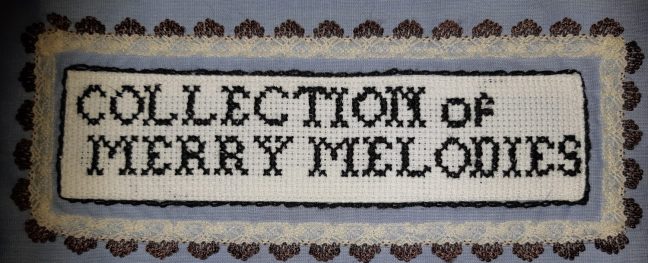
Not everything is a ‘research output’, obviously. I stitched my lockdown journal, for a start. (I even made a video about it.) I learned the concertina, and I wrote tunes for it.
I broke my foot, baked banana bread, put on weight, and once my foot was better, I put myself on a diet and exercise regime to lose some pounds. I’ve made gallons of soup, and done 95% of the housework. (Two of the three of us are over sixty – and two are oblivious to housework or the absence of our weekly cleaner!)
But in terms of research? Working from home since March, I’ve benefited from a mostly peaceful dining room (albeit a thoroughfare to the kitchen), and gained my commuting time along with the new responsibility of cooking most weekday meals. The allocation of my time to library (70%) and research (30%) is unchanged. I’ve done my user education and made several training videos in my library role, and I love this side of it. But I fight a compulsion to answer library emails at any time of the day or night (even the day after Boxing Day) for fear of being considered unhelpful if I don’t – whilst research would swallow me up whole, without any resistance from me, if I didn’t occasionally get dragged away from it! I freely admit that I have absolutely NOT limited my research activities to ten hours a week. It makes me excellent value, but I’m reaching the point where I feel I cannot try much harder, and it won’t really make any difference to my career trajectory. If one can have a flat trajectory in the first place!
Quite apart from wanting to achieve “outputs”, I have tried to take the attititude that it is easier to attend a Zoom conference than to arrange for everything to run smoothly in my absence attending a “real” live event in a diffferent city.
So, how have I done this very weird year? I am not dissatisfied.
PUBLICATIONS
- ‘The Cinderella of Stationers’ Hall: music (and metadata) in Georgian legal deposit libraries’ Catalogue and Index 201 (Dec 2020)
- ‘A Music Library for St Andrews: use of the University’s Copyright Music Collections, 1801-1849’, in Journal of the Edinburgh Bibliographical Society no.15 (2020), pp.13-33.
- Romantic National Song Network blogpost, 9 Sept 2020, ‘Revisiting the Achievements of Song-Collector Alexander Campbell’
- ‘The sound of forgotten music: Karen McAulay uncovers some of the great female composers who have been lost from history’. The People’s Friend, Special Edition, 11 Sep 2020, 2 p. Dundee : D C Thomson.
- ‘Performative Silence in the Library’, Icepops Annual 2020: International Copyright Literacy Event with Playful Opportunities for Practitioners and Scholars, ed. Chris Morrison and Jane Secker, p. 32-33
- ‘Library support to students on blended-learning courses: some thoughts on best practice’ (SCONUL Focus 71, February 2020) https://www.sconul.ac.uk/sites/default/files/documents/Karen%20McAulay%20FOCUS%2071.pdf
- Guest co-editor (and contributor) of Brio vol.56 no.2 (Winter 2019), dedicated to Claimed From Stationers Hall network-related writings.
PRESENTATIONS (whatever would we have done without Zoom and Teams?!)
- University of Glasgow Scottish and Celtic Studies Department, ‘Alexander Campbell’s song-collecting for Albyn’s Anthology’ (17 November)
- Traditional Song Forum, ‘Scottish song-collector Alexander Campbell and his ethnomusicological exploits’
- EFDSS Conference, London, ‘All the right notes, but not necessarily in the right order’: musical resemblances over the border.’
- CILIP Metadata Group Conference, ‘The Cinderella of Stationers’ Hall: Music (and Metadata) in Georgian Legal Deposit Libraries’
I’ve also facilitated an event for the Friends of Wighton, made a mini video presentation about my research for a Scottish research event …
… and made the aforementioned video about my stitched lockdown journal. I’ve done quite a few training videos with my library hat on, too, but I’ll spare you the details of those!
Another Christmas Delivery: Article in Catalogue and Index issue 201, Dec 2020
Again with perfect timing, my ‘Cinderella’ article is just published in my professional organisation CILIP’s Catalogue and Index issue 201 (December 2020). This originated as a conference paper that I gave earlier this Autumn. It’s open access, so you can read it online right away. (I shall be adding it to our RCS Institutional Repository as well, goes without saying!)
‘The Cinderella of Stationers’ Hall: music (and metadata) in Georgian legal deposit libraries’
ABSTRACT
A visit to see the University of St Andrews’ Copyright Music collection led to my undertaking research into the history and contents of several hundred bound volumes of music. They’re intriguingly supported by contemporary Georgian and Victorian borrowing records, allowing us to see exactly who borrowed what, and when. We can piece together some details about how exactly the materials were borrowed, and the archives even hold a handwritten catalogue dating from 1826, which would have shown borrowers what was bound into the individual volumes.
However, since St Andrews was only one of a number of legal deposit libraries in this era, this raised the question as to what the others did with the music they were entitled to. An AHRC grant enabled me to pursue this further by founding the Claimed From Stationers’ Hall research network.
Modern catalogues became a prime research tool, enabling the network to explore what survives to the present day. However, it soon became apparent that not all libraries retained – or even claimed – music that was registered at Stationers’ Hall. Moreover, it has recently come to light that when music was added to stock, or when cataloguing took place, some interesting decisions were made by our Georgian and Victorian predecessors. Furthermore, early 21st century funding for retrospective online cataloguing failed to cover all the surviving music.
Inspired by a British Library big data project looking at British music published over the centuries, I had aspirations for a big data analysis of surviving legal deposit music, but the incomplete availability of automated catalogue records means that this ambition is currently not feasible, although cataloguing is still being updated, and the time may come when such a project can be revisited.
In the meantime, this research demonstrates the value of library cataloguing metadata not only in enabling readers to trace particular publications, but also for exploring a large corpus of music that was originally accepted by libraries almost as a by-product, of considerably less importance than the learned tomes which the universities were keen to claim for their students and professors’ use. You could say that Cinderella has at last made it to the ball!
A Christmas Delivery: Article in Journal of the Edinburgh Bibliographical Society

With impeccable festive timing, two copies of the latest EBS journal popped through my door this morning. The first article is mine, a major output from my research for the AHRC-funded Claimed From Stationers Hall network, for which I won grant-funding a couple of years ago.
‘A Music Library for St Andrews: use of the University’s Copyright Music Collections, 1801-1849’, in Journal of the Edinburgh Bibliographical Society no.15 (2020), pp.13-33. The final proof copy is uploaded on Pure, our RCS institutional repository, though it won’t be visible to the naked eye until the input has been authorised, so you won’t be able to see it straight away.
ABSTRACT
The author’s researches into the Copyright Music Collection at the University of St Andrews led, inevitably, to the Library’s Receipt Books, in which all loans were recorded, whether to professors, students, or “Strangers” – friends of the professors who borrowed under the names of obliging academic staff.
Several thousand pages later, every music loan between 1801 and 1849 has now been logged. Notwithstanding the difficulties of inferring much detail from over 400 Sammelbände (ie, bound collections of multiple items), there are still many interesting observations to be made.
This paper explores findings to date, outlining the progress of the author’s research into a field in which music and library history meet, thereby shedding light on early nineteenth century musical activities in a small university town.
Special Note of Commendation

Although I didn’t win the Researcher-Practitioner award from my professional body, I was honoured to receive a special note of commendation today. This is a very nice thing to receive from CILIP’s LIRG (Library and Information Research Group) – I’m basking in the glow this evening!
” … special note of commendation to Karen. The panel particularly wanted to recognise Karen’s breadth of research work and scholarship and her ability to blend music research with librarianship.”
Elevator Pitch!
Today, I took part in Explorathon20, where I showed a tiny videoclip discussing my research into late Victorian and early 20th century Sottish music. (It was actually called the Global Science Show, but it was an opportunity for researchers to showcase their research in whatever discipline. I was probably the token musicologist!)
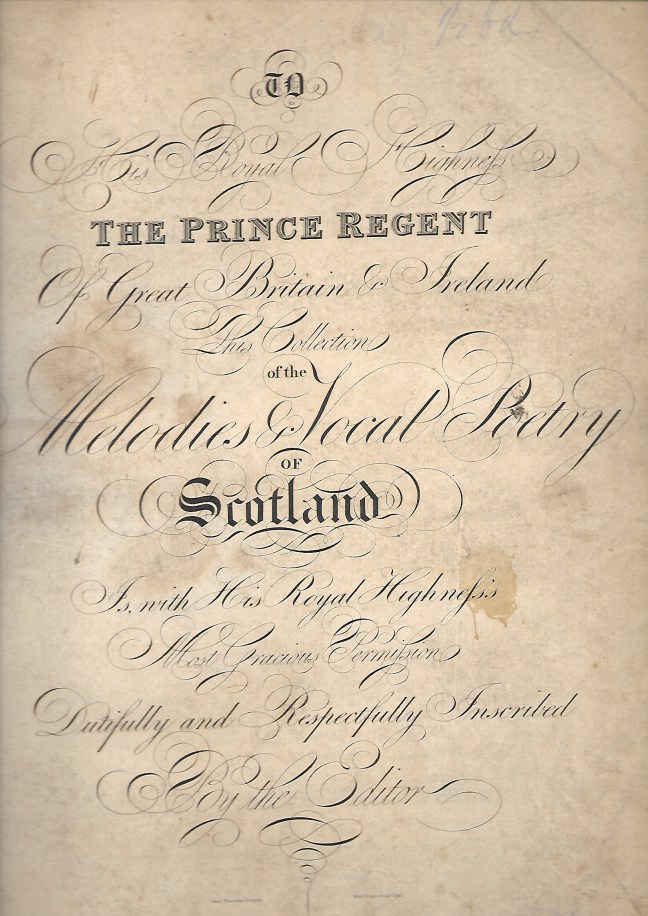
Alexander Campbell’s song-collecting for Albyn’s Anthology (5.30 Tues 17th November)
The talk itself wasn’t recorded, but I did make a recording of my final rehearsal. Please do contact me if you’d like to see it for research purposes – I’m not going to post it publicly here.

At the risk of being insufferable, I’m sharing this on all my social media haunts! At 5.30 pm tomorrow night, folks – I’m talking about an early Scottish song collector, Alexander Campbell – for Glasgow Uni’s Scottish and Celtic Studies Department. You can join us if you like:- https://www.eventbrite.co.uk/e/alexander-campbells-song-collecting-for-albyns-anthology-tickets-121414950385
Scottish Music Puzzle

Why am I posting a jigsaw puzzle? It’s for the Scottish Research Showcase on Friday 27 November 2020! See how quickly you can complete it. You’ll get the full context tomorrow when I tweet a link to my videoclip.
If you follow Twitter, these are the necessary names and hashtag to follow:-
- @Ernscot
- #GlobalScienceShow
- And my own account, @Karenmca
See you there!
One Tune, One Little Tune!

So here’s a fine state of affairs. I’m working on a book chapter. I’m also polishing a paper for a lecture I’m giving next month. There I was the other day, looking at one of the sources that I’m focusing on for the chapter, and suddenly – hey, THERE was a tune that had also been used by the anthology compiler that I’m lecturing on.
One thing led to another. I now have a new section in the lecture, a new selfie-stick for recording myself PLAYING the tune in various different iterations, a practising schedule to make sure the tunes sound good in the recording, and the distinct possibility that I shall write something more extended for this blog at some stage. Which is great, of course.
However, that aside, these particular points of interest are neither connected with the impending book chapter, nor my own research into Scottish music publishers! I’m stuck with an earworm. Meanwhile, I need to set the lecture aside for now, and put some more work into the chapter …
My Gift-to-Self
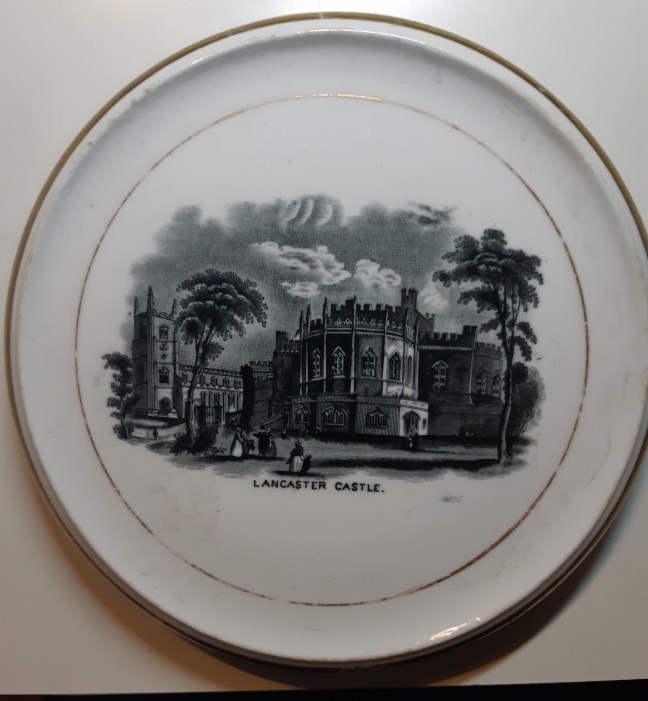
This is Lancaster Castle’s Shire Hall, built circa 1798, depicted on a teapot stand from – probably – around 1830. Earlier in the 1790s, ‘my’ lady music cataloguer, Elizabeth Lambert, was christened in St Mary’s Church, to the left of the picture. The Shire Hall hadn’t yet been built, and Elizabeth’s widowed mother had moved her young family to St Andrews to join her brother, a professor at the University there. Nonetheless, the church was there.
Fast forward to the mid 20th century. I was born in Lancaster and brought home to a flat at St Mary’s Gate, which was adjacent to the church.
Was there something in the water, that made both Elizabeth and me music cataloguers?! Anyway, this was just a wee bargain on eBay, and plainly I had to have it. Luckily for me, it was of huge significance to me, but not of high value to the vendor!

