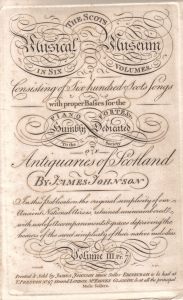
Asked, in connection with another project, where the legal deposit music is in Britain, it seemed a good idea to summarise the current position. What follows is a very broad outline, but it might prove helpful to anyone trying to track down an old British piece of music!
The British Library has always received legal deposit materials from the start, has the most complete collection and all are catalogued. The collection began as the Royal Collection, then formed the basis of the British Museum collection, from which the British Library evolved.
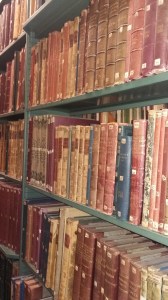
For the remainder of the legal deposit libraries, remember that historically, some form of library committee decided which music to keep. This varied widely:-
- Bodleian Library, University of Oxford – has always received legal deposit materials, from the start right up to the present. Mostly all catalogued, though historical entries aren’t all full, in-depth records, having been digitised from old records.
- Cambridge University Library – has always received legal deposit materials, from the start right up to the present. Not all historical materials are catalogued.
- Aberdeen University Library – was a legal deposit library up to 1836. A very incomplete collection, but what survives is catalogued – not all catalogued online.
- St Andrews University Library – again, a legal deposit library up to 1836. A more comprehensive collection, but only items post 1800 are catalogued online, and the paper catalogue records for the earlier items appear to be missing. Interestingly, the historical music collection was very much a working one, frequently borrowed by professors, students, and friends of the professors.
- Edinburgh University Library – a legal deposit library up to 1836. A very patchy collection, but items that ended up in the Reid Music Library, established in the 19th century, are at least now listed on a spreadsheet.
- Glasgow University Library – a legal deposit library up to 1836. A more comprehensive collection, and catalogued online.
- National Library of Scotland – evolved from the Advocates Library in Edinburgh, and is a legal deposit library to this day. Historical music is catalogued in the Victorian paper catalogue; probably not as complete as the British Library, for various reasons. More modern materials are catalogued online.
- Trinity College Dublin. Although a legal deposit library since 1801, there is little historical music copyright material to speak of, because it wasn’t collected. Still a legal deposit library.
- Sion College, London, was historically a theological institution, with a legal deposit library prior to 1836. All holdings have more recently been transferred to Lambeth Palace Library, London, and little music survives. Not catalogued.
- King’s Inns, Dublin – another historical legal deposit library 1801-1836, but music appears not to have been catalogued to any extent, except very popular publications which must have been added to stock individually as they made their way to the library.
- National Library of Wales. Was not a legal deposit library until the 20th century. (Unlike the National Library of Scotland, it was a new establishment in 1907, not growing out of an earlier institution.
Agency for the Legal Deposit Libraries – find out about today’s legal deposit system.
Introduction to Legal Deposit – a helpful introduction from the National Library of Wales.
Acknowledgement: image https://www.flickr.com/photos/yellowbookltd/ – https://www.flickr.com/photos/yellowbookltd/2875093931/, CC BY 2.0, https://commons.wikimedia.org/w/index.php?curid=7093190


 Well, what else would you do if you were snowbound for a third day?! The bibliography has been updated considerably. This is not to say that I’ve read every single reference, which would be difficult in my part-time research existence, but hopefully there will be plenty of inspiration for anyone embarking on any aspect of the research network’s interests.
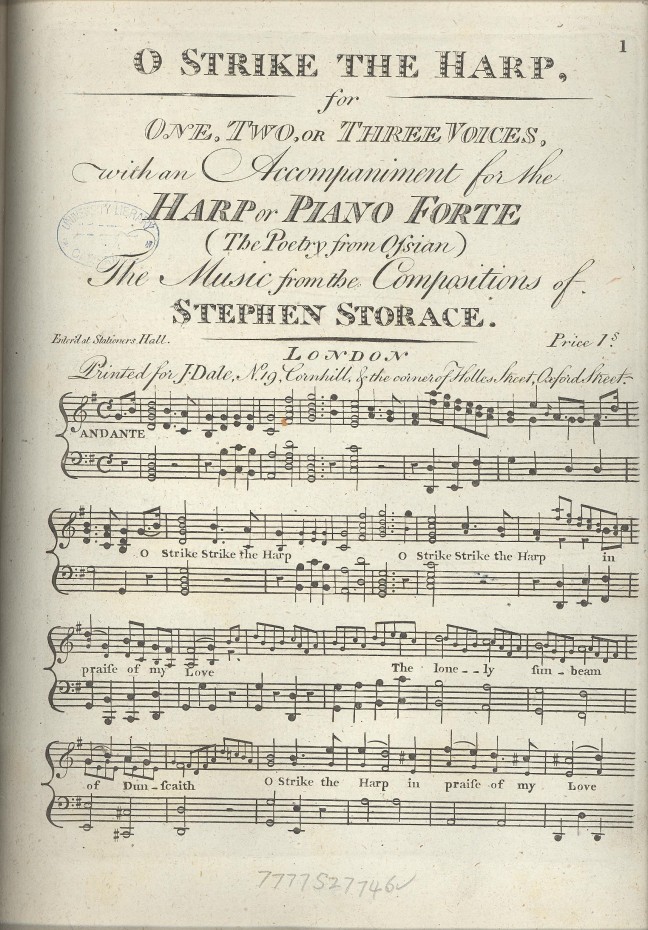 Well, yes! Coincidentally, I used an image of this very song in my write-up of Sandra Tuppen’s Big Data talk at IAML(UK & Ireland) 2015. See ‘ASW 2015: The Bigger, the Better – A Big Data History of Music’
  The Claimed From Stationers’ Hall research network, whilst very well-represented in Scotland, is not actually focused on Scottish music. Nonetheless, we’re sharing this conference booking announcement for anyone who is working in that area.
 In the past month, I’ve been to Edinburgh, Cambridge and Oxford in connection with the Claimed From Stationers’ Hall research network. I’ve chatted with Almut Boehme in the National Library of Scotland, Elizabeth Lawrence and Jenny Nex at the University of Edinburgh, Margaret Jones and Jill Whitelock in Cambridge, and Martin Holmes and Giles Bergel in Oxford. We’ve talked about how different libraries stored and curated their legal deposit collections, attitudes towards music and cataloguing, and the influence of the British Museum’s mid-nineteenth century cataloguing rules. Several libraries began by categorising their music as instrumental or vocal – so to anyone wondering why our library does it that way – well, we’re following the Library of Congress, and they seem to have followed the British Museum too!
 and the lists of music – lists that came from Stationers’ Hall at regular intervals, and lists that were made of material as it was accessioned. Serendipity is a wonderful thing – Margaret looked out scores corresponding to material in the lists, and came up with a bound collection of various national songbooks – always a popular genre – not to mention an English opera that might have made no ripples in nearly two centuries, but certainly raised a few smiles in that meeting room in February 2018!
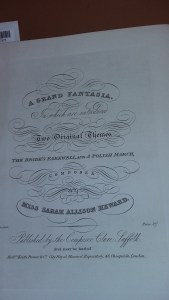 Meanwhile, Martin’s selection of scores included a composition by a young English woman whom I’d never heard of before – Sarah Allison Heward – and a network member in Germany has since unearthed a whole wealth of information about her and her musical family. Watch this space – there’s a blogpost coming up!
 If you’re signed up to our JISC mailing list, you’ll have just received the