Oral Transmission of Folk Songs

Wavy lines of music and an artistic interpretation of a fiddle

Attribution and Authorship

When I’m talking to students about oral transmission of folk songs, my take is – perhaps a bit controversially – that I believe a lot of songs were actually written by ONE person. Passed on, passed around, changed certainly, but I don’t buy the idea that they somehow ‘grew’ anonymously or collectively out of the soil. Maybe a group of pals did sometimes sit in the pub, stand in the fields or sit at their looms working up words or a tune, but as often as not, someone ‘wrote’ or devised that song. We just don’t always know who did.

Tune Variants

The other problem, of course, is variants. If you pass things round and they get picked up by ear, or someone writes it down – but not exactly how it was performed by the last person – the tunes change slightly. Or, in times-gone-by, gaps between crotchets got filled in by two stepwise quavers, or an ornament got written out in full. And how do you determine what the ‘right’ version is? I don’t think you can, often enough, though you can certainly try to identify the most common form of a tune.  Or if you’re able to, the earliest printed version. (If Hamish McHamish wrote a song in 1825, then the earliest printed version is most likely to be closest to his intentions. But unless he took his tune to the printer, or published it himself, you can’t be sure. )

The Ravages of Time

So we have at least a couple of centuries in which some tunes had the opportunity to change a multitude of times. (And that’s before an accompanist decided that G7 would be better than E minor at a particular point …) Try and compare a song in three different published collections. It won’t necessarily be exactly the same.

The Strong but Wrong Singer

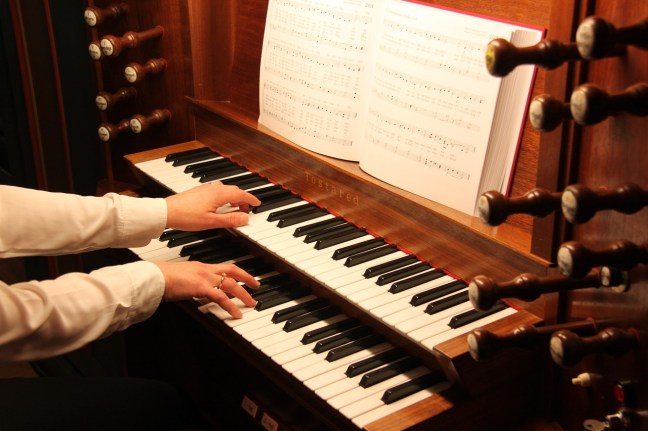
I also use the modern-day example of my own church organist experience. You teach the congregation a new tune. A strong singer gets something wrong, and thereafter, try as you may, everyone sings Jemima’s version of the tune. That, too, could be construed as oral transmission in action!

(And as for Technology)

Today, we had a new song. The choir had studiously learned it, syncopated rhythms and all. We sang it first as an anthem. Later, we sang it with the congregation. Even the syncopations went moderately well, though I can’t say I was listening out for those who, ‘like sheep had gone astray’ (to quote Handel’s Messiah). There was only one problem: the verses appeared on the PowerPoint in the wrong order, and there was not a thing could be done about it once we’d started. When the choir sang it with the congregation, the latter sang what they could, or what they saw on the screen …. ! Maybe that’s why the syncopations went well – not everyone was actually singing.

All I can do is offer a corrected version of the lyrics for the PowerPoint, and we’ll try again another day. Who knows what might have changed in the meantime?
And on Saturday, I Practised

There’s a great hymn in the Church of Scotland Hymnbook, ‘For my sake and the Gospel, go’, to Arthur Sullivan’s tune, ‘Bishopgarth’. But although I thought there ought to be a grand last-verse arrangement for it, there wasn’t one in either of my last-verse collections. So I made one myself. Back home, I got it notated before I forgot what I intended to do!

Here you go – Bishopgarth, a last-verse arrangement by Yours Truly.

You can probably begin to see how I propose to amuse myself when I’m semi-retired!

I’m very HiPP today [Historically-informed Performance Practice]

Picture of old music - arrangements of Scottish songs

You can tell when I’m using avoidance tactics on a writing day! But the pictures I’m about to share with you come from an old instrumental Scottish song medley, and it was in the pile of papers that simply had to be sorted out. It’s a library copy, so I can’t actually keep it – I thought I’d take a few snaps just to remind myself what it’s like.

THE HIGHLAND WREATH

Expressly for AMATEURS

It comes from a series of 48 medleys published by arranger Carl Volti for the London firm, Ascherberg, Hopwood and Crew. This is a series ‘arranged expressly for AMATEURS‘. Oh, what almost limitless fun the great-great aunties and uncles would’ve had, considering each contained at least four different ‘Scotch Airs’! Volti had other arrangements published by Scottish music publishers – but he clearly wasn’t prepared to limit himself to Scotland!

HiPP

Historically-informed performance practice is very much a buzz-word in music conservatoire circles. The more closely I looked at this piece of music, the more little hints I gleaned about the expectations around its performance.

  • Instrumentation – violin and piano, but also available with parts for a second violin, viola, cello, flute, ‘clarionet’ (no oboe, just clarinet), and cornet.
  • Intended for amateurs. The front cover quotes an approving review in the Musical Times, highlighting the suitability for amateur players of moderate ability. (I couldn’t find the review in JSTOR – this frustrates me, but it’s not hugely important.)
  • Instructions for simulating a bagpipe drone on a violin: ‘By lowering the D string four notes (to A) and bowing on two strings at the same time, a good imitation of the bagpipes can be produced.’
  • Indications where a violin solo appears, and at another point there’s an optional clarinet solo.
  • Some double-stopping for the fiddle
  • Instruction to play one section piano on the first time round, and forte when it’s repeated.
Music score with violin solo indicated
Violin solo
Bagpipe ‘drones’ at the ready!

Nathan’s Hebrew Melodies, to words by Byron

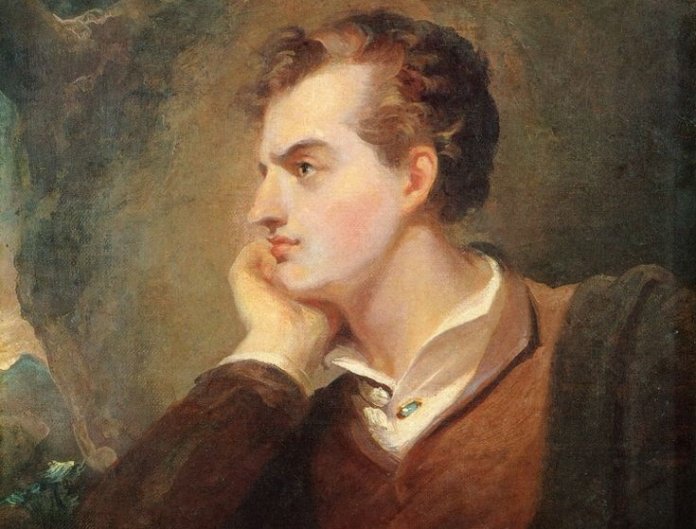
Lord Byron-c.-1826-1828-by-Thomas-Sully-696x529
Image of Lord Byron, from Wikipedia. Artist: Thomas Sully

As I’ll be talking about “national songs” in my conference paper at Cecil Sharp House next weekend, I’ll be making the most fleeting of references to the poet Byron’s Hebrew Melodies, set to music by Isaac Nathan.  Fleeting, because despite Nathan’s claims, very few of the melodies (and it’s a very fat vocal score!) have the remotest connection with Jewish music.  There’s a long and well-referenced article about them on the Newstead Abbey Byron Society website, so there’s no need for me to summarise it all here.  The most pertinent sentences from my point of view are those giving lie to all Nathan’s claims of authenticity.  As I know only too well from my Scottish song-collections doctoral research, authenticity was frequently claimed but seldom genuine.*

I don’t know the name of the author who wrote the Society’s essay, but I’m happy to quote the link here, along with the extracts that I’ve selected to share:-

“There was nothing new in the project. Nathan, and to an extent Byron, were cashing in on a vogue for nationalist airs from minority cultures or oppressed peoples in all corners of the globe. The market was flooded with Scottish, Welsh, Indian, and of course, from Thomas Moore, Irish Melodies. The ethnic authenticity of none of such scores could be relied on.” (p.2)

““Wildness and pathos” are a long way off. Only seven of them have been identified as
having Jewish music in them. They are: She Walks in Beauty, Oh! Snatched Away in Beauty’s Bloom, The Harp the Monarch Minstrel Swept, My Soul is Dark, Jephtha’s Daughter, On Jordan’s Banks, Thy Days are Done.” (p.4)

Source (49 pages, published later than 2002, accessed 1 November 2018):-

http://www.newsteadabbeybyronsociety.org/works/downloads/hebrew_melodies.pdf 

I have also found a pdf of Nathan’s Hebrew Melodies, in a rather poor reproduction, but it’s better than nothing! There are 262 pages – I don’t think I’ll be printing them out!

http://ks.imslp.net/files/imglnks/usimg/0/08/IMSLP221262-PMLP365149-Nathan-HebrewMelodiesBW.pdf

If you’d like to read my own writing about authenticity in the Scottish song context, you can find my doctoral thesis online at the University of Glasgow, or read the augmented and improved book that followed a few years later!  (It’s available in paperback, hardback and as an e-book.)

  • Our Ancient National Airs: Scottish Song-Collecting from 1760-1888 (Thesis, 2009)
  • Our Ancient National Airs: Scottish Song-Collecting from the Enlightenment to the Romantic Era (Routledge, 2013)

Recommended Reading

I’ve just been reading a great article by William Lockhart, ‘Trial by ear: legal attitudes to keyboard arrangement in nineteenth century Britain’, Music & Letters 93.2 (2012), 191-221. It’s on JSTOR:

http://www.jstor.org/stable/41684166

Now, it’s not about legal deposit per se, although it is mentioned. (If I were to make one minor point, it’s to clarify that when the author states that items were ‘physically deposited’ at Stationers’ Hall, this implies that the Hall was, itself, a legal deposit repository, but this was not so. Stationers’ Hall registered publications, then passed on the legal deposit copies to the libraries – if they weren’t directly sent from the publishers themselves.)

The article is, in fact, an excellent analysis of three British music copyright cases. Considering how prevalent musical arrangements were, it is no surprise that there was litigation concerning copyright from time to time. Legal arguments examined various factors. No-one disputed the importance of the melody, but as we all know, there is more to a composition than that, and as for a series of opera tunes rearranged into a different order for dancing to? Well, you’ll have to read it!

It was interesting to find names that I have often encountered in other capacities, and particularly fun to meet my friend the quadrille arranger, Philippe Musard, again. (I looked at some of his quadrilles while reconstructing the contents of the University of St Andrews’ most popular copyright music volume, vol.284, now missing.)

Even if I don’t rush off to follow up all Lockhart’s references, there are a dozen or so that I shall be adding to our bibliography. There’s a lot there, excellent for providing context to our own research:-

  • What music the Victorians enjoyed
  • The development of legal definitions around the process and art of musical arrangement
  • How musicians perceived arrangements
  • Evidence that the records of music registration were actually referred to in cases of litigation!

When I get the chance to open my laptop, I will get these references into Mendeley and then into the bibliography. For now, with a tablet on a crowded Virgin train, I have to concede temporary defeat!