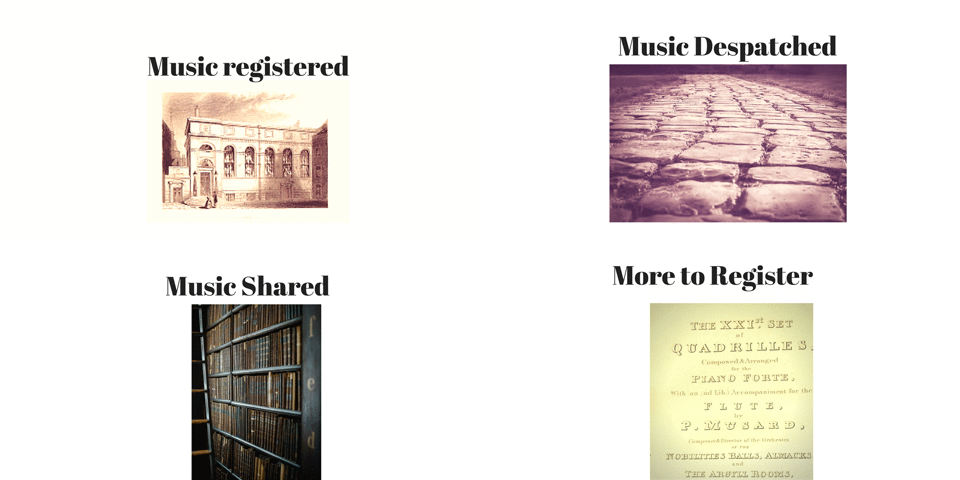
Dr Karen McAulay explores the history of Scottish music collecting, publishing and national identity from the 18th to 20th centuries. Research Fellow at Royal Conservatoire of Scotland, author of two Routledge monographs.
Before establishing the Claimed From Stationers’ Hall network, I was a postdoctoral researcher on the Bass Culture project, which looked at Scottish fiddle tune collections largely from the Georgian era. In that context, I read a paper at Musica Scotica in Spring 2014, about a couple of London-published music collections. It has finally been published in Scottish Music Review Vol.5 (2019), 75-87, this week.
Sometimes when we look back at earlier work, we wonder if we’d have written it differently today, but I’m still pretty happy with this article. If anything, I think it justifies my claim that the history of this kind of collection does indeed deserve to count as “book history”, even if it is music rather than literature. So, here it is for your enjoyment:-
As I’ve mentioned recently, this is another network with which I’ve been involved. Last week, the new website of the Romantic National Song Network was launched – and yesterday, my contributed guest blogpost about a Scottish song – Afton Water – went live. It draws heavily on my doctoral research into Scottish song-collecting, but I like to think that my present interest in the wider context (collecting, publishing, curating) has also influenced my approach. I was certainly very glad of the National Library of Scotland’s Digital Gallery, which I can’t praise enough!
My own personal thanks to Special Collections and Archives at James B. Duke Library, Furman University (Greenville, SC), for supplying one of the images used in my guest blogpost.
I’m delighted to introduce today’s blogpost by Andrea Cawelti, who is the Ward Music Cataloger at Houghton Library, Harvard University. Andrea attended a course at the American Rare Book School a couple of years ago, and is keen for everyone to know what a wonderful opportunity it would be for anyone who could attend this year’s course. I shared a link to Andrea’s reflections on the course, which she authored for the Houghton Library blog last year – you’ll find the link in the posting below. Now you can read more about it – if you manage to get there, do please consider sharing your own experiences here!
Philadelphia skyline (Pixabay image)
Fellow readers of Claimed from Stationers’ Hall may be aware that the American incarnation of Rare Book School has offered a course on the Stationers’ Hall since Peter Blayney, one of the stalwart fathers of research on the Stationers, taught the course in the 1990s. But I see that applications have been opened today for this summer course, now taught by Professor Ian Gadd, so I’d like to share a bit about my excellent experience in taking this course in 2016, as prompt applications are usually the most successful.
This term, as in 2016, the course will be held in Philadelphia, June 2-7, at the Kislak Center for Special Collections, Rare Books and Manuscripts at the University of Pennsylvania, with reasonably-priced and comfortable dorm space available within easy walking distance through the picturesque Penn campus. As this course represented my first experience at the Kislak Center, I was delightfully surprised by our genuine welcome, and helpful assistance by the staff, both of the library and those in attendance from the Rare Book School, even though this wasn’t their turf. The Center holds significant hand-press material for examination and project fodder, and Penn Libraries holds a complete set of microfilms of the Stationers’ Company registers and archives, which we consulted extensively for our work.
As with all RBS courses, ample opportunities are presented for individual discussion, questions, and networking, including regular morning and afternoon breaks, lunches, and receptions. Evenings often include programmed activities from lectures to film presentations, and during my course, there was an excellent presentation by Lynne Farrington, senior curator at the Kislak, on American subscription publishers and their German-American readers. Dr. Farrington provided a fascinating overview of the American subscription publishing industry, and how it was utilized for foreign-language titles to be sold through the subscription network. The lecture was accompanied by a hand-on exploration of subscription samples from several of the Kislak’s collections.
Enough of that, you may say, what about the course itself?!?!?! Well, first of all, I should mention that I arrived with a specific agenda, which was to familiarize myself with the Registers, what was in them of a music format, and to learn how to use the microfilms most effectively (Harvard, too, holds a complete set of these microfilms).
Like many of you I’m sure, I’ve had cases where I’d hoped to find a specific date in the 18th century when something had been published, or to establish some kind of sequence for several publications, and had been frustrated by my inability to harness these resources. Now of course, newer products are available, including the Literary Print Culture online access, which Professor Gadd has now incorporated into the course. Still, the navigation of this product isn’t straightforward, and one really needs to know what one is doing before attempting to use, or it is easy to get completely lost.
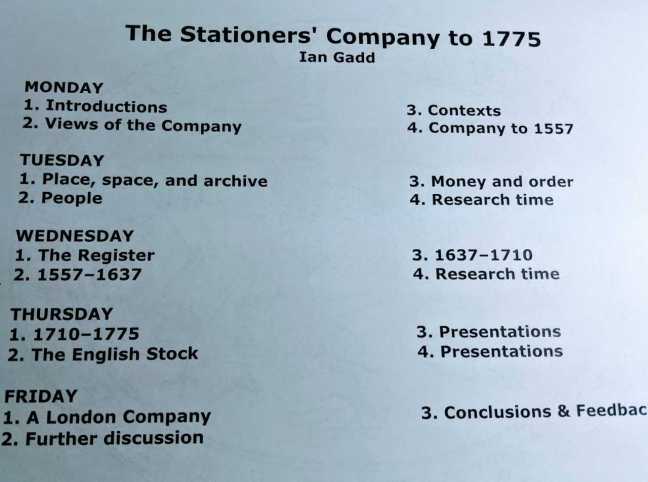
Course schedule
As you can see, the schedule was laid out to allow us a proper introduction to the history of the company and its archives: Professor Gadd offered spirited presentations on each aspect, as well as providing references to online and printed documentation which would be of use later in our explorations. Each of us was then tasked to research and present on some topic of particular interest to us (see “research time” and “presentation time” in the daily schedule). I chose a particular segment of time and explored all of the Registers chronologically to gain an idea of what music was being brought to the Stationers for registration between 1799 and 1804. Several of my discoveries ended up in our Houghton Blog, which presents a bit more information for those who are interested.
I had honestly come into this course completely unaware of how extensive the Stationers’ archives were apart from the Registers! Learning more about the “people” documentation was particularly eye-opening, and quite helpful in my cataloging. The online index to the London Book Trades for instance, based on the Stationers’ archives is great for finding more information on printers when researching, creating authority records, or for investigating connections between people. As always, Professor Gadd provided helpful hints: don’t use the “search” box, just go directly to the “index – names”. There were so many trails of bread crumbs offered to us, that who could remember them all (certainly not I!) Knowing this, the professor provided us with an extensive workbook to take home, complete with bibliography and most useful for me after the fact, an overview of the most important copyright legislation affecting just what was registered with the Company.
Workbook table of contents
While this course only goes up to 1775, and consequently doesn’t cover some of the most influential music-related legislation, suggested readings within provide an appendix as it were, and after going through the history before 1775, reading forward into the 1790s was not difficult. Additional revealing segments covered what species of books were included in the English Stock and why this was important, and an introduction to Edward Arber’s term catalogues – keyword-searchable, and covering (among others and appendices) periods into the 18th century. A mind-boggling amount of work, which doesn’t include that much music but is well worth a look.
Two and a half years later, am I glad I took the course? You bet I am; it has proved to be perhaps one of the most useful courses I’ve taken at RBS. Possibly more so for me, because I was essentially ignorant of so many details of the Stationers’ history, but I would heartily recommend this to anyone preparing to work with, or already working with 17th to 18th century music. The context will provide you with an invaluable overview of how printing functioned in Britain, and how and why and what was registered. I hope that I’ve given something of the flavor of the course, and if anyone has questions about how RBS works, please do ask the RBS:-
If you’re considering attending, you can find out more about the RBS on their website. The homepage explains, “Rare Book School provides continuing-education opportunities for students from all disciplines and skill levels to study the history of written, printed, and digital materials with leading scholars and professionals in the field.”
Be quick! The early bird catches the worm, as they say.
Good luck and good researching!
Andrea Cawelti Ward Music Cataloger Houghton Library Harvard University
Hans Gal (1890-1987) catalogued Edinburgh University’s Reid Music Library during the summer and autumn of 1938, at the instigation of Sir Donald Tovey. The latter was keen to find work for the gifted composer and musicologist, who had emigrated from Vienna when Hitler annexed Austria. (Here’s a recording of his earlier Promenadenmusik for wind band, which he wrote in 1926. ) A grant from the Carnegie Trust enabled Gal’s catalogue to be published in 1941. When the Second World War ended, Gal joined the University music staff, and remained there beyond retirement age.
The reader is referred to the Hans Gal website for further biographical information (I am checking this weblink, which occasionally falters):- http://www.hansgal.org/
Gál, Hans, Catalogue of manuscripts, printed music and books on music up to 1850 : in the Library of the Music Department at the University of Edinburgh (Reid Library) (London, Edinburgh: Oliver and Boyd, 1941)
(Partially) catalogued by Gal
The catalogue is in three parts, listing manuscripts, printed music, and books on music. Gal did not list every individual piece of music in the library, but prioritised more serious classical music, whether vocal or instrumental. One might suggest that there were various reasons for Gal’s decision.
In his preface, he explains that, ‘for practical reasons I confined this catalogue to the old part of the library, namely the manuscripts, printed music and books on music up to 1850, which is the latest limit of issues that might be looked upon as of historical importance’. [Gal, vii]
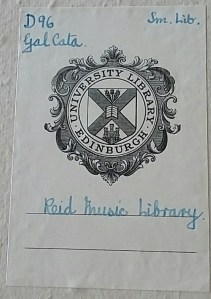
However, this was not the only limitation placed on the listing. Gal omitted many of the pieces of sheet music that must have arrived as legal deposit copies during the Georgian era, until copyright legislation changed in 1836. The Reid music cupboards contained a number of Sammelbänder, or ‘binder’s volumes’, ie, bound volumes of assorted pieces of music. Occasionally Gal made oblique reference to these, eg, to cover the 44 items in volume D 96:-
“Songs, Arias, etc., by various composers (Th. Smith, D. Corri, Bland, R. A. Smith, Rauzzini, Davy, Kelly, Urbani; partly anon.) Single Editions by Longman & Broderip, Urbani, Polyhymnian Comp., etc., London (ca. 1780-1790). Fol. D 96″ [Gal, 44]
Longman & Broderip were prolific music publishers, amongst the most assiduous of firms making trips to Stationers’ Hall to register new works. They published a lot of theatrical songs and arrangements, and much dance music, as well as the more serious, ‘classical’ music repertoire. The catalogue entry cited above details some more commonly known composers of decidedly middle-of-the road, if not downmarket material. One does not need to speculate as to whether Gal considered such material less respectable, for he made no secret of his disdain for much of the music published in this era! In the preface, he asserts that,
“The gradual declining from Thomas Arne to Samuel Arnold, Charles Dibdin, William Shield, John Davy, Michael Kelly, is unmistakeable, although there is still plenty of humour and tunefulness in musical comedies such as Dr Arnold’s “Gretna Green”, Dibdin’s “The Padlock”, Shield’s numerous comic operas and pasticcios.
“After 1800 the degeneration was definitive, in the sacred music as well as in songs and musical comedy. […] It is hardly disputable that the first third of the nineteenth century, the time of the Napoleonic Wars and after, was an age of the worst general taste in music ever recorded in history, in spite of the great geniuses with which we are accustomed to identify that period.” [Gal, x]
Faced with several hundred of such pieces in a number of bound volumes, and quite possibly a limited number of months in which to complete the initial cataloguing, it is hardly surprising if Gal was content to make a few generic entries hinting at this proliferation of ‘bad taste’. (One might add as an aside, that Gal’s wife at one point observed that Gal ‘hated swallowing the dust in archives’, in connection with an earlier extended project in the late 1920s – clearly, he was able to overcome his distaste when the need arose! (See http://www.hansgal.org/hansgal/42, citing private correspondence of 10.10.1989)
Interestingly, it is evident that Edinburgh, like several other of the legal deposit libraries, must have been selective in what was retained, but it’s significant that national song books were certainly considered worth keeping. Gal, in turn, included some of the prominent titles in his listing.
Thus, Gal’s catalogue is another reminder to us that the history of music claimed from Stationers’ Hall under legal deposit in the Georgian era, actually and actively continues beyond the Georgian era, for the material has already been curated by musicologists and bibliographers prior to our own generation. In St Andrews, Cedric Thorpe Davie took an active interest, whilst Henry George Farmer was involved in curating the University of Glasgow collection.
Meanwhile, in connection with the current Claimed From Stationers’ Hall network research, the priority is to establish which volumes – formerly in the Reid School of Music cupboards, but now in the University of Edinburgh’s Centre for Research Collections – were received under legal deposit. Two spread-sheet listings enable us to examine the contents of different volumes, by volume:-
Where publication dates are not given in the spread-sheet, they can be looked up in Copac, and even if there are no decisive dates, then their presence in other legal deposit collections will suggest that these copies arrived by the same route. If music predates 1818, then works can be looked up in Michael Kassler’s Music Entries at Stationers’ Hall, 1710-1818, from Lists prepared for William Hawes, D. W. Krummel and Alan Tyson. (Click here for Copac entry.)
Essentially, the first task is to ascertain which volumes contain legal deposit music, and then to look not only at what survives, but whether there are any patterns to be discerned. In terms of musicological, book, library or cultural history, the question today is not whether the music was ‘degenerate’ or in ‘bad taste’, but to ask ourselves what it tells us about music reception and curation in its own and subsequent eras.
Postscript: as an interesting twist in the world of library and book history, my own copy of Gal’s catalogue was purchased secondhand – a withdrawn copy from a university library where the music department closed a few years ago. What goes around, comes around, as they say!
Posted on the very excellent Echoes from the Vaultblog by the capable and insightful Special Collections team at the University of St Andrews, another interesting article touching on the Copyright Collection there. (And it’s about one of the seminal books in Scottish music, as I discussed in my book, Our Ancient National Airs …)
The Lighting the Past team share their highlights from the ‘M’ section of the Copyright Deposit Collection. You can see the previous posts in the series here.
The title page of vol. 1 of the St Andrews copy of The Scots Musical Museum. s M1746.J8S3 Vol. 1
While cataloguing the ‘M’ classmark (music) of the Copyright Deposit Collection, Lighting the Past discovered 5 volumes from The Scots Musical Museum, a 1787-1803 Edinburgh publication attempting to capture all Scots folk music and verse, amounting to 6 volumes once complete.
Robert Burns took a keen interest in the planned compilation project whilst in Edinburgh in 1787, writing ‘An Engraver, James Johnson, in Edin[burgh] has, not from mercenary views but from an honest Scotch enthusiasm, set about collecting all our native Songs and setting them to music.’ With Burns as the principal editor of vols. 2-4 (he died prior to the publication…
This may sound as though I’m speaking in riddles. Truly, I’m not!
I alluded in my earlier posting today to the question of “When less is more”, in the context of the apparently minimal amount of Stationers’ Hall music surviving at Edinburgh University Library, and how I was forced to look at the little that was there, in quite a close focus.
But I still have copies of those lists of music in the National Library of Scotland. So, on the one hand, we have very little of the music surviving in what was then “Edinburgh College”. On the other hand, we have lists of music from the Advocates Library in 1830, but we don’t know what the purpose of the lists was.
I’ve started to transcribe these lists – only a few pages, but interesting nonetheless. But, how do I rationalise to other people just why they’re interesting? And this is why:-
If I can establish which of these pieces actually SURVIVED in different libraries, then I get a snapshot view – fragmented and blurred, admittedly – of which libraries retained more, or less, and I can see if certain categories were more likely to survive at that time, shortly before the legal deposit system was radically reduced. Yes, it means another spreadsheet. But I still think there may be something interesting to unearth. Watch this space!
And yes, I do still need to establish whether there is music surviving but not yet catalogued online. I know about some of the libraries, but not absolutely clearly for all of them. That’s why I’m making my visits around the country!
Followers of the Claimed From Stationers’ Hall music research project may be aware that Sion College (in London) was one of the original legal deposit libraries, and Karen is planning to pay a visit to Lambeth Palace Library, where the Sion College library holdings ended up, in the next few months.
It is therefore of HUGE interest to note that Lambeth Palace Library is working on a really significant project tracing provenance of the Sion College Library collections. A circular was emailed to rare books librarians today, explaining precisely what this project is all about. We have permission to share this notification here, and are more than happy to spread the joy!
“Lambeth Palace Library is pleased to announce the re-launch of the Sion College Library Provenance Project, which has been migrated to a dedicated WordPress account. The new site allows you to search through galleries of hundreds of images (which are being regularly uploaded), including an array of armorial bindings, bookplates, inscriptions and much more from the Sion College Library collection.
“All the pre-1850 material from Sion College came to Lambeth Palace Library in 1996 and is now the focus of a major cataloguing project which is uncovering a wealth of provenance evidence. Viewers are warmly invited to not only search the database to discover its fascinating contents, but are encouraged to actively contribute by helping us identify marks of provenance within the collection, providing information with which to supplement and enrich our detailed catalogue records. Please do have a look and try your hand at some transcriptions and identifications. We look forward to hearing your comments!”
I spent the day authoring and starting to disseminate the first network Newsletter; actually, it’s both an update and an invitation to particate! After spending some time this evening reading MailChimp’s instructions, I worked out how to get the hyperlink for viewing in your browser. Triumph! Click the link to read it, here.
By way of light relief, I opened my favourite book – Kassler’s Music Entries at Stationers’ Hall* – to see what was registered on this day, over 200 years ago. Two surprises awaited me. In 1784, John Valentine of Leicester registered Thirty Psalm Tunes in Four Parts, and eleven copies are still extant, not only in legal deposit libraries. Plainly psalm tunes were considered worth keeping (or leaving to libraries!); not only that, but Trinity College Dublin has a copy, and they didn’t as a rule show much interest in trivial matter such as legal deposit music.
The second surprise was some piano trios by Pleyel, dedicated to Miss Elizabeth Wynne and registered on 20th September 1790. According to Copac, several copies survive in UK, and the British Library also has copies with a later date posited. And there could still be others not yet catalogued online. But here’s the exciting bit – you can access a German edition on IMSLP. Who wants to be first to play it?!
I checked Kassler’s Music Entries at Stationers’ Hall (2004) last night, to discover that although music wasn’t registered on a daily basis, it was actually registered on that date in three consecutive decades: 1797, 1807, and 1817. A curious confluence of the stars, nothing more, but it made an interesting thumbnail case-study. On 19th September 1797: Singer and singing teacher Rauzzini registered no.7 of his Periodical Collection of Vocal Music. Few copies survive, and it’s a bit hard to tell which volume contains no.7, though I know an expert who could probably locate it!
Also OTD in 1797, Bland & Weller registered James Hook’s Vauxhall Gardens song, Maidens would you know?, along with Hook’s Welsh song, Jem of Aberdovey, and his When the sprightly fife and drum. It’s all pretty typical fare – a song by a popular Bath impresario, and some Vauxhall Gardens songs including a ‘national’ and a military song, by composers still (just) known today. As it happens, there were also imprints of another ‘Jem’ song by Hook under English, Irish and Scottish imprints – Jem of Aberdeen! – but that’s not part of the 19th September story. You can trace a few copies in Copac, but certainly not in all of the legal deposit libraries.
Jump forward to 19th September 1807, and publisher Goulding registered 2 Dibdin songs for a show, Bannister’s Budget. Copies survive in three Copac libraries today. (If musical theatre is a popular genre today, it’s a case of ‘plus ca change’!)
Meanwhile, exactly two hundred years ago yesterday, Bath musician John Charles White registered his piano rondo, The Fairy Queen on 19th September 1817. There are seemingly three surviving copies in the UK. However, there could be further copies of any of the aforementioned titles, because not all of the early legal deposit music has been catalogued online. That’s the intriguing part of this story!
For now, this tiny snapshot of three anniversaries neatly encapsulates the kind of music popular in those decades: typical of their eras, they represent concerts by famous names in Vauxhall Gardens; touch upon the fashion for songs of a military nature during the Napoleonic Wars, the popularity of national songs; and a plethora of piano rondos for the amateur pianist. Not bad, for a random handful of music entries in the Stationers’ Hall registers!
This is officially the start of the new AHRC-funded network, Claimed From Stationers Hall. A fuller blogpost will appear within the next 24 hours. Have a wander round the website, and please do get in touch if you’d like to be added to the email mailing list. The topic is the music that was registered at Stationers’ Hall in the eighteenth and early nineteenth centuries up to 1836, so if you have an interest in music publishing of that era, or indeed anything involving British-published sheet music and its performance, or its documentation whether through conventional bibliographic means or in the context of digital humanities … then we’d love to hear from you!
(Never let a musicologist near a gif! I promise to do better ….)


 As I’ve mentioned recently, this is another network with which I’ve been involved. Last week, the new website of the Romantic National Song Network was launched – and yesterday, my contributed guest blogpost about a Scottish song – Afton Water – went live. It draws heavily on my doctoral research into Scottish song-collecting, but I like to think that my present interest in the wider context (collecting, publishing, curating) has also influenced my approach. I was certainly very glad of the National Library of Scotland’s




 The title page of vol. 1 of the St Andrews copy of The Scots Musical Museum.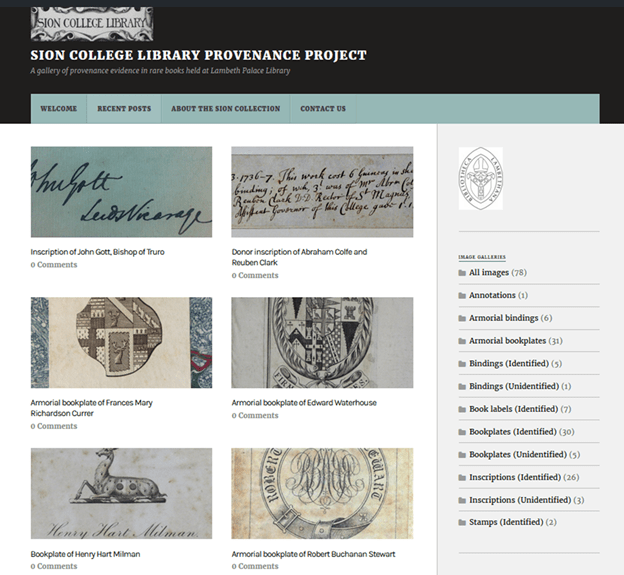

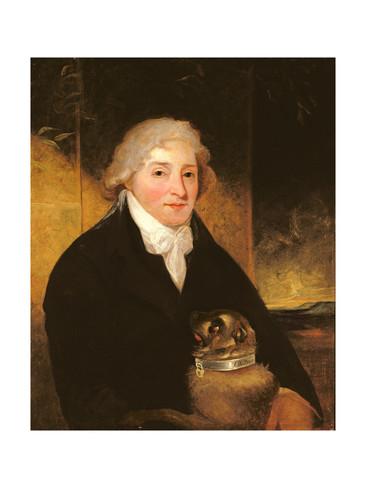 On 19th September 1797: Singer and singing teacher Rauzzini registered no.7 of his Periodical Collection of Vocal Music. Few copies survive, and it’s a bit hard to tell which volume contains no.7, though I know an expert who could probably locate it!
 Also OTD in 1797, Bland & Weller registered James Hook’s Vauxhall Gardens song, Maidens would you know?, along with Hook’s Welsh song, Jem of Aberdovey, and his When the sprightly fife and drum. It’s all pretty typical fare – a song by a popular Bath impresario, and some Vauxhall Gardens songs including a ‘national’ and a military song, by composers still (just) known today. As it happens, there were also imprints of another ‘Jem’ song by Hook under English, Irish and Scottish imprints – Jem of Aberdeen! – but that’s not part of the 19th September story. You can trace a few copies in Copac, but certainly not in all of the legal deposit libraries.
 Meanwhile, exactly two hundred years ago yesterday, Bath musician John Charles White registered his piano rondo, The Fairy Queen on 19th September 1817. There are seemingly three surviving copies in the UK. However, there could be further copies of any of the aforementioned titles, because not all of the early legal deposit music has been catalogued online. That’s the intriguing part of this story!