Dr Karen McAulay explores the history of Scottish music collecting, publishing and national identity from the 18th to 20th centuries. Research Fellow at Royal Conservatoire of Scotland, author of two Routledge monographs.
This week I’ve been focusing on my paper for the EFDSS conference, Traditional Folk Song: Past, Present & Future, on Saturday 10 November, 9:30am – 5:00pm at Cecil Sharp House, London. I’ll be talking about ‘National Airs in Georgian British Libraries’, and particularly focusing on the collections in St Andrews and Edinburgh. I’ll also be alluding to that old nineteenth century irritation – the allegation that England had no national music!
As it happened, I needed to take a day’s annual leave for a non-work related reason yesterday, but I hoped that for most of the day I would be free to concentrate on my presentation. Well, it didn’t work out quite that way, but I did start writing in the evening. Today, I spent the first couple of hours teaching library research skills, then it was back to the laptop in the research room for the rest of the day.
By the end of the working day, I had written just over 4,000 words and felt I deserved a treat: I left my papers on the desk and came home to spend the evening sewing! (Better still, another little indulgence had arrived in the post for me: a silver sixpence dating from 1821, the year of George IV’s coronation, and with a hole pierced in it by a previous owner so that it could be worn on a ribbon. As of course I already am!)
The conference will actually be the culmination of a particularly busy week for me: I’ll be visiting the two Irish Georgian legal deposit libraries in Dublin earlier in the week, and Stationers’ Hall and the British Library on the day before the conference. One of my choir-members looked somewhat surprised when I remarked that I’d be fitting in choir practice between Dublin and the overnight sleeper between Glasgow and London!
I’m particularly looking forward to this conference because it will be a completely different audience to those at the conferences I’ve already been to this year. I’m intending to give a fairly wide-ranging paper. If I unearth any surprises in Dublin, then there will be last-minute tweaking to add them into the mix!
NB If you liked this, you might like a post I wrote on a related topic, earlier this year – essentially a continuation of the story after the period that I’ll be describing in my latest conference paper:- England has no National Music? Chappell Set Out to Refute This
My research lecture at Edinburgh University went well last week (though I say it myself!) – I was delighted to have received such a warm reception. Here’s my powerpoint, also uploaded to the Calendar tab of this blog. It was good to have the opportunity to give a talk focusing on a collection (well, what’s left of the legal deposit music!) that hasn’t had a great deal of exposure before, and I was absolutely delighted to make the acquaintance of a former Edinburgh academic who is probably the only person to have investigated Edinburgh’s legal deposit music in a systematic way. Apart, of course, from Hans Gal’s bibliographic efforts, which noted some but not all of the Reid Music Library’s contents dating pre-1850. I’m about to start reading some notes that I was generously given after my lecture – it’s a great privilege to be given them.
Whilst St Andrews has its magnificent collection and all the related documentation and archival material, I’m keen to stress that Edinburgh has different strengths: not nearly as much legal deposit music, but an entire historical musical instrument collection, and the wonderful St Cecilia’s Hall which not only exhibits them, but also offers unique performance spaces. Nothing would make me happier than to learn that students were inspired to explore the music on the historical instruments! Early printed music is fascinating in musicological terms, but bringing it back to life in terms of sound is something special – as the Sound Heritagenetwork has been keen to demonstrate in many wonderful ways.
Next stop, meetings in Dublin and London – and then the EFDSS conference. Better get writing again!
I was at Edinburgh University Library yesterday – I’m trying to work out which bound volumes might contain music that arrived through the legal deposit route. I was looking at one particular volume, and came to a batch of pieces all by the same Edinburgh-based composer. I looked him up – and found he spent some time in Italy in his youth, under the direction of a particular teacher.
Then I remembered that I’d encountered some music BY that teacher, in a different volume. And then – exploring the University Library catalogue – I found more by the Edinburgh composer AND more by the Italian musician. Is it remotely possible that the individual who arranged for that legal deposit volume to be bound, also knew the Edinburgh musician? It was some decades before music would have an official, recognised place in the University curriculum, but obviously some music was being collected.
Equally, might the music by the Italian – in another volume, not necessarily legal deposit, and in other volumes definitely not so – have come to Edinburgh in some way connected with his British pupil?
You might argue that this doesn’t have much to do with legal deposit. In one sense, that’s true. But if we’re thinking about what the University decided to keep, out of the legal deposit material that they received, then this is – if nothing else – quite interesting, surely?
As to the identity of these guys – well, let me enjoy the mystery a bit longer, once I’ve worked out if there’s any more to be discovered!
Hans Gal (1890-1987) catalogued Edinburgh University’s Reid Music Library during the summer and autumn of 1938, at the instigation of Sir Donald Tovey. The latter was keen to find work for the gifted composer and musicologist, who had emigrated from Vienna when Hitler annexed Austria. (Here’s a recording of his earlier Promenadenmusik for wind band, which he wrote in 1926. ) A grant from the Carnegie Trust enabled Gal’s catalogue to be published in 1941. When the Second World War ended, Gal joined the University music staff, and remained there beyond retirement age.
The reader is referred to the Hans Gal website for further biographical information (I am checking this weblink, which occasionally falters):- http://www.hansgal.org/
Gál, Hans, Catalogue of manuscripts, printed music and books on music up to 1850 : in the Library of the Music Department at the University of Edinburgh (Reid Library) (London, Edinburgh: Oliver and Boyd, 1941)
(Partially) catalogued by Gal
The catalogue is in three parts, listing manuscripts, printed music, and books on music. Gal did not list every individual piece of music in the library, but prioritised more serious classical music, whether vocal or instrumental. One might suggest that there were various reasons for Gal’s decision.
In his preface, he explains that, ‘for practical reasons I confined this catalogue to the old part of the library, namely the manuscripts, printed music and books on music up to 1850, which is the latest limit of issues that might be looked upon as of historical importance’. [Gal, vii]
However, this was not the only limitation placed on the listing. Gal omitted many of the pieces of sheet music that must have arrived as legal deposit copies during the Georgian era, until copyright legislation changed in 1836. The Reid music cupboards contained a number of Sammelbänder, or ‘binder’s volumes’, ie, bound volumes of assorted pieces of music. Occasionally Gal made oblique reference to these, eg, to cover the 44 items in volume D 96:-
“Songs, Arias, etc., by various composers (Th. Smith, D. Corri, Bland, R. A. Smith, Rauzzini, Davy, Kelly, Urbani; partly anon.) Single Editions by Longman & Broderip, Urbani, Polyhymnian Comp., etc., London (ca. 1780-1790). Fol. D 96″ [Gal, 44]
Longman & Broderip were prolific music publishers, amongst the most assiduous of firms making trips to Stationers’ Hall to register new works. They published a lot of theatrical songs and arrangements, and much dance music, as well as the more serious, ‘classical’ music repertoire. The catalogue entry cited above details some more commonly known composers of decidedly middle-of-the road, if not downmarket material. One does not need to speculate as to whether Gal considered such material less respectable, for he made no secret of his disdain for much of the music published in this era! In the preface, he asserts that,
“The gradual declining from Thomas Arne to Samuel Arnold, Charles Dibdin, William Shield, John Davy, Michael Kelly, is unmistakeable, although there is still plenty of humour and tunefulness in musical comedies such as Dr Arnold’s “Gretna Green”, Dibdin’s “The Padlock”, Shield’s numerous comic operas and pasticcios.
“After 1800 the degeneration was definitive, in the sacred music as well as in songs and musical comedy. […] It is hardly disputable that the first third of the nineteenth century, the time of the Napoleonic Wars and after, was an age of the worst general taste in music ever recorded in history, in spite of the great geniuses with which we are accustomed to identify that period.” [Gal, x]
Faced with several hundred of such pieces in a number of bound volumes, and quite possibly a limited number of months in which to complete the initial cataloguing, it is hardly surprising if Gal was content to make a few generic entries hinting at this proliferation of ‘bad taste’. (One might add as an aside, that Gal’s wife at one point observed that Gal ‘hated swallowing the dust in archives’, in connection with an earlier extended project in the late 1920s – clearly, he was able to overcome his distaste when the need arose! (See http://www.hansgal.org/hansgal/42, citing private correspondence of 10.10.1989)
Interestingly, it is evident that Edinburgh, like several other of the legal deposit libraries, must have been selective in what was retained, but it’s significant that national song books were certainly considered worth keeping. Gal, in turn, included some of the prominent titles in his listing.
Thus, Gal’s catalogue is another reminder to us that the history of music claimed from Stationers’ Hall under legal deposit in the Georgian era, actually and actively continues beyond the Georgian era, for the material has already been curated by musicologists and bibliographers prior to our own generation. In St Andrews, Cedric Thorpe Davie took an active interest, whilst Henry George Farmer was involved in curating the University of Glasgow collection.
Meanwhile, in connection with the current Claimed From Stationers’ Hall network research, the priority is to establish which volumes – formerly in the Reid School of Music cupboards, but now in the University of Edinburgh’s Centre for Research Collections – were received under legal deposit. Two spread-sheet listings enable us to examine the contents of different volumes, by volume:-
Where publication dates are not given in the spread-sheet, they can be looked up in Copac, and even if there are no decisive dates, then their presence in other legal deposit collections will suggest that these copies arrived by the same route. If music predates 1818, then works can be looked up in Michael Kassler’s Music Entries at Stationers’ Hall, 1710-1818, from Lists prepared for William Hawes, D. W. Krummel and Alan Tyson. (Click here for Copac entry.)
Essentially, the first task is to ascertain which volumes contain legal deposit music, and then to look not only at what survives, but whether there are any patterns to be discerned. In terms of musicological, book, library or cultural history, the question today is not whether the music was ‘degenerate’ or in ‘bad taste’, but to ask ourselves what it tells us about music reception and curation in its own and subsequent eras.
Postscript: as an interesting twist in the world of library and book history, my own copy of Gal’s catalogue was purchased secondhand – a withdrawn copy from a university library where the music department closed a few years ago. What goes around, comes around, as they say!
In the past month, I’ve been to Edinburgh, Cambridge and Oxford in connection with the Claimed From Stationers’ Hall research network. I’ve chatted with Almut Boehme in the National Library of Scotland, Elizabeth Lawrence and Jenny Nex at the University of Edinburgh, Margaret Jones and Jill Whitelock in Cambridge, and Martin Holmes and Giles Bergel in Oxford. We’ve talked about how different libraries stored and curated their legal deposit collections, attitudes towards music and cataloguing, and the influence of the British Museum’s mid-nineteenth century cataloguing rules. Several libraries began by categorising their music as instrumental or vocal – so to anyone wondering why our library does it that way – well, we’re following the Library of Congress, and they seem to have followed the British Museum too!
As I’ve mentioned before, our Victorian forbears periodically attempted to impose order on the never-ending stream of music that just kept on flowing into their libraries.
Both in Cambridge and in Oxford, we looked at old bound books of legal deposit music, and the lists of music – lists that came from Stationers’ Hall at regular intervals, and lists that were made of material as it was accessioned. Serendipity is a wonderful thing – Margaret looked out scores corresponding to material in the lists, and came up with a bound collection of various national songbooks – always a popular genre – not to mention an English opera that might have made no ripples in nearly two centuries, but certainly raised a few smiles in that meeting room in February 2018!
Meanwhile, Martin’s selection of scores included a composition by a young English woman whom I’d never heard of before – Sarah Allison Heward – and a network member in Germany has since unearthed a whole wealth of information about her and her musical family. Watch this space – there’s a blogpost coming up!
A tour of shelves at Cambridge University Library was enough to change the mental pictures in my mind from a general impression of scores gently drifting towards the various libraries, to a picture of a very, very large fountain – or an overflowing bathtub. You see, whereas the Scottish university libraries and Sion College lost their right to legal deposit books in 1836 – a very long time ago – the flood simply never stopped when it came to the national libraries, Oxford and Cambridge. For someone working in a conservatoire library – large enough on its own terms, but certainly tiny compared to the legal deposit giants – it’s quite overwhelming to see just how much music has actually been published. And then, to realise that it hasn’t all been catalogued online – a backlog of these proportions is a frightening thing to get one’s head around! I didn’t ask how many linear miles of bookshelves each library is responsible for – offsite storage and all – but they are certainly amazingly big institutions.
In Oxford, a large data-input exercise in the Philippines meant that most of the legal deposit music has now been listed online, but only by accepting that the catalogue data would be less clearly formatted, and more incomplete, than a modern cataloguer would consider acceptable.
My meeting with Giles, on the other hand, afforded me the opportunity to find out more about two projects using Stationers’ Hall data – one, a commercial database, and the other, a website that will go live in April this year. I also learned about optical recognition software being tasked with identifying different imprints of ballad texts and woodcuts – all fascinating stuff.
Our forthcoming research network meeting will bring together all the legal deposit library ‘descendants’ with a responsibility for the surviving sheet music. There might have been meetings or correspondence between groups of these libraries in Georgian times, but I think we can safely say that there has never before been a gathering quite like this before. We’ll be looking both backwards (at the history) and forwards (at documentation and access issues, not to mention big data considerations. It promises to be quite a day!
Nothing is more satisfying than talking about one’s research passion. So, clearly, this announcement from the National Library of Scotland would prove irresistible:-
“The National Library of Scotland Slam Week offers a platform to tell an audience and a judging panel about your work.
“Compete in one of our slams and you will have three rounds (each two minutes long) to convince the judges that you are the worthy winner.There are two slams to choose from — research or poetry — and both are free to enter. “
I saw the announcement a few weeks ago, and initially hesitated. I could say plenty about our research network, but could I say enough about my research in NLS? But then I saw another online announcement, thought again, and realised that actually, there was plenty I could say. Without further ado, I signed up! I wonder if anyone I know will be there?
The research slam is on Wednesday night, 24th January, at 6 pm. Sitting here in Glasgow this weekend, and scowling balefully at the snow outside, I have been praying that the weather forecast will prove correct and that both the pavements and public transport will have returned to normal by Wednesday!
There are three rounds in the research slam, and we can now speak for a maximum of three minutes in each session (there are only seven entrants):-
Overview of research topic
Using the Library’s collections, and approach/methodology
Research impact
I’ve written my three contributions – and there’s still time to polish my prose! I felt a little wobble when I realised that the 2017 winner produced their contributions in poetry! I can only write limericks or metrical verse, and my last effort at poetry fell flat on its face, so I think I’d best stick to normal sentences for my own attempt!
Batt-printed porcelain contemporary with the copyright music era
No disrespect to my day-job, but years of cataloguing have trained me to tolerate repetitive tasks to a very high degree! Cataloguing can be repetitive and, I’m afraid, monotonous. However, in terms of endurance training, this background stands me in good stead. I just keep on going, like the Duracell bunny in the battery ads!
My innocent vacation amusement this week has been the rather slow-moving exercise of comparing one database with another. Why would anyone spend hours, days, starting to go through a list that amounts to some 2000 pieces of music? Ah, for a very good reason. This is the list of Edinburgh University Library’s Reid Hall Cupboard collection, and I’m finding out how much legal deposit music was actually retained. First, I compared it with the entire registered output of 1810 as listed in Kassler. Very little was there. Then with the registered output for 1818, the last year listed there. Possibly one match. Then I compared the Reid Cupboard contents with the material listed by the Advocates in 1830 – twelve years after the period itemised in Kassler. Very little correlation there, either.
A Significant Sample: 68 Hits
However, at different periods, copyright music WAS selectively retained at the University of Edinburgh. I concluded that there was nothing for it but to go through that a significant sample of that spreadsheet, just to begin with. Some music is continental (mainly French or German) in origin, and some is in manuscript; these categories don’t form part of my investigation. The problem is that no single approach can be taken to the whole corpus. We’re not comparing like with like, and different listings cover different periods, apart from any other considerations:-
There is the option of checking Kassler’s listing (if Copac indicates that the piece was published before 1819); checking Kassler in digital format is generally easier than in the paper edition, because one can check by title in the e-book. The physical book has various indices, but there’s no alphabetical title listing, and only the composers’ names are listed, not their works.
The Advocates 1830 lists merely cover February to March of one year. Even if much of this material turns up in the Victorian catalogue at NLS, it’s not a huge sampling.
It’s marginally quicker checking the EUL Reid cupboard material against the St Andrews copyright music spreadsheet (which did arrive by the legal deposit route) than it is checking against Copac, but it has to be said that checking Copac is the more thorough way. Having said that, we can’t be totally certain that the Copac-listed material was registered at Stationers’ Hall if it postdates 1818, short of actually checking the Stationers’ Hall records. An item appearing in the British Library, and one or more of the other copyright libraries, was probably accessioned under legal deposit, but not categorically so. And not everything that should have been registered and legally deposited, actually was.
The St Andrews collection is only catalogued online for material dating from 1801 onwards, and of course, will not include items that were discarded rather than being bound in the big composite volumes.
After several lengthy sessions checking and cross-referring, I had nearly finished composers beginning with “G”!
Thursday – the brightness of a [rainy] new dawn …
Faced with a very large collection of Haydn publications, I concluded that although the most comprehensive approach would be a complete comparision of the EUL Reid Hall cupboard contents with Kassler, St Andrew’s online copyright collection, and items listed in Copac, maybe this isn’t necessary immediately. Instead, a few broad statistics give us an overview of what’s there.
Comparing Kassler’s listing for 1810 with the Reid Hall cupboard: a maximum of 9 matches, and possibly only 7.
Comparing Kassler’s listing for 1818 with the Reid Hall cupboard: possibly one match. It’s a very popular Irish selection, so it could have arrived by other routes than legal deposit, eg by donation.
Comparing the Advocates’ lists of February and March 1830 with the Reid Hall cupboard: only three matches, which are European editions.
Comparing an initial sample of 68 Reid Hall cupboard items matched either with the St Andrews copyright collection or Copac: obviously, percentages could only be calcuated if the entire list was compared; they’d be meaningless with a small sample. Nonetheless, we can observe that in Edinburgh, items seem to have been retained very intermittently between 1770 and 1811; there’s no real pattern. Between 1812 and 1821, noticeably more material was retained, although nothing like the St Andrews collection. After that it appears to be even more intermittent than in the earlier period.
Title page of Hommage a Clementi, by Pixis. Image from copy in Glasgow University Library Collection, with thanks
It feels like time for a quick update, so I’ll spend the last few minutes of the working day doing just that. Here’s a quick reminder of what the Claimed From Stationers’ Hall music research network is all about:-
The project is investigating the music deposited in the former British Copyright Libraries under the Queen Anne Copyright Act and subsequent legislation up to 1836, when most university libraries lost their legal deposit entitlement, receiving book grants instead. The repertoire largely dates from the late 1780s (when legal action clarified the entitlement of music to copyright protection) through to 1836.
The project aims to establish what exactly has survived; whether there are interesting survival patterns; and the histories of the music’s acquisition, curation and exploitation, not just in during that era, but also subsequently. It also aims to raise the profile of the material and to foster more engagement with it, both within and outwith academia; and the repertoire can be used to inform historical cultural perceptions which often became embedded into contemporary writings; for example, an idea very prevalent during the 19th century was that the English had no national music; and yet collections of national songs were very popular. Thus, both the fact that these books were popular, and our close reading of the paratext within individual volumes can be used to inform our modern-day understanding. But a nation’s music is not just “national songs”, of course – it’s the whole repertoire of music published within that country.
To date, I’ve visited the University Libraries of St Andrews, Edinburgh and Glasgow. I’ve been in touch with retired scholars from Aberdeen, and I’ve visited the National Library of Scotland. Next, I need to spread my wings south of the border, and hopefully after a few more such meetings, we’ll have a clearer idea of what we’d like to talk about when we plan a study day to be held in Spring 2018.
The exciting, and yet tantalising part of all these visits is the realisation that there is a lot to explore, but not being able to stop and do all the research then and there! For example, there are undoubtedly pieces of legal deposit music at the University of Edinburgh that aren’t labelled as such, but that appear in other copyright libraries and therefore probably arrived by the same means. I so long to find them all, or to encourage other people to find them! Similarly, the University of Glasgow has a very generous collection of copyright music – alluded to by the late 19th century author, W. P. Dickson amongst “works of fiction, juvenile literature, fugitive poetry, and music … issued yearly from the press” – but previously summarised by Divinity Professor Dr McGill in 1826 as “a great many idle books”. (Dickson, The Glasgow University Library, 1888 p.16) I’m eager to see if I can work out which volumes they might have been in before they were re-bound into their present volumes! Meanwhile, the National Library of Scotland has an online catalogue, a card catalogue, but also “the Victorian catalogue”. This I must see!
It is interesting to reflect that earlier musicologists have also had a hand in the arrangement and preservation of these materials. Cedric Thorpe Davie in St Andrews disbound some volumes, and moved pieces to different places in the library. Fourth Reid Professor Donaldson got involved with the Advocates’ collections in Edinburgh; Hans Gal had a go at listing some of the Edinburgh University Library Collections; and Henry Farmer spent some time in what for anyone else would have been retirement, as a music librarian at Glasgow University Library – one of the many careers in his portfolio! – and yes, he did some sorting out and rearranging, too. Whilst we sigh over the thought of original sources being shuffled, we also owe these chaps a debt of gratitude for taking care of them and ensuring that they were preserved at all.
Prof. John Donaldson, from the National Galleries of Scotland
Henry Farmer, from the Henry Farmer papers at Glasgow University
Hans Gal
Cedric Thorpe Davie
The Pixis Variations Challenge
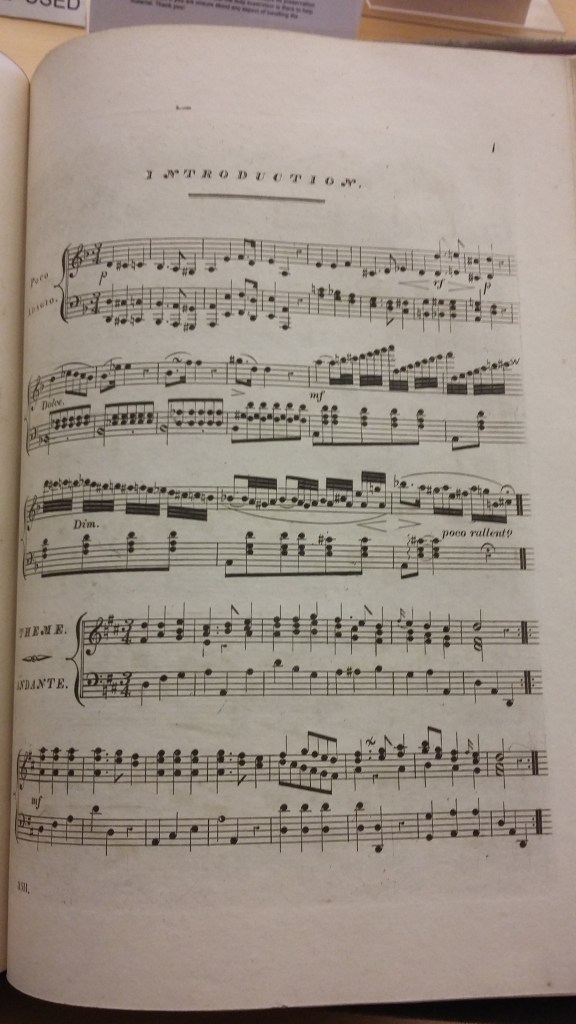
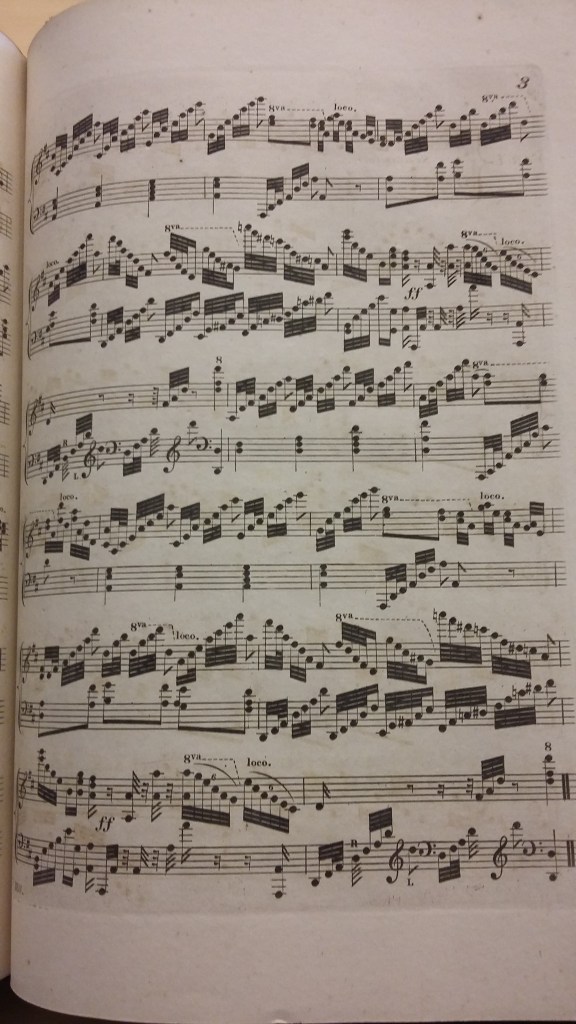
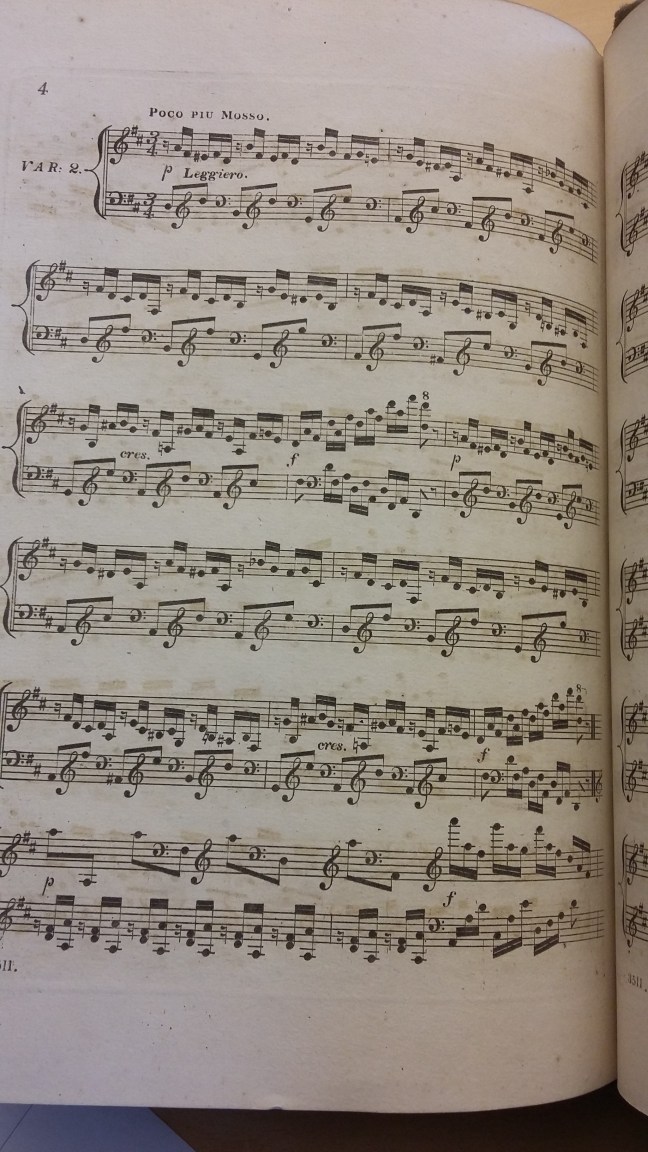
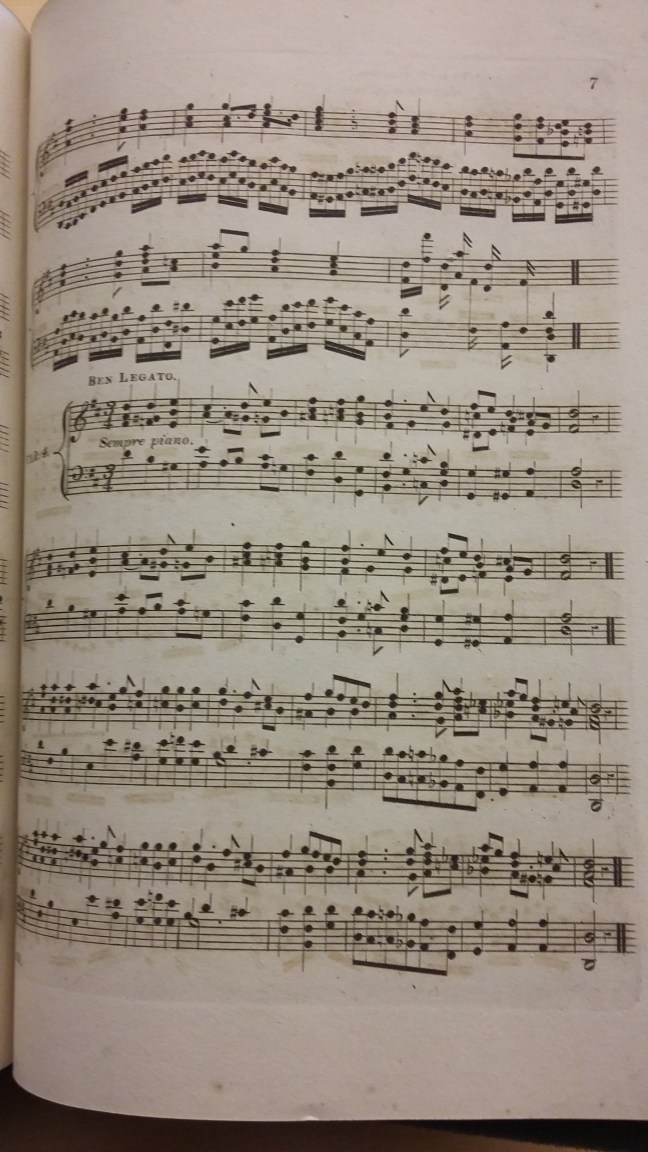
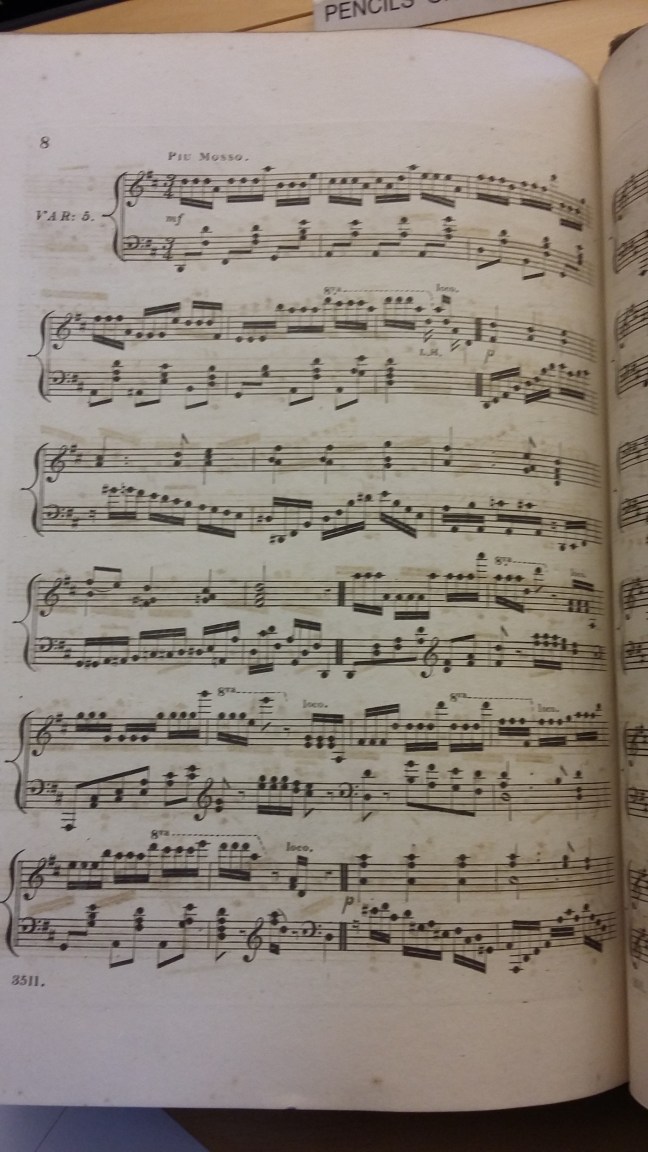
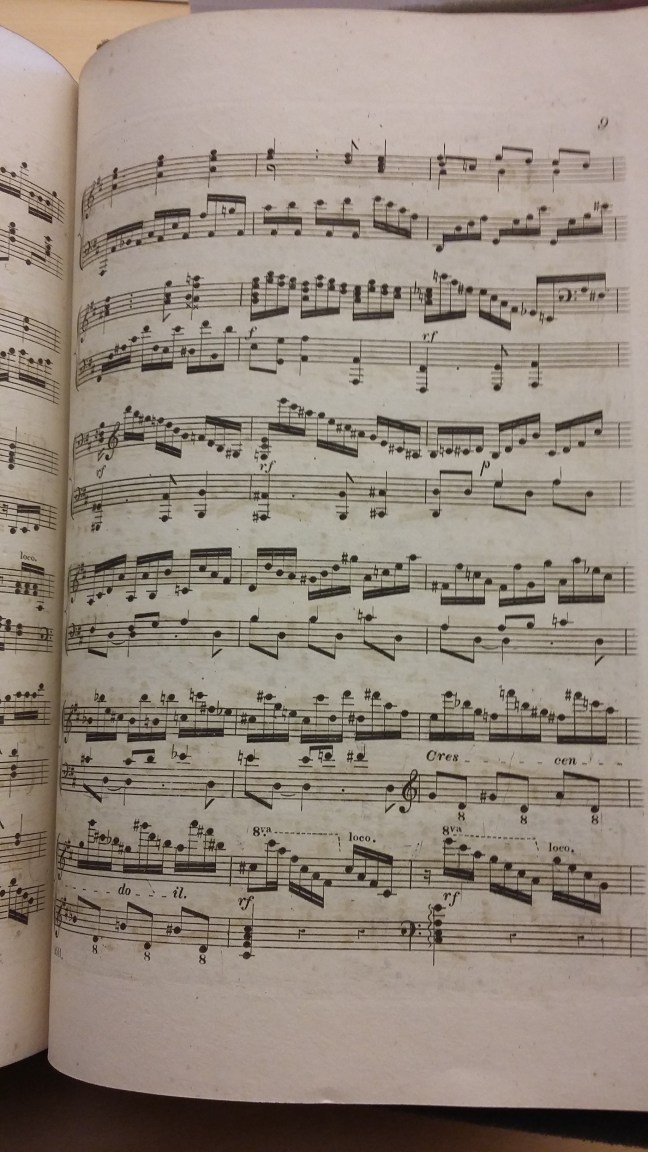
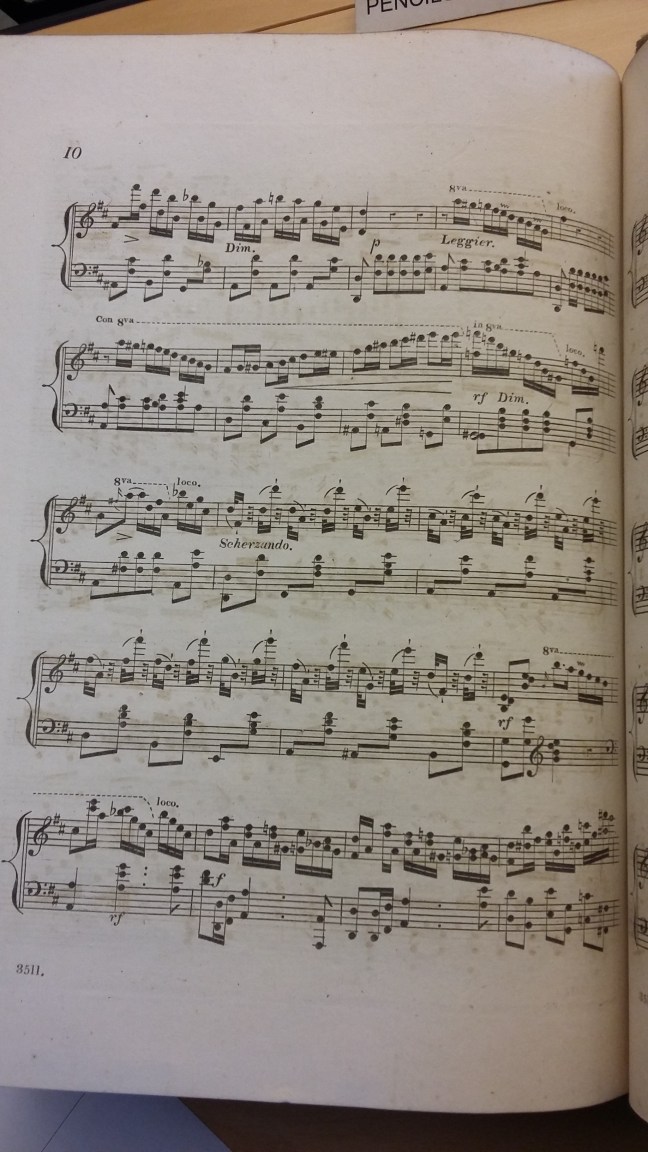
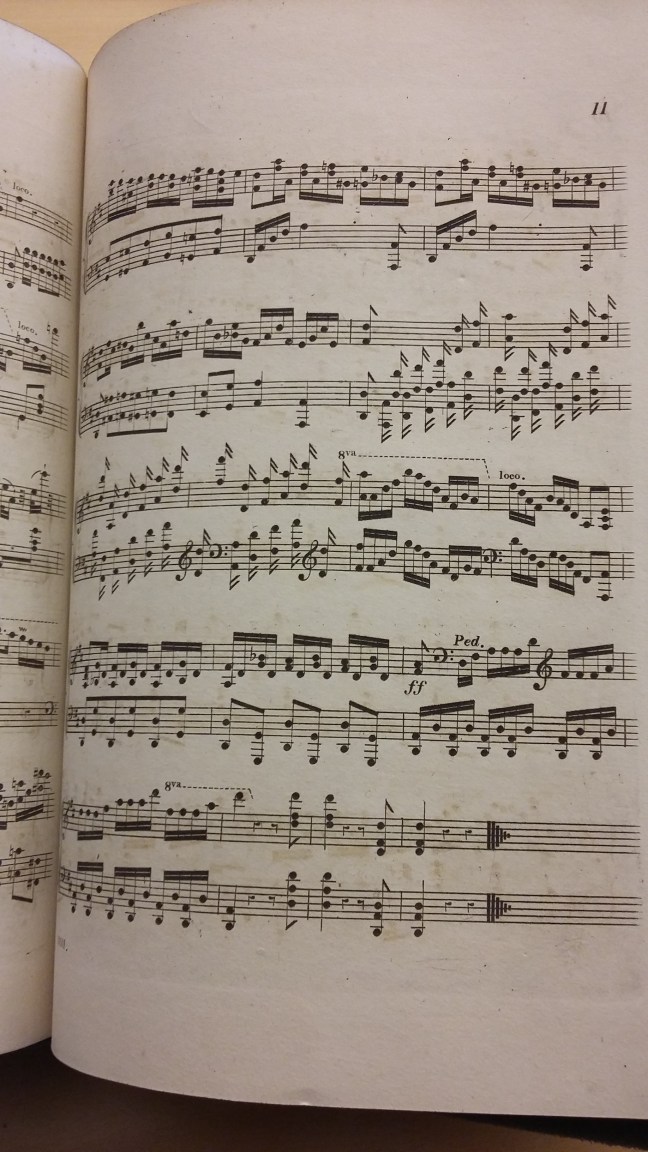
I long to play, or hear performed, some of these long-forgotten treasures. I’ve been generously allowed by the Special Collections department of Glasgow University Library, to share a set of piano variations by the now forgotten German composer, Pixis: Hommage a Clementi, which are actually based on the National Anthem, ‘God Save the King’. I’m putting them on our Twitter feed and Facebook page, one page at a time. At page 3, my pianistic skills are already being stretched beyond their comfort zone! I wonder if anyone will get to the end …. ? PLEASE let us know if you do!
Other pieces were undeniably less interesting. I tweet “on this day” posts about some of the pieces that were registered, just to give a flavour of what was being published. These references come with no value-judgements whatsoever! Luckily for me, I don’t have instant access to all these pieces, so I would only go out of my way to hunt down something that looked particularly intriguing.
Here, for the record, is the start of Pixis’s variations – I’ll add the rest in due course. Please do keep following the blog! And I’m pleased to say that it’s not long before the first of our guest postings will appear – a welcome change of “voice” and a fresh insight into a different aspect of this fascinating topic.
Our friends at Edinburgh University Library’s Centre for Research Collections have been cataloguing their historical music collections, and it was with great excitement that I found these Excel spreadsheets online this evening! Looking at the Reid Concert Hall Cupboard sequence, I found Thomas Hamley Butler’s Gin a body meet a body – a piano rondo from 1810. It was registered at Stationers’ Hall on 13 April that year. It’s very late at night, so I didn’t keep looking, but this certainly entices me to look much, much more closely. Extraordinary useful lists, and fabulously fun!
Reid Music Library page on the CRC website, where these lists can be found:-


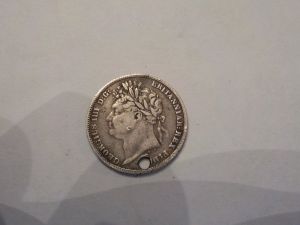 from 1821, the year of George IV’s coronation, and with a hole pierced in it by a previous owner so that it could be worn on a ribbon. As of course I already am!)

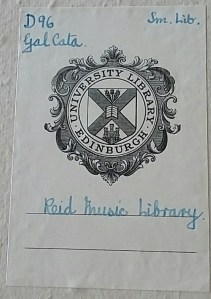
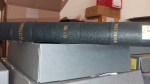 In the past month, I’ve been to Edinburgh, Cambridge and Oxford in connection with the Claimed From Stationers’ Hall research network. I’ve chatted with Almut Boehme in the National Library of Scotland, Elizabeth Lawrence and Jenny Nex at the University of Edinburgh, Margaret Jones and Jill Whitelock in Cambridge, and Martin Holmes and Giles Bergel in Oxford. We’ve talked about how different libraries stored and curated their legal deposit collections, attitudes towards music and cataloguing, and the influence of the British Museum’s mid-nineteenth century cataloguing rules. Several libraries began by categorising their music as instrumental or vocal – so to anyone wondering why our library does it that way – well, we’re following the Library of Congress, and they seem to have followed the British Museum too!
 and the lists of music – lists that came from Stationers’ Hall at regular intervals, and lists that were made of material as it was accessioned. Serendipity is a wonderful thing – Margaret looked out scores corresponding to material in the lists, and came up with a bound collection of various national songbooks – always a popular genre – not to mention an English opera that might have made no ripples in nearly two centuries, but certainly raised a few smiles in that meeting room in February 2018!
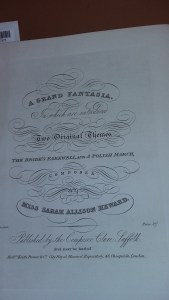 Meanwhile, Martin’s selection of scores included a composition by a young English woman whom I’d never heard of before – Sarah Allison Heward – and a network member in Germany has since unearthed a whole wealth of information about her and her musical family. Watch this space – there’s a blogpost coming up!

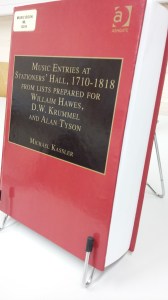 was published before 1819); checking Kassler in digital format is generally easier than in the paper edition, because one can check by title in the e-book. The physical book has various indices, but there’s no alphabetical title listing, and only the composers’ names are listed, not their works.





 cataloguing their historical music collections, and it was with great excitement that I found these Excel spreadsheets online this evening! Looking at the Reid Concert Hall Cupboard sequence, I found Thomas Hamley Butler’s Gin a body meet a body – a piano rondo from 1810. It was registered at Stationers’ Hall on 13 April that year. It’s very late at night, so I didn’t keep looking, but this certainly entices me to look much, much more closely. Extraordinary useful lists, and fabulously fun!
 Karen McAulay, Musicologist