

Today, I took part in Explorathon20, where I showed a tiny videoclip discussing my research into late Victorian and early 20th century Sottish music. (It was actually called the Global Science Show, but it was an opportunity for researchers to showcase their research in whatever discipline. I was probably the token musicologist!)
Researchfish – Safely reeled in!

Funded research clearly has to be documented, and in the UK that involves uploading outputs to a website called Researchfish. I’m glad I was just about up-to-date on my Researchfish entries, so it didn’t take excessively long to check a few entries and submit the whole thing.
It’s a good thing I checked, though. The bibliography is on the blog – and the blog was logged literally ages ago. But today I decided that the bibliography was such a huge output that it deserved its own mention. And although I logged our Brio special issue over a month ago, elsewhere in my earlier narrative I had noted that it was “pending”. I hastily updated that, too! (The Brio issue is all there on Pure, our institutional repository, along with my other research outputs.)
 So as far as I’m concerned, the “fish” has been netted, weighed, documented and forwarded to the distributor! I’ve hit SEND, and now all that remains is to apply for the next research grant.
Well, after a deserved coffee, anyway!
Researchers and Television – an opportunity

I had the opportunity to attend an event sponsored by AHTV and the Arts and Humanities Research Council this week. It took place at the Barbican Centre on Wednesday 5th February, so I travelled down the previous evening, and back to Glasgow on Thursday. The whole purpose of the event was to provide academic researchers with an opportunity to meet with TV professionals, and to learn more about getting one’s research discovered and disseminated through the medium of television.
It was a most informative day. I must confess to feeling a little star-struck when I realised that the keynote address was by Bettany Hughes, whom I’ve seen and admired on television history programmes. Similarly, hearing about the making of ‘Suffragettes’ with Lucy Worsley was fascinating – even if Lucy herself wasn’t actually there! I also availed myself of the opportunity to have a speed meeting with a TV professional.
I’d genuinely love to have the opportunity to get the Claimed From Stationers’ Hall network research out to a wider audience, but my first problem is the fact that we need big names or significant events to hang our story on. However, our primary heroine – Elizabeth Williams, nee Lambert – was, on the face of it a complete nonentity in terms of big names or big achievements. It goes without saying that she wasn’t a nobody in my opinion! (See A Labour of Love for Miss Lambert, also on this blog.) Of course, we know that her music catalogue was significant and highly useful to the music lovers of St Andrews in the late Georgian era. It made the collection much more easily navigable, and hence more useable.
In the wider scheme of things, it demonstrates the importance of work that goes on behind the scenes in libraries to this day. Very few professional cataloguers have a prominent public profile, and Miss Lambert certainly wasn’t a professional of any kind – she was paid a tiny amount for producing a catalogue, and that appears to be the sum total of her ‘official’ involvement. She married at a fairly late age and went off to join her husband, his mother and brothers, in Islington – and there’s not a lot more known about her life apart from her gift of her shell collection to the Natural History Society of Northumbria not long before her death. You could say that her life went as unnoticed as the vast majority of women of her era (and indeed subsequent eras), and yet those two handwritten music catalogue volumes do have significance in their own way.

We have to bear in mind that this veritable mountain of legal deposit music wasn’t exactly what most Georgian university officials wanted in their libraries – it was the books on law, theology, medicine and science that they had their eyes on. The St Andrews professors maybe took a different attitude to most, in allowing non-university music lovers to borrow music through the good offices of their professorial friends. The collection that was clearly important to Miss Lambert was heavily used by both men and women – I interrogated the music in terms of what was most borrowed by various categories of readers. Considering that there were parallel collections in several other legal deposit libraries, we were keen to compare what survived elsewhere, but nowhere else are there borrowing records or evidence of such intensive use. So many stories – but can I argue the case for a television documentary? Well, let’s see!
Icepops 2019 Presentations and Photos
Networking with Other Networks: Panellist at ISECS – International Congress on the Enlightenment

I’m excited to be part of a panel talking about paratext at the forthcoming ISECS Congress, 14th – 19th July 2019, hosted by the University of Edinburgh. Registration is now open, though the detailed programme isn’t yet finalised. (There’s an early bird rate until 30 April.)
Networking with Other Networks: Reframing Heritage through Art Practice at the University of the West of Scotland

Out of the Past, Into the Present: Reframing Heritage through Art Practice
The other day, I saw details of the abovenamed event hosted at the CCA by the University of the West of Scotland’s Creative and Cultural Industries course in the School of Media, Culture & Society. It took place today, and I spent my morning there, hearing about music as a creative response to global warming, music using heritage technology (synthesizers), and documentary film about post-industrial Ravenscraig, about Irish women’s role in rural society some decades ago, and about a pioneer woman engineer.
 You might ask what any of this has to do with Georgian legal deposit music? On the face of it, not a lot. This is partly because although the web announcement named UWS and the titles of the talks, it didn’t name the department or that a couple of the presentations were based on Masters students projects. The department has a contemporary and recent contemporary, rather than a centuries-old historical focus, so there was a divergence of approaches between theirs and mine. Also, partly because I saw the words “reframing heritage” and “art practice”, and I read what I wanted to read. And that’s my fault – but don’t we often do this?! Obviously, “heritage” does not have to mean Georgian. “Reframing” can also include responding musically to something other than music, whilst my own research places heritage music as the primary focus and looks for ways to reframe that, to make it relevant and appealing to people today. But my research response is not to write music (although I’ve been known to write the odd self-indulgent tune!), and – until today – it wouldn’t have occurred to me to produce a documentary film about it.
So, I felt a bit of a dinosaur, really – here were people responding to real global issues, using music and film, whilst I am exploring the history of centuries-old music. You could say I’m reframing it to make it interesting to new audiences, but not in quite the same way! Would anyone be interested in a documentary film about Stationers’ Hall legal deposit music? My fear is that there would be a smaller audience than for the topics being discussed today!
Anyway, back to the drawing-board now. I’m looking for new grants and new directions to take the Claimed From Stationers’ Hall research – better get on with it!
2018 Round-Up: the Scholar-Librarian
Annual Review, 2018
 I am a Performing Arts Librarian 3.5 days a week, and a Postdoctoral Researcher 1.5 days a week. In this self-imposed annual review, I’m not listing routine activities conducted in either capacity; it goes without saying that I’ve answered queries, catalogued, delivered library research training to a number of different class groups, attended meetings, and pursued research-related activities and fieldwork.
From September 2017 to September 2018, I was the AHRC-funded Principal Investigator for a new research network, the Claimed From Stationers’ Hall music research project. Since then, I have continued to conduct research and network with the various scholars and libraries involved with this project, and in the new year shall be pursuing further grant-funding in order to extend the reach of the project.
As someone who continually asks themselves, “Am I doing enough?”, I feel that even I can be reasonably content with this year’s outputs!
- JANUARY
- Chaired sessions at Traditional Pedagogies, international conference at Royal Conservatoire of Scotland
- FEBRUARY
- Blogpost: Copyright Literacy: Legal Deposit (Copyright Behind the Scenes) – and Scores of Musical Scores https://copyrightliteracy.org/2018/02/21/legal-deposit-copyright-behind-the-scenes-and-scores-of-musical-scores/
- Initial iteration of Claimed From Stationers Hall Bibliography, (since updated regularly) https://claimedfromstationershall.wordpress.com/bibliography/
- Book chapter, ‘Wynds, Vennels and Dual Carriageways: the changing Nature of Scottish Music’, in Understanding Scotland musically: folk, tradition and policy. Abingdon, Oxon: Routledge, p. 230-239.
- MARCH
- Claimed From Stationers’ Hall Workshop, Royal Conservatoire of Scotland, (26 Mar)
- Scottish Library & Information Council (SLIC) From PGCert to PG Certainty: Enabling the Distance Learner (invited talk, sectoral organisation) (March 2018)
- APRIL
- IAML(UK & Irl) Annual Study Weekend, invited talk, Pathways, outputs and impacts: the ‘Claimed from Stationers Hall’ music project takes wings
- IAML(UK & Irl) Annual Study Weekend From PGCert to PG Certainty: Enabling the Distance Learner (quick-fire session) (April 2018)
- MAY
- Blogpost based on the session I gave at the IAML(UK & Ireland) Annual Study Weekend 2018 for the IAML(UK & Ireland) blog, http://iaml-uk-irl.org/blog/libraries-reaching-out-distance-learners
- JUNE
- EAERN (Eighteenth-century Arts Education Research Network), ‘Claimed From Stationers’ Hall: But What Happened Next?’ (University of Glasgow, 6 June)
- Romantic Song Network steering group seminar at British Library
- JULY
- IAML/AIBM Annual Congress, Leipzig, ‘A Network of Early British Legal Deposit Music: Explored through Modern Networking
- SEPT
- RMA Conference, Bristol, ‘Overlapping Patterns: the Extant Late Georgian Copyright Music Explored by Modern Research Networking’
- NOV
- Field-trip to King’s Inns and Trinity College Dublin Libraries, and British Library
- EFDSS Conference, London, ‘National Airs in Georgian British Libraries’
- ARLGS (Academic and Research Libraries Group Scotland) Teachmeet at Glasgow University Library – speaker
- Article, Trafalgar Chronicle, New Series 3 (2018), 202-212, jointly authored with Brianna Robertson-Kirkland, ‘My love to war is going’: Women and Song in the Napoleonic Era’.
- DEC
- Article, Information Professional, Nov-Dec 2018, ‘Coffee and Collaboration’ [teaching electronic resource strategies]
Additionally, I have authored 79 blogposts and 5 Newsletters in connection with the Claimed From Stationers’ Hall research project.
 Institutional Repository: Pure. My profile:- https://tinyurl.com/KarenMcAulayPureInstRepository
I’ve blogged elsewhere about my musical and sewing activities – both essential to me in terms of relaxation and balance! You’ll find it here:-
https://karenmcaulay.wordpress.com/2018/12/22/2018-round-up-in-creative-mode/
Researchfish – Little Fish in a Big Pond
When one is awarded a grant by a major research body, obviously accountability is a  very important consideration. To that end, activities have to be logged on the poetically-named but very definitely serious Researchfish website. All big scholarly funders use it, asking for details of such matters as publications arising out of the research, further funding, engagement activities (there’s quite a bit I can enter here!) and so on.
At first sight, it’s a bit intimidating, but once I’d downloaded a list of “Common Outcome Types with sub-types”, and crossed out the columns in which no-one would remotely expect me to have outputs (Medical Products, Interventions and Clinical Trials, or such Research Tools as Biological samples, or human models of mechanisms or symptoms), it didn’t look quite so bad. I do feel a bit like a little fish in a big pond compared to people winning major awards to find cures for horrific diseases, design new space rockets, or solve the greater political and social conundrums of our age. Still, one has to start somewhere!
So, my activity for the rest of today will be to go through the list I’ve already compiled, and add the various presentations, blogs and guest-blogposts, and so on, and just see how far I get! For one-and-a-half days a week over 13 months, it looks okay – well, in my opinion, at any rate! As I’ve said often enough before, watch this space.
Latour – Piano Professor & King’s Pianiste
Followers of this blog will know that you can look at historical piano teaching materials in the libraries that hold legal deposit collections. Nowadays, there are a handful of big national and university libraries in the UK that still receive one copy of everything published, under statutory legislation. But there are other libraries – especially in Scotland – that also received this material, until the beginning of Queen Victoria’s reign.
Theodore Latour was pianist to King George IV – Victoria’s uncle. He taught privately and at girls’ schools, played and composed, and also wrote some piano tutor books. As it happens, Emily Bronte had music by Latour in her collection, including one of his books of progressive exercises, although I haven’t examined that particular publication. (Robert K. Wallace mentions it, in his Emily Bronte and Beethoven: Romantic Equilibrium in Fiction and Music.)
It’s possible to find copies of some of Latour’s works online via Google Books, IMSLP or Archive.org, so if you’re interested, we could point you in the right direction.
I have been experimenting with other ways of talking/writing about the Stationers’ Hall Georgian legal deposit music corpus. Here are my Saturday afternoon efforts. Have you tried any such audiovisual presentations in your own research? Do you find them helpful?
We’re a research network! (And Scroll Down for the Pixis Variations Challenge!)
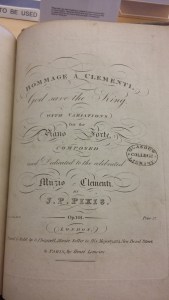
It feels like time for a quick update, so I’ll spend the last few minutes of the working day doing just that. Here’s a quick reminder of what the Claimed From Stationers’ Hall music research network is all about:-
The project is investigating the music deposited in the former British Copyright Libraries under the Queen Anne Copyright Act and subsequent legislation up to 1836, when most university libraries lost their legal deposit entitlement, receiving book grants instead. The repertoire largely dates from the late 1780s (when legal action clarified the entitlement of music to copyright protection) through to 1836.
The project aims to establish what exactly has survived; whether there are interesting survival patterns; and the histories of the music’s acquisition, curation and exploitation, not just in during that era, but also subsequently. It also aims to raise the profile of the material and to foster more engagement with it, both within and outwith academia; and the repertoire can be used to inform historical cultural perceptions which often became embedded into contemporary writings; for example, an idea very prevalent during the 19th century was that the English had no national music; and yet collections of national songs were very popular. Thus, both the fact that these books were popular, and our close reading of the paratext within individual volumes can be used to inform our modern-day understanding. But a nation’s music is not just “national songs”, of course – it’s the whole repertoire of music published within that country.
To date, I’ve visited the University Libraries of St Andrews, Edinburgh and Glasgow. I’ve been in touch with retired scholars from Aberdeen, and I’ve visited the National Library of Scotland. Next, I need to spread my wings south of the border, and hopefully after a few more such meetings, we’ll have a clearer idea of what we’d like to talk about when we plan a study day to be held in Spring 2018.
The exciting, and yet tantalising part of all these visits is the realisation that there is a lot to explore, but not being able to stop and do all the research then and there! For example, there are undoubtedly pieces of legal deposit music at the University of Edinburgh that aren’t labelled as such, but that appear in other copyright libraries and therefore probably arrived by the same means. I so long to find them all, or to encourage other people to find them! Similarly, the University of Glasgow has a very generous collection of copyright music – alluded to by the late 19th century author, W. P. Dickson amongst “works of fiction, juvenile literature, fugitive poetry, and music … issued yearly from the press” – but previously summarised by Divinity Professor Dr McGill in 1826 as “a great many idle books”. (Dickson, The Glasgow University Library, 1888 p.16) I’m eager to see if I can work out which volumes they might have been in before they were re-bound into their present volumes! Meanwhile, the National Library of Scotland has an online catalogue, a card catalogue, but also “the Victorian catalogue”. This I must see!
It is interesting to reflect that earlier musicologists have also had a hand in the arrangement and preservation of these materials. Cedric Thorpe Davie in St Andrews disbound some volumes, and moved pieces to different places in the library. Fourth Reid Professor Donaldson got involved with the Advocates’ collections in Edinburgh; Hans Gal had a go at listing some of the Edinburgh University Library Collections; and Henry Farmer spent some time in what for anyone else would have been retirement, as a music librarian at Glasgow University Library – one of the many careers in his portfolio! – and yes, he did some sorting out and rearranging, too. Whilst we sigh over the thought of original sources being shuffled, we also owe these chaps a debt of gratitude for taking care of them and ensuring that they were preserved at all.

Prof. John Donaldson, from the National Galleries of Scotland

Henry Farmer, from the Henry Farmer papers at Glasgow University

Hans Gal

Cedric Thorpe Davie
The Pixis Variations Challenge
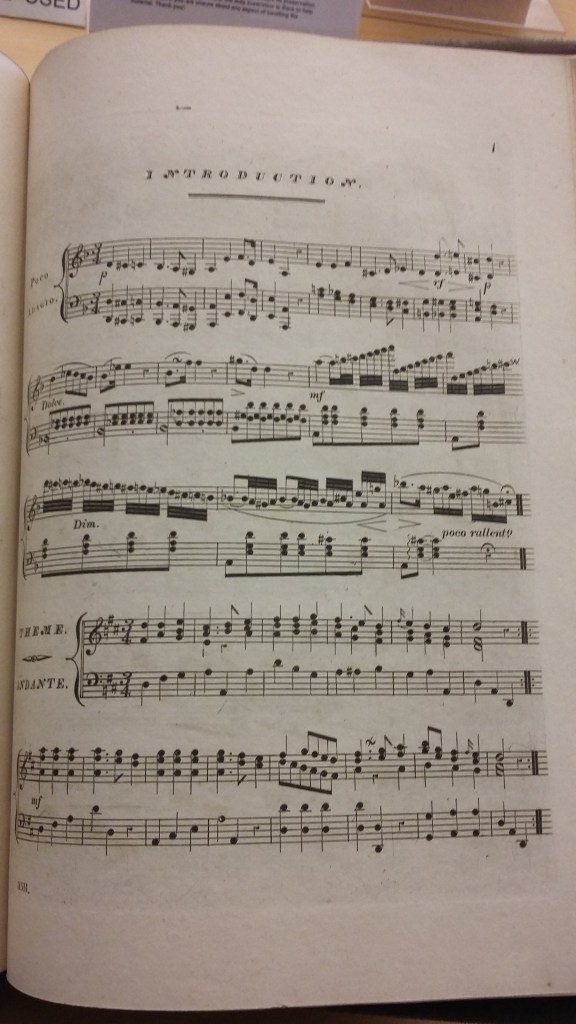
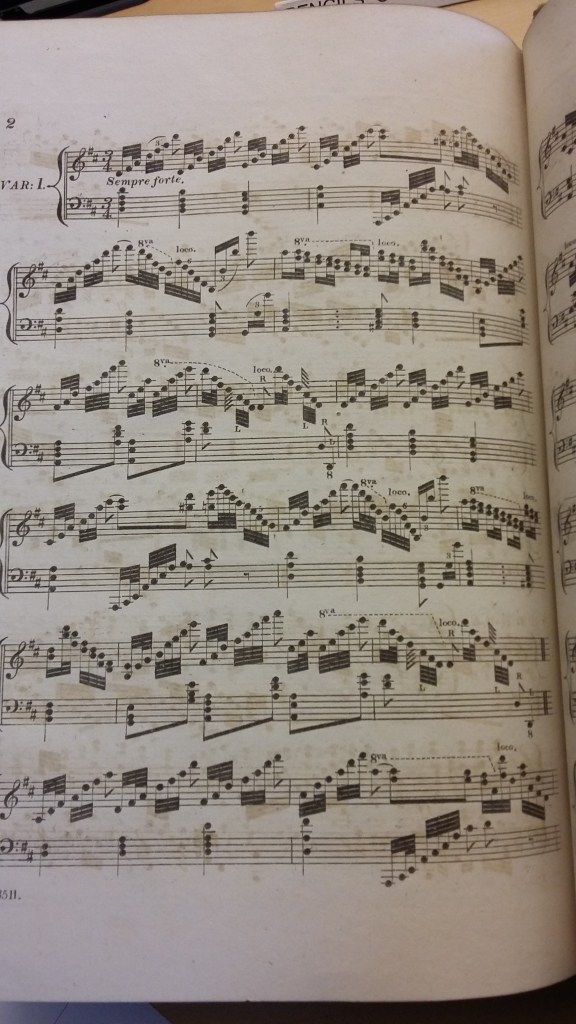
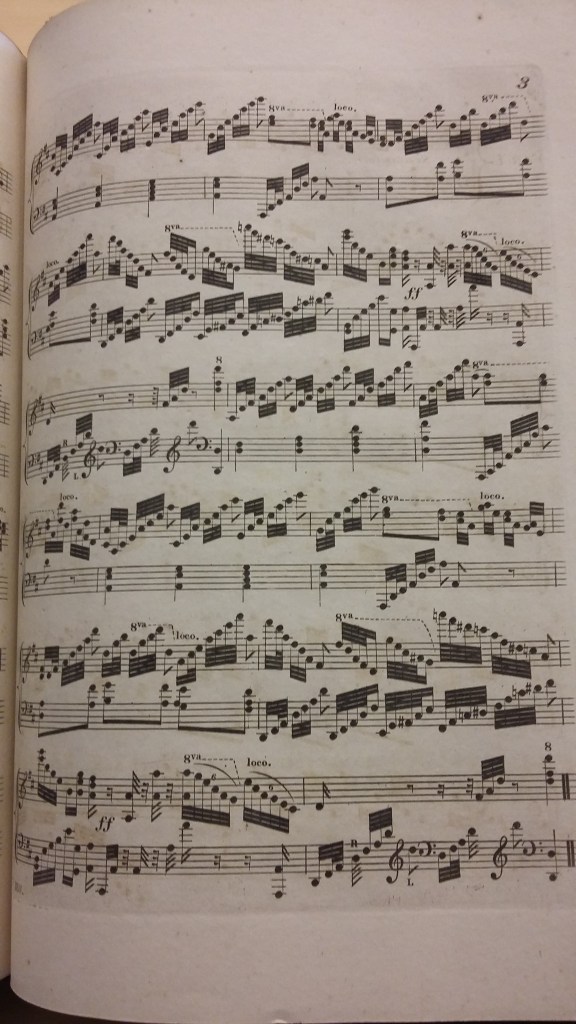
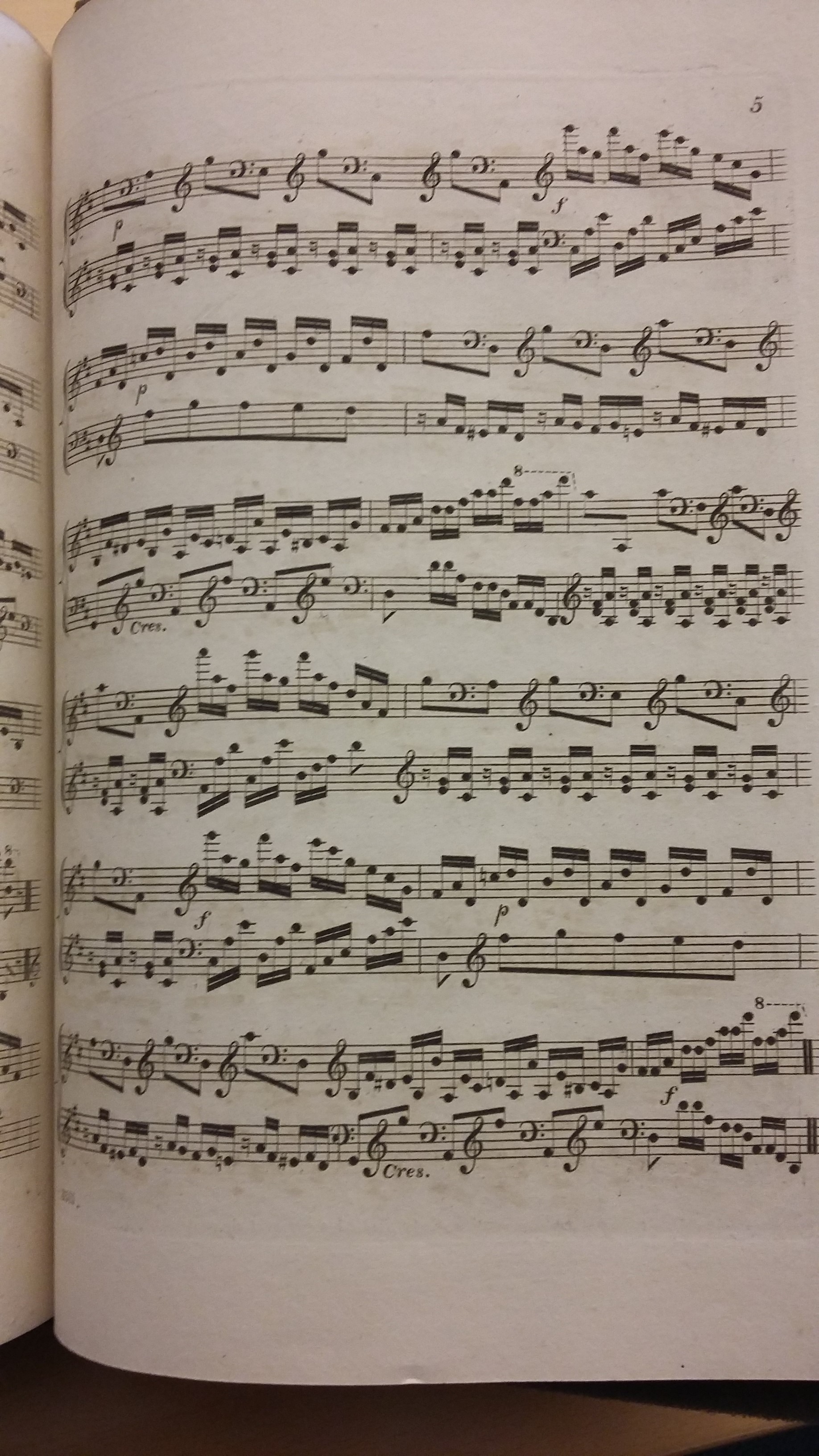
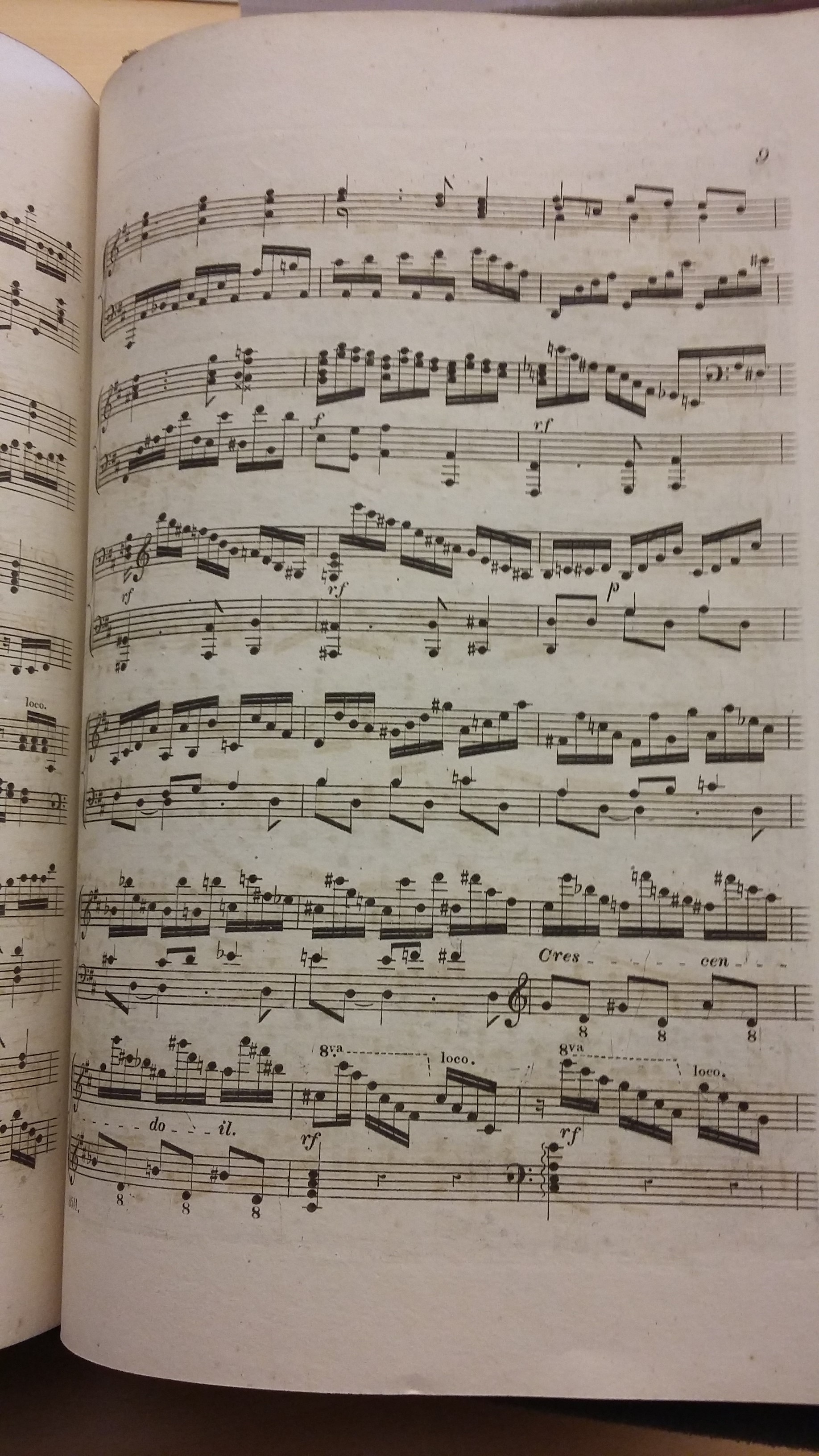
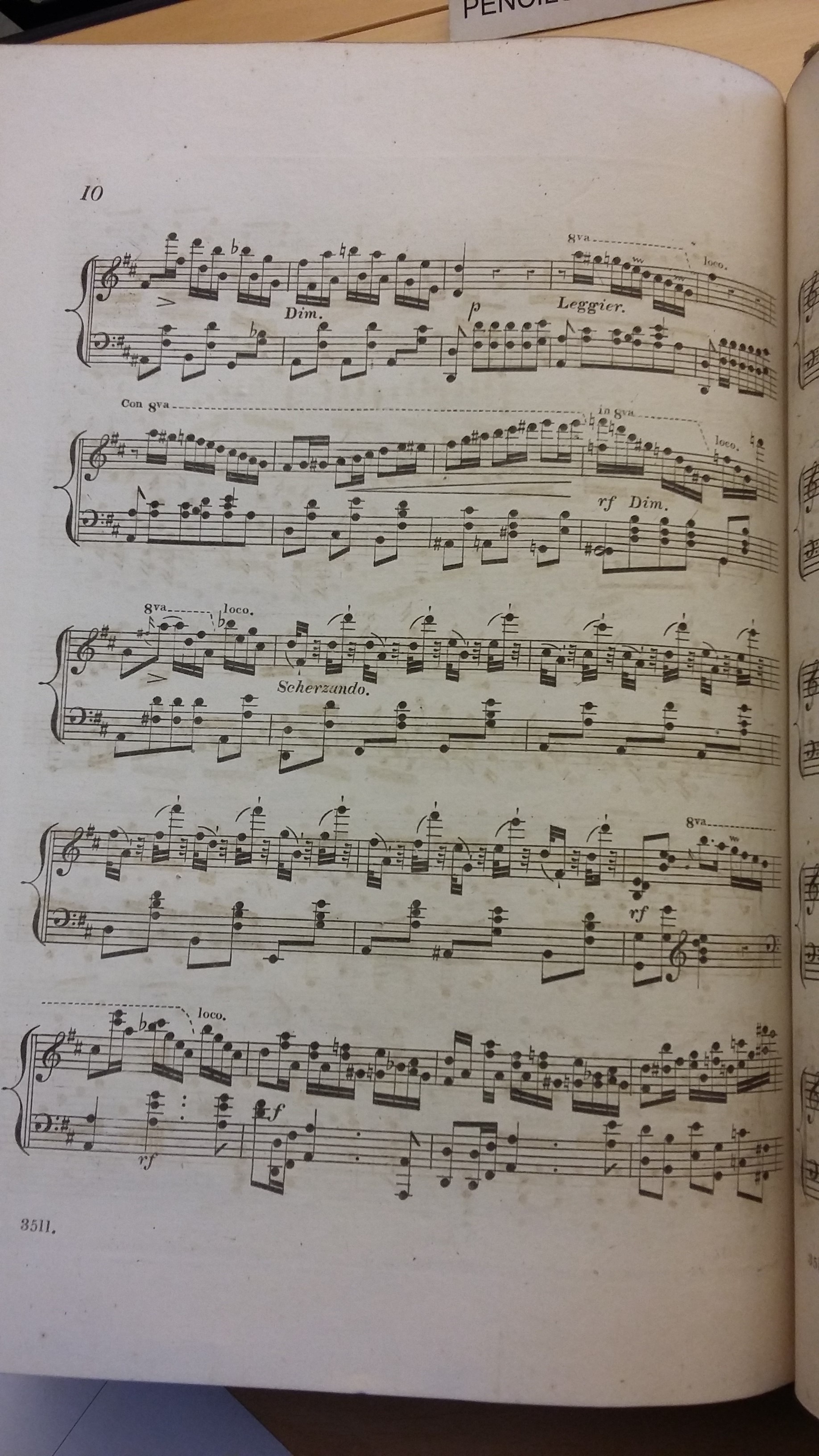
I long to play, or hear performed, some of these long-forgotten treasures. I’ve been generously allowed by the Special Collections department of Glasgow University Library, to share a set of piano variations by the now forgotten German composer, Pixis: Hommage a Clementi, which are actually based on the National Anthem, ‘God Save the King’. I’m putting them on our Twitter feed and Facebook page, one page at a time. At page 3, my pianistic skills are already being stretched beyond their comfort zone! I wonder if anyone will get to the end …. ? PLEASE let us know if you do!
Other pieces were undeniably less interesting. I tweet “on this day” posts about some of the pieces that were registered, just to give a flavour of what was being published. These references come with no value-judgements whatsoever! Luckily for me, I don’t have instant access to all these pieces, so I would only go out of my way to hunt down something that looked particularly intriguing.
Here, for the record, is the start of Pixis’s variations – I’ll add the rest in due course. Please do keep following the blog! And I’m pleased to say that it’s not long before the first of our guest postings will appear – a welcome change of “voice” and a fresh insight into a different aspect of this fascinating topic.




 Karen McAulay, Musicologist