University of Nottingham, you cannot drop Music and Modern Languages!

Nottingham University view from Pixabay

The screenshot below, is of the University of Nottingham Music Department homepage. A flourishing department, which sadly hit the news for all the wrong reasons a couple of days ago.
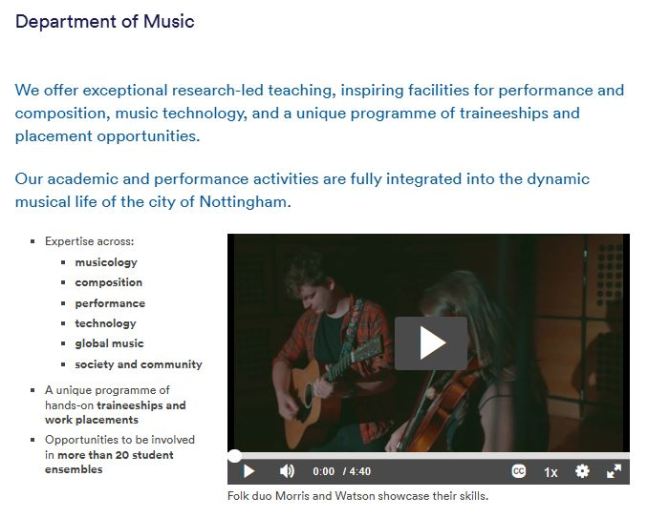
Snip from Nottingham University Music Department homepage

BBC News:- University to suspend music and language courses

Music graduates and linguists across the UK (and beyond) will have been aghast to learn that the University of Nottingham is suspending its Music and Modern Languages degree courses. Allowing present students to complete their courses, that is, but not taking any new entrants.

Now, I’m not a Nottingham graduate – I’ve no connection with the University at all (apart from having declined a graduate library traineeship back in 1982, for reasons entirely unconnected with Nottingham University Library). Nonetheless, I know, after my own academic music-related career, that the department has an excellent name. I also know – since I have a BA (Hons), MA and PhD in Music – the value of a music degree.

The decision to suspend teaching music seems to me to be a very retrograde step. It is true that students can still be offered the chance to sing in choirs, play in orchestras and so on, but recreational music, at however high a level, is hardly the same as academic study. To suggest that ‘they can still make music’, puts me in mind of 1920s and 1930s pedagogy, where music was often considered a ‘practical’ subject like sewing, art or woodwork, rather than an academic discipline. Don’t get me wrong – I am certainly not denigrating these subjects. Indeed, if I’m not studying or making music, I can usually be found with a needle and thread. I am a creative individual. However, I wish to make the point that even ‘practical’ creative subjects can be studied in a scholarly sense.

So, since I’m now semi-retired, what can I do to help? Arguably, not a lot, but I can use my voice to make a bit more noise. Let me outline what I studied in my own music degrees, decades ago; and then I’ll share how the knowledge I gained has been put to use in my subsequent career. Nottingham’s Music Department homepage offers expertise across: musicology, performance, composition, technology, global music and society and community – a similar, but updated list of what I studied in Durham, Exeter and Glasgow.

My Own Undergraduate Music Experience

  • Score-reading
  • Harmony & counterpoint
  • Aural training
  • Music history (musicology)
  • Music analysis
  • Ethnomusicology (not global; I studied Javanese Gamelan music)
  • Electronic Music
  • Composition
  • Writing about music
  • Acoustics

My own Masters and PhD Music Journey

  • Music history (musicology)
  • Analysis
  • Cultural and social history
  • Writing about music

I studied librarianship after my first, unfinished PhD, spending my career as a music librarian, but I returned to research mid-career and thereafter combined librarianship and research. I didn’t become a teacher, which was one of the traditional destinations for music graduates; neither could I find a way into arts administration. So, music librarianship seemed a sensible choice.  I worked briefly in the public library sector,  and then in academic librarianship. But ask around, and you’ll find music graduates in all sorts of careers.

What did I gain from my music degrees? Well, as a music librarian with appropriate academic music qualifications, I was very much a subject specialist, and was appreciated as such. Simply being in a choir or student orchestra, without the academic study, wouldn’t have made me as knowledgeable.

The Value of Knowing Your Subject: the Evidence

  • Many thanks for all your efforts in finding all this music!
  • I showed the class the print-out from this CD record sleeve, which was very relevant
  • Thanks very much for your enlightening and entertaining contribution yesterday.
  • A very thorough and impressive piece of research
  • Thanks! HOW do you do it?  I can hardly contain my exuberance.  When I’m running the planet, you’ll get the money your worth and  3 extra vacation days.  Promise!
  • Just wanted to thank you so v much for all your help yesterday. It was a great help to come in and find all the music ready
  • Thanks for your efforts – they are very much appreciated.
  • [they said] the Library was a great resource: [they had] come in to find four fairly obscure things and we had (and helped find!) all four.
  • Will mention your wonderful help in the programme notes! 🙂
  • This very useful, thank you! 

And as an organist and choir director? I use my skills on a weekly basis: arranging music; transposing it; writing it; choral training; and planning/developing repertoire.

Lastly, as a music postdoctoral fellow? Enough said. I wouldn’t be researching at a postdoctoral level if I hadn’t studied it at university first.  My research has often focused on the region where I live, but also on music in education and society.

It seems to me a crying shame to cut music degrees, denying students future opportunities, and (presumably) cutting staff with immeasurable expertise in their subject. The city of Nottingham, too, will lose out from the expertise that is lost to the region.

Modern languages are every bit as important. How can you have a university that doesn’t teach modern languages?  You want translators? Teachers? People who can conduct business, or write books, or manuals, in a language other than English? Or careers where language graduates bring their own aptitudes? (A friend of mine went into computing, because their linguistic skills apparently made them eminently suitable for that path.) So you need modern language graduates!

My late music-teaching, comprehensive school head of modern languages father will be turning in his grave!

Take Action

Change.org Stop the suspension of undergraduate music courses at The University of Nottingham

Change.org Stop the removal of Modern Languages courses at the University of Nottingham!

Image by David Reed from Pixabay
15 Years a PhD

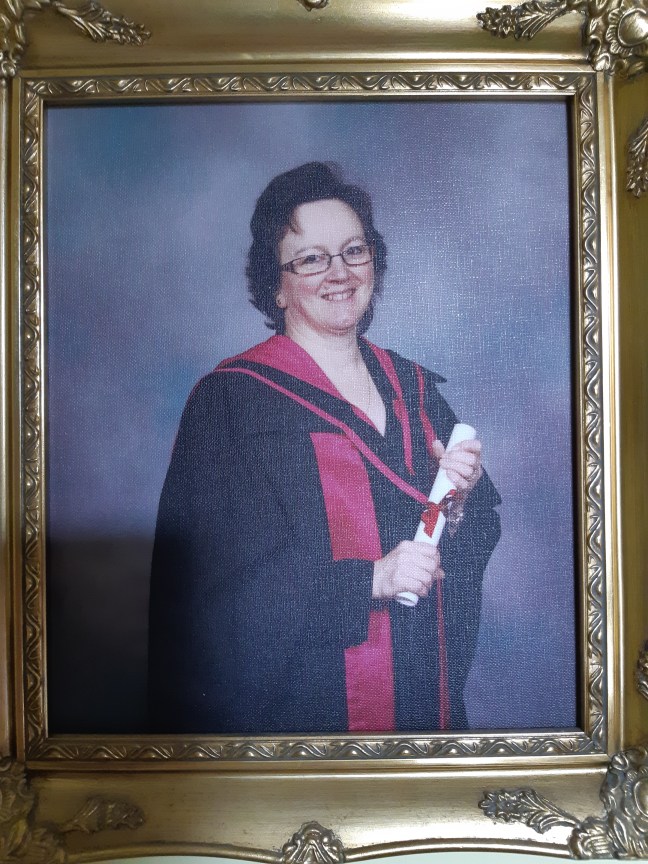
Facebook has just reminded me it’s 15 years since my doctoral graduation.  Heavens, where did the time go?

Two Knees and a PhD

Summer 2009 was quite a summer!  I submitted my thesis. He had two knee replacements, three months apart. He walked comfortably at my graduation ceremony.

Baking is not really one of my strengths!

Since then? Too much to enumerate. The thesis became a book.  I contributed chapters to others’ essay collections. I published another book last month.

Why would a Librarian want a PhD?

Someone asked that, before I even started. I think I’ve demonstrated why.

Why would a Librarian want a PGCert?

Someone asked that, too. It seemed a good move at the time, and I have recently been doing a little teaching cover, proving that this wasn’t such a bad idea, either.

If one thing is certain, I wouldn’t now have a semi-retired existence as a postdoctoral research fellow, if I hadn’t found three old flute manuscripts in a cupboard that was being dismantled, a couple of years before I started the PhD.

No regrets.

Trains, Trossachs, Choirs and the Council: Neilston Parish Church’s First Organist

I have contributed an article about the first organist of Neilston Parish Church, to the Glasgow Society of Organists for the September 2022 issue of The Glasgow Diapason: Newsletter. It doesn’t really relate to my own musicological research, apart from its connection with amateur music-making in the West of Scotland in the late Victorian and Edwardian eras, but I thought I’d share it here as well, since I had a lot of fun writing it!

Trains, Trossachs, Choirs and the Council

Dr Karen E McAulay, Neilston Parish Church

Moving from an Allen organ in a post-war church, to Neilston’s historical tracker action instrument, I’m enjoying the new playing experience, and change of scenery getting there.  My research interests in Scottish music history mean I’m also intrigued by the church’s long past.  Although not everyone is enthralled by local history, I love finding out what mattered to people in their everyday lives, and I wondered what I could find out about the very first organist. As you’ll see, someone – the organist himself? – kept the local press well-informed about his activities.

Neilston Parish Church Organ

Neilston got its Conacher organ in 1888, when the church decided their three-year old harmonium wasn’t sufficiently supportive of congregational singing.  Two ladies of the congregation made generous donations, the balance being found by the rest of the congregation. The organist, master grocer Hugh Gibson Millar (1859-1932), had inaugurated the harmonium, and now led a ‘select choir’ in a grand Friday inaugural musical entertainment, accompanied by Mr Fraser of Queen’s Park Church.  The new organ occasioned a new pulpit being built, the old one banished to the manse!  (The old manse has been demolished, and the pulpit disposed of before living memory.  Maybe when the bachelor incumbent was promoted heavenward, his successor didn’t want this extra furniture.)

Neilston village had not only a flourishing church choir, but also a Tonic Sol-Fa Society.  (Despite classically-trained musicians regarding the sol-fa system disparagingly, it was undeniably the means of many working and not-so-working class singers learning to perform music, at home or in a choir, from the late 19th century well into the 20th.)  Some people were in both, causing problems when the same day was double-booked for a concert in December 1888.  There was a flurry of angry “letters to the Editor” about this, with Neilston Parish Church Musical Association wading into the fray!

Millar was the son of a Kilmarnock shoemaker.  Marrying in Kilmarnock, he lived and worked as a grocer in Glasgow for a couple of years, but they moved to Gertrude Place in Barrhead sometime between 1881-1883.  By 1896, he had shops in Barrhead and Neilston, and the following year he was advertising for a boy to work in an ironmonger’s shop.

Ambitious and undoubtedly talented, he got a Mus. Bac. from the University of Trinity College, Toronto in 1896.  This external qualification (early distance learning?!) was discontinued in 1897, and the University merged with the University of Toronto not long after. By the 1920s, degrees like his were dismissed as bogus by many. Nonetheless, the press reported significant exam successes by his pupils. (Millar’s degree was reported by the press in connection with any musical activity, but not with his trade.)  The year he got his degree, one of his female pupils excelled in practical and ‘Musical Knowledge’ exams with Trinity College London, whilst in 1901 Robert Craig of Barrhead got top marks in Musical Knowledge, and was reported as studying organ, harmony, counterpoint and music history with Millar. 

The newspaper reported a Christmas service led by Millar and the choir in 1898, including what was performed.  The choral items later appear in the United Free Church of Scotland Anthem Book (1909), clearly popular choices.

  • Smith, R. A., How beautiful upon the mountains,
  • [Elvey or Hopkins] Arise, shine, for Thy light is come
  • Hatton, J. L., Let us now go even unto Bethlehem
  • Batiste, Édouard,  Angelic voices [organ]
  • Handel, G. F., March in Scipio [organ]

Choir outings were popular in the two decades before the Great War. (You have only to look at eBay listings for choir trip postcards!)  The Barrhead News reported an outstandingly successful choir outing by train to Callander and the Trossachs, led by Millar ­­and the Revd. Robert Barr in June 1899.  They had a great time, with unspecified high jinks in the railway tunnel between Queen Street and Cowlairs; a picnic by the banks of Loch Katrine, provided by the young ladies of the choir; and singing and violin playing on the way home, arriving back at 11pm.  An evening party on another occasion seems to have ended after midnight!  Being in a church choir plainly enhanced one’s social life.

Within a month, though, he was moving to play a Willis organ at Clark Memorial Church in Largs – reported as a step up, with a good organ and a better salary.  Indeed, his census return in 1901 finds him living in a fine terraced house with a sea view on Aubery Crescent, Largs with his wife and thirteen-year old Andrew.  Millar was described as an organist – not a grocer – and Andrew as an organist’s apprentice. Hugh and Sarah’s two older boys had clerking jobs, and were apparently staying with an ironmonger’s family back in Gertrude Place. The Millars seems to have had homes in both Largs and Barrhead from then on, as later confirmed by his death certificate. 

He was barely at Clark Memorial two years, when the Barrhead News announced in September 1902 that he had left, and was resuming music teaching in Barrhead.  His home, ‘Hughenden’ in Gertrude Place, by now had a Conacher organ of its own, available to pupils for practising; there’s no further mention of being a church organist. 

1903 saw him becoming local secretary for an examination board called the International Music College, a one-man concern run by a music-teaching organist in London.  Millar also made enquiries about the water supply for a water-powered chamber organ – another domestic instrument, or was he moving the Gertrude Place instrument? – in a house he proposed to build on Neilston Road.  Described again as a grocer, 1904 saw him standing for election as a councillor in Barrhead. The following year, Councillor Millar, Mus. Bac., FRSM, did have all his qualifications reported!  In time he became a bailie, and finally, Provost. 

Millar died in 1932, in Aubery Crescent, Largs, but his death certificate gave his usual residence as ‘Sandringham’, Paisley Road, Barrhead.  The Scotsman published his obituary:- ‘Hugh G. Millar carried on business in Barrhead, was a member of the Town Council for about 25 years, and served two terms in the civic chair. He also represented the burgh on Renfrewshire County Council for a long period. He had a residence in Largs for 30 years, and took a keen interest in local municipal affairs, being Chairman of the North Ward Ratepayers Committee.  The ex-Provost, who was 73 years of age, is survived by a widow and three sons.’

A man of many talents, he seems to have had a comfortable, varied and interesting life.  His shoemaker father would never have guessed that his tradesman son would end up probably the first Barrhead provost with a music degree, a diploma, two homes and his own chamber organ!

Music Professors, Degrees and Curricula

Last week I shared some of my findings and thoughts about the absence of sheet-music at Trinity College Dublin in the early 19th century (see Literary Minstrelsy: the Books Trump the Scores!).  To be fair, there was neither music professor nor music department at Trinity in the Georgian era, so the absence of sheet-music probably barely caused a ripple!

Nonetheless, I provoked a little Twitter-storm of knowledge exchange on the subject of TCD music degrees, and I saved that conversation into a Twitter moment, in order to keep record of the thread: Minstrelsy, Music and Honorary Degrees. (2018-11-21)

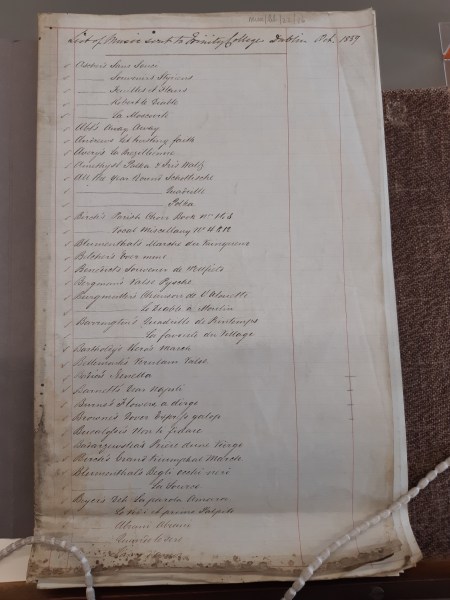
Music received from Stationers' Hall 1859-1860
Music received from Stationers’ Hall 1859-1860

I was recommended a chapter contributed  by Lisa Parker to Paul Rodmell’s ‘Music and Institutions in Nineteenth-Century Britain’, which I read with interest this morning.  Whilst the history of music education at the University of Dublin really took off after the Georgian era, I find it interesting to look ahead to see how things did ultimately develop.  As I mentioned last week, the earliest listings retained from Stationers’ Hall dated from 1859-60.

Parker’s chapter perhaps helps us understand why it took so long before there was much interest in curating music in the library, so I’ve extracted a timeline which I think you might find informative:-

  • 1612   TCD first awarded a Bachelor in Music degree – MusB
  • 1764   Appointment of the first music professor, Earl of Mornington, Garret Wesley (1735-81) – his role seemed to be in composing suitable pieces for TCD occasions.
  • 1774 Mornington resigned, and wasn’t replaced for 73 years!
  • 1827 John Smith, the man who would become the next professor some years later, received his MusD – a music doctorate.  This didn’t mean he had done the kind of intensive study that doctoral students do today!  There had been no requirement to be residential, no course of teaching and learning, and no thesis.
  • 1844-1846 – Robert Prescott Stewart, who would later become John Smith’s successor – became organist of the chapel, and then also conductor of the university choral society.
  • 1847 John Smith was appointed music professor. Opinion was divided about his expertise.  His only duties entailed assessing ‘submitted exercises’, but there’s also reference to a lecture.  He could teach private students but gave no ‘formal tuition’. There were still no student residency requirements, and only four music degrees (other than honorary ones) were awarded in his 14 years’ professorship.
  • 1851 only now did Smith get his doctoral robes (TWENTY-FOUR YEARS LATER – not impressive! David O’Shea informs me that the gowns were copied from the Oxford style of academic dress, since there weren’t actually gowns for music degrees at TCD prior to this).  Smith got these at the request of the choral society (not the university authorities) – and it looks as though Stewart received HIS robes at the same event, with the latter’s MusB and MusD exercises being performed.
  • 1861 Smith died.
  • 1862 Robert Prescott Stewart became professor, also remaining in the roles of University organist and conductor of the University of Dublin Choral Society His duties involved conducting the exams and presenting candidates at graduation, but he could also deliver public lectures if he wished, and could give private instruction to members of university.  Shortly after his election, introduced literary examinations, and introduced a requirement for music students to matriculate in a variety of arts subjects.  This was influential upon music degree arrangements at Oxford and Cambridge.)  That decade, requirements were tightened up and spelled out, as to what was needed in degree compositions.
  • 1871 Stewart’s duties were revised, and class lectures were required.  These could have been the public lectures he gave between 1871-77.
  • Parker notes that 97 music degrees were awarded to 63 candidates during the period 1862-1894.  It’s noteworthy that music degrees were often not regarded as being as rigorous as other kinds of degrees – and that they tended to be awarded to church musicians.  It would be interesting to see if this was reflected in the library stock, both of scores and texts, although I won’t let myself be distracted just now!

The above information is all from Parker’s chapter, which I’ll reference fully below.  Much of Parker’s chapter is about Stewart’s work on the syllabus, and then Ebeneezer Prout’s, so it’s about an era later than my main focus.  In an effort to remain focused, I skimmed these last pages, but at least I know they’re there if I need them.  (I’ve generally used 1836, the change of copyright and legal deposit legislation, as my cut-off date, but of course, legal deposit was still being made at a smaller number of universities, and Trinity College Dublin was one of them.)

TCD musicologist David O’Shea comments that librarian James Henthorn Todd was involved with music in the library collections around Smith’s time, so I need to refer to Peter Fox’s 2014 monograph about the Library to find out more in this regard.  (The book is sitting at home on my desk, demanding my attention, so this won’t be a hardship at all!)

REFERENCES

Peter Fox, Trinity College Library Dublin : a history (Cambridge: Cambridge University Press, 2014)

Lisa Parker, ‘The expansion and development of the music degree syllabus at Trinity College Dublin during the nineteenth century’, in Music and institutions in nineteenth-century Britain, ed. Paul Rodmell (Ashgate, 2012), pp.143-160