A Touch of Tartan

Red McKinnon, MacKinnon tartan sash with The Scottish Clans Association of London badge

Do you want any more Flora Woodman,  or have I said enough?! I published an article earlier this year – same subject matter as my paper today, but certainly not the same piece of writing:-

‘The ‘Scottish Soprano’ and the ‘Voice of Scotland’: the Importance of Nationality to Flora Woodman and Robert Wilson’, History Scotland Vol.25 no.1 (Spring 2025), 74-81

Public library e-magazine apps may still provide access to the issue, though History Scotland is no longer published. I believe you can access it via the former publisher, too. Let me share the message I received from History Scotland a few weeks ago:-


I made a McKinnon tartan sash as a ‘prop’ for my talk. That was Flora’s mum’s family tartan, going back a few generations. Flora said it – I haven’t verified this!  It also bears the Scottish Clans Association of London badge – oh, I take these things seriously!  (If you are reading this after the event but missed it – I only wore the tartan sash for 15 seconds to show how it would be worn.  Minimal cultural appropriation was committed.)

As we answered questions after the first three talks, something occurred to me. Flora had something significant in common with her Scottish Clans Association of London audiences. The vast majority of them were of Scottish descent, and – like Flora – quite a few of them would have been born outwith Scotland. To them, she was quite simply, Scottish, the same as they themselves were. No-one was going to accuse her of not really being Scottish, because that would negate their own sense of Scottishness too. If Scottish blood flows in your veins – you’re Scottish, wherever you are.

(Me? No, no, I’m only as Scottish as my surname!)
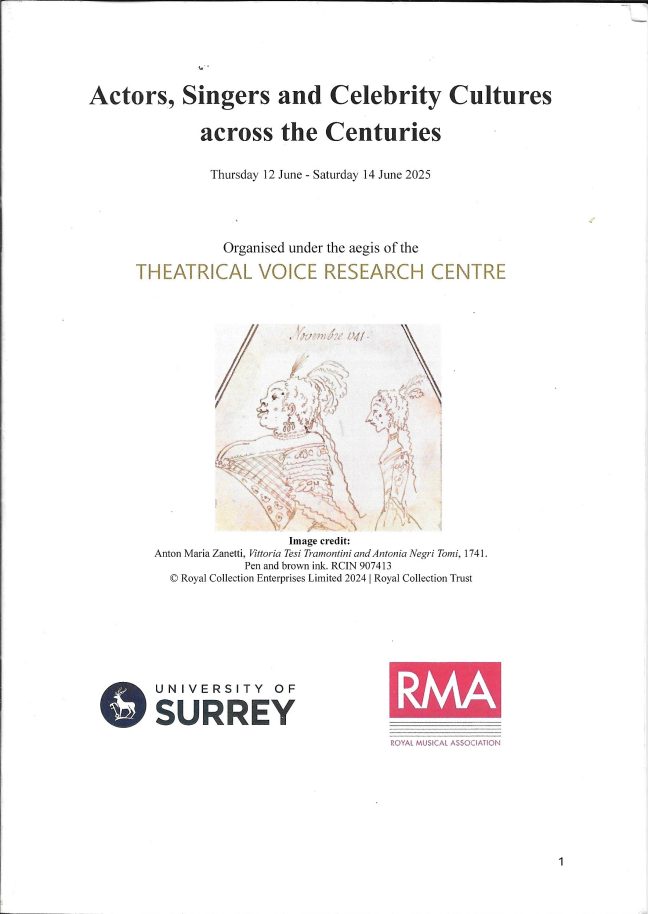
Conference Programme: Actors, Singers and Celebrity Cultures across the Centuries

Abstract

Concerts, Deportment … and Accessories

A strange coincidence occurred to me last week – I encountered conductor Landon Ronald in two quite different research contexts.

Firstly, I knew that soprano Flora Woodman appeared in at least a couple of concerts with Landon Ronald (1873-1938), Principal of the Guildhall School of Music. (Possibly more – but I was mainly focusing on her repertoire as I went through her logbook and scrapbooks.) However, I did note in her scrapbooks of press-cuttings, en passant, that she wished it to be clarified that she was not his protegee. Interesting – but there’s really nothing more to be said. If she wasn’t, she wasn’t.

Nonetheless, I had also encountered Landon Ronald in a different context last week. In 1936, Thomas Nelson published a book, Let’s Get up a Concert by Rodney Bennett (1890-1948, father of composer Richard Rodney Bennett) and H. S. Gordon, with a preface by Sir Landon Ronald and Illustrations by Joyce Dennys. Landon Ronald again! Nothing to do with Woodman this time. Indeed, it may not have a great deal to do with Landon Ronald either. I’ve found no evidence that he didn’t author the preface, but I do have evidence that someone else paid a ‘big name’ to put their signature to a preface for another book, in full knowledge that the ‘big name’ could be mentioned in book promotions and would undoubtedly add appeal and authority to the book. If Thomas Nelson allowed one author to do this, who’s to say they didn’t with others too?

Now aged 63, Ronald was still Principal of Guildhall, but he says he no longer promotes concerts. He alludes to his experience of ‘hundreds of orchestral concerts in the Summer Season on Sunday evenings at that most democratic of all holiday resorts, Blackpool’ (yes, Flora performed in Blackpool too) – ‘and an unbroken series of four hundred Sunday afternoon orchestral concerts at the Royal Albert Hall.’ (Plenty more about him on the CHARM website, which is the AHRC Research Centre for the History and Analysis of Recorded Music.)

But back to Bennett’s book. Part Two consists of practical advice to performers: dealing with nervousness, platform technique –

However much you desire to pop off like a frightened rabbit, don’t.

‘Walk like a Dancer’

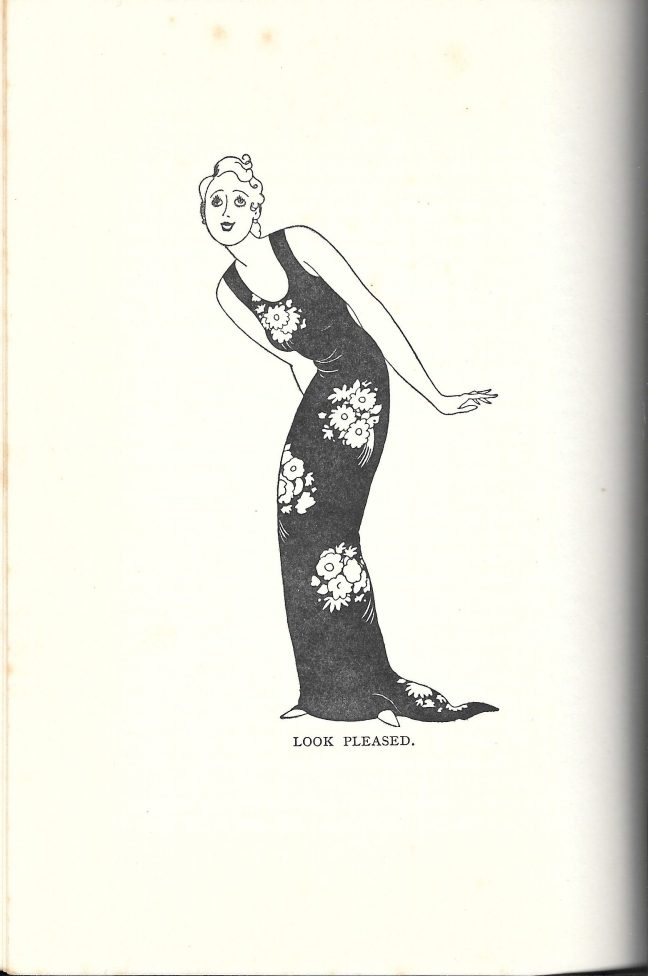
The eager would-be concert performer is advised to ‘learn from professionals’ (p.135) especially from foreign artists, whom Bennett says are more accomplished in this regard – and about ‘pleasing the eye’ (p.136). You must ‘walk like a dancer’, and ‘support [the man in charge*] with unfaltering loyalty’, whilst pianists should appear to be a ‘natural, kind-hearted, happy human being’.

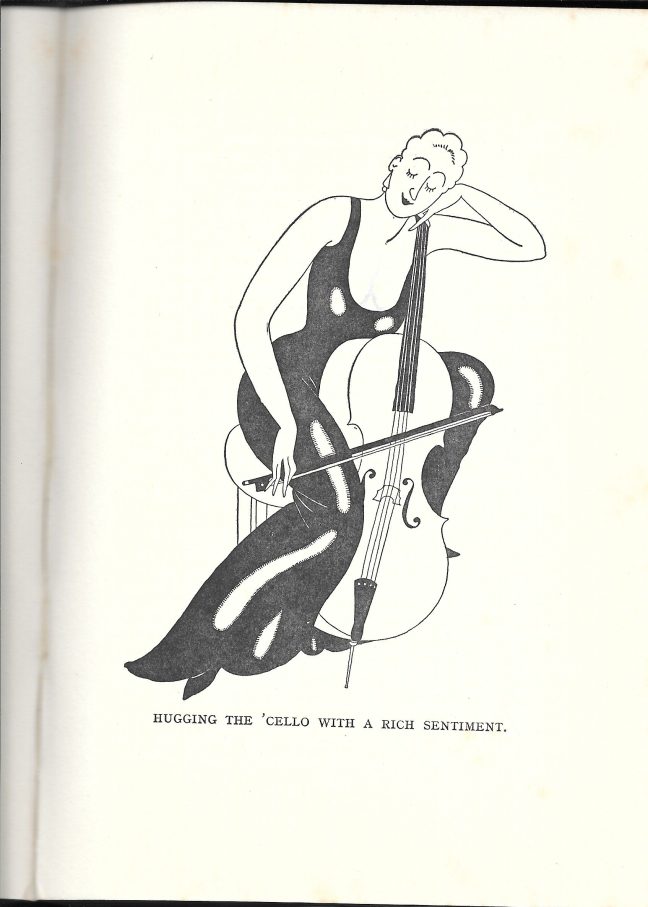
In fact, dated as it seems in some respects, there’s a lot of useful advice in this book. I can only commend the individual who presented it to Penarth County Girls’ School* Library in 1946. It would have been helpful at the time, and a lot of it still is. The illustrations are decidedly tongue-in-cheek, but on the plus side, they don’t patronise the intended audience – advice is always easier taken if the advice giver uses a touch of humour! The artist, Joyce Dennys (1893-1991) was a cartoonist and illustrator. The book perfectly fits into Thomas Nelson’s lists, with their emphasis on providing self-improvement, self-educational material for the intelligent layperson. You might be a teacher needing more guidance on laying on concerts, a nervous and somewhat inexperienced performer, or an organiser of any number of different kinds of musical entertainment, and this title would have plenty of accessible, useful advice.


Of course, platform etiquette would have been second nature to a superstar like Flora Woodman, who would probably have needed little advice after her first few performances.  (Neither, I imagine,  would she have liked the suggestion that foreign artistes had more stage presence! My gut feeling is that she had it by the bucketful.)  She was mixing with professionals of the highest calibre, in Britain’s best concert halls.

I’ve already posted details of some of her fabulous wardrobe, and it would become rather dull if I went on producing lists. But I noticed today how she liked to ring the changes with glamorous accessories. They wouldn’t be wise choices today, but hey, this was a century ago. So – I spotted white fox, ermine, beaver and swansdown, as well as velvet hats, black tulle, hydrangeas, lilacs, pink flowers, a wreath (garland?), and regular adornments of silver (silver what? she doesn’t say). Also, even within a couple of years, she updated her outfits, with ‘second editions’ of her black and white, and pink and pearl ensembles. (Once again, do use your imagination – I’ve given you plenty to work on!)

Meanwhile, excuse me whilst I browse through Rodney Bennett’s book a bit more …


*Yes, Bennett does talk about ‘the man in charge’. It was a different age – don’t shoot me!

*Penarth County Girls’ School is now Stanwell School, Penarth

Autoethnographical? Autobiographical? Reflective?

Well, the ‘Scottish Entertainment’ took place yesterday – attended by sixty to seventy people, if you include our [small] choir. A great time was had by all. There was lots of community singing, along with a couple of choir items, and a smattering of solo items (two spoken, two sung solos, and the concertina.)  And, of course, haggis, neeps and tatties in the middle of the entertainment.  Our pastoral care committee organised the whole event  – I just coordinated the entertainment bit!

It wasn’t a research event, and I can’t exactly call it public engagement – it wasn’t in any sense designed for, or linked with, my research. (Although, as I’ve mentioned, my little introductions were informed by my research!) So, I don’t think I can call this autoethnographical or practice-based research, but I can certainly reflect upon the whole experience.

Timing

I planned two equal ‘halves’ for either side of the meal. It wasn’t a full-scale meal, as such, but I underestimated how much time we’d spend eating. The first half of the entertainment was almost spot-on: we only had to leave one item until after the meal. However, the second ‘half’ had to be significantly cut back (mostly by omitting verses) – so I could really have made it a good bit shorter.

Feedback

The feedback was gratifying. Our repertoire went down well, as did the solos.  I shall respect the soloists’ privacy, so I won’t elaborate further on that point. 

My own debut as a soloist surprised me as much as everyone else, though.  ‘I didn’t know you sang’, someone said. ‘Nor did I – I’ve never sung a solo in public before!’

I chose a song within my range, and the concertina piece was likewise as simple as I could find!  Considering that I took up the concertina during lockdown, with the deliberate aim of having a ‘folk’ instrument for just such an occasion, it was gratifying to be able to play to an appreciative audience.

People were still talking about the event today, which was lovely to hear.

Repertoire

Remember that I did a BBC Scotland radio interview 13 months ago, discussing the top ten Scottish songs of nowadays, the results of a Visit Scotland survey? I didn’t even consult that list for our own afternoon entertainment. There was some, but not a lot of overlap – but I’m happy that the songs chosen by myself and the choir, went down well with our audience.  We had a few Burns songs, a few from the early 20th century, some from the middle and a couple from towards the end of it.

And if we were to  do another event, well, there’s still that Visit Scotland list to draw on!  There is bound to be variation, depending on the sample of people surveyed – whether they are young or old, whether they had children or taught children in schools, and so on.

‘Una Voce Poco Fa’ (a Voice a Little While Ago) – a Hit for Two Centuries

The aria, ‘Una Voce Poco Fa’ from Rossini’s Il Barbiere di Siviglia (The Barber of Seville) may have been composed in 1816, but it remains popular to the present day – a showpiece for coloratura sopranos.  It was certainly an often-performed solo in recitals by the early 20th century star about whom I’m writing at the moment.  In the context of the original opera, it’s sung by Rosina, whose overbearing guardian wants to marry her. Of course, Rosina’s sights are set on a handsome young suitor. (Eventually the barber sorts it all out. Of course!) 

The Lyric Opera of Chicago gives you the relevant details on a handy page about the work, here.

You can find a translation on the Opera Arias Database.

But what, exactly, draws both singers and audiences to this amazing piece?  Jenna Simeonov has written a guide for sopranos learning the aria, on the Schmopera website, and her introduction gives a few clues as to why it would have appealed to a talented young soprano:-

This is a cornerstone aria for many young mezzos, and one of the few chances they have to show off coloratura and play a girl. It’s also an aria full of options.

‘How-to Aria Guides: Una Voce Poco Fa (14 October, 2015)

Sure enough, the woman I’m researching was very young, so the role of Rosina would have felt like one she could empathise with.

Simeonov gives a great deal of useful advice on singing the later coloratura part of the aria, helpfully with a marked-up score to show what she’s talking about.  She gives more insight into singing it, from a  performer’s point of view, than I could possibly have hoped for, but in her opening words, also advises working with a singing teacher.

The fast part

As we get into the coloratura bits, I can offer some general, if incomplete, advice. Help yourself by always finding the larger tune within the string of sixteenth notes, and stay nice and light. For more specifics, get thee to thy voice teacher.

Looking at the score – my goodness, talk about vocal acrobatics! Swooping scales, trills and other ornamentation, high notes, tricky fast passages that would challenge any soloist – and that’s before the conductor tries to keep an orchestra in synch with ‘Rosina’.  Or it’s up to the pianist, in a recital context.  No wonder ‘my’ singer was in the habit of noting if her allocated accompanist was good, bad or indifferent!

Here’s Kathleen Battle singing the aria – a beguiling, and impeccable performance:-

(Kathleen Battle – Rossini: ‘Una voce poco fa’, from the opera Il Barbiere di Siviglia by Gioacchino Rossini.  Recorded in Antwerpen December 1984.  From the TV show: Rene Kollo – Ich lade gern mir Gäste ein.

So, it really is completely understandable why it’s such a well-loved piece of the repertoire, isn’t it?!

Cover image from IMSLP: Editor Castil-Blaze (1784-1857)
Pub. Info. Paris: La Lyre moderne, n.d. Plate 346.
Copyright: Public Domain
Misc. Notes Biblioteca Fondazione Rossini Pesaro

A Syncopated Sensation

https://wp.me/p99Vwa-167

Here’s a story on the Dundee City Archives blog, involving our friends, Dundee music firm Methven Simpson in 1921. And a very special and innovative jazz band!

Flower Pots! How to Brighten a Music Librarian’s Day

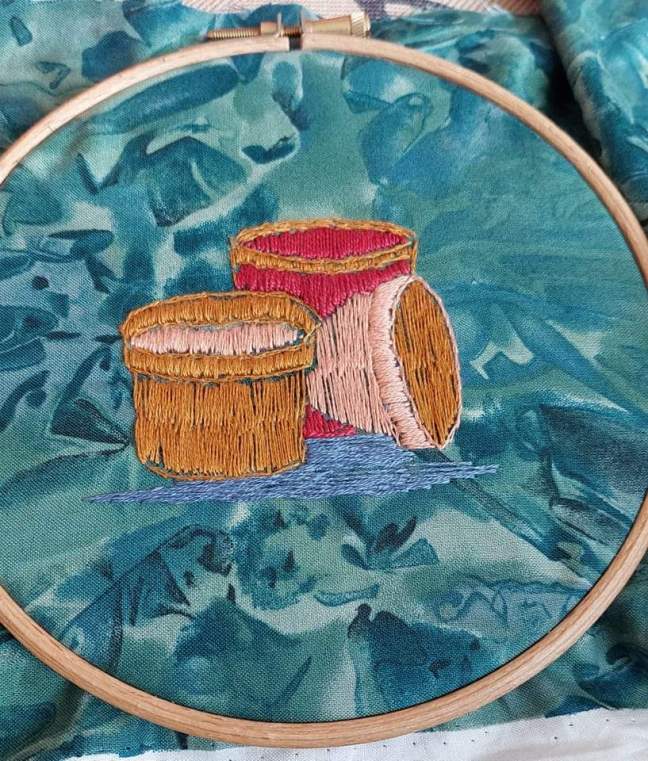
Embroidered picture of flower pots

I’ve mentioned before how, for the past four or five years, I’ve particularly focused on getting more music by women and composers of colour into the Whittaker Library. By the time I reach retirement age, there will be a good, up-to-date selection of such works for students to choose from. (I’ve also mentioned my rationale for this activity – if we introduce this music to today’s students, then whether they go out and perform it, or teach it, or combine these with other activities, there’s hope that they’ll pass on a wider, more receptive approach to repertoire-building to the students that follow on behind them.

Today, I was invited to attend a recital by one of our students. Two of the pieces were pieces by women composers, that their teacher had recommended us to acquire. It was a great recital – innovative, exciting and impressive. One particular piece involved a percussionist playing a counterpart on – wait for it – an assortment of carefully-chosen, differently pitched flower pots. You didn’t think flower pots were pitched? No, they aren’t deliberately tuned, but they can be chosen for the sound they make when you hit them! I bet you none of the audience had ever heard flower pots in a recital before, but it was great. Another piece had been written with piano accompaniment, but this time it was played on accordion. (From a personal point of view, this was of considerable interest. I got an accordion a few months before the pandemic, and a concertina a few weeks before. I get a lot of enjoyment out of my beginner’s attempts with two inexpensive instruments. But to sit and hear a truly excellent instrument in expert hands – and a “button box”, too; completely baffling to me! – well, that was something else. If you think accordions are just about ceilidhs and the good old days of Jimmy Shand, then believe me, you’ve missed so much.)

I and my colleagues even got a mention in the programme “credits”, for having obtained the music. It makes all the difference to feel that we were part of the programme-planning in our own small way. Sometimes, in a performing institution, it’s easy to feel that our hidden-away, behind-the-scenes work is really very insignificant and unnoticed. Obviously, we research and source the materials, catalogue and index them, then sit back and wait to see what happens. Our job is effectively done, one score or resource at a time, and the performers then go off and do the hard work, putting together a balanced programme and practising hard. We don’t always get to hear the results, though, which is why this morning’s recital was so lovely.

I have already expressed my opinion on – and weariness of – repetitive cataloguing. Processing CD after CD, all in the same genre and series, is mind-numbing. The mental exercise in cataloguing and indexing fresh, contemporary sheet music is definitely more enjoyable! Nothing can be ‘discovered’ in a library unless it has first been carefully catalogued, indexed and assigned the correct place on the shelves.

Seeing and hearing the results reminds me of the importance of music librarianship. A timely reminder!

Gratitude

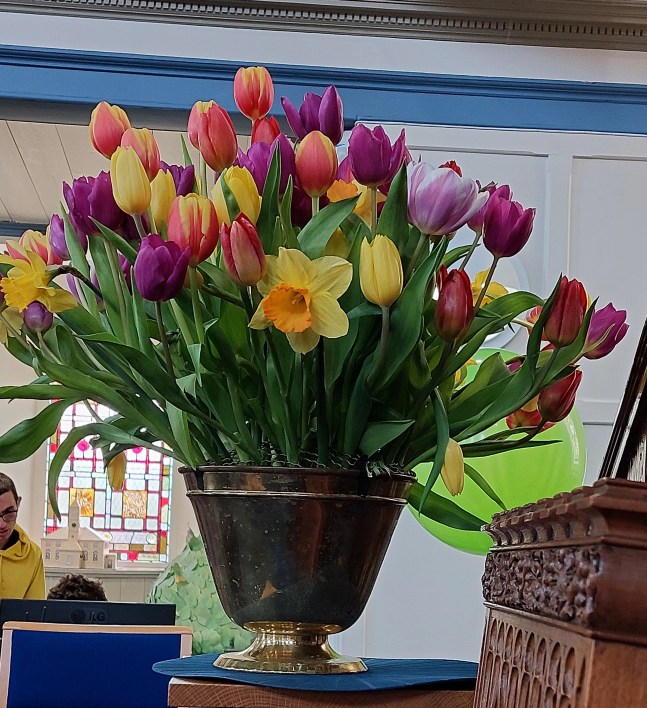
A bowl of tulips at church

It goes against my principles to pay for private medical treatment, but when I developed a trigger thumb late last November, it didn’t take long to work out that if I didn’t do something about it, I’d be looking at sick-leave from organ-playing, and a car immobile out in the street. The NHS waiting list was long – it didn’t look promising. Within a couple of months, it was taking more than two hours before I could bend my thumb in the morning, and if I accidentally had a nap in front of the telly at night, my thumb was locked solid until the next morning. I was lucky enough to find private surgery which I could afford, locally, and the operation was early in February.

Today, I played Widor’s Toccata for the Easter Sunday service at the church where I’m organist. Needless to say, I’m very grateful to the surgeon who fixed my thumb, and even more grateful that it was probably one of the cheapest surgeries that he performs. (As I sat in the waiting-room, my eyes widened at the video showing procedures that were available – and their cost. Yikes! I was astonished at what some folk choose to do to themselves in the name of beauty.)

I still think it’s wrong that I was forced to go private. The under-funding of the NHS has had far worse impact on so many people, but this was my first experience of not being able to get the treatment I needed, when I needed it. But hey, I’m very grateful for the private surgeon’s skill, and there’s also a church that was spared my prolonged absence. They’ll be grateful too!

Friday Frivolity: a Lassie in a Kilt

In the 1900s, touring Scottish singer/entertainers turned up all over the world with their songs and anecdotes, and often wore the kilt. Men AND women, that is.

Overseas, this spelled ‘Scottish Highlands’, even if the singer was actually a Lowlander.

At home, opinions on women wearing short kilts were less polite. Like this:-

“Man, she’s a bit bonnie lassie, and has a gude pipe [= good voice]; but to see her puir porritch-sticks o’ legs keekin’ out below the kilt …’ [= her poor porridge-stirrer sticks of legs peeping out below the kilt] And here a spontaneous and hilarious burst of laughter completed the sentence.

Southern Reporter newspaper, 1911

Aye, right!

Copyright & Performance

harvard-205539_1920 free download CCA Creative Commons, PixabayYou probably didn’t expect to find a link to the latest edition of the Harvard Gazette on this website!  Nonetheless, it contains an interview with Professor Derek Miller, author of a new book about copyright and performance rights from 1770-1911 – so there’s bound to be matter of interest to our networking project.

I haven’t yet got hold of the book itself, so I don’t know how much it focuses on European versus American copyright law, but I must confess I’m keen to find out.  It’s fascinating to learn more about the philosophy and the reasoning that led to legislation developing the way it did.

So, here’s the link:-

Jill Radsken (Harvard Staff Writer), ‘Lurking in your favourite song, the law: ‘, The Harvard Gazette, 30 November 2018.

And here’s the book citation:-

Derek Miller, Copyright and the Value of Performance, 1770–1911 (Cambridge University Press, 2018) ISBN 9781108425889.  Publisher’s link

And now I’ll add both to my Mendeley bibliography, pending the next time I update the network bibliography listing that appears as a separate page on this very blog.


Mind-Maps? Not This Time!

picture-frame-427233_1920
Stepping  Back to View The Big Picture

Last night, I thought I’d try to devise a mind-map to demonstrate the many directions the Claimed From Stationers’ Hall research has taken me – and could, indeed, take us further as a network.  After twenty minutes spent manipulating triangles in a Word document, I realised the error of my ways.  Never mind the mind-map – I could just list the topics.  So, here goes:-

The whole corpus of legal deposit music in the late 18th and early 19th centuries:-

  • Where it went
  • How it got there
  • What was retained
  • Who was involved in its immediate and subsequent curation
  • Whether it was used
  • What about the materials not retained?
  • The approach to this material in different institutions
  • Women composing music
  • Women performing music
  • Women teaching music
  • Music composed in response to war
  • Music in cultural history – what was popular, when, with whom?
  • Music for dance
  • Music pedagogy prior to the mid-19th century
  • Music for particular instruments (eg harp) or ensembles
  • Musical arrangements, music re-purposed in some way (and copyright issues)
  • National music – privileged in terms of retention?
  • Religious music – I haven’t separated out any strands here yet
  • Hymn books – published with and without music. Another strand I have yet to explore
  • Documentation, cataloguing
  • Big data (when more collections are catalogued online)
  • Comparison of retention patterns between different libraries
  • Digitisation
  • Performance possibilities
  • Finally, last and by no means least – The big picture.  Even acknowledging the contribution of the European great masters to music of this era, have we underestimated the importance of contemporary British music? Some is good, admittedly some is bad, and some is indifferent – but much of it is significant in revealing cultural trends at the time.  This, I believe, is the true importance of the Georgian legal deposit music corpus.