58 Weeks to Go – How is This Meant to Feel?

Goalposts

The government moved the goalposts – when I started work, I imagined I’d have retired by now.  Instead, I’ve worked an extra five years, with one more to go. I shall hit 66 in summer 2024.  I don’t want to retire entirely, but I must confess I’m utterly bored with cataloguing music! (Except when it turns out to be a weird little thing in a donation, perhaps shining a light on music education in earlier times, or repertoire changes, or the organisation behind its publication – or making me wonder about the original owner and how they used it … but then, that’s my researcher mentality kicking in, isn’t it?!)

Status Quo: Stability and Stagnation

Everyone knows I’m somewhat tired of being a librarian.  Everyone knows that my heart has always been in research.  Librarianship seemed a good idea when I embarked upon it, and it enabled me to continue working in music, which has always been my driving force.  But the downside of stability – and I’d be the first to say that it has been welcome for me as a working mother – has been the feeling of stagnation.  No challenges, no career advancement, no extra responsibility.  Climbing the ladder?  There was no ladder to climb, not even a wee kickstep!  (I did the qualification, Chartership, Fellowship, Revalidation stuff. I even did a PhD and a PG Teaching Cert, but I never ascended a single rung of the ladder.)

In my research existence, I get a thrill out of writing an article or delivering a paper, of making a new discovery or sorting a whole load of facts into order so that they tell a story. I love putting words on a page, carefully rearranging them until they say exactly what I want them to say. I’m good at it. But as a librarian, I cannot say I’m thrilled to realise that I’ve now catalogued 1700 of a consignment of jazz CDs, mostly in the same half-dozen or so series of digital remasters.  (I’d like to think they’ll get used, but even Canute had to realise that he couldn’t keep back the tide.  CDs are old technology.)

The Paranoia of Age

But what really puzzles me is this: when it comes to the closing years of our careers, is it other people who perceive us as old? Is age something that other people observe in us?  Do people regard us as old and outdated because they know we’re close to retirement age? 

Cognitive Reframing (I learnt a psychology term!)

Cognitive reframing? It’s a term used by psychologists and counsellors to encourage someone to step outside their usual way of looking at a problem, and to ask themselves if there’s a different way of looking at it.

So – in the present context – what do other people actually think? Can we read their minds? Of course not. Additionally, do our own attitudes to our ageing affect the way other people perceive us?  Do I inadvertently give the impression that I’m less capable?  Do I merely fear that folk see me as old and outdated because I know I’m approaching retirement age? A fear in my own mind rather than a belief in theirs?

How many people of my age ask themselves questions like these, I wonder?

Shopping Trolley

Am I seen as heading downhill to retirement?  Increasingly irrelevant?  Worthy only to be sidelined, like the wonky shopping-trolley that’s only useful if there’s nothing else available?

Is my knowledge considered out-of-date, or is it paranoia on my part, afraid that I might be considered out of date, no longer the first port-of-call for a reliable answer?

When I queue up for a coffee, I imagine that people around me, in their teens and early twenties, must see me as “old” like their own grandparents.  And I shudder, because I probably look hopelessly old-fashioned and fuddy-duddy.  But is this my perception, or theirs?  Maybe they don’t see me at all.  Post-menopausal women are very conscious that in some people’s eyes, they’re simply past their sell-by date.  I could spend a fortune colouring my hair, and try to dress more fashionably, but I’d still have the figure of a sedentary sexagenarian who doesn’t take much exercise and enjoys the odd bar of chocolate!  (And have you noticed, every haircut leaves your hair seeming a little bit more grey than it was before?)

Similarly, I worry whether my hearing loss (and I’m only hard of hearing, not deaf) causes a problem to other people?  Does it make me unapproachable and difficult to deal with?  I’m fearful of that.  Is it annoying to tell me things, because I might mis-hear and have to ask for them to be repeated?  Or do I just not hear, meaning that I sometimes miss information through no fault but my own inadequate ears?  Friends, if you thought the menopause was frightening, then believe me impending old age is even more so. I don’t want to be considered a liability, merely a passenger. And I know that I’m not one. But I torment myself with thoughts that I won’t really be missed, that my contribution is less vital than it used to be.

Gazing into the Future
Crystal ball
Crystal Ball Gazing

I wonder if other people at this stage would agree with me that the pandemic has had the unfortunate effect of making us feel somewhat disconnected, like looking through a telescope from the wrong end and perceiving retirement not so much a long way off, as approaching all too quickly?  The months of working at home have been like a foretaste of retirement, obviously not in the 9-5 itself (because I’ve been working hard), but in the homely lunch-at-home, cuppa-in-front-of-the telly lunchbreaks, the dashing to put laundry in before the day starts, hang it out at coffee-time, or start a casserole in the last ten minutes of my lunchbreak.  All perfectly innocuous activities, and easily fitted into breaks.  But I look ahead just over a year, and realise that I’ll have to find a way of structuring my days so that I do have projects and challenges to get on with. 

Not for me the hours of daytime TV, endless detective stories and traffic cops programmes. No, thanks!  Being in receipt of a pension need not mean abandoning all ambition and aspiration. I want my (hopeful) semi-retirement to be the start of a brand-new beginning as a scholar, not the coda at the end of a not-exactly sparkling librarianship career.  If librarianship ever sparkles very much!

I’m fortunate that I do have my research – I’m finishing the first draft of my second book, and looking forward to a visiting fellowship in the Autumn.  As I wrote in my fellowship application, I want to pivot my career from this point, so that I can devote myself entirely to being a researcher, and stop being a librarian, as soon as I hit 66.  And I want to be an employed researcher.  I admire people who carve a career as unattached, independent scholars, but I’d prefer to be attached if at all possible!

Realistically, I will probably always be remembered as the librarian who wanted to be a scholar.  At least I have the consolation of knowing that – actually – I did manage to combine the two.

First Ketelbey Fellowship at University of St Andrews

Here’s the big news I’ve been bursting to share! During Autumn 2023, I’m to be the first holder of the honorary Ketelbey research Fellowship in Late Modern History, in the University of St Andrews’ School of History. I’ll be there on Wednesdays and Thursdays for one semester, continuing to research and think about Scottish music publishers and other related topics, and enjoying the experience of being a research fellow in a very highly-rated university history department. St Andrews was rated the top UK university in the Times and Sunday Times Good University Guide last September, and the School of History came top in both the Times and Sunday Times rating, and the Guardian University Guide 2023 – so I’m dead chuffed! I’m an academic librarian and musicologist – I guess this means I can call myself halfway to being a historian, too.

The Fellowship is named after Doris Ketelbey (1896-1990), who was the first female academic in the School of History; a respected author; and had a phenomenal career for a woman of her times. Aileen Fyfe has written a blog post about her, which you can read here:-

Doris Ketelbey, 1896-1990 (in the series, ‘Women Historians of St Andrews’) by Aileen Fyfe

Interestingly, Ketelbey taught at St Leonard’s School at one point. A few years ago, I wrote a blogpost for the EAERN Network about about the very first owner of a private school in the same premises, in the early 19th century: Mrs Bertram’s Music Borrowing. But the St Leonard’s that Ketelbey taught at would have been a more sophisticated institution than Mrs Bertram’s doubtlessly estimable establishment!

– and yes, she was the sister of composer Albert Ketelbey, who wrote an enormous quantity of lighter music and songs. I bet he was proud of his determined, high-achieving sister!

From Stationers’ Hall to the Wider World

With my most scholarly hat on, I can announce …

I have a magnificent idea for a research project, building upon my doctoral AND postdoc work, papers I’ve written, networks I’ve been involved with, and so on. I’ve written it all down as a discussion paper – I really think it could work. Watch this space!


Have You Met Your Original Objectives?

fishmosaic

One of the questions asked by ResearchFish – the private limited company responsible for collecting data about everyone’s grant-funded research – is this:-

“Have you met your original objectives?”

It’s a multiple-choice answer: Yes; No; Partially; or Too early to say.  I’ve devoted quite a bit of time to asking myself this question, and I believe that yes, I have achieved what I set out to achieve, with the help and support of all those who have involved themselves in the Claimed From Stationers’ Hall music research network.

fishmosaicThe project sought, in the first instance, to identify the patterns of survival of the Georgian music copyright material. Whilst aware that perhaps only one quarter of all Georgian-era published music was actually registered at Stationers’ Hall, we now have a very clear overall picture of the survival patterns of the registered musical material in historical legal deposit libraries, with the most obviously complete collections being at the British Library, the Bodleian and the University of Glasgow, and with the University of St Andrews’ collection close behind them.  Cambridge and Aberdeen University Libraries, and the National Library of Scotland have rather less, but cataloguing is incomplete, whilst Edinburgh University retained only a very modest amount of the copyright music that they received. (There’s a magnificent spreadsheet, and the music is now gradually being fully catalogued.)

Three libraries seem not to have retained music, for historical reasons tied up with the institutions themselves: Trinity College Dublin made a decision not to claim music; King’s Inns, also Dublin, was a legal library, and it is impossible to tell whether the unexpected small holdings of music arrived through legal deposit or by other means; and the theological Sion College’s surviving holdings, now in Lambeth Palace Library, appear not to have had any copyright music by the time of transfer.

fishmosaicSecondly, the project sought to identify where collections may not yet be catalogued online, to establish the extent of the work outstanding in order to facilitate access to the material in library special collections via Copac. We now have a clear picture of where holdings are not yet catalogued online; and until the time when the bulk of this material ­is retrospectively catalogued, big data analysis would perforce be somewhat misleading. On a more positive note, interest has been expressed in attempting to rectify this situation at four of the libraries, and the increased interest in the repertoire that this project has engendered, has certainly provided motivation.  Some interesting big data analysis was produced using data from the St Andrews material currently catalogued online, and data gathered from historical loan records of the entire St Andrews music copyright collection.  However, no other institution holds comparable loan records.

fishmosaicThe third objective concerned interdisciplinary networking, with the project offering an opportunity for networking by interested parties from all relevant disciplines, seeking to explore the history of British-published music in all British legal deposit libraries. Extensive networking, in person, via electronic means, and in print, has raised the profile of this repertoire. A workshop at the Royal Conservatoire of Scotland brought together librarians from most of the historical copyright libraries, together with interested scholars from the fields of musicology, big data analysis and digitisation of resources, and library history.

Papers have been given at a number of conferences, with the possibility of more in future months; and relationships have been forged both nationally and internationally with individuals and with relevant organisations:- librarians, particularly in music libraries and special collections; book and library historians; musicologists, folklorists and copyright specialists; and contact with Stationers’ Hall itself.  In short, a wide range of people have been introduced to this project at the various events I’ve spoken at, from scholars of various disciplines, to librarians in different kinds of libraries, to folklorists, copyright specialists, local historians and genealogists, and users of archives.

fishmosaicA fourth objective was to draw together documentation in support of the interdisciplinary study of such collections’ history, by compiling a bibliography for the shared use of both librarians and scholars, which would itemise both archival sources and existing scholarship and writings on these music collections for future exploitation by scholars of various disciplines. A substantial bibliography has been compiled, detailing scholarship on all aspects of historical music copyright and legal deposit, also embracing some of the wider context of copyright legislation, and pertaining to music in individual institutions. Histories of individual libraries have been included, with the extent of archival documentation at the University of St Andrews standing out above most others, particularly in terms of the use made of the music copyright collection there.  This bibliography, currently online via the present network blog, will also very soon be made available via the institutional repository, Pure, at the Royal Conservatoire of Scotland.

fishmosaicA fifth objective was to introduce and promote these collections and their research potential at interdisciplinary meetings and via appropriate publications. To this end, the study day at the Royal Conservatoire of Scotland in March 2018, afforded delegates the opportunity to share knowledge about individual collections; to look ahead to future collaborative possibilities; and to reflect upon the need for further retrospective cataloguing; and to listen to a performance of some Napoleonic-era songs by women composers.

Themes arising from the study of this repertoire, and mentioned at the study day, have also been explored in subsequent conference papers and blogposts (both for this blog, and also as a guest blogger on others), demonstrating how the copyright collections provide a wealth of source material for studying the social and cultural history of music, eg the role of women in creating as well as performing music in the Georgian era; early music pedagogical repertoire; or the writing of popular songs and marches as a cultural response to the Napoleonic Wars.

The study day resulted in a commitment to produce a guest co-edited issue of Brio, the music librarianship journal of the International Association of Music Libraries’ UK and Ireland branch; authors have agreed to provide material in time for the November 2019 issue.

fishmosaicLastly, the project sought to foster the performance of music from these collections, encouraging network participants to consider small-scale local events to showcase this material. A performance of some Napoleonic songs composed by women had already taken place both in St Andrews and at the University of Glasgow before the commencement of the network proper, and two of these songs were performed at the study day itself. The opportunities posed by this kind of material have also been outlined in spoken conference and seminar papers, and the possibility of further educational outreach to under-18 year olds is still currently under discussion.  Key issues are that, whilst librarians are custodians of the rare musical materials, it would require collaboration between librarians, musicologists and performers to research the collections in order to present particular historical themes, and to facilitate live performances. Furthermore, the exploitation of music through performance is probably more likely to take place beyond, rather than in, individual libraries, thus making the coordination of such events more complicated than they might initially appear – but assuredly not impossible!

fishmosaicIn summary, the stated objectives of the Claimed From Stationers’ Hall networking project have certainly been met.  The challenge now, of course, is to examine the findings and, taking all considerations into account, to determine the most promising directions for future research!

blue-turquoise-mosaic.jpg


Research Outcomes

At a time when all researchers earnestly and diligently record and submit outcomes and fishmosaicoutputs for ResearchFish, I wonder how I could intimate the activities that have been initiated for 2019 as well?!  This month, I’ve submitted abstracts in response to FOUR conference calls for papers.  I’ve started thinking about another potential project.  But I’ve also got several things already in the pipeline, written during the research grant for Claimed From Stationers’ Hall – and indeed, a few that have been in the pipeline for much longer than that!  (Inspired by ResearchFish – not that this particular piece of writing has anything to do with my present research – I have just enquired about some encyclopedia entries that I wrote in 2016, and was relieved to hear that publication is (in encyclopedic terms) imminent.  It’ll be good to strike them off my “pending” list!)

Isn’t it frustrating when your outputs are significantly greater than have actually reached fruition or publication!

Ah well, back to ResearchFish, and I’ll see if I’ve missed anything off the present list!

Once Upon a Year: 1817

Kings’ Inns guardbook catalogue

A few weeks ago, I had what was effectively a week-long fieldtrip.  Well, two short ones – first to Dublin, then to London.  I’ve already blogged about the trips to King’s Inns and Trinity College Libraries, where  I was hunting down national songbooks – neither expecting to find, nor actually finding, very many Georgian-era music scores or textbooks, but chancing across a few surprises, and also discovering that balladry – poetry – was rather more popular.  I should explain that collecting policies in Trinity at that time are known to have precluded much music being kept, whilst one would not perhaps expect any music to turn up in a law library unless it was donated!- but there was still a literary interest in the words of national ballads, in both institutions.

Anyway, back I flew to Glasgow, did a day’s work and an evening rehearsal, then got the overnight sleeper to London so that I could visit Stationers’ Hall, meet my music librarian opposite number at the British Library, and speak at the English Folk Dance and Song Society Conference.

I hadn’t had the opportunity to visit Stationers’ Hall before.  It’s very grand – used as a venue for conferences and weddings – but I was there to visit the archivist, and to have my first look at one of the Georgian era registers.

Faced with the choice of many years’ Stationers’ Hall registers, I had to make a choice.  My time was limited, and there was no hope of looking at more than one or two volumes.  I made my choice based on the fact that Kassler’s Music Entries at Stationers’ Hall lists full entries from 1710 to 1810, but the appendix (based on William Hawes’ summary listing for 1810-1818) gives much less information – most noticeably, no publication details and no library locations.  If I was going to spend a few hours looking at anything, I would look at a volume from the later era, to see how easy it was to spot music entries, and to get a bit more information about anything I found. 

1817*

I was also curious to see how long it would take to glean this information.  I wondered about actually transcribing the entries, but once I saw them, I realised that this was going to get me a limited amount of information with which I could do very little – I’d get more by taking a broad sweep.  Accordingly, I took my own copy of Kassler, and annotated the entries from June 27, 1817 to June 24, 1818 – this was a full year from the start of one of the register volumes, and also conveniently encompassed some royal events that I already knew were memorialised in song – the deaths first of Princess Charlotte of Wales in 1817, and then of her grandmother Queen Charlotte the following year.  I was able to note the publishers, look out for anything surrounding these events that I had not yet spotted in Hawes’ abbreviated listing, and I also spotted another royal event – Queen Charlotte’s visit to Bath, literally a couple of days before her grand-daughter died in childbirth.  Seeing the music in the context of all the other entries showed me just how much literature proliferated to commemorate the deaths in particular – elegies, other poems, a multitude of published sermons … if you remember the outpourings of grief when Diana, Princess of Wales died, then you can imagine similar outpourings back in 1817-18, using the media that was available at the time.

Stationers’ Hall

But an equally interesting discovery was the realisation that Mr Greenhill the warehouse keeper also recorded how many copies of any particular title were handed in.  Chappell always handed in just one copy, whether or not the legislation required eleven.  One assumes that the libraries requested his works from the lists that Greenhill sent them, because (although I’ve only checked a handful of titles from June to early July so far) they did actually get the music, presumably collected via agents rather than directly from Greenhill at Stationers’ Hall.  Other publishers might hand in one copy, or the full eleven, and I begin to think that the smaller publishers or self-publishers might have tended to hand in the latter. 

Here’s the challenge – a whole year’s music is quite a lot of music!  From the little I’ve checked so far, the libraries that I expected to have a lot of the registered music, had nearly all of it.  Those that I thought would have less, do indeed seem to have less.  But – I’ve only checked in Copac.  Until we check the “not catalogued online” holdings, we will not have the full picture.  So the next challenge is  a logistical one: how to get the checking done!  This might require another grant application.  Certainly, it requires more conversation with network members!

I’m toying with the idea of creating a Mendeley bibliography of the whole year’s output.  It’s a lot of work, but it might help at a later stage in the project: a decent bibliographic listing will have so much more information, even if a parallel Excel spreadsheet offers different benefits by way of comparing library holdings.

* Incidentally, the idea of taking one year and researching its story has already been done, albeit not in musical terms: a couple of years ago, Turtle Bunbury published 1847: A Chronicle of Genius, Generosity and Savagery  – so when I found out about it last week, I ordered a copy.  I’m really looking forward to reading it.  But finding out that someone else has not only had the same idea as me, but published it, doesn’t mean there isn’t mileage in exploring 1817.  Indeed, I would argue it just goes to show that the idea is a good one!

And What Next?

The next challenge, of course, is what to do with the data.  At the very least, it would indicate what survives for one notable year.  And there are other questions, too:-

  • Is there a pattern as to which publishers deposited single or multiple copies?
  • Is there a pattern as to what was more likely to be retained, in those libraries that retained less?
  • Out of interest, how much of what was submitted, was composed by women?
  • How many compositions/publications were  prompted by significant occasions of whatever kind?
  • Would anyone be interested in a performance opportunity based on the output of that particular year? Or in facilitating a workshop locally?
  • If we then took another year later in the century – possibly after the Queen Anne copyright act had been superceded – could we compare repertoire patterns, perhaps also comparing what survived in Oxford and Cambridge, or looking for pedagogical material?
  • Lastly , of course, there is the possibility of creating further bibliographical listings.  At the moment, the Adam Matthews’ digital offering is beyond our means.  It offers digital images, not full-text searching capabilities, but further grant funding might make it possible to create listings using the digital substitute, rather than having to travel to London to consult the registers themselves.

There’s a lot to think about, isn’t there?  As always, all comments and suggestions are very welcome!

We’re a research network! (And Scroll Down for the Pixis Variations Challenge!)

Pixis Hommage a Clementi TP
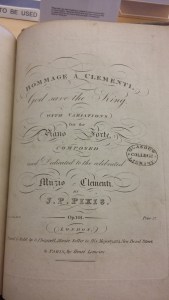
Title page of Hommage a Clementi, by Pixis. Image from copy in Glasgow University Library Collection, with thanks

It feels like time for a quick update, so I’ll spend the last few minutes of the working day doing just that.  Here’s a quick reminder of what the Claimed From Stationers’ Hall music research network is all about:-

The project is investigating the music deposited in the former British Copyright Libraries under the Queen Anne Copyright Act and subsequent legislation up to 1836, when most university libraries lost their legal deposit entitlement, receiving book grants instead. The repertoire largely dates from the late 1780s (when legal action clarified the entitlement of music to copyright protection) through to 1836.

The project aims to establish what exactly has survived; whether there are interesting survival patterns; and the histories of the music’s acquisition, curation and exploitation, not just in during that era, but also subsequently. It also aims to raise the profile of the material and to foster more engagement with it, both within and outwith academia; and the repertoire can be used to inform historical cultural perceptions which often became embedded into contemporary writings; for example, an idea very prevalent during the 19th century was that the English had no national music; and yet collections of national songs were very popular.  Thus, both the  fact that these books were popular, and our close reading of the paratext within individual volumes can be used to inform our modern-day understanding.  But a nation’s music is not just “national songs”, of course – it’s the whole repertoire of music published within that country.

To date, I’ve visited the University Libraries of St Andrews, Edinburgh and Glasgow.  I’ve been in touch with retired scholars from Aberdeen, and I’ve visited the National Library of Scotland.  Next, I need to spread my wings south of the border, and hopefully after a few more such meetings, we’ll have a clearer idea of what we’d like to talk about when we plan a study day to be held in Spring 2018.

The exciting, and yet tantalising part of all these visits is the realisation that there is a lot to explore, but not being able to stop and do all the research then and there!  For example, there are undoubtedly pieces of legal deposit music at the University of Edinburgh that aren’t labelled as such, but that appear in other copyright libraries and therefore probably arrived by the same means.  I so long to find them all, or to encourage other people to find them!  Similarly, the University of Glasgow has a very generous collection of copyright music – alluded to by the late 19th century author, W. P. Dickson amongst “works of fiction, juvenile literature, fugitive poetry, and music … issued yearly from the press” – but previously summarised by Divinity Professor Dr McGill in 1826 as “a great many idle books”.   (Dickson, The Glasgow University Library, 1888 p.16)  I’m eager to see if I can work out which volumes they might have been in before they were re-bound into their present volumes!  Meanwhile, the National Library of Scotland has an online catalogue, a card catalogue, but also “the Victorian catalogue”.  This I must see!

It is interesting to reflect that earlier musicologists have also had a hand in the arrangement and preservation of these materials.  Cedric Thorpe Davie in St Andrews disbound some volumes, and moved pieces to different places in the library.  Fourth Reid Professor Donaldson got involved with the Advocates’ collections in Edinburgh; Hans Gal had a go at listing some of the Edinburgh University Library Collections; and Henry Farmer spent some time in what for anyone else would have been retirement, as a music librarian at Glasgow University Library – one of the many careers in his portfolio! – and yes, he did some sorting out and rearranging, too.  Whilst we sigh over the thought of original sources being shuffled, we also owe these chaps a debt of gratitude for taking care of them and ensuring that they were preserved at all.

The Pixis Variations Challenge

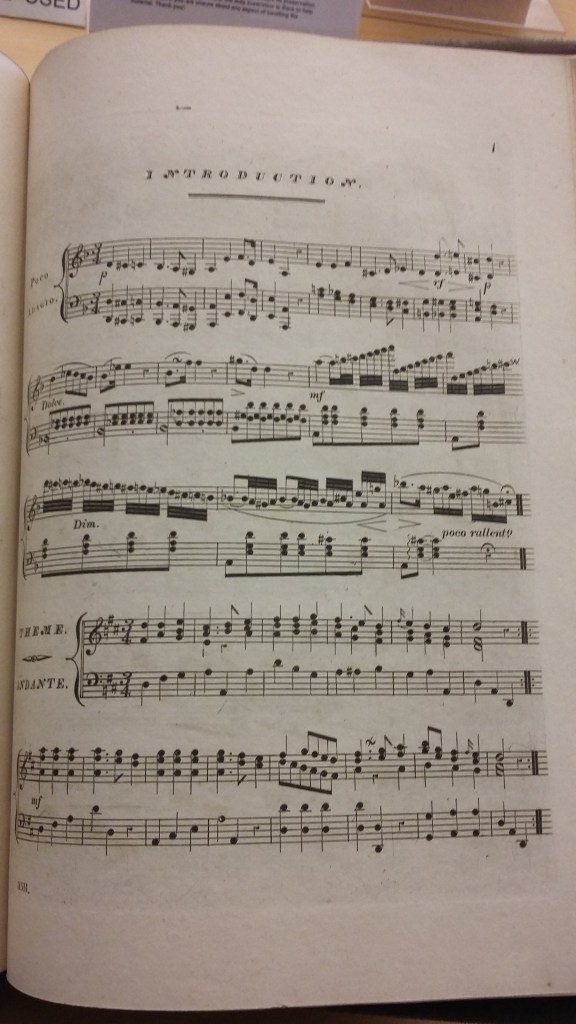
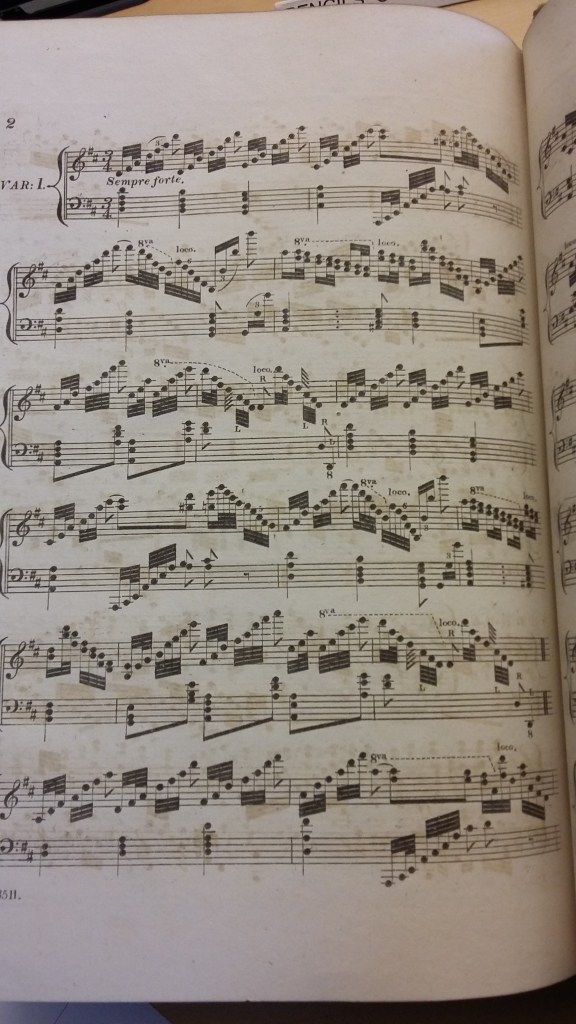
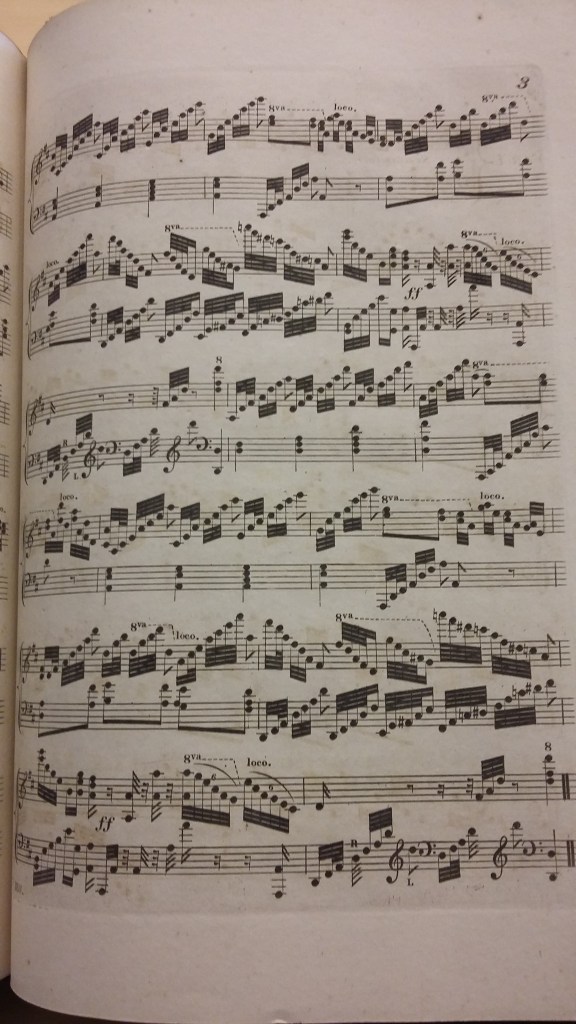
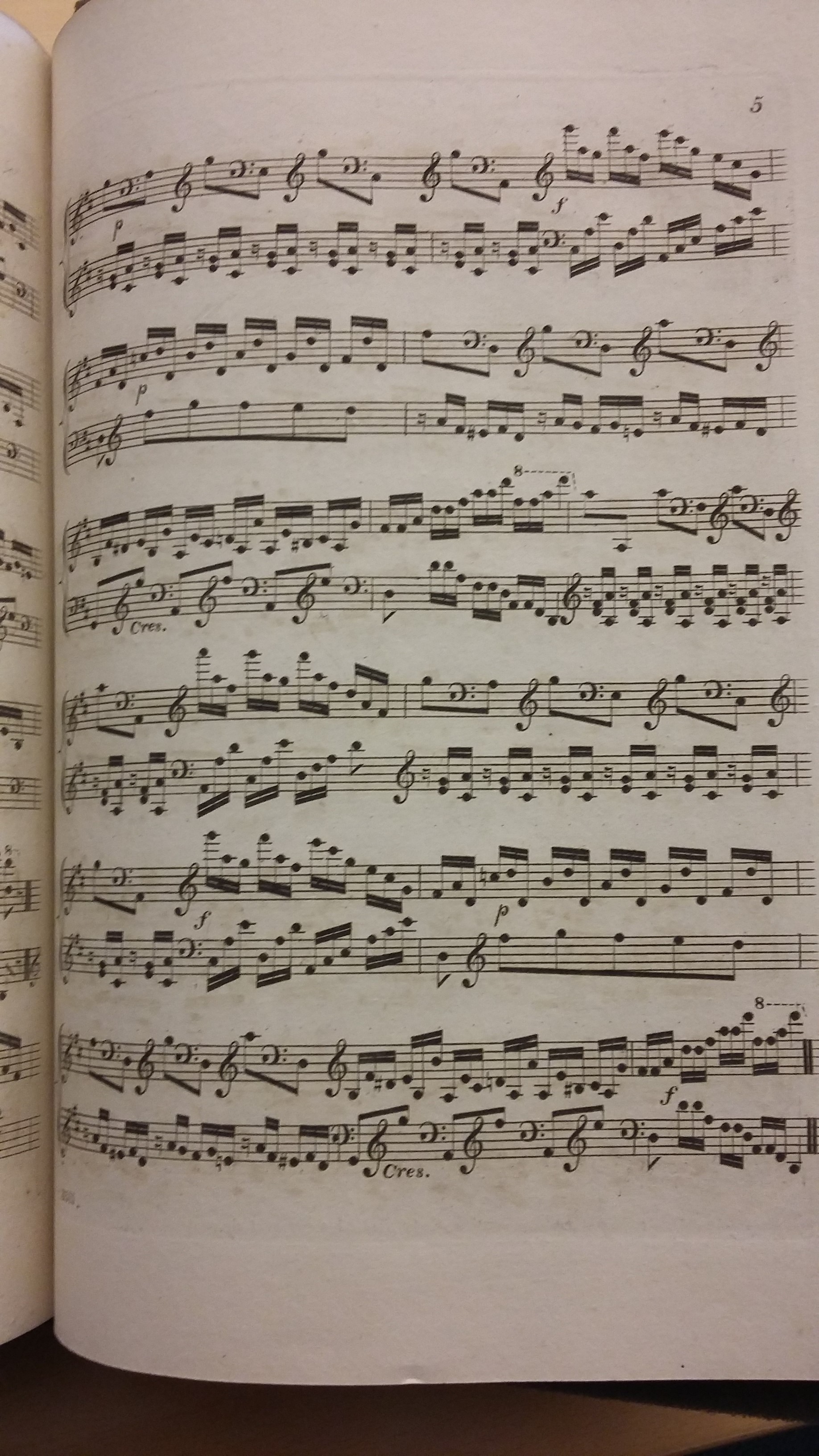
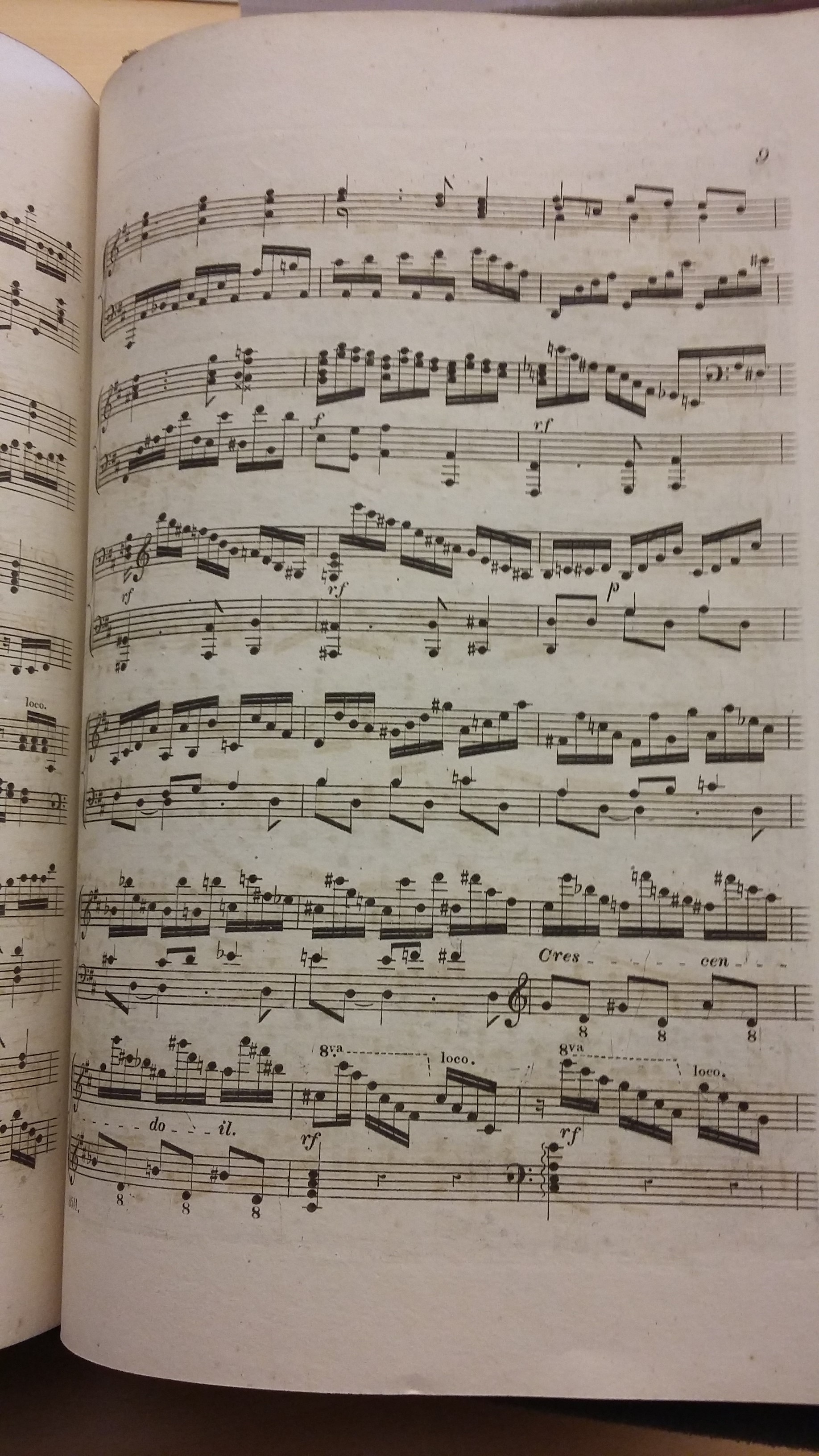
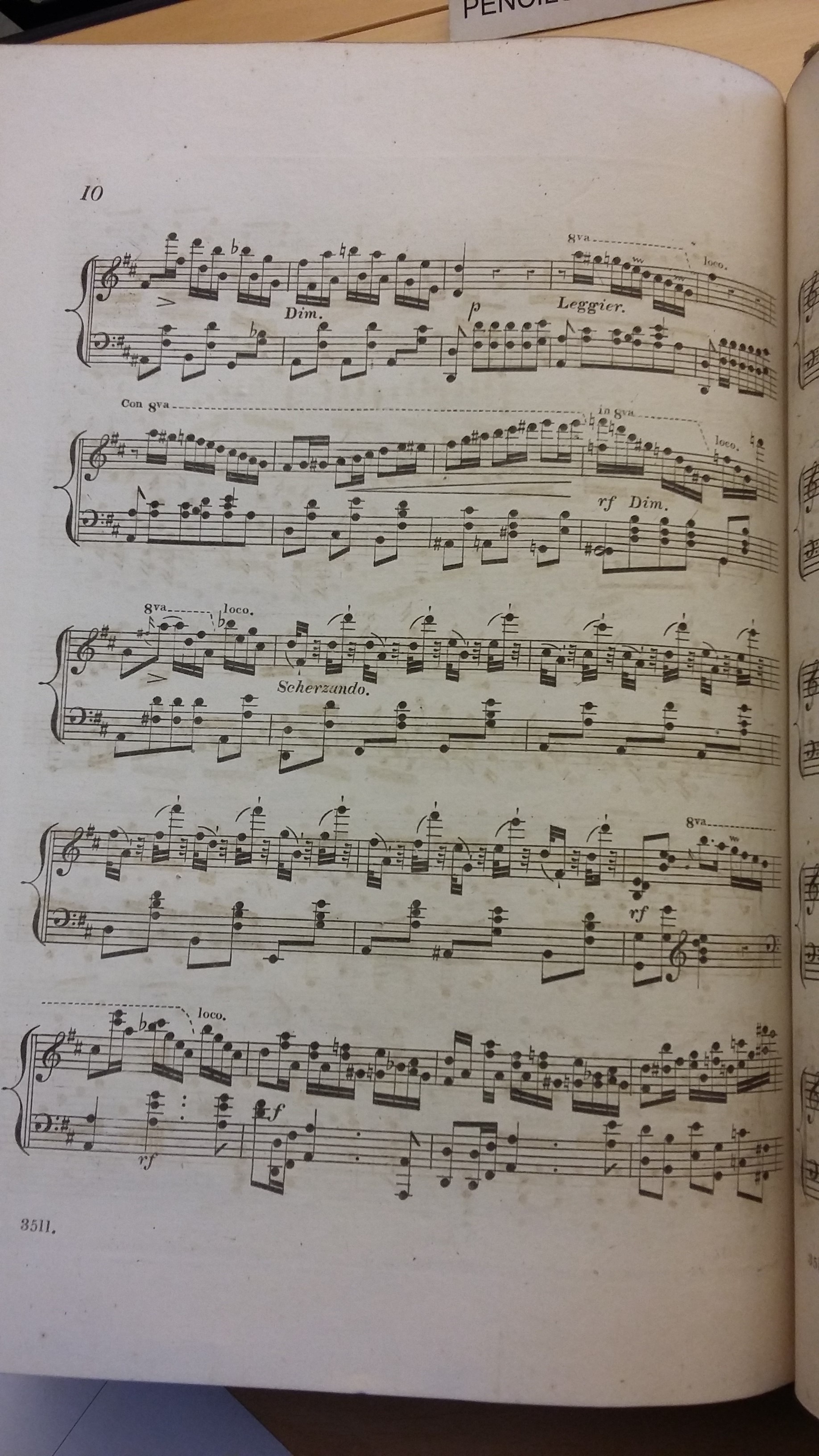
I long to play, or hear performed, some of these long-forgotten treasures.  I’ve been generously allowed by the Special Collections department of Glasgow University Library, to share a set of piano variations by the now forgotten German composer, Pixis:  Hommage a Clementi, which are actually based on the National Anthem, ‘God Save the King’.   I’m putting them on our Twitter feed and Facebook page, one page at a time.  At page 3, my pianistic skills are already being stretched beyond their comfort zone!  I wonder if anyone will get to the end …. ?  PLEASE let us know if you do!

Other pieces were undeniably less interesting.  I tweet “on this day” posts about some of the pieces that were registered, just to give a flavour of what was being published.  These references come with no value-judgements whatsoever!  Luckily for me, I don’t have instant access to all these pieces, so I would only go out of my way to hunt down something that looked particularly intriguing.

Here, for the record, is the start of Pixis’s variations – I’ll add the rest in due course.  Please do keep following the blog!  And I’m pleased to say that it’s not long before the first of our guest postings will appear – a welcome change of “voice” and a fresh insight into a different aspect of this fascinating topic.

Pixis Hommage a Clementi p1

Pixis Hommage a Clementi p2


Pixis Hommage a Clementi p3Pixis Hommage a Clementi p4Pixis Hommage a Clementi p5Pixis Hommage a Clementi p6Pixis Hommage a Clementi p7Pixis Hommage a Clementi p8Pixis Hommage a Clementi p9

Pixis Hommage a Clementi p10Pixis Hommage a Clementi p11


When Less is More and More is Less

This may sound as though I’m speaking in riddles.  Truly, I’m not!

I alluded in my earlier posting today to the question of “When less is more”, in the context of the apparently minimal amount of Stationers’ Hall music surviving at Edinburgh University Library, and how I was forced to look at the little that was there, in quite a close focus.

But I still have copies of those lists of music in the National Library of Scotland.  So, on the one hand, we have very little of the music surviving in what was then “Edinburgh College”.  On the other hand, we have lists of music from the Advocates Library in 1830, but we don’t know what the purpose of the lists was.

I’ve started to transcribe these lists – only a few pages, but interesting nonetheless.  But, how do I rationalise to other people just why they’re interesting?  And this is why:-

If I can establish which of these pieces actually SURVIVED in different libraries, then I get a snapshot view – fragmented and  blurred, admittedly – of which libraries retained more, or less, and I can see if certain categories were more likely to survive at that time, shortly before the legal deposit system was radically reduced.  Yes, it means another spreadsheet.  But I still think there may be something interesting to unearth.  Watch this space!

And yes, I do still need to establish whether there is music surviving but not yet catalogued online. I know about some of the libraries, but not absolutely clearly for all of them.  That’s why I’m making my visits around the country!


Dreams of Distant Places

aircraft-123005_640

This week’s news is cautiously optimistic.  I have the opportunity to speak at a conference in New Zealand if I can secure the funding to get me there! I’ve applied for funding – so watch this spot.

What about the Colonies?

Meanwhile, however, it set me wondering about legal deposit in the colonies in the nineteenth century.  This is not something that I’d thought about before.  Obviously, early printed music in New Zealand or Australia would generally have come from Europe, whether as new imports, brought by emigrants or sent to them by their families.  (See the excellent work being done by Sydney Living Museums in Australia, or – as an example of an early immigrant musician’s life – Michael Kassler’s fascinating paper, ‘The remarkable story of Maria Hinckesman‘, in Musicology Australia (2007).  I really don’t know much about the nineteenth century music trade beyond Britain.  I seized my copy of Partridge’s The History of the Legal Deposit of Books (1938) for a quick overview, where I learned that New Zealand’s own legal deposit legislation came much later.  It would still be nice to know more about the publication of music actually composed there during the 19th century!   Has anyone studied this?

You can’t beat a good bibliography

Over the past couple of years, I’ve compiled quite an extensive bibliography covering legal deposit (both at the general and music-specific level), and the nineteenth-century histories of the British legal deposit libraries.  I’m sure I haven’t yet listed everything that’s out there, but progress is being made.  I’m currently tidying up this listing, then I’ll post it online.  What I need more of, are links to finding aids, published or online, outlining what archival information is available for the different libraries.  Once I’ve got it into a shape fit for public consumption, I’d love to receive any further suggestions for suitable additions.  A student at the University of Edinburgh made a great listing of catalogues, accounts, and borrower loan records (“receipt books” in eighteenth- and nineteenth-century terminology) this summer, and I’ve currently got a copy of it on my desk to peruse closely.  Next week, I’m going to consult a couple of resources recommended to me by the National Library of Scotland’s Music Librarian – these will hopefully fill in my knowledge about what’s available there.  In this age of the internet, it pays to remember that not everything is online, and it’s invaluable to know about the existence of earlier finding aids that remain in their original print format.  I’m quite well clued-up about the resources in St Andrews, and I’ve got several useful links for Sion College’s holdings, now in Lambeth Palace Library.  Any further suggestions about other libraries, anyone?!

Official Commissions

At various times, official commissions looked into the legal deposit libraries’ handling and curation of the legal deposit materials, and library provision for universities in general. I really do need to capture details of all surviving documentation.  Partridge  mentions that after the 1814 Copyright Act, returns were requested from the legal deposit libraries (1st July 1817), which resulted in the Return of the Libraries, ordered to be printed by the House of Commons on 6 March and 9 April, 1818 [BM.515 l 20] (Partridge ibid, p.73].*  This contains a table of rejected items from Oxford or Cambridge – I have also found an amended return from Cambridge, which has of course been added to the bibliography!

Amended Return Cambridge - see mention of music

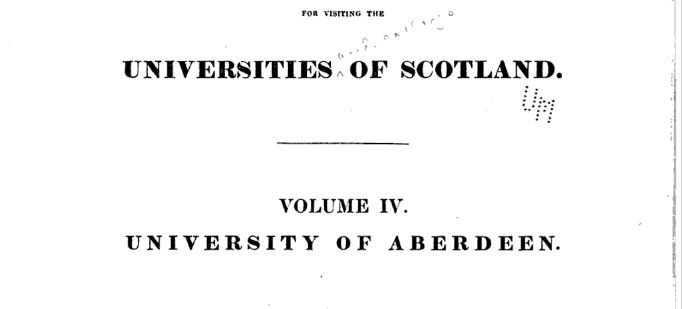
Similarly, from 1826 onwards, there was a Royal Commission investigating library provision to the University Libraries in Scotland. I’ve seen one of the huge tomes emanating from this exercise, regarding the Aberdeen responses, and transcribing interviews with individual professors.  Revd. William Paul remembered the sale of some legal deposit music, a couple of decades earlier.  Oh, really? This is interesting stuff!!

Great Britain. Commission for Visiting the Universities and Colleges of Scotland  W. Clowes and Sons, 1837

It’s fair to say that bibliographic control of this material is sometimes slightly inconsistent, but it would appear desirable to track down each Scottish university’s response, and to look at the other responses from St Andrews, Edinburgh and Glasgow!

Evidence Oral and Documentary Commissions 1837 top page

Evidence Oral and Documentary Commissions 1837 middle page

Evidence Oral and Documentary Commissions 1837 bottom page


Guest Blogposts Ahead!

We now have five offers of guest blogposts for this blog, two of them scheduled for the beginning of December.  Embracing technology, I’ve set up a Doodle poll for other interested guests.  The link has been sent to everyone signed up to the Jisc Music from Stationers’ Hall mailing list.  Completing a Doodle poll is simplicity itself, and I’ll get to see any responses to the poll. If you’re on the list, please check your email inbox!  (If you’re not on the list, here’s how to sign up!  Open Invitation to Join the Conversation)

And More Visits

When I only have one and a half days a week for research, even scheduling visits to all the former legal deposit libraries is just a touch more tricky, but I’m doing my best.  Every week, I try to think ahead and start planning another trip, so we’ll see where I end up visiting next! Which reminds me … time to tie up some arrangements …

  •  House of Commons, Extracts of so Much of the Returns Made by the Universities of Oxford and Cambridge, (pursuant to the Orders of the 1st July 1817 and 20th February Last) as State, Whether Any of the Books Claimed under the Late Copyright Act Have Been Omitted to Be Placed in their Respective Libraries, and how otherwise disposed of.  (1818) [Paper no.98. Available via database, UK Parliamentary Papers (ProQuest)]

Planning Ahead

If Research Days were like Saints’ Days, then my Tuesdays would be Research Day Eves! The arts in daily life - Mrs Playfair of Dalmarnock's journalNormally, I’m busy being a librarian on a Tuesday, but since I have a day’s leave, I can look ahead to what’s in store tomorrow.

  1. Firstly, we’ve had several offers of blogposts, so to help with the planning, I’m contemplating setting up a Doodle-poll (or something similar) so that interested people can commit themselves a bit more definitely, and we get some sense of what’s next.  Research Doodle-poll.
  2. I need to set up some more meetings, after last week’s very productive mission to Edinburgh.  Quite a few meetings, in fact.
  3. I need to tidy up the rest of my bibliography – or what I’ve got so far – so that I can post it online and share it more widely.  I’d love to be notified of any other useful reading that I’ve missed.
  4. Bibliographer to the last, I need to check out the various commissions to examine universities and their libraries, in the Georgian/early Victorian era.  I need precise citations for reports for ALL the legal deposit libraries involved in those commissions.  Not quite sure how I’ll get round to reading them all, but the first objective is to identify them all.  They aren’t always all that easy to trace, and sometimes library copies don’t have title pages – a bit of a setback, you could say!

My apologies that no podcast has happened for a couple of weeks; inspiration hasn’t descended upon me, and at present I’m hoarse, if not speechless.  A podcast will happen soon, rest assured.  (At least 21st century scholars have more effective cold remedies than our early 19th century forbears!)