Musicology, and a Nerdy but Meaningful Spreadsheet

Musical notes cut out of old sheet music

How to Assess whether a Song Book was Aligned with Contemporary Tastes

There were once four books of Scottish songs in a mini-series: just under 100 songs, all told. They weren’t much advertised, and few copies are now extant.  If they were intended mainly for school use, then I need to know to what extent their contents were standard Scottish song repertoire for their day. (Each generation has its favourites, noticeably different from the previous ones.)

Now then, I spent a very long time indexing song books as a librarian; that library catalogue is now a reference resource in its own right.  Last night, I listed the contents of those four books, and next, I shall look each song up in our RCS library catalogue.  I’ll end up with two figures for each song:-

  1. How many times the song is listed altogether: a high figure means popularity over a long period.
  2. How many times the song is listed between 1930-1970: this will be a shorter range of numbers. If it’s as high as, say, five hits, then it was popular amongst quite a few compilers over that 40 years.  If it’s not in any other books between 1930-1970, then it’s either old-fashioned, or a more obscure ‘rarity’ from less well-known or very old collections. 

And THEN, I can look up the rare ones in the National Library of Scotland’s Digital Gallery. 

This is the only accurate way of ascertaining whether the contents themselves might have been off-putting to the very audiences that they were meant to attract. I hope that’s not the case, because the compilers were well-placed, indeed ideally-placed to know exactly what went down well with school children. Nonetheless, I want hard evidence, and comparing the repertoire with two significant sets of data – the RCS more standard books, and NLS rare books – seems to me a pretty good way of doing it.

Blogging Helps Clarify the Question

I enjoy writing this blog, because it helps me clarify in my mind what the big issues are that I am addressing. Writing for a wide audience, which may or may not have exactly the same scholarly interest in the topic as I do, is a good way of reminding myself to write accessibly, and hopefully interestingly, about the things which occupy my thoughts as I pursue my research. Do I succeed? You tell me!

‘Una Voce Poco Fa’ (a Voice a Little While Ago) – a Hit for Two Centuries

The aria, ‘Una Voce Poco Fa’ from Rossini’s Il Barbiere di Siviglia (The Barber of Seville) may have been composed in 1816, but it remains popular to the present day – a showpiece for coloratura sopranos.  It was certainly an often-performed solo in recitals by the early 20th century star about whom I’m writing at the moment.  In the context of the original opera, it’s sung by Rosina, whose overbearing guardian wants to marry her. Of course, Rosina’s sights are set on a handsome young suitor. (Eventually the barber sorts it all out. Of course!) 

The Lyric Opera of Chicago gives you the relevant details on a handy page about the work, here.

You can find a translation on the Opera Arias Database.

But what, exactly, draws both singers and audiences to this amazing piece?  Jenna Simeonov has written a guide for sopranos learning the aria, on the Schmopera website, and her introduction gives a few clues as to why it would have appealed to a talented young soprano:-

This is a cornerstone aria for many young mezzos, and one of the few chances they have to show off coloratura and play a girl. It’s also an aria full of options.

‘How-to Aria Guides: Una Voce Poco Fa (14 October, 2015)

Sure enough, the woman I’m researching was very young, so the role of Rosina would have felt like one she could empathise with.

Simeonov gives a great deal of useful advice on singing the later coloratura part of the aria, helpfully with a marked-up score to show what she’s talking about.  She gives more insight into singing it, from a  performer’s point of view, than I could possibly have hoped for, but in her opening words, also advises working with a singing teacher.

The fast part

As we get into the coloratura bits, I can offer some general, if incomplete, advice. Help yourself by always finding the larger tune within the string of sixteenth notes, and stay nice and light. For more specifics, get thee to thy voice teacher.

Looking at the score – my goodness, talk about vocal acrobatics! Swooping scales, trills and other ornamentation, high notes, tricky fast passages that would challenge any soloist – and that’s before the conductor tries to keep an orchestra in synch with ‘Rosina’.  Or it’s up to the pianist, in a recital context.  No wonder ‘my’ singer was in the habit of noting if her allocated accompanist was good, bad or indifferent!

Here’s Kathleen Battle singing the aria – a beguiling, and impeccable performance:-

(Kathleen Battle – Rossini: ‘Una voce poco fa’, from the opera Il Barbiere di Siviglia by Gioacchino Rossini.  Recorded in Antwerpen December 1984.  From the TV show: Rene Kollo – Ich lade gern mir Gäste ein.

So, it really is completely understandable why it’s such a well-loved piece of the repertoire, isn’t it?!

Cover image from IMSLP: Editor Castil-Blaze (1784-1857)
Pub. Info. Paris: La Lyre moderne, n.d. Plate 346.
Copyright: Public Domain
Misc. Notes Biblioteca Fondazione Rossini Pesaro

Reunited! Moffat and Kidson’s Nursery Rhymes

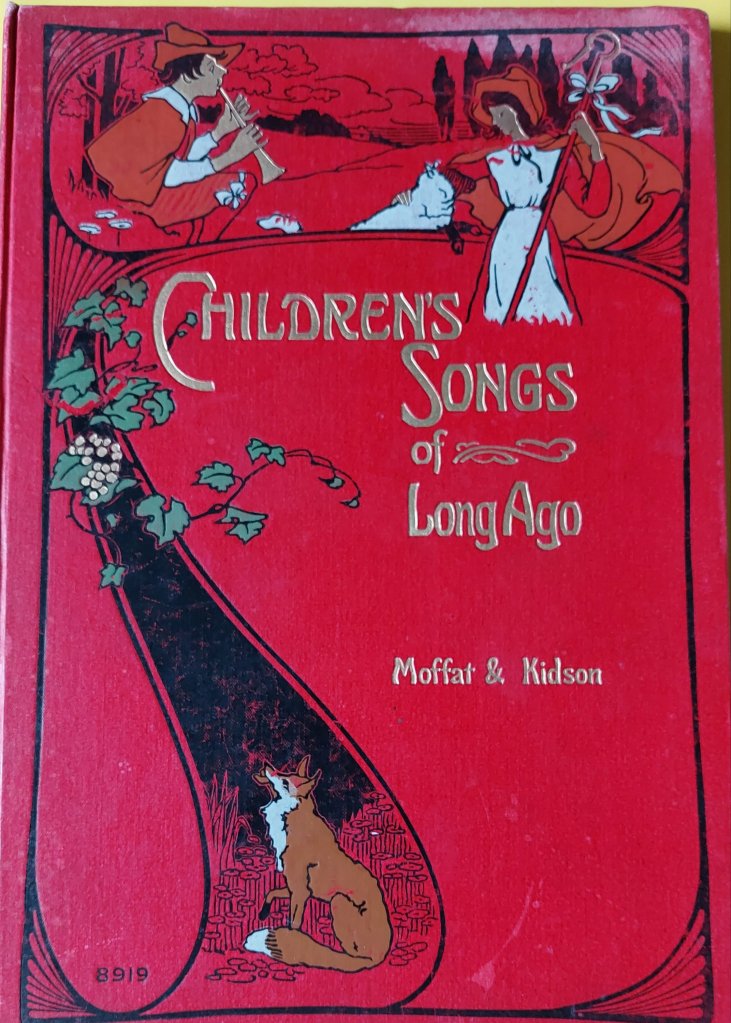
You’ll remember that I recently treated myself to an Edwardian book of children’s songs published by Augener, partly because I’m interested in the compilers, but mostly for the delightful cover? I subsequently discovered it was the sequel to an earlier book, British Nursery Rhymes. Well, I couldn’t have the second without the first, could I?

The sequel: Children’s Songs of Long Ago

Luckily, my interests are generally quite inexpensive! I will take them to the piano at some point – and look more closely at the contents, from the point of view of repertoire.

D’you know, just about every bit of research I’ve done has involved examining repertoire. Starting with 13th century Gregorian chant – not many people know I was initially a mediaevalist! I’ve come a long way.