The Dead Mouse

I’ve typed so much, and moved so much text around – not to mention manipulating images on the PowerPoint – that my mouse has died.

Yes, it has been another working weekend – I’ve edited and resubmitted a librarianship article to a librarianship journal, licked my seminar paper about Sir John Macgregor Murray into its final, polished shape, and totally indulged myself sourcing suitable images for the PowerPoint!   No kidding – I have had to abandon the mouse, which I’ve left twitching at the back of my desk.  It has had a long and interesting life.

I do have a day-trip planned for this week, to the archives of the Royal Highland and Agricultural Society of Scotland.  I’m off to inspect more Macgregor Murray documents – I can’t NOT see them!  It has been an interesting assignment, because I’ve found out so much more about him than I knew at the time of writing my PhD.

And then … back to grant-writing.  And thoughts of Stationers’ Hall music, amongst other things!

Have You Met Your Original Objectives?

fishmosaic

One of the questions asked by ResearchFish – the private limited company responsible for collecting data about everyone’s grant-funded research – is this:-

“Have you met your original objectives?”

It’s a multiple-choice answer: Yes; No; Partially; or Too early to say.  I’ve devoted quite a bit of time to asking myself this question, and I believe that yes, I have achieved what I set out to achieve, with the help and support of all those who have involved themselves in the Claimed From Stationers’ Hall music research network.

fishmosaicThe project sought, in the first instance, to identify the patterns of survival of the Georgian music copyright material. Whilst aware that perhaps only one quarter of all Georgian-era published music was actually registered at Stationers’ Hall, we now have a very clear overall picture of the survival patterns of the registered musical material in historical legal deposit libraries, with the most obviously complete collections being at the British Library, the Bodleian and the University of Glasgow, and with the University of St Andrews’ collection close behind them.  Cambridge and Aberdeen University Libraries, and the National Library of Scotland have rather less, but cataloguing is incomplete, whilst Edinburgh University retained only a very modest amount of the copyright music that they received. (There’s a magnificent spreadsheet, and the music is now gradually being fully catalogued.)

Three libraries seem not to have retained music, for historical reasons tied up with the institutions themselves: Trinity College Dublin made a decision not to claim music; King’s Inns, also Dublin, was a legal library, and it is impossible to tell whether the unexpected small holdings of music arrived through legal deposit or by other means; and the theological Sion College’s surviving holdings, now in Lambeth Palace Library, appear not to have had any copyright music by the time of transfer.

fishmosaicSecondly, the project sought to identify where collections may not yet be catalogued online, to establish the extent of the work outstanding in order to facilitate access to the material in library special collections via Copac. We now have a clear picture of where holdings are not yet catalogued online; and until the time when the bulk of this material ­is retrospectively catalogued, big data analysis would perforce be somewhat misleading. On a more positive note, interest has been expressed in attempting to rectify this situation at four of the libraries, and the increased interest in the repertoire that this project has engendered, has certainly provided motivation.  Some interesting big data analysis was produced using data from the St Andrews material currently catalogued online, and data gathered from historical loan records of the entire St Andrews music copyright collection.  However, no other institution holds comparable loan records.

fishmosaicThe third objective concerned interdisciplinary networking, with the project offering an opportunity for networking by interested parties from all relevant disciplines, seeking to explore the history of British-published music in all British legal deposit libraries. Extensive networking, in person, via electronic means, and in print, has raised the profile of this repertoire. A workshop at the Royal Conservatoire of Scotland brought together librarians from most of the historical copyright libraries, together with interested scholars from the fields of musicology, big data analysis and digitisation of resources, and library history.

Papers have been given at a number of conferences, with the possibility of more in future months; and relationships have been forged both nationally and internationally with individuals and with relevant organisations:- librarians, particularly in music libraries and special collections; book and library historians; musicologists, folklorists and copyright specialists; and contact with Stationers’ Hall itself.  In short, a wide range of people have been introduced to this project at the various events I’ve spoken at, from scholars of various disciplines, to librarians in different kinds of libraries, to folklorists, copyright specialists, local historians and genealogists, and users of archives.

fishmosaicA fourth objective was to draw together documentation in support of the interdisciplinary study of such collections’ history, by compiling a bibliography for the shared use of both librarians and scholars, which would itemise both archival sources and existing scholarship and writings on these music collections for future exploitation by scholars of various disciplines. A substantial bibliography has been compiled, detailing scholarship on all aspects of historical music copyright and legal deposit, also embracing some of the wider context of copyright legislation, and pertaining to music in individual institutions. Histories of individual libraries have been included, with the extent of archival documentation at the University of St Andrews standing out above most others, particularly in terms of the use made of the music copyright collection there.  This bibliography, currently online via the present network blog, will also very soon be made available via the institutional repository, Pure, at the Royal Conservatoire of Scotland.

fishmosaicA fifth objective was to introduce and promote these collections and their research potential at interdisciplinary meetings and via appropriate publications. To this end, the study day at the Royal Conservatoire of Scotland in March 2018, afforded delegates the opportunity to share knowledge about individual collections; to look ahead to future collaborative possibilities; and to reflect upon the need for further retrospective cataloguing; and to listen to a performance of some Napoleonic-era songs by women composers.

Themes arising from the study of this repertoire, and mentioned at the study day, have also been explored in subsequent conference papers and blogposts (both for this blog, and also as a guest blogger on others), demonstrating how the copyright collections provide a wealth of source material for studying the social and cultural history of music, eg the role of women in creating as well as performing music in the Georgian era; early music pedagogical repertoire; or the writing of popular songs and marches as a cultural response to the Napoleonic Wars.

The study day resulted in a commitment to produce a guest co-edited issue of Brio, the music librarianship journal of the International Association of Music Libraries’ UK and Ireland branch; authors have agreed to provide material in time for the November 2019 issue.

fishmosaicLastly, the project sought to foster the performance of music from these collections, encouraging network participants to consider small-scale local events to showcase this material. A performance of some Napoleonic songs composed by women had already taken place both in St Andrews and at the University of Glasgow before the commencement of the network proper, and two of these songs were performed at the study day itself. The opportunities posed by this kind of material have also been outlined in spoken conference and seminar papers, and the possibility of further educational outreach to under-18 year olds is still currently under discussion.  Key issues are that, whilst librarians are custodians of the rare musical materials, it would require collaboration between librarians, musicologists and performers to research the collections in order to present particular historical themes, and to facilitate live performances. Furthermore, the exploitation of music through performance is probably more likely to take place beyond, rather than in, individual libraries, thus making the coordination of such events more complicated than they might initially appear – but assuredly not impossible!

fishmosaicIn summary, the stated objectives of the Claimed From Stationers’ Hall networking project have certainly been met.  The challenge now, of course, is to examine the findings and, taking all considerations into account, to determine the most promising directions for future research!

blue-turquoise-mosaic.jpg


Research Impacts: Asking You!


fishmosaic

The other day, I blogged about research outcomes.  Much joy has been experienced in the logging of these – it’s actually quite rewarding to look back and see what has been achieved in one and a half days a week.  (Okay, some was admittedly achieved in evenings and weekends as well.  But an outcome’s an outcome, isn’t it?!)

However, if you’ve had an opportunity to glance at my recent guest-blogpost for IAML (UK and Ireland Branch), you’ll realise that the outcomes are only one side of the story.  So, today I’ve been contemplating research impacts.  This project has made networking connections with loads of people, libraries and organisations, so there’s no denying there has been impact within academia … but what about beyond the ivory towers?!  Some of the organisations have a preponderance of researchers, but others certainly embrace both academia and those in non-academic circles.

So, here’s my appeal to you: if you’ve been enjoying following the project, and you feel we’ve in any way influenced you in your academic OR non-academic existence, I’d positively love to hear from you.  I know I haven’t been blogging into a void, because people do respond to what they see … but I’d hate to think I had overlooked some impact or influence that was worth shouting about!  Similarly, do let me know what you’d like to happen next.

I’ve allowed comments on this post – but any form of communication, social-media or otherwise, would be very warmly welcomed!  Thank you.

Pathways, Outputs and Impacts: Being a Librarian-Researcher Today

gold-cobblestonesIAML (UK & Ireland) Guest-Blogpost

At last year’s Annual Study Weekend of my professional organisation (the International Association of Music Libraries, UK and Ireland Branch), I spoke to members about my experiences of successfully seeking research-grant funding.  And now here’s my guest-blogpost reminding colleagues about it:-

via Pathways, Outputs and Impacts: Being a Librarian-Researcher Today

Research Outcomes

At a time when all researchers earnestly and diligently record and submit outcomes and fishmosaicoutputs for ResearchFish, I wonder how I could intimate the activities that have been initiated for 2019 as well?!  This month, I’ve submitted abstracts in response to FOUR conference calls for papers.  I’ve started thinking about another potential project.  But I’ve also got several things already in the pipeline, written during the research grant for Claimed From Stationers’ Hall – and indeed, a few that have been in the pipeline for much longer than that!  (Inspired by ResearchFish – not that this particular piece of writing has anything to do with my present research – I have just enquired about some encyclopedia entries that I wrote in 2016, and was relieved to hear that publication is (in encyclopedic terms) imminent.  It’ll be good to strike them off my “pending” list!)

Isn’t it frustrating when your outputs are significantly greater than have actually reached fruition or publication!

Ah well, back to ResearchFish, and I’ll see if I’ve missed anything off the present list!

2018 Round-Up: the Scholar-Librarian

Annual Review, 2018

St Pauls SilhouetteI am a Performing Arts Librarian 3.5 days a week, and a Postdoctoral Researcher 1.5 days a week.  In this self-imposed annual review, I’m not listing routine activities conducted in either capacity; it goes without saying that I’ve answered queries, catalogued, delivered library research training to a number of different class groups, attended meetings, and pursued research-related activities and fieldwork.

From September 2017 to September 2018, I was the AHRC-funded Principal Investigator for a new research network, the Claimed From Stationers’ Hall music research project.  Since then, I have continued to conduct research and network with the various scholars and libraries involved with this project, and in the new year shall be pursuing further grant-funding in order to extend the reach of the project.

As someone who continually asks themselves, “Am I doing enough?”, I feel that even I can be reasonably content with this year’s outputs!

  • JANUARY
  • Chaired sessions at Traditional Pedagogies, international conference at Royal Conservatoire of Scotland
  • FEBRUARY
  • Blogpost: Copyright Literacy: Legal Deposit (Copyright Behind the Scenes) – and Scores of Musical Scores  https://copyrightliteracy.org/2018/02/21/legal-deposit-copyright-behind-the-scenes-and-scores-of-musical-scores/
  • Initial iteration of Claimed From Stationers Hall Bibliography, (since updated regularly) https://claimedfromstationershall.wordpress.com/bibliography/
  • Book chapter, ‘Wynds, Vennels and Dual Carriageways: the changing Nature of Scottish Music’, in Understanding Scotland musically: folk, tradition and policy. Abingdon, Oxon: Routledge, p. 230-239.
  • MARCH
  • Claimed From Stationers’ Hall Workshop, Royal Conservatoire of Scotland, (26 Mar)
  • Scottish Library & Information Council (SLIC) From PGCert to PG Certainty: Enabling the Distance Learner (invited talk, sectoral organisation) (March 2018)
  • APRIL
  • IAML(UK & Irl) Annual Study Weekend, invited talk, Pathways, outputs and impacts: the ‘Claimed from Stationers Hall’ music project takes wings
  • IAML(UK & Irl) Annual Study Weekend From PGCert to PG Certainty: Enabling the Distance Learner (quick-fire session) (April 2018)
  • MAY
  • Blogpost based on the session I gave at the IAML(UK & Ireland) Annual Study Weekend 2018 for the IAML(UK & Ireland) blog, http://iaml-uk-irl.org/blog/libraries-reaching-out-distance-learners
  • JUNE
  • EAERN (Eighteenth-century Arts Education Research Network), ‘Claimed From Stationers’ Hall: But What Happened Next?’ (University of Glasgow, 6 June)
  • Romantic Song Network steering group seminar at British Library
  • JULY 
  • IAML/AIBM Annual Congress, Leipzig, ‘A Network of Early British Legal Deposit Music: Explored through Modern Networking
  • SEPT
  • RMA Conference, Bristol, ‘Overlapping Patterns: the Extant Late Georgian Copyright Music Explored by Modern Research Networking’
  • NOV
  • Field-trip to King’s Inns and Trinity College Dublin Libraries, and British Library
  • EFDSS Conference, London, ‘National Airs in Georgian British Libraries’
  • ARLGS (Academic and Research Libraries Group Scotland) Teachmeet at Glasgow University Library – speaker
  • Article, Trafalgar Chronicle, New Series 3 (2018), 202-212, jointly authored with Brianna Robertson-Kirkland, ‘My love to war is going’: Women and Song in the Napoleonic Era’.
  • DEC
  • Article, Information Professional, Nov-Dec 2018, ‘Coffee and Collaboration’ [teaching electronic resource strategies]

Additionally, I have authored 79 blogposts and 5 Newsletters in connection with the Claimed From Stationers’ Hall research project.

Bat printed cup and saucer possibly New Hall £2-00Institutional Repository: Pure.  My profile:- https://tinyurl.com/KarenMcAulayPureInstRepository

I’ve blogged elsewhere about my musical and sewing activities – both essential to me in terms of relaxation and balance!  You’ll find it here:-

https://karenmcaulay.wordpress.com/2018/12/22/2018-round-up-in-creative-mode/

Collage map golden triangles legal deposit

The Elocution Teacher’s Daughter: a Moral Tale

Before you get too excited about the idea of an immoral daughter, I should let you down gently: the moral doesn’t concern this young lady at all – rather, it’s a warning of what a few holiday hours’ google-searching can turn up!

Brown, Mather, 1761-1831; The Battle of the Nile: Destruction of 'L'Orient', 1 August 1798
Battle of the Nile, destruction of L’Orient 1.8.1798, by Mather Brown (Artuk.org)

All I wanted was to find out was the identity of the young lady music teacher who composed a particular song.  A colleague and I are working on a paper about women who composed Napoleonic songs, and I found another which looked chronologically timely, and potentially interesting.  Musically, it truly isn’t a great song in the slightest regard.  The lady didn’t appear to have much clue about harmony, harmonic progressions or satisfactory cadences, and expected her singer to reach a top B twice, not to mention five As!  The British Library has it online – I don’t think anyone will want to perform it, which leaves musicological detectives like me to pore over it and explore its context!

I was curious as to who she was, nonetheless, and equally curious as to the poet who supplied her with the words.  (He probably also published it, since it was later advertised in a novel that he’d published.)  It referenced the Battle of the Nile, and – in a nutshell – the poet believed he’d be able to forget his wounds when his beloved shed tears over them.  It’s a sentimental, human take on the horrors of war – I imagine our young composer would have enjoyed the thought that the protagonist was simply yearning for the sympathetic embrace of his sweetheart.

How the composer encountered the publisher/poet is something we’ll never know.  He was based in London, she in Edinburgh.  Along with literature and a bit of poetry by famous names, he had also already carved a reputation for himself as the pseudonymous “Thomas Little”, editing and publishing illustrated books about – ahem! – romantic love and reproductive anatomy.  (I’m trying not to attract the bots here!)  Shall we just say that the illustrations were detailed, and some years later, one of his books was found being circulated and well-thumbed by the occupants of a prison.  There was also a court-case about the Hansard reporting of this.  John Joseph Stockdale unknown artist image courtesy of British Museum Public DomainAnother of his disreputable triumphs was the publication in 1826 of  a very famous courtesan’s autobiography. Harriette Wilson had been one of Wellington’s mistresses.  So now you know where the phrase, “publish and be damned” comes from – Wellington said it when his identity was revealed.

What does this have to do with a young music teacher composing a setting of a Napoleonic song?  Absolutely nothing!  Her publisher/poet’s first troublesome publication had been released in 1811; perhaps she knew nothing about it.  Her own song was published five years later in 1816.  She married an Edinburgh artist in 1818, probably lived near Dollar in Clackmannanshire when he became art professor at Dollar Academy in 1824, and was widowed in 1829, with three young daughters to look after. (Their only son had died in infancy.)

During her lifetime – before and after marriage – she published ten musical pieces, at least a couple of hymn-tunes, and a melodrama.  Four of her pieces were settings of Scottish songs, and one of them was dedicated to Sir Walter Scott’s daughter, a distant relative.  It’s possible that one of the other songs may also have a Napoleonic theme, but until I go and see the sole surviving copy, I can’t really be sure.  I discovered that she was “a very fine harpist”, but the observation was unreferenced.  (As we all know, you need a CITATION!)

Howe Street Mrs GibsonOne of the hymns – appropriately named with an Edinburgh location – was “Howe Street”, which appeared in Sacred Harmony for the Use of St George’s Church Edinburgh.  You can find this book on IMSLP, or see an abc transcription of the tune on Jack Campin’s Embro, Embro website.  But – as final demonstration that I’ve probably spent too long on the internet today – you can also find the tune used for a psalm-like modern interpretation of a Georgian herbal by scientist Elizabeth Blackwell – with musical adaptation by Frances M. Lynch.  If our lady music teacher doesn’t turn in her grave at the exposure of her Napoleonic poet for what he was, then she will certainly rise to haunt the imaginative interpreters of her psalm-tune!

Curious Herbs (With Mary’s love without her fear)

And the moral of the tale? Sometimes it’s better to take the evidence at face-value.  A composer, a poet, a Napoleonic song – the rest makes for a great day’s Googling, but really has little bearing on the topic in hand!

When Less is More and More is Less

This may sound as though I’m speaking in riddles.  Truly, I’m not!

I alluded in my earlier posting today to the question of “When less is more”, in the context of the apparently minimal amount of Stationers’ Hall music surviving at Edinburgh University Library, and how I was forced to look at the little that was there, in quite a close focus.

But I still have copies of those lists of music in the National Library of Scotland.  So, on the one hand, we have very little of the music surviving in what was then “Edinburgh College”.  On the other hand, we have lists of music from the Advocates Library in 1830, but we don’t know what the purpose of the lists was.

I’ve started to transcribe these lists – only a few pages, but interesting nonetheless.  But, how do I rationalise to other people just why they’re interesting?  And this is why:-

If I can establish which of these pieces actually SURVIVED in different libraries, then I get a snapshot view – fragmented and  blurred, admittedly – of which libraries retained more, or less, and I can see if certain categories were more likely to survive at that time, shortly before the legal deposit system was radically reduced.  Yes, it means another spreadsheet.  But I still think there may be something interesting to unearth.  Watch this space!

And yes, I do still need to establish whether there is music surviving but not yet catalogued online. I know about some of the libraries, but not absolutely clearly for all of them.  That’s why I’m making my visits around the country!


Claiming Copyright in your Music

Music Copyright, the 18th/19th Century Way:

So you’re a composer in Regency Britain, say 1813, and you want to claim copyright inwriting-1043622_640 your music.  What do you do?  Well, if you have a publisher, they might submit it to Stationers’ Hall, where it would be registered.  They might not, though.  (Some publishers thought they’d have the best of both worlds – they’d print a copyright statement to the effect that it had been entered at Stationers’ Hall, but they wouldn’t actually bother doing so.)  In any event, it’s a bit hit or miss.
If you’re self-publishing, then you might consider it in your own interest to register your copyright in the work.  After all, by now it’s at least accepted that composers’ work did count as intellectual property and deserved protection.  That wasn’t necessarily the case in the mid-18th century!

Copies of music registered at Stationers’ Hall would then be sent to all the legal deposit libraries – the British Museum (which became the British Library), Sion College in London, the Universities of Oxford, Cambridge, Edinburgh, Glasgow, St Andrews, Aberdeen and Trinity College Dublin, the Advocates’ Library (which became the National Library of Scotland), and Kings’ Inns, also in Dublin.  Whether the music gets to all these places is also a bit hit or miss!  It’s not always sent, not always kept methodically upon arrival, and some libraries don’t want all this music anyway.

Tracing It Today

The Claimed from Stationers Hall project sets out to find out more about what happened to all the Stationers’ Hall music.  This is Week 2 of the network’s existence, so you’ve come in right at the start.  If you’re interested in early music publishing, library history, or the social, cultural side of the music borrowed from these libraries, then this network is right up your street.  Please follow this blog, and the Twitter @ClaimedStatHall, and do let us know if you’re working on anything in any way related to this repertoire!

St Andrews and now Aberdeen

Karen has spent some time exploring the rich archival resources at the University of St Andrews, where the Stationers’ Hall music was sifted through, much was catalogued, and then it was eagerly borrowed by a number of people via the professors’ library memberships.  We can trace what was received, find it in a fascinating handwritten catalogue, and even observe who borrowed what.

unknown artist; King's College, Aberdeen
King’s College, Aberdeen
unknown artist
University of Aberdeen

But what of the other libraries?  This week, the magnifying glass focused on the parallel collection in Aberdeen.  Work has been done on the documentation of what was received by the library in the 18th century by former librarian and research scholar Richard Turbet, and we can now see what was received in these early years, even if it doesn’t all survive today.  (Turbet, ‘Music Deposited by Stationers’ Hall at the Library of the University and King’s College of Aberdeen, 1753-96′, RMA Research Chronicle 30 (1997) pp.139-162)

Roughly half of the surviving copyright music is now in the online catalogue there: at the time of writing, 2062 of an approximate 4400 items in the entire bound Stationers Hall Music collection.  How was it used by the community in contemporary Aberdeen, though?  The next question is to establish where there are comparable loan records to those in St Andrews.  We do know, through Richard Turbet’s work, that there were concerns as to what had happened to the Stationers’ Hall music, in the Aberdeen Censor of 1826.  Intriguing!

Catalogues and Conundrums

The union catalogue of UK University and national libraries makes it easy to trace most things so long as they have been catalogued online.  However, differences in cataloguing mean that it’s not always as easy as you’d think.  Take Gesualdo Lanza’s Elements of Singing in the Italian and English Styles.

Different cataloguing approaches make it a little difficult to untangle, but if you search Lanza, Elements of Singing, you retrieve 16 entries, one of which is just a print portrait. It was published in 1813 – different catalogues have it self-published, published by Button and Whittaker, or indeed printed and sold by Chappell.  Around 1819-20, an abridged version appeared, again by Chappell (though the catalogue records don’t all state this the same way), and apparently again in 1826.

So there are at least two if not three basic versions, and you’d expect them each to appear in all the copyright libraries?  Think again!  Differently styled catalogue records reveal copies of the 1813 publication in Glasgow, St Andrews, Aberdeen, the British Library and Oxford Bodleian, and a copy in York, which was not a copyright library.  The other legal deposit libraries don’t have it, unless it’s still not catalogued online.  (That’s another interesting question.  Some pre-1801 material is definitely not yet catalogued – grant-funding for retro-conversion theoretically took care of (most of) the post 1801 material, just over a decade ago.)  In total, the two or three versions of 1813, 1820 and perhaps 1826 yield 16 entries in Copac, which equates to slightly more than 16 copies.

This Was Week 2 of the Project

Besides looking at work already done on the Aberdeen collection, this week has also entailed documentation of some of the conferences and other networks that touch upon the subject of Regency music or library history – see our Useful Links page, and do please contact us if there are others we’ve missed!  And of course, we’ve been networking.  We’ve tweeted and we’ve emailed, and we’re loving the responses we’ve received.  Keep in touch!

The Long Tail of Research …

I’ve recently spent a few days assessing a departmental music collection in St Andrews.  I St Andrewshad my ‘librarian hat’ on, primarily, but even that hat has a musicological lining, so I couldn’t help thinking research-minded thoughts from time to time.  In particular, one train of thought was provoked by the discovery of a pile of early 20th century popular songs with eye-catching cover art, betraying cultural trends and prevailing preoccupations such as patriotism around war-time; nostalgia; family ties; romantic relationships; or the portrayal of children.  Not ‘serious music’, this, but the pictures and the content, not to mention musical styles such as ragtime, all tell us about popular musical preferences.
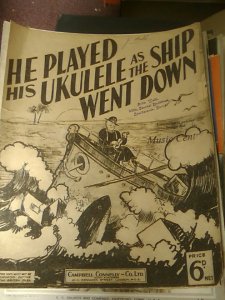
Cover art - ukuleleIs it worth keeping, then?  It might be.  Not for the classical musicians to attempt to analyse as they would a Haydn string quartet, but to inform us about cultural history.  So, if early twentieth century popular music can inform us in this way, then it follows that the Georgian and early Victorian songs and other material appearing in legal deposit music collections will have their own stories to tell … and any statistics about library usage tells us just which volumes were popular with the borrowers.  I’ve made a start on this with the St Andrews historical copyright music collection, having collated the music borrowing records from 1801-1849 and started gathering statistics.

My other research-minded thoughts were more directly focused on the St Andrews historical collection.  We know that a twentieth-century professor dis-bound some volumes and redistributed their contents to other collections.  (How much he did, I have yet to discover. Not a huge amount, maybe, but it’s interesting all the same, isn’t it?)  And I’ve a suspicion that I unearthed a handful of disembodied legal deposit music pieces during my departmental collection assessment.  The librarian in me knows that they should go “home” to their special collection friends and relatives.  But the researcher itches to check out whether they really are taken from earlier bound collections, and whether they number amongst the items listed in the archival receipt books of materials claimed from Stationers’ Hall.

So, the Claimed from Stationers Hall project may be focused on early nineteenth century library collections, but there’s a long tail extending into at least the mid-twentieth.  It was hinted at in Elizabeth Frame’s article for the Edinburgh Bibliographical Society Transactions, but today’s scholars need to understand in perhaps greater detail just what the esteemed professor got up to!