

Before you get too excited about the idea of an immoral daughter, I should let you down gently: the moral doesn’t concern this young lady at all – rather, it’s a warning of what a few holiday hours’ google-searching can turn up!
All I wanted was to find out was the identity of the young lady music teacher who composed a particular song. A colleague and I are working on a paper about women who composed Napoleonic songs, and I found another which looked chronologically timely, and potentially interesting. Musically, it truly isn’t a great song in the slightest regard. The lady didn’t appear to have much clue about harmony, harmonic progressions or satisfactory cadences, and expected her singer to reach a top B twice, not to mention five As! The British Library has it online – I don’t think anyone will want to perform it, which leaves musicological detectives like me to pore over it and explore its context!
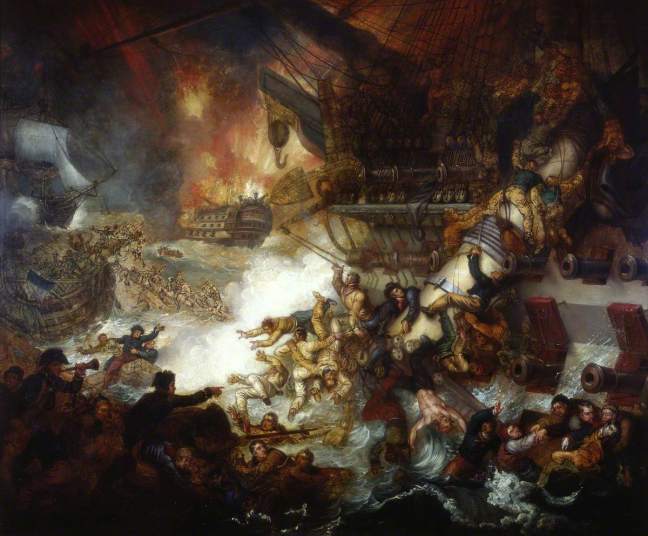
I was curious as to who she was, nonetheless, and equally curious as to the poet who supplied her with the words. (He probably also published it, since it was later advertised in a novel that he’d published.) It referenced the Battle of the Nile, and – in a nutshell – the poet believed he’d be able to forget his wounds when his beloved shed tears over them. It’s a sentimental, human take on the horrors of war – I imagine our young composer would have enjoyed the thought that the protagonist was simply yearning for the sympathetic embrace of his sweetheart.
How the composer encountered the publisher/poet is something we’ll never know. He was based in London, she in Edinburgh. Along with literature and a bit of poetry by famous names, he had also already carved a reputation for himself as the pseudonymous “Thomas Little”, editing and publishing illustrated books about – ahem! – romantic love and reproductive anatomy. (I’m trying not to attract the bots here!) Shall we just say that the illustrations were detailed, and some years later, one of his books was found being circulated and well-thumbed by the occupants of a prison. There was also a court-case about the Hansard reporting of this.  Another of his disreputable triumphs was the publication in 1826 of a very famous courtesan’s autobiography. Harriette Wilson had been one of Wellington’s mistresses. So now you know where the phrase, “publish and be damned” comes from – Wellington said it when his identity was revealed.
What does this have to do with a young music teacher composing a setting of a Napoleonic song? Absolutely nothing! Her publisher/poet’s first troublesome publication had been released in 1811; perhaps she knew nothing about it. Her own song was published five years later in 1816. She married an Edinburgh artist in 1818, probably lived near Dollar in Clackmannanshire when he became art professor at Dollar Academy in 1824, and was widowed in 1829, with three young daughters to look after. (Their only son had died in infancy.)
During her lifetime – before and after marriage – she published ten musical pieces, at least a couple of hymn-tunes, and a melodrama. Four of her pieces were settings of Scottish songs, and one of them was dedicated to Sir Walter Scott’s daughter, a distant relative. It’s possible that one of the other songs may also have a Napoleonic theme, but until I go and see the sole surviving copy, I can’t really be sure. I discovered that she was “a very fine harpist”, but the observation was unreferenced. (As we all know, you need a CITATION!)
 One of the hymns – appropriately named with an Edinburgh location – was “Howe Street”, which appeared in Sacred Harmony for the Use of St George’s Church Edinburgh. You can find this book on IMSLP, or see an abc transcription of the tune on Jack Campin’s Embro, Embro website. But – as final demonstration that I’ve probably spent too long on the internet today – you can also find the tune used for a psalm-like modern interpretation of a Georgian herbal by scientist Elizabeth Blackwell – with musical adaptation by Frances M. Lynch. If our lady music teacher doesn’t turn in her grave at the exposure of her Napoleonic poet for what he was, then she will certainly rise to haunt the imaginative interpreters of her psalm-tune!
Curious Herbs (With Mary’s love without her fear)
And the moral of the tale? Sometimes it’s better to take the evidence at face-value. A composer, a poet, a Napoleonic song – the rest makes for a great day’s Googling, but really has little bearing on the topic in hand!
 your music. What do you do? Well, if you have a publisher, they might submit it to Stationers’ Hall, where it would be registered. They might not, though. (Some publishers thought they’d have the best of both worlds – they’d print a copyright statement to the effect that it had been entered at Stationers’ Hall, but they wouldn’t actually bother doing so.) In any event, it’s a bit hit or miss.
 had my ‘librarian hat’ on, primarily, but even that hat has a musicological lining, so I couldn’t help thinking research-minded thoughts from time to time. In particular, one train of thought was provoked by the discovery of a pile of early 20th century popular songs with eye-catching cover art, betraying cultural trends and prevailing preoccupations such as patriotism around war-time; nostalgia; family ties; romantic relationships; or the portrayal of children. Not ‘serious music’, this, but the pictures and the content, not to mention musical styles such as ragtime, all tell us about
 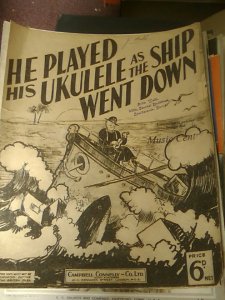 Is it worth keeping, then? It might be. Not for the classical musicians to attempt to analyse as they would a Haydn string quartet, but to inform us about cultural history. So, if early twentieth century popular music can inform us in this way, then it follows that the Georgian and early Victorian songs and other material appearing in legal deposit music collections will have their own stories to tell … and any statistics about library usage tells us just which volumes were popular with the borrowers. I’ve made a start on this with the St Andrews historical copyright music collection, having collated the music borrowing records from 1801-1849 and started gathering statistics.
 Karen McAulay, Musicologist