Dr Karen McAulay explores the history of Scottish music collecting, publishing and national identity from the 18th to 20th centuries. Research Fellow at Royal Conservatoire of Scotland, author of two Routledge monographs.
You turn up to start a new university course, all ready to elevate your ukulele* performance to the highest possible level … and suddenly, you’re being told about referencing and citation, catalogue searching and note-taking, and you have a written assignment which terrifies the life out of you? How have things got so serious, so soon?
As you’ll have been told, it is very important that whoever marks your essay can see where you drew your information from. When you studied maths at school, your teachers probably told you to ‘show your workings’ (or some similar expression), right? Referencing is pretty much the same idea – they need to know how you arrived at your final argument, and which authorities informed your thinking. Referencing (some people call it citation) is how you show your workings in academia.
You’ll also have been told about the Turnitin software which can determine whether your submission is likely to be all your own work, or cut and pasted from various other sources without acknowledgement. Academic honesty is all-important. Using other folks’ work is not acceptable – and using AI such at Chat GPT is equally frowned upon.
‘Chat GPT can’t do referencing’
(said a colleague from another institution, in discussion)
Is this correct? In the spirit of scientific discovery, we decided to put this to the test. We wrote an ‘essay’ (well, a couple of paragraphs) containing some genuine references, but also some downright lies about pizza and curry! then asked Chat GPT to write a piece of prose with a bibliography.
Chat GP entered into the spirit of the thing, and made up some titles in line with the nonsense we’d written!
Well, this wouldn’t be much good in an essay, would it? Made up titles? No publisher details? No, thanks. Perhaps, we thought, we had been wrong to TELL Chat GPT we were only playing with it.
Removing the dates, we left incomplete references. Chat GPT completed every reference with ‘(year of publication and the title are not provided).’ That wasn’t much use either.
How could we get Chat GPT to produce a Harvard reference? Indeed, any decent reference?
We tried a third time. This time, we left the imaginary essay out of it, and just gave Chat GPT five authors’ names and the years of their genuine publications.
Chat GPT was stumped! However, it was scrupulously polite in admitting it:-
‘I apologize, but I couldn’t find specific references or sources for the provided citations. It’s possible that these references do not exist or that they are not widely known in the academic or literary world. If you have any other questions or need assistance with different topics, please feel free to ask.’
Chat GPT, 16 October 2023
So, it’s true. You can’t get Chat GPT to write a Harvard reference! It might be tempting to try to use technology to help write your essay, but you’re seriously better off doing the work – and the referencing – yourself! You learn, your tutor sees that you’ve done the work, and everyone is happy. (NB The library can help you find resources to get your referencing right. It sounds complicated, but it’s really quite easy to get the hang of it. Look for the Ask a Librarianlink on the catalogue home-page.)
My talk for the Scottish Graduate School of Arts and Humanities was incredibly well-attended. It was lovely to be able to talk about one of my specialisms to people who were genuinely interested. My thanks to you for attending, if you were one of those people! At least one individual had just started their bibliography, so hopefully I was able to share some useful tips.
I’ve uploaded my PowerPoint and text to my Conservatoire Pure account – our institutional repository – please click here.
If anyone tried to sign up, but experienced a problem getting into the meeting, please contact me via the SGSAH Summer School organisers.
I’ve already mentioned that I would be attending Icepops 2019 at the University of Edinburgh yesterday – a conference about copyright literacy, and providing appropriate training to students, researchers and other staff colleagues.
(Icepops = International Copyright-Literacy Event with Playful Opportunities for Practitioners and Scholars).
My challenge was to deliver a Pecha Kucha which mentioned my research into historical legal deposit music, and ALSO touched on library user education into matters pertaining to copyright. ‘Silence in the Library: from Copyright Collections to Cage’, did just that. I have never spoken about John Cage’s controversial piece, 4’33” before. Neither have I deliberately inserted six seconds of silence into a format DESIGNED for brevity and concision! If you Google how many words you can fit into 20 seconds, you’ll find it’s just 60 words. That’s if you don’t use long words! So giving up a third of a slide to silence was, I felt, a calculated risk, but how else was I to demonstrate what you might hear during a silent episode?! All went well, and my calculations worked out – what a relief!
The conference was about a playful (lusory) approach to copyright education. In that regard, I discussed how Cage’s piece – silent though it was – still has copyright in the concept, and how students could be encouraged to contemplate how intellectual property can reside in the most unlikely situations – whilst also pointing out that 4’33” cannot be performed or even hinted out without dire legal consequences. You don’t believe me? I’ll put my presentation on our Pure institutional repository, and you can follow the references for yourself!
I mentioned playing the piano during the evening social? Oh boy, did we play?! I wasn’t alone – there was also a clarinet duet, and I staggered through a piano duet, unknown to both of us, with one of the (multi-talented) clarinet duo. The same clarinettist, on clarinet, kindly gave the premiere performance of a piece I’d recently written. That was definitely a first – I’ve never had an instrumental composition (as opposed to an arrangement) of my own performed publicly before.
Definitely an out-of-the-ordinary conference, then. I seem to be making a habit of this! Better get back to the eighteenth and early nineteenth centuries, now …
This week I’ve been focusing on my paper for the EFDSS conference, Traditional Folk Song: Past, Present & Future, on Saturday 10 November, 9:30am – 5:00pm at Cecil Sharp House, London. I’ll be talking about ‘National Airs in Georgian British Libraries’, and particularly focusing on the collections in St Andrews and Edinburgh. I’ll also be alluding to that old nineteenth century irritation – the allegation that England had no national music!
As it happened, I needed to take a day’s annual leave for a non-work related reason yesterday, but I hoped that for most of the day I would be free to concentrate on my presentation. Well, it didn’t work out quite that way, but I did start writing in the evening. Today, I spent the first couple of hours teaching library research skills, then it was back to the laptop in the research room for the rest of the day.
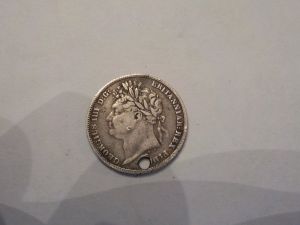
By the end of the working day, I had written just over 4,000 words and felt I deserved a treat: I left my papers on the desk and came home to spend the evening sewing! (Better still, another little indulgence had arrived in the post for me: a silver sixpence dating from 1821, the year of George IV’s coronation, and with a hole pierced in it by a previous owner so that it could be worn on a ribbon. As of course I already am!)
The conference will actually be the culmination of a particularly busy week for me: I’ll be visiting the two Irish Georgian legal deposit libraries in Dublin earlier in the week, and Stationers’ Hall and the British Library on the day before the conference. One of my choir-members looked somewhat surprised when I remarked that I’d be fitting in choir practice between Dublin and the overnight sleeper between Glasgow and London!
I’m particularly looking forward to this conference because it will be a completely different audience to those at the conferences I’ve already been to this year. I’m intending to give a fairly wide-ranging paper. If I unearth any surprises in Dublin, then there will be last-minute tweaking to add them into the mix!
NB If you liked this, you might like a post I wrote on a related topic, earlier this year – essentially a continuation of the story after the period that I’ll be describing in my latest conference paper:- England has no National Music? Chappell Set Out to Refute This
When I was doing my PGCert, I surveyed a cohort of postgraduate distance-learners to see what they thought of some brief instructional self-help clips that I had designed. I asked for feedback, and I got it – short videos were very welcome, it seemed, but several students particularly asked for animations. I liked this idea – apart from wondering how I would achieve this!
When I found Biteable.com, I was quite excited – there are a number of templates and audio backgrounds to choose from, and you can just edit in your own text, changing colours and adding pictures as you choose. I’ve already done a couple for this research network, and a couple of months ago I made one as a library guide, too.
This week, I made two more. One is about setting up email alerts for our library discovery layer, and the video I’ve just curated today is about fake news – basically, not leaping to conclusions about things when you haven’t enough evidence to back your suppositions up. It stemmed from Wednesday’s field trip. It would have been great to have been able to say that I’d discovered a whole story about how certain music scores got into an old library collection. But – as you’ll see – in truth, I haven’t enough evidence to back up my guesses, and my initial ideas are probably pure fantasy! The scores are there, some of them in what might be a legal deposit volume. But to infer any connection between the scores by these two particular composers would, at present, be reckless in the extreme!
Anyway, do have a look. I had fun making them, and I hope both videoclips will be useful.
Spotting Fake News (Be a Good Scholar) – videoclip




 from 1821, the year of George IV’s coronation, and with a hole pierced in it by a previous owner so that it could be worn on a ribbon. As of course I already am!)
 Karen McAulay, Musicologist