Dr Karen McAulay explores the history of Scottish music collecting, publishing and national identity from the 18th to 20th centuries. Research Fellow at Royal Conservatoire of Scotland, author of two Routledge monographs.
Why do collectors collect things? Especially old things. The link with the past? The feeling that in some remote way, there’s a virtual thread linking you and an earlier era, or a particular individual?
As I’ve mentioned, I’m writing a long article about some late Victorian/Edwardian Scottish women musicians. It’s virtually finished. But there’s one more thing to do.
I have a single 78 rpm shellac recording of one of these women, whose reputation was not inconsiderable in her day. She played in London. She and her ‘orchestra ‘ made a handful of recordings. But I have no means of playing this precious artefact. I’ve tried to beg or borrow an old gramophone (or newer technology) to no avail, so eventually I bought a record player on Amazon.
All this because I wanted to know what instruments were in her band, a century ago! My article is incomplete without this detail.
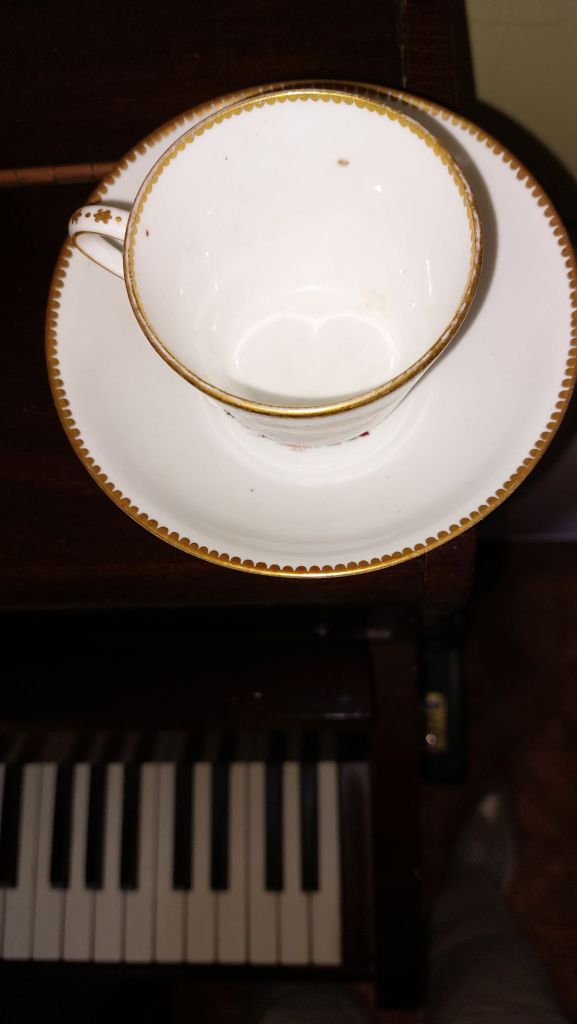
PetronellaThere’s an anecdote about a whisky-filled teacup rattling on a piano edge whilst she played …!
I spent years as a specialist music librarian, trying to boost our holdings of music by women composers. This chapter would have been on my list of useful links, had I come across it before retirement from librarianship! I’ll share it here now; tomorrow I’ll be following up some of the references, for my own research interests.
Still in search of ‘my’ Victorian ladies, I headed for RCS Archives. Thanks to my British Newspaper Archive subscription, I had already ascertained that two individuals had a connection with the old Athenaeum, but I wanted to dig deeper, to find out exactly which classes the ladies attended, and for how long.
The Glasgow Athenaeum: Buchanan Street building, opened September 1892
I went through annual reports and prospecti, until I had satisfied myself that I had gleaned all that there was to glean. At different times, the examination results and scholarship awards were listed in different places; fortunately, I needed to search less than a decade, so I know I haven’t missed any mentions. I can’t claim to have unearthed a wealth of information, but I did flesh out what I already knew.
At this point, even though I’d been advised that the nineteenth-century minutes of meetings really wouldn’t show me anything detailed about individual students, I decided to flick through just a couple of these minutes to see what exactly was there. I was in for a surprise. They had discovered that some of their employees were not receiving a ‘living wage’, and resolved to look into this. I had assumed that a ‘living wage’ was modern terminology, but evidently not!
And, I read, ‘the lavatories really need to be sorted out.’ The mind boggles. ‘My’ ladies had left the Athenaeum by that stage, I think, so hopefully they hadn’t been inconvenienced by the unsatisfactory conveniences!
You’ll remember that I’m currently writing an article about some Scottish women whom I encountered during the research for my forthcoming book. (Actually, I have quite a bit more detail, to the extent that it would be a shame not to share it.)
So of course, I can’t share it here, yet. However, I can reveal that one lady in particular worked as an entertainer, in a trio taking Scotland to emigrants in the diaspora. (I had only traced her on one tour – I didn’t find evidence of her subsequent life – until today. But we’ll come to that in a minute!)
I did NOT expect to find her, as an even younger adult, performing what was then comparatively recent chamber music back home in Scotland.
So I looked for YouTube recordings, just to hear what exactly she had performed. This was more highbrow, and more ambitious than I had given her credit for!
Anton Rubinstein – Piano Trio no.2, op.15, in G minor (1851)
Henryk Wieniawski – Legende, violin and piano (1860)
Henryk Wieniawski – Scherzo-Tarantelle, op.16, violin and piano (1885)
Today, I also found confirmation that this lady emigrated to Vancouver, got married (over there?) – and was a theatre musician for some years. Given Vancouver’s penchant for vaudeville, that may have been her work, but this is pure conjecture.
I’m so pleased with these quick glimpses of another side of someone who I had previously imagined just as a purveyor of sentimental Scottish songs. It doesn’t pay to pigeonhole people!
I am capable of searching obsessively for the most minute detail. On and on I go. Former librarians do not like giving up, and I’m afraid to say that by the time I’ve finished, I’m pretty certain that I’ve either found all that’s online to find, or it isn’t there.
So, I started writing an article last week. I have plenty of data. Why, I even have a scanned document from the National Library of Australia, and I have a photo of one individual that I never expected to find at all.
Nonetheless, on Saturday night, I thought of another search that I hadn’t tried. Oh, my! Immediately, I found one of my musical Scotswomen exactly where I had wanted to find her. Very satisfying.
I went to bed thinking about my search strategy. I had breakfast and did a bit more before going out. This afternoon? Yup, back at it again.
South of the Border …
I think I persevered a tad too long. I found more adverts for her works. I explored the names of professionals who performed them. I even searched for pictures of the now-demolished theatre where one piece was performed. (Oh yes, I found it.) She may not even have seen that herself!
Finally, I found her advertising the services of two particular performers for whom she had written music. Not Scots, either. But that’s enough. I suspect she didn’t do a lot more after that, or I’d surely have found it.
Am I drawing the line here, then? Well, I have a couple of archival queries that I simply must see through to the bitter end, but then? I’m still a part-time researcher.
Better get on with the writing in the time allocated to research!
I’m languishing with Covid right now. (The only placesI’ve been to catch it are buses and libraries!)
I don’t feel up to writing a blog post today. So instead, let me share an interesting post that I found on GoHenry, about women, property, and money. All useful information when I’m contemplating historical women music publishers!
I was bemoaning my many failings yesterday, when I was told (firmly) that I should be more positive and regard myself as a success-story. Unfortunately, I grew up being made so aware of my deficiencies that I’m kind of pre-programmed to look on the dark side. I’ve never quite matched up to expectations!
There’s no Pleasing Some People
Mind you, the criticisms have changed over the years:-
You’re clumsy, untidy and hopeless at sport’;
‘Don’t be disappointed if you fail your 11-plus exam’;
‘You need a secretarial qualification – in case your research doesn’t get you a job’;
‘that “Dr” on your address-labels looks like showing-off’,
‘So-and-so says all those qualifications are ridiculous’,
Are you writing another boring book?’
Which just goes to show that some people are never happy, and maybe I should disregard the comments altogether. For what it’s worth, my books are fascinating! And I rather like my ostentatious “Dr”. Liking my ‘letters’ is probably a failing too.
Being a Successful Woman in the Early 20th Century
Tools of the trade?
However, when I consider how much harder it must have been to be a successful woman a hundred years ago, I’m mightily impressed by the women I’ve encountered during my researches into Scottish music publishing. I’m contemplating writing an article about them, but they are often ridiculously modest and very hard to track down, which presents a would-be writer with quite a few problems!
So, who have I got? No, I’m not going to name them just yet. Suffice to say, I have two ladies whose death certificates mention music publishing. And a piano teacher who wrote and self-published a handful of really rather good songs, along with raising three children. And the entertainer’s mother who arranged some Scottish hits. (So far, I’ve only traced documentation of her up to her marriage and the birth of her first child – so frustrating!)
Best of all – and I’ve only recently started researching this in more depth, so she gets the most passing of mentions in my forthcoming book – an incredible lady whose father-in-law started up the business, but who very definitely eventually ran the business herself, with her husband helping her (not the other way round). At the same time, she was a much sought-after conductor with her own orchestra. Wow! Impressive. She didn’t have children. In those days, I can’t imagine how she’d have done what she did, if there was a whole brood of Edwardian children with all their white frilly laundry to do, and no convenience foods! One maidservant? Or two?
I’ve encountered another woman, a singer, whose life looks equally fascinating in different ways. Not a publisher, this time, though. She needs a different article written about her.
Only this weekend, I was reading a blogpost which said that there weren’t really that many women booksellers in the Victorian era, which I think makes it all the more remarkable that these late Victorian and early-twentieth century Scotswomen were quietly forging careers in the music business. So, I shall carry on quietly digging away to find out what I can about them all, and at some point, one, or hopefully two interesting articles will emerge. Watch this space!
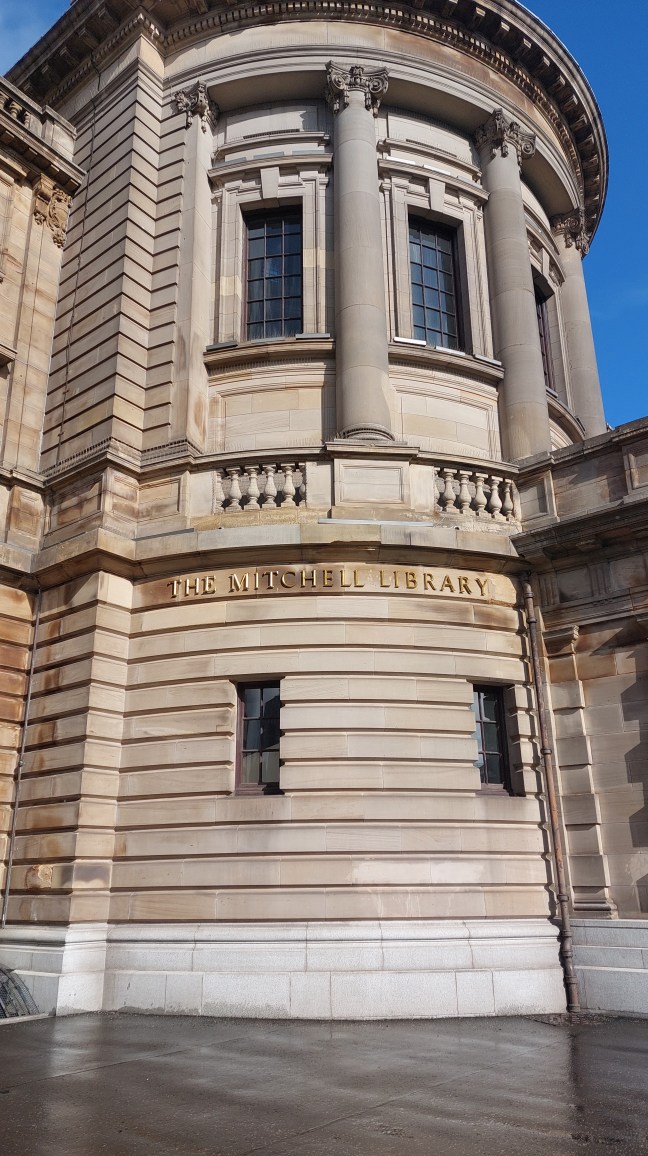
I went back to the Mitchell Library in my continuing search for old (historically old) lady music publishers. Floor 5 was temporarily operating from Floor 3, but the books I needed could thankfully still be got out for me.
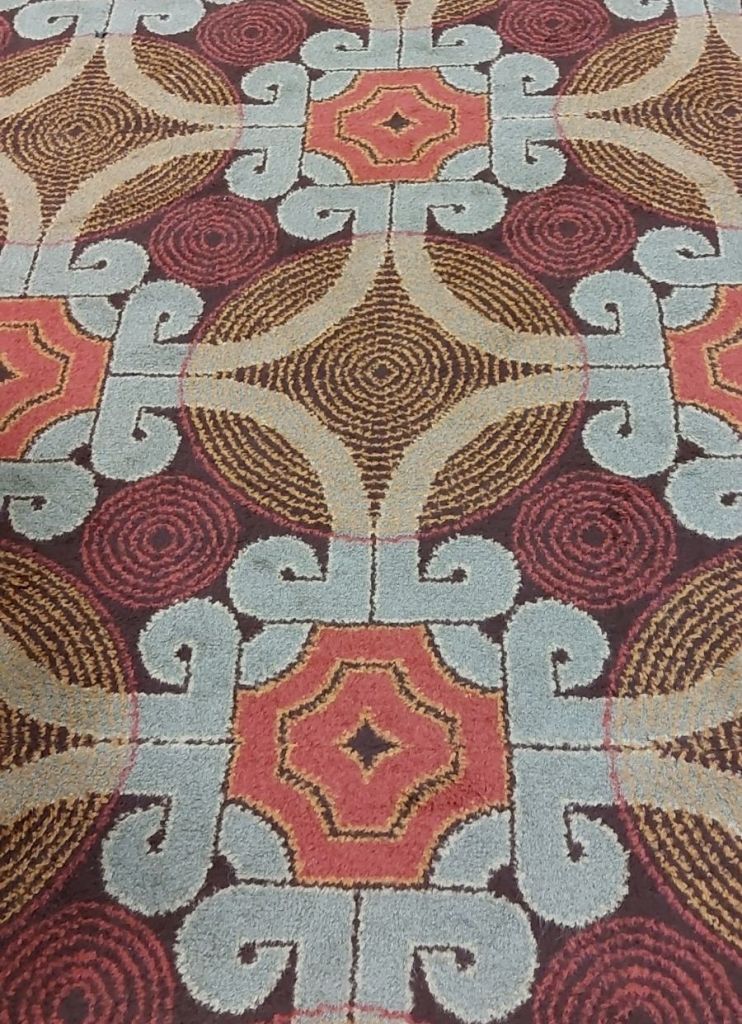
The Mitchell’s epic carpets. Glasgow logo.
The ladies were nowhere to be seen in the book documenting the Glasgow Society of Musicians. Nor was there any hint of them in another book about live music for Victorian Glaswegians. (Although I did, whilst I was still in the library, get an Ancestry message from one of the ladies’ descendants!)
Floor 4 for the Music 🎶 Catalogue
Undeterred, I headed for Floor 4, to have another look in the old card music catalogue – a really useful resource. Again, I only found two of one composer’s pieces. I already own one of them, but that still means one find. And I also spotted a couple of issues of a journal that interested me. A quick flick through, allowed me to note potentially interesting pages, even if they don’t relate to the present theme. I was in my element.
Closing my laptop, I decided to round off the morning with a coffee downstairs …
Then the fire alarm went off. Everyone filed out, and I looked down the street. Would I find a café?
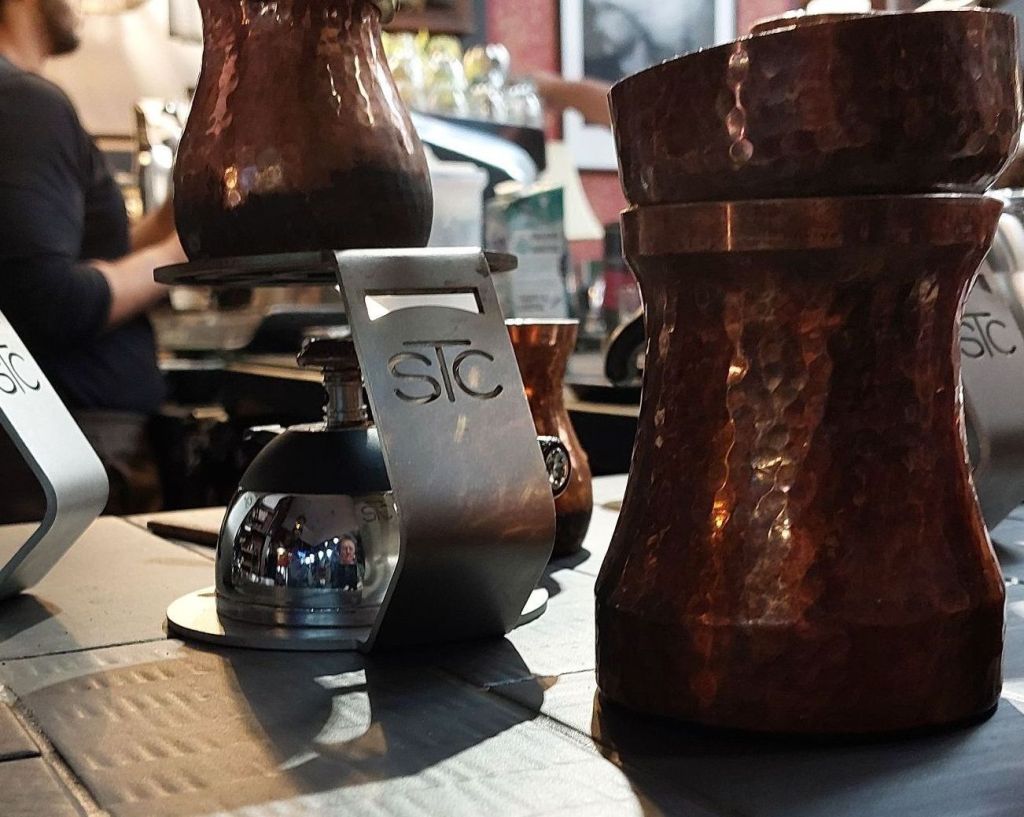
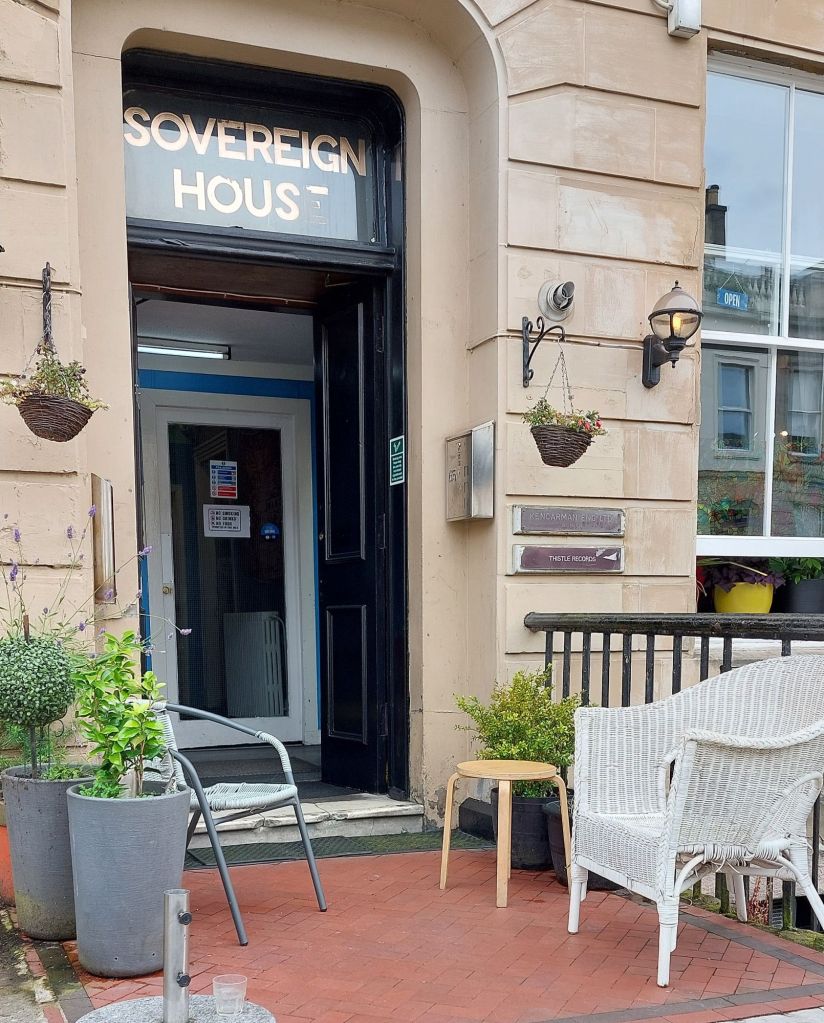
Turkish coffee potsThe erstwhile Thistle Records in Sovereign House. Name plaque still there.
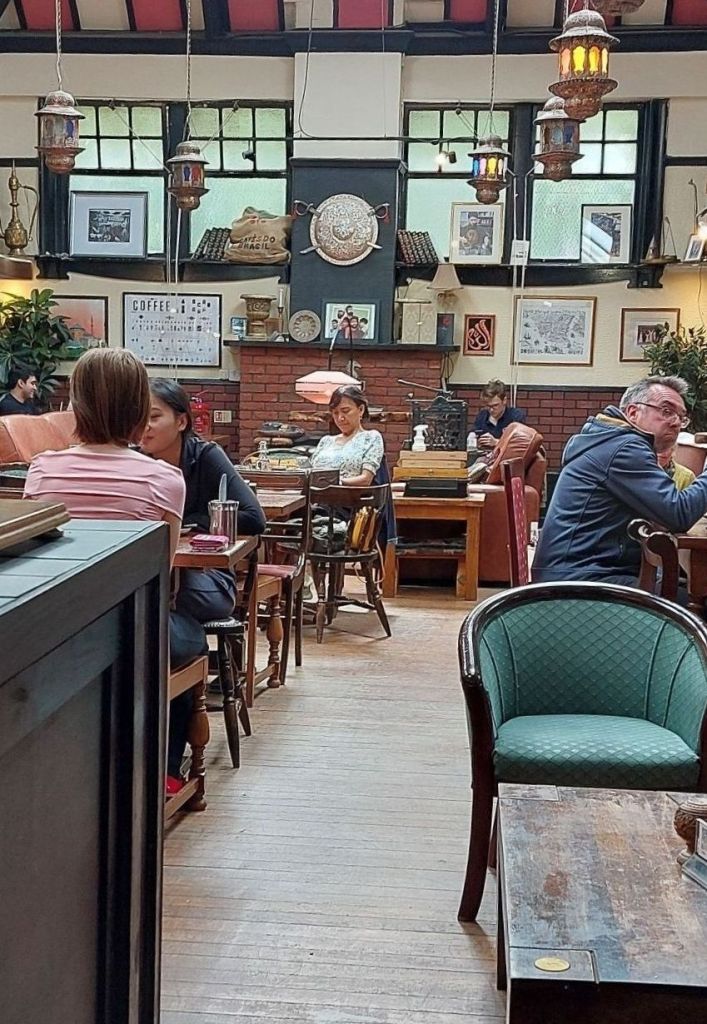
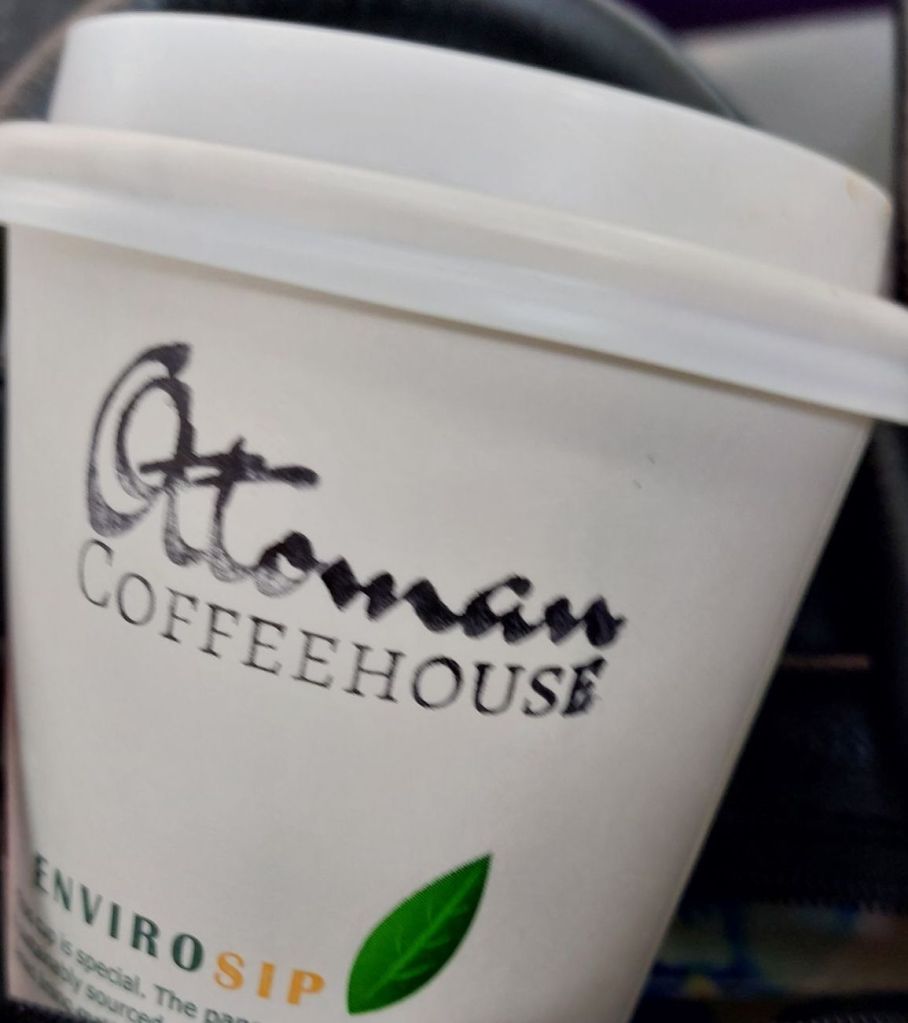
Believe it or not, the Turkish cafe in between what had been Thistle Records, and Kerr’s Music Corporation (Glasgow Music Centre), was in another building with a historical past: no less than the Glasgow Society of Musicians, about which I had just been reading. I got my latte, also snapping a picture of the interior – clearly once the Musicians’ Concert Room – and the art-nouveau front door.
Where once they heard piano trios …You can just see the arched ceiling …Mission accomplished!
Another time, I’ll make sure I have a coffee ‘to sit in’ rather than takeaway! Glasgow’s most eminent musicians would have enjoyed performances there … whether or not the ladies ever got a look-in!
Yesterday, I set out to track down some music. It’s light music, not great music – almost ephemeral, you could say – but together, it tells a story.
I also wanted to find out more about the life of one of these fin-de-siecle Glasgow woman music publishers.
It’s not that easy. The music is scattered round our legal deposit libraries; the cataloguing isn’t completely consistent; and fin-de-siecle ladies, whether single, married, childless or proud mothers, didn’t leave much record of their daily lives. They’re hidden in the shadows of family members, and, whilst I imagine they knew one another, let me stress that this is NOT a tale of a female publishing cooperative!
I had a nice chat with a local history librarian, making an acquaintance who is now equally keen to find out more; then I headed home – as yet, none the wiser – to devise a complex spreadsheet of music titles. I’m visualising a pinboard with strings criss-crossing between ladies, libraries and work-lists.
So complex, indeed, that I still haven’t planned how best to get to SEE the music.














 Karen McAulay, Musicologist